
Michigan Insurance Fraud: Penalties, Red Flags, And Response
Understand how Michigan defines insurance fraud, the penalties involved, and the reporting rules that shape enforcement.
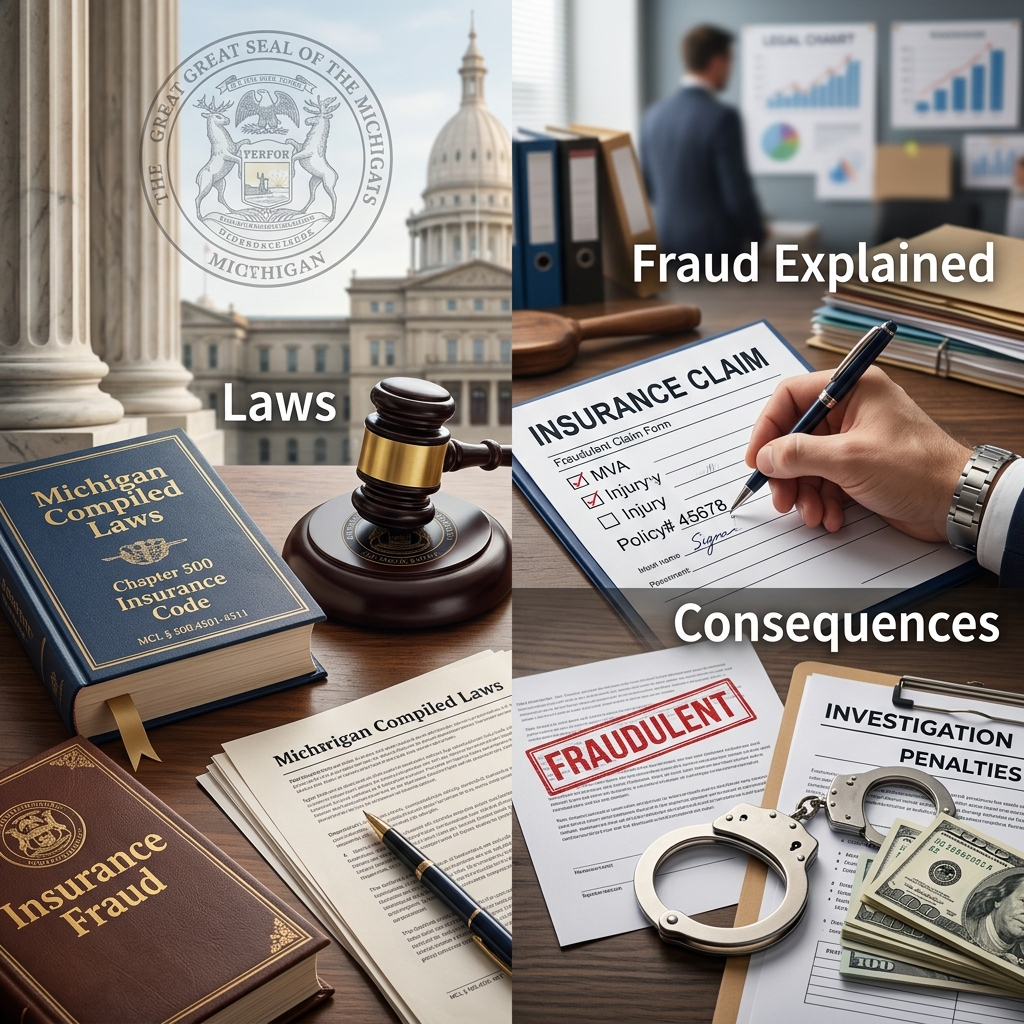
Insurance fraud is treated seriously in Michigan because it can affect premiums, claims handling, and the integrity of the insurance system as a whole. State law defines fraudulent conduct broadly, and both individual claimants and coordinated schemes can face criminal penalties, civil fines, restitution, and related consequences.
This overview explains how Michigan approaches insurance fraud, what actions may qualify as a fraudulent insurance act, how criminal punishment is structured, and what reporting duties insurers may have when fraud is suspected. It also looks at the practical impact of these rules for drivers, policyholders, insurers, and anyone involved in a claim.
What Michigan Means by Insurance Fraud
Michigan law does not limit insurance fraud to one narrow type of false statement. Instead, the state uses a broad concept known as a fraudulent insurance act. The central idea is that a person knowingly acts, or fails to act, with the intent to injure, deceive, or defraud an insurer or another party connected to an insurance transaction.
That means the law can reach conduct that happens before a policy is issued, while a policy is active, or during the claims process. A false statement on an application may be covered, but so may fabricated losses, inflated damage estimates, altered documents, or coordinated efforts to submit dishonest claims.
Conduct That Can Trigger a Fraud Case
Insurance fraud cases often involve more than one layer of misconduct. Michigan law is written broadly enough to include several common patterns:
- Providing false information in an insurance application or renewal.
- Submitting a claim for a loss that did not happen.
- Inflating the value of a real loss or repair bill.
- Omitting important facts that would affect coverage or payment.
- Helping another person present a dishonest claim.
- Using forged or altered supporting documents.
- Participating in a plan to deceive an insurer for money or benefits.
The key element is usually intent. A mistake, typo, or innocent misunderstanding is not the same as a deliberate effort to mislead. But once investigators believe the false statement or omission was intentional and material, the matter can become a fraud allegation rather than a routine coverage dispute.
Why the Claims Stage Matters So Much
Many insurance fraud disputes arise after a loss occurs, when a person is trying to obtain payment under a policy. That stage matters because the facts of a claim are often easier to verify than general background information. Investigators may compare a claimant’s statements with photographs, repair records, medical documentation, witness accounts, or digital evidence.
In auto cases, for example, investigators may examine whether the reported accident matches the damage pattern, whether treatment dates are consistent, and whether multiple claims appear linked by the same people or the same repair network. In other lines of insurance, similar scrutiny may focus on property damage, injury claims, business losses, or staged events.
Michigan Criminal Penalties for Fraudulent Insurance Acts
Michigan’s Insurance Code provides criminal penalties for fraudulent insurance acts. Under current law, a person who commits such an act can be charged with a felony, with punishment that may include imprisonment, a fine, and restitution. A person who agrees or conspires with others to commit fraud can face a more serious felony exposure.
In practical terms, the punishment level depends on the specific statute charged, the amount involved, whether the conduct was part of a conspiracy, and whether the case is tied to other offenses. Because fraud schemes often involve repeated acts or coordinated participants, prosecutors may also look beyond the insurance law itself and consider broader criminal charges when supported by the facts.
| Type of conduct | Possible legal exposure | Common consequences |
|---|---|---|
| Single fraudulent insurance act | Felony charge under Michigan insurance law | Prison, fines, restitution |
| Conspiracy or agreement to commit fraud | More serious felony exposure | Longer prison term, larger financial penalties |
| Repeated or organized scheme | Possible enhanced prosecution theory | Multiple charges, broader investigation, civil and criminal consequences |
Civil Penalties and Restitution
Criminal punishment is not the only consequence. Michigan law also allows civil fines in connection with fraud enforcement. Those fines can add to the financial pressure on a person who has already been accused of a dishonest claim or scheme.
Restitution is also a major issue. If a fraud case results in an unlawful payment, the court may order the defendant to repay money that was obtained improperly. That can include reimbursement to an insurer or to another victim who suffered a financial loss because of the fraud.
For many defendants, restitution is especially significant because it can remain in place even after other parts of the sentence are served. A fraud case can therefore follow a person long after the initial criminal proceedings end.
How Insurers and State Agencies Respond
Michigan has moved toward stronger anti-fraud enforcement and information sharing. State agencies and insurers may investigate suspicious claims, and insurers may have duties to report suspected fraud after completing a good-faith investigation. That reporting structure is designed to make it easier for regulators and law enforcement to identify patterns rather than isolated incidents.
The Michigan Department of Insurance and Financial Services is a central agency for consumer complaints and fraud reporting. It serves as a place where suspicious activity can be submitted, reviewed, and forwarded when necessary. In serious matters, investigators may coordinate with prosecutors, law enforcement, and other agencies.
What Makes Auto Insurance Fraud a Special Focus
Auto insurance fraud receives special attention because Michigan’s no-fault system generates many claims and involves significant financial exposure. Fraud can appear in injury claims, property damage claims, billing records, treatment documentation, and staged-loss scenarios.
Because the system is so claims-heavy, even small falsehoods can become costly when repeated across multiple files or used as part of a larger plan. That is one reason state lawmakers and regulators have pursued reforms aimed at better detection, stronger reporting, and faster enforcement.
How a False Statement Can Affect Coverage
A fraud allegation does not always end with a criminal charge. Sometimes the immediate result is a coverage dispute. If an insurer believes a policyholder made a material misrepresentation, the company may argue that the policy should be rescinded or that a claim should be denied. The result can depend on when the false statement was made and what type of coverage is involved.
Michigan law and court decisions have treated some post-application statements differently from statements made to obtain coverage in the first place. In certain contexts, a material lie can lead to serious consequences for the policy itself, especially where the policyholder sought coverage through deception.
Fraud, Conspiracy, and Organized Schemes
Michigan law does not focus only on the person who signs the claim form. A person can also face exposure if they agree with others to carry out a fraud plan. That matters because many insurance scams rely on cooperation among multiple participants, such as claimants, repair operators, medical providers, vehicle sellers, or intermediaries.
When a fraud case becomes conspiratorial, the investigation usually broadens. Prosecutors may examine communications, payment flows, repeated transactions, and linked claims to determine whether the conduct was accidental, opportunistic, or deliberately organized.
Common Warning Signs Investigators Look For
There is no single checklist that proves fraud, but suspicious claims often share recognizable patterns. Investigators may pay close attention to the following:
- Documents that do not match each other.
- Claim dates that conflict with repair or treatment records.
- Damage that appears inconsistent with the reported event.
- Repeated claims involving the same people or vendors.
- Unusual billing patterns or inflated charges.
- Late changes to the story after the claim is opened.
- Evidence that a loss was staged or partially fabricated.
These red flags do not prove guilt by themselves. They simply show why claims may be investigated more closely before payment is issued or while a case is under review.
What to Do if You Are Under Investigation
If someone is contacted about a suspected fraud issue, the best response is to treat the matter seriously from the beginning. Even informal questions from an insurer, investigator, or state agency can become part of a broader case.
Potentially important steps include reviewing records, preserving documents, avoiding guesses when answering questions, and getting legal advice before making detailed statements. Because insurance fraud cases can involve both criminal and civil exposure, a fast response may matter as much as the facts themselves.
How Michigan’s Reporting System Helps Enforcement
Michigan’s fraud enforcement framework relies on information sharing. That can include insurer reports, agency complaints, and referrals from investigative units. The goal is not just to punish one false claim, but to identify larger networks or repeated conduct that would otherwise stay hidden.
By requiring or encouraging reporting in appropriate situations, the state can compare patterns across carriers and regions. This approach helps regulators spot organized schemes, detect recurring fraud methods, and improve the accuracy of future claims handling.
Frequently Asked Questions
What is a fraudulent insurance act in Michigan?
It is conduct done knowingly and with the intent to injure, defraud, or deceive in connection with an insurance transaction, claim, or policy process.
Can a person be charged for trying to commit insurance fraud even if the plan failed?
Yes. Michigan law can reach conspiracies and agreements to commit fraud, not just successful schemes.
Does insurance fraud only involve false claims?
No. It can also involve false applications, omitted facts, forged records, inflated losses, or coordinated misconduct.
Can fraud lead to both fines and prison time?
Yes. Michigan law allows criminal punishment that may include imprisonment, fines, and restitution, depending on the charge.
Who investigates suspicious insurance fraud in Michigan?
Insurers, the Department of Insurance and Financial Services, law enforcement, and prosecutors may all be involved depending on the case.
Does a fraud allegation always mean a criminal conviction?
No. An allegation is only an accusation. The government still has to prove the case under the law.
Why the Law Matters for Everyday Policyholders
Most people never intend to commit fraud, but even routine claim mistakes can draw attention if the facts look inconsistent. That is why accuracy matters in every part of the insurance process, from applications to repair estimates to final claim forms.
Michigan’s fraud laws are designed to protect the insurance market from deception while giving regulators tools to respond to serious abuse. For honest policyholders, the main takeaway is straightforward: keep records, answer claims questions carefully, and make sure all information submitted to an insurer is truthful and complete.
References
- MCL – Section 500.4503 – Michigan Legislature — Michigan Legislature. 2026. https://www.legislature.mi.gov/Laws/MCL?objectName=mcl-500-4503
- MCL – Section 500.4511 – Michigan Legislature — Michigan Legislature. 2026. https://www.legislature.mi.gov/Laws/MCL?objectName=mcl-500-4511
- Insurance Fraud — State of Michigan, Department of Insurance and Financial Services. 2026. https://www.michigan.gov/difs/consumers/fraud
- DIFS Fraud Reporting Form — State of Michigan, Department of Insurance and Financial Services. 2026. https://difs.state.mi.us/Complaints/FraudReportStart.aspx
- Michigan House passes 6-bill insurance fraud crackdown — OurMidland.com. 2026. https://www.ourmidland.com/news/article/michigan-insurance-fraud-penalties-21053361.php
Similar Articles








Read full bio of Sneha Tete




