Michigan Employer Rules on Criminal Records
Navigate Michigan's laws on how employers can use arrest and conviction records in hiring decisions effectively.
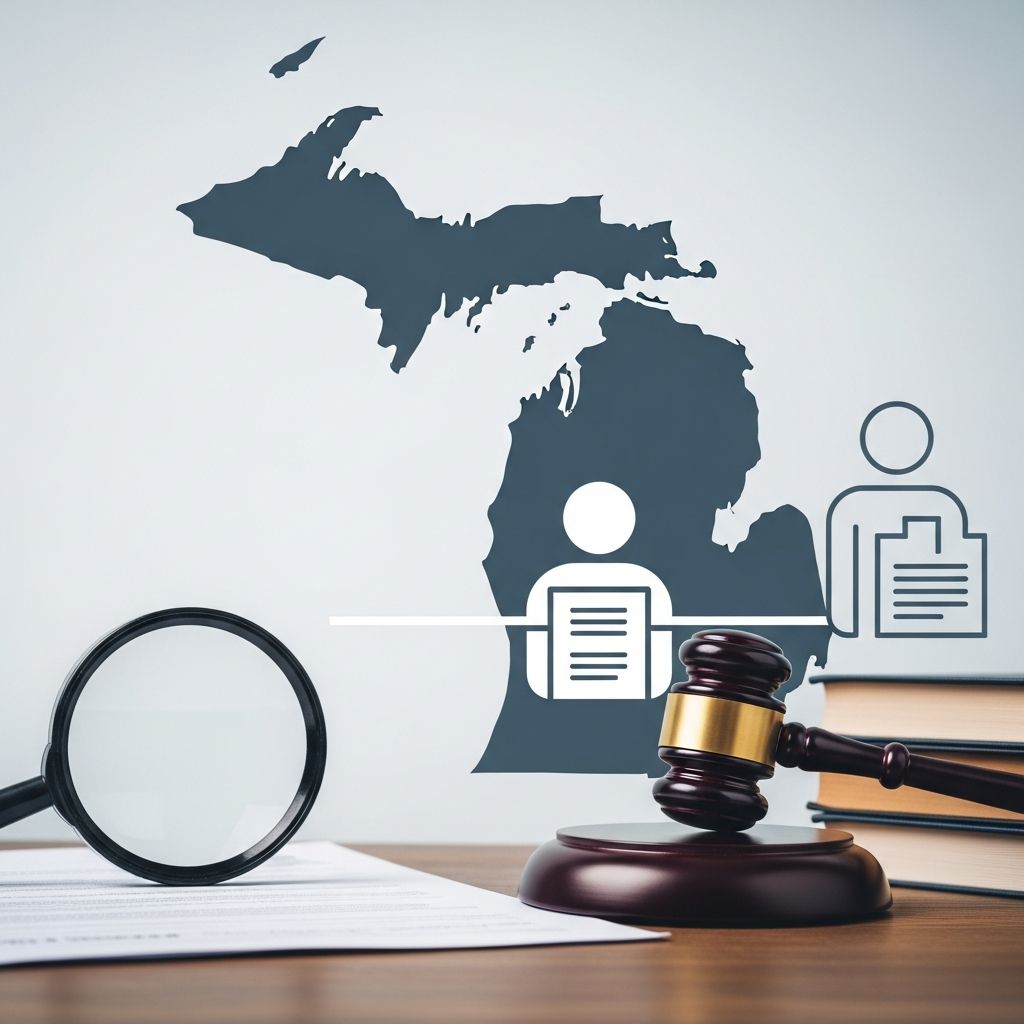
Michigan employers must follow a combination of state and federal laws when considering arrest and conviction records during the hiring process. These regulations aim to promote fair employment opportunities while allowing businesses to assess job-related risks.
Overview of Key Legal Frameworks
The foundation for handling criminal records in Michigan hiring stems from both state statutes and federal mandates. Employers cannot discriminate based on protected characteristics and must adhere to timing restrictions for criminal history inquiries. Failure to comply can lead to lawsuits, fines, or regulatory penalties.
- Federal Fair Credit Reporting Act (FCRA): Governs background checks conducted through consumer reporting agencies (CRAs), requiring disclosure, consent, and adverse action notices.
- EEOC Guidelines: Prohibit disparate impact discrimination from blanket criminal record exclusions.
- Michigan Elliott-Larsen Civil Rights Act (ELCRA): Bans employment discrimination on bases like race, age, and sex, extending to screening practices.
Private sector employers face fewer state-specific restrictions compared to public entities, but all must integrate federal rules.
Ban-the-Box Policies in Michigan
Michigan implements a ‘ban-the-box’ approach primarily for public sector jobs via Executive Directive 2018-4. State and local government employers cannot inquire about criminal history on initial applications. Questions are deferred until after an initial interview or conditional job offer.
Private employers lack a statewide ban-the-box law but should exercise caution to avoid disparate impact claims under EEOC guidance. Some cities may impose local rules, so businesses must verify municipal ordinances.
| Entity Type | Ban-the-Box Requirement | Timing of Inquiry Allowed |
|---|---|---|
| State/Local Government | Yes (Exec. Dir. 2018-4) | Post-interview or conditional offer |
| Private Employers | No statewide mandate | Any time, but post-offer recommended |
| Federal Contractors | Subject to federal rules | Comply with OFCCP guidelines |
This table summarizes application timing, helping employers structure their processes compliantly.
Permissible Use of Arrest Records
Under Michigan Compiled Laws (MCL) § 37.2205a, employers generally cannot base hiring decisions on arrests that did not result in convictions, except for pending felony charges. Misdemeanor arrests without conviction are off-limits for decision-making.
Criminal records checks often reveal arrests, but employers must distinguish between charges, arrests, and convictions. Using non-conviction arrests risks violating state anti-discrimination laws or EEOC standards.
- Arrests leading to dismissals or acquittals: Not usable.
- Pending felony arrests: May be considered if job-related.
- Expunged records: Inaccessible and unusable.
Handling Conviction Records
Convictions can be considered if directly related to job duties, but employers must perform an individualized assessment per EEOC directives. Factors include the nature of the crime, time elapsed, and relevance to employment.
Michigan does not impose a statewide lookback period for convictions, unlike some states. However, FCRA limits non-conviction reports to seven years for lower-salary roles. Convictions reportable indefinitely.
Best practice: Document the assessment process, considering evidence of rehabilitation, such as completion of probation or certificates of employability.
FCRA Compliance for Background Checks
When using a CRA for Michigan background checks, strict FCRA protocols apply universally.
- Disclosure: Provide a clear, standalone written notice of intent to obtain a consumer report.
- Authorization: Secure written consent from the applicant.
- Adverse Action: If denying employment based on the report, issue a pre-adverse action notice with the report copy, summary of rights, and time to respond (typically 5 days).
- Final Notice: Send adverse action notice if proceeding with denial.
Violations can result in class-action lawsuits with statutory damages up to $1,000 per violation plus attorney fees.
EEOC Guidance on Criminal Records
The Equal Employment Opportunity Commission (EEOC) advises against blanket policies excluding applicants with convictions, as they disproportionately affect minorities, potentially violating Title VII.
Employers should adopt a targeted approach:
- Evaluate crime severity and job relatedness (e.g., theft conviction for financial roles).
- Assess time since offense (older convictions less relevant).
- Review mitigating factors like job performance evidence.
Michigan’s ELCRA aligns with these principles, prohibiting policies with unjustified disparate impacts.
Special Considerations for Certain Industries
Regulated sectors face additional scrutiny:
- Childcare/Healthcare: Mandatory fingerprint-based checks via Michigan’s Workforce Background Check system.
- Financial Institutions: FCRA credit reporting with 10-year bankruptcy limits.
- Driving Positions: Motor vehicle records (MVRs) permissible under FCRA.
For licensure-required roles, convictions may bar eligibility; check Michigan Department of Licensing and Regulatory Affairs (LARA).
Best Practices for Compliant Hiring
To minimize risks:
| Step | Action | Legal Basis |
|---|---|---|
| 1. Delay Inquiry | Post-conditional offer | Ban-the-box, EEOC |
| 2. Obtain Consent | Written FCRA form | FCRA |
| 3. Assess Individually | Document job-relatedness | EEOC, ELCRA |
| 4. Notify if Adverse | Pre- and final notices | FCRA |
| 5. Train HR | Annual compliance sessions | Risk mitigation |
Partnering with compliant CRAs like those adhering to FCRA streamlines processes.
Consequences of Non-Compliance
Violations invite:
- EEOC/ELCRA lawsuits for discrimination.
- FCRA private actions or FTC enforcement.
- State penalties under MCL provisions.
Courts award back pay, compensatory damages, and punitive awards in egregious cases.
Frequently Asked Questions (FAQs)
Can Michigan private employers ask about criminal history on job applications?
No statewide ban for private employers, but delaying until later stages avoids EEOC risks.
How far back do background checks go in Michigan?
No state limit; FCRA restricts some non-convictions to 7 years for salaries under $75,000.
Is consent required for background checks?
Yes, written authorization under FCRA when using a CRA.
What if an arrest didn’t lead to conviction?
Generally unusable per MCL § 37.2205a, except pending felonies.
Do convictions expire for hiring purposes?
No Michigan limit, but assess relevance per EEOC.
References
- Michigan Background Checks: Fast, Compliant Screening — GoodHire. 2023. https://www.goodhire.com/background-checks/michigan/
- Michigan Background Check Laws: A Guide for Businesses and HR — GCheck. 2023. https://gcheck.com/blog/michigan-background-check-laws-a-guide-for-businesses-and-hr/
- Background Checks in Michigan: Laws, Process & Fast Screening — Checkr. 2023. https://checkr.com/background-check/michigan
- Michigan Background Checks for Employment: A Complete Guide — iProspectCheck. 2023. https://iprospectcheck.com/michigan-background-check/
- An Employer’s Guide to Michigan Background Checks — ScoutLogic Screening. 2023. https://www.scoutlogicscreening.com/blog/michigan-background-checks-guide/
- Pre-Employment Inquiry Guide — State of Michigan MDCR. 2020-10-01. https://www.michigan.gov/-/media/Project/Websites/mdcr/brochures/pre-employment-guide.pdf?rev=0d0f0e842eb04d8eb8347dc840b448c3
- Workforce Background Check — State of Michigan LARA. 2026. https://www.michigan.gov/lara/bureau-list/bchs/workforce-back
Similar Articles







Read full bio of Sneha Tete