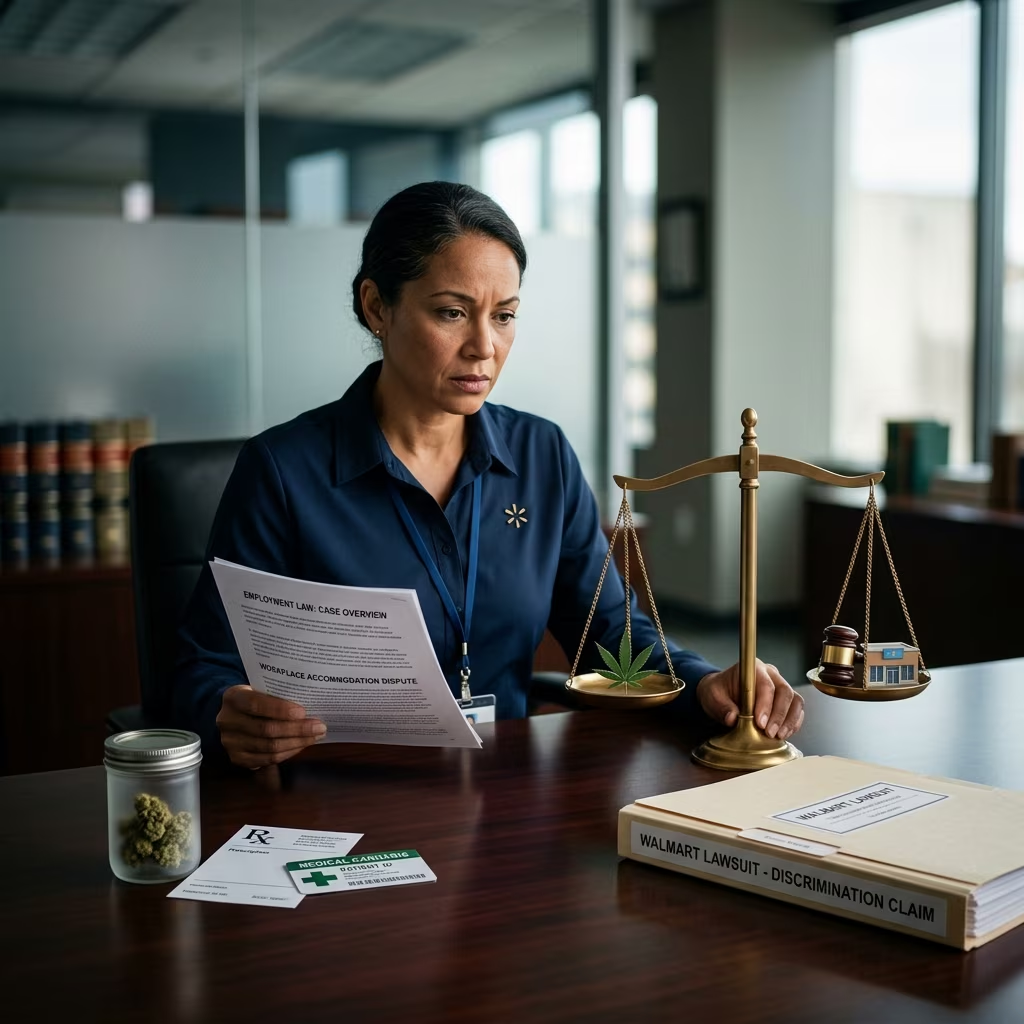
Across the United States, medical marijuana laws have expanded rapidly, but employment protections for patients have not kept pace. The high-profile firing of a medical marijuana patient by Walmart, and the subsequent lawsuit, illustrates the tension between state-level legalization and employer drug policies, especially when federal law still classifies marijuana as an illegal substance.
This article uses that Walmart case as a starting point to explore how medical marijuana interacts with employment law, what courts have said in different states, and what practical steps workers and employers should consider when navigating this evolving area.
Background: Walmart, Medical Marijuana, and the Casias Case
One of the earliest widely discussed disputes involved a Walmart employee in Michigan, Joseph Casias, who was a registered medical marijuana patient under the Michigan Medical Marihuana Act (MMMA). He used marijuana in accordance with state law to manage pain from a serious medical condition. After he tested positive in a workplace drug screen, Walmart terminated his employment, prompting a lawsuit supported by the American Civil Liberties Union (ACLU).
The ACLU argued that Walmart’s decision violated protections afforded by the MMMA, claiming the statute was meant to shield compliant medical marijuana patients from adverse actions such as termination. However, federal courts ultimately interpreted the MMMA more narrowly: they concluded that while the law protected patients from state criminal sanctions, it did not create a private right of action regulating decisions of private employers.
The result in Casias’s case was that Walmart could lawfully fire him under existing Michigan law, even though his marijuana use was medically authorized and occurred off duty. This decision aligned with similar rulings in other states, reinforcing employers’ ability to enforce zero-tolerance policies.
State Medical Marijuana Laws vs. Employment Protections
Medical marijuana is now permitted in dozens of states, yet the scope of workplace protections varies significantly. Many statutes focus on criminal law—protecting patients from arrest or prosecution—while saying little or nothing about employment outcomes.
- Laws focused on criminal immunity: Often protect patients from being arrested or prosecuted for possessing or using medical marijuana in compliance with state rules, but do not mention employment.
- Laws with explicit employment language: Some states prohibit discrimination against registered cardholders or limit when employers can take adverse action based on test results or off-duty use.
- Hybrid approaches: A few states provide protections but carve out exceptions for safety-sensitive positions or situations involving on-the-job impairment.
In Casias’s Michigan case, the courts held that the MMMA was not designed to regulate employer decisions, emphasizing that its text did not explicitly grant employment rights or remedies. Similar reasoning has been applied in several other jurisdictions, including decisions in Oregon, California, Montana, and Washington, where courts recognized that employers can terminate medical marijuana users for violating workplace drug policies.
Illustrative Differences Between States
| State | Medical Marijuana Legal? | Explicit Employment Protections? | Key Court or Statutory Position |
|---|---|---|---|
| Michigan | Yes | Generally no explicit employment protections | Casias decision: MMMA does not create employment rights or a private cause of action. |
| Arizona | Yes | Yes, including protections for cardholders | Federal court recognized an implied private cause of action under the Arizona Medical Marijuana Act (AMMA) when employers take adverse action based on use alone. |
| New Jersey | Yes (medical and recreational) | Statutory limits on adverse action based on off-duty use | Employers argue enforcement belongs to regulators, not private lawsuits; litigation continues over how these protections operate. |
Key Legal Issues Raised by the Walmart Case
The Walmart case, and related litigation in other states, highlights several core legal questions about medical marijuana in the workplace.
1. Does State Law Create a Private Right to Sue Employers?
In Michigan, courts ruled that the MMMA did not include a private right of action for employees who are terminated due to medical marijuana use. Because the statute lacked explicit language regulating employment or granting a remedy, judges concluded that patients could not sue employers for violations under that law.
By contrast, an Arizona federal court interpreting the Arizona Medical Marijuana Act (AMMA) found an implied private cause of action. The judge reasoned that statutory protections for cardholding employees would be meaningless if workers could not enforce them, allowing an employee fired by Walmart to pursue claims for discrimination based on medical marijuana use alone.
2. How Do Zero-Tolerance Drug Policies Interact With Medical Use?
For many employers, especially large national companies, drug testing policies treat marijuana as a prohibited substance regardless of its legal status under state law. In Casias’s case, Walmart’s policy barred marijuana use and relied on test results without distinguishing between recreational and medical use.
Courts have often upheld these policies, particularly in states where statutes do not directly address employment. Judges have reasoned that employers retain broad authority to set workplace standards, including requiring drug-free conditions, provided they do not run afoul of other laws such as disability discrimination statutes.
3. Federal Law and the Controlled Substances Act
Under federal law, marijuana remains a Schedule I controlled substance, meaning it is considered illegal with no accepted medical use at the federal level. This classification creates a baseline legal conflict: while states may authorize medical use, federal law continues to prohibit possession and use.
Some courts and employers argue that this federal illegality supports strict workplace policies, especially for positions involving federal contracts or safety-sensitive duties. However, many recent state decisions and legislative changes focus more on impairment and less on mere presence of metabolites, reflecting an effort to reconcile the state–federal divide.
Employees: Practical Implications of the Walmart Case
The Walmart litigation underscores how vulnerable medical marijuana patients can be in the workplace, even when they follow state law and use medication off duty. Employees should be aware of the specific protections—or the lack thereof—in their state.
Important Considerations for Workers
- Know your state’s statute: Check whether your medical marijuana law addresses employment, discrimination, or drug testing, and whether any courts have interpreted those provisions.
- Understand employer policies: Review company handbooks and drug testing rules. Many policies still treat marijuana as a banned substance, even for registered patients.
- Consider disclosure carefully: Some employees choose to inform employers of their patient status, particularly when accommodation issues arise. Others may be hesitant because of potential stigma or retaliation; legal advice can help weigh the risks.
- Document medical needs: Maintain medical records that explain why marijuana was recommended and how it is used. This may matter in disability-related discussions, even if the marijuana itself is not directly protected under federal law.
- Seek legal counsel if disciplined: Employees facing termination or other adverse action based on medical marijuana use should consult an attorney experienced in employment law to evaluate potential claims under state statutes or disability law.
Employers: Balancing Safety, Compliance, and Evolving Law
For employers, the Walmart case serves as both a warning and a guidepost. While some states allow strict zero-tolerance approaches, others impose obligations or constraints when dealing with registered medical marijuana users.
Policy Design and Risk Management
- Review state law where you operate: Multi-state employers should avoid assuming a single policy is lawful everywhere. Arizona, for instance, requires consideration of medical status and generally prohibits adverse action based solely on a positive test for cardholders.
- Focus on impairment, not just test results: Recent decisions and statutes in some states emphasize evidence of on-the-job impairment, not merely the presence of metabolites. Employers should develop procedures to assess impairment objectively and consistently.
- Communicate policies clearly: Courts have noted the importance of written policies and advance notice before drug testing. Employers should provide accessible documentation and training so employees understand expectations.
- Consider job-specific distinctions: Safety-sensitive roles may justify stricter rules, while other positions could allow more flexibility regarding off-duty, compliant medical use.
- Coordinate with legal and HR teams: Because the law is changing quickly, legal counsel and human resources professionals should periodically review policies for compliance and update them as new statutes and cases emerge.
Comparing Michigan and Arizona: Different Paths After Walmart
Walmart has faced medical marijuana-related litigation in more than one state, and the outcomes demonstrate how varied the legal landscape can be.
Michigan: Limited Protection for Employees
In Michigan, the Casias decision from the U.S. Court of Appeals for the Sixth Circuit reaffirmed dismissal of the employee’s wrongful discharge suit. The court found that the MMMA’s main purpose was to provide limited protection against state arrest and prosecution rather than to regulate private employment decisions.
Because the statute did not explicitly grant employment rights or remedies, the court concluded there was no implied cause of action. Walmart’s termination, based on its drug policy, therefore stood.
Arizona: Recognizing a Cause of Action for Cardholders
In Arizona, a different Walmart employee claimed she was wrongfully terminated and discriminated against in violation of the Arizona Medical Marijuana Act (AMMA). A federal judge held that AMMA provides an implied private cause of action, allowing cardholding employees to sue when employers take adverse action based on protected medical use.
The ruling emphasized that employers should not rely solely on positive drug tests when disciplining employees with valid medical marijuana cards. Instead, they need evidence that the worker was impaired at work or otherwise violated company rules beyond lawful medical use.
In practice, this means Arizona workers enjoy stronger protections than those in states where medical marijuana statutes are silent on employment. It also signals that, in some jurisdictions, broad zero-tolerance policies may be legally risky if they fail to account for state-level rights.
Recreational Legalization and New Challenges
Beyond medical programs, several states have legalized recreational marijuana, raising new questions about off-duty use. New Jersey, for example, bars employers from refusing to hire candidates or firing employees solely because they use marijuana during their personal time.
Walmart has argued in litigation that enforcement of those protections belongs to the state’s Cannabis Regulatory Commission rather than individual lawsuits, contending the law does not explicitly grant a private right of action. Courts are still working through how these recreational protections will apply, particularly in situations involving job applicants and remote workers.
As recreational laws spread, employers must adjust policies that once assumed any marijuana use justified discipline. At the same time, employees should recognize that protections may differ significantly between medical and recreational statutes, and between states that allow private suits and those that do not.
Frequently Asked Questions (FAQs)
Can my employer fire me for medical marijuana use if it is legal in my state?
It depends on your state’s law and how courts have interpreted it. In some states, like Michigan, courts have upheld employer decisions to fire medical marijuana patients when statutes do not provide explicit employment protections. In others, such as Arizona, employees with valid medical marijuana cards may be protected from adverse action based solely on lawful use.
Does federal law protect medical marijuana users at work?
No. Under federal law, marijuana remains a Schedule I controlled substance with no recognized medical use, and there is no federal statute giving employment protection to medical marijuana users. Some workers may have rights under disability laws, but those protections generally do not require employers to allow marijuana use itself.
What should I do if I test positive for marijuana on a workplace drug test?
If you are a medical marijuana patient, review your state’s law and your employer’s policies, then consult an employment attorney. In states with explicit protections or court decisions recognizing a cause of action—such as Arizona—you may have legal arguments if you used marijuana lawfully and were not impaired at work.
Are employers required to prove impairment, or is a positive test enough?
In many states, a positive test may still be sufficient for discipline, particularly where statutes are silent. However, laws and rulings in some jurisdictions stress the need for evidence of impairment on the job rather than mere presence of metabolites, especially for cardholding medical marijuana patients.
How are recreational marijuana laws changing the workplace?
Recreational legalization has prompted new provisions restricting employers from taking action based solely on off-duty use, as seen in New Jersey. Yet the enforceability of these protections and whether workers can bring private lawsuits remain active areas of litigation, so both employees and employers must monitor ongoing court decisions.
References
- ACLU Sues Wal-Mart for Firing Employee for Medical Marijuana Use — American Civil Liberties Union. 2010-09-09. https://www.aclu.org/news/smart-justice/aclu-sues-wal-mart-firing-employee-medical-marijuana-use
- Walmart Employee’s Medical Marijuana Wrongful Discharge Suit Dismissed — Miller Canfield. 2012-09-26. https://www.millercanfield.com/resources-alerts-794.html
- Walmart Can Fire Medical Marijuana Users — FindLaw Legal Blogs. 2010-09-10. https://www.findlaw.com/legalblogs/law-and-life/walmart-can-fire-medical-marijuana-users/
- Federal Court Rules that Walmart Firing Violated the Arizona Medical Marijuana Act — Sacks Tierney P.A. 2019-05-09. https://www.sackstierney.com/blog/federal-court-rules-that-walmart-firing-violated-the-arizona-medical-marijuana-act/
- Walmart Moves to Dismiss Lawsuit Over Marijuana Screenings for Job Applicants — WorldatWork Workspan Daily. 2023-06-26. https://worldatwork.org/publications/workspan-daily/walmart-moves-to-dismiss-lawsuit-over-marijuana-screenings-for-job-applicants