
Beyond the Blood Spot: Police and Medical DNA Privacy
Protecting your genetic blueprint from warrantless police searches.
Introduction
Imagine walking into a hospital to perform one of the most selfless acts possible: donating a kidney to a stranger, or registering as an organ donor upon your death. Alternatively, envision the exhausting but joyful first days of a child’s life, which inevitably include a routine heel prick to test the newborn for severe, preventable metabolic diseases. In both scenarios, patients and parents willingly hand over biological material under the fundamental assumption that it will be used exclusively for healthcare, healing, and medical advancement.
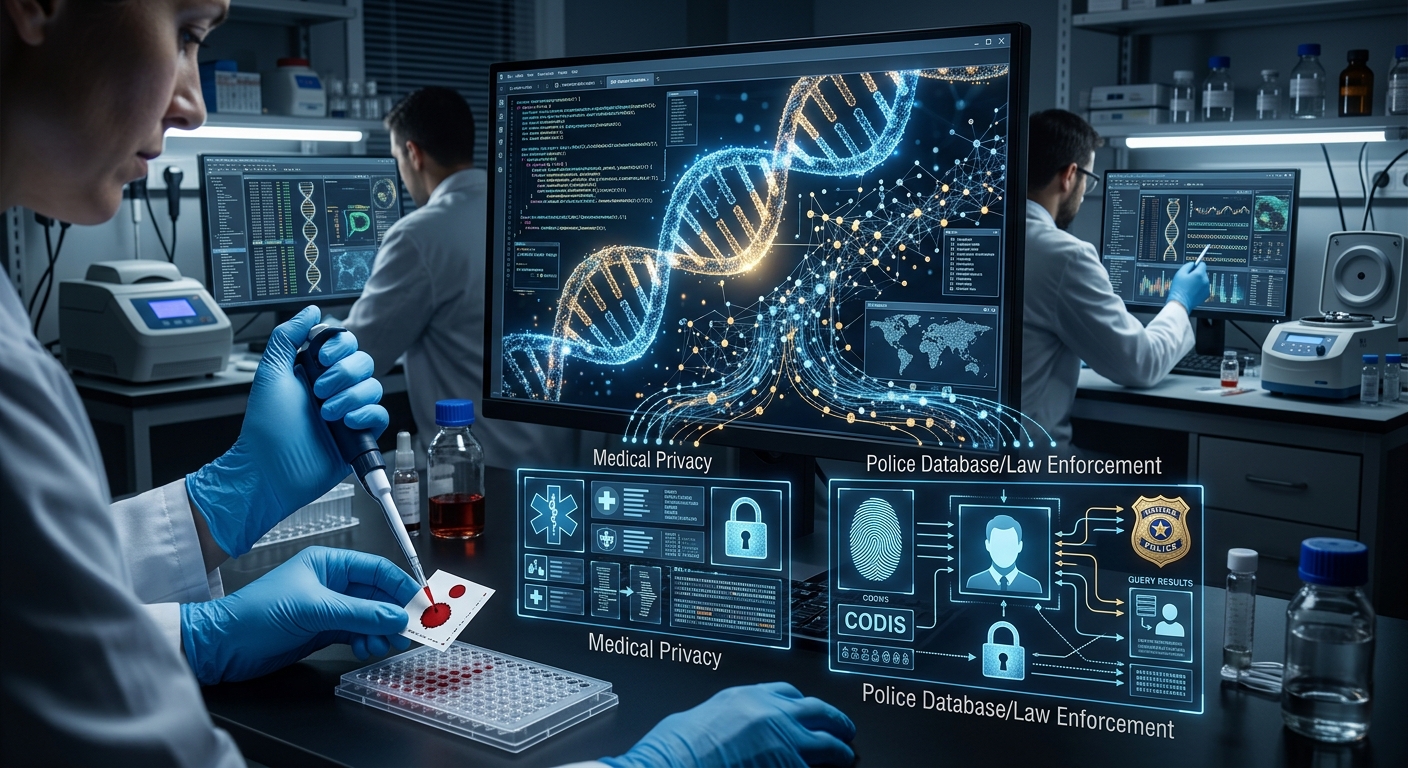
However, a concerning intersection of technology, law enforcement, and medical archiving is rapidly dismantling this assumption. Across the United States, police departments and investigators have discovered that medical biobanks—ranging from state-run newborn blood spot registries to tissue and organ donation centers—serve as expansive, unregulated genetic databases. By accessing these repositories, law enforcement can bypass the traditional, rigorous constitutional requirements of obtaining a probable-cause warrant, opting instead for easily acquired subpoenas.
This growing practice of tapping into medical DNA for criminal investigations presents a profound threat to civil liberties. It turns public health initiatives into covert surveillance networks, jeopardizing the delicate trust between patients and medical professionals. When law enforcement treats clinical specimens as evidence lockers rather than protected healthcare data, the implications for genetic privacy, constitutional rights, and public health are staggering.
The Unwitting DNA Vaults: Newborn Screenings and Tissue Banks
To understand the scale of this privacy vulnerability, one must first examine how these biological repositories are formed and why they contain such a wealth of information.
The Life-Saving Heel Prick
Newborn screening is a mandatory public health program in the United States. Within the first forty-eight hours of life, a few drops of blood are collected from a baby’s heel and placed onto a filter paper card. These blood spots are tested for dozens of congenital disorders, such as phenylketonuria (PKU) and cystic fibrosis. The program is undeniably crucial, saving thousands of infants from severe disability or death each year by ensuring early intervention.
But what happens to the physical blood spot after the diagnostic test is complete? The answer varies drastically by state jurisdiction. Some health departments destroy the cards after a few months. Others retain them for years, or even indefinitely, storing them in massive, state-run biobanks. Originally, this retention was intended for quality control, calibrating lab equipment, or conducting anonymized epidemiological research. Today, however, these archives have caught the attention of criminal investigators looking for genetic clues.
Organ and Tissue Repositories
Similarly, when individuals register to become organ, eye, or tissue donors, or when they undergo biopsies and blood draws for severe medical treatments, their biological material is preserved by private hospitals, research institutions, and procurement organizations. These tissue samples are stored meticulously to ensure viability and accurate medical record-keeping. Unintentionally, they also carry the complete, highly identifiable genetic blueprint of the individual.
The Forensic Goldmine
Because genetic material is inherited, a single DNA sample does not just identify the individual; it identifies their parents, siblings, children, and distant cousins. Law enforcement has realized that if they cannot find a suspect’s DNA in standard criminal databases like CODIS (the Combined DNA Index System), they might find a familial match in a medical database. For example, in a prominent New Jersey case, detectives investigating a decades-old crime lacked the suspect’s DNA. Instead, they served a subpoena to a state health laboratory to acquire the newborn blood spot of the suspect’s young child. By proving a biological link between the crime scene DNA and the child’s medical sample, they circumvented the need to get a warrant for the suspect directly.
The Fourth Amendment vs. The Subpoena Loophole
The U.S. Constitution’s Fourth Amendment was drafted to protect citizens against unreasonable searches and seizures. In the context of criminal investigations, this typically means that police must demonstrate probable cause to a neutral judge to obtain a warrant before they can search your home, your phone, or your bodily fluids.
Yet, police are frequently accessing medical DNA without warrants. How is this legally permissible?
The answer lies in a controversial legal concept known as the Third-Party Doctrine. Originating in the 1970s, this doctrine suggests that individuals lose their reasonable expectation of privacy in information they voluntarily turn over to third parties, such as banks or telephone companies. While the Supreme Court has recently started to push back against this doctrine in the digital age—recognizing that historical cell phone location data requires a warrant—the law remains murky regarding biological samples held by hospitals and state labs.
Because the state or the hospital holds the physical blood spot or tissue sample, prosecutors argue that the patient no longer exercises a direct privacy interest over it. Therefore, investigators can utilize an administrative or grand jury subpoena to demand the DNA. Below is a breakdown of why this distinction is critical for civil liberties:
| Legal Instrument | Standard of Proof Required | Judicial Oversight | Privacy Implications |
|---|---|---|---|
| Probable-Cause Warrant | High. Police must show specific, articulable facts that evidence of a crime will be found. | Strict. Issued and reviewed by an impartial, neutral judge. | Highly protective. Limits the scope of the search to specific, relevant parameters. |
| Subpoena | Low. Must merely show the information is generally relevant to an ongoing investigation. | Minimal. Often issued directly by prosecutors or grand juries without prior judicial approval. | Vulnerable. Allows for broad investigatory access through medical records and biological data. |
When law enforcement uses subpoenas instead of warrants to access medical DNA, they effectively lower the constitutional shield that protects the most intimate information a person possesses: their genetic code.
The Illusion of Medical Privacy: Why HIPAA Falls Short
When confronted with the reality of genetic surveillance, most Americans intuitively point to the Health Insurance Portability and Accountability Act (HIPAA) as their primary defense. HIPAA is deeply ingrained in the public consciousness as the ultimate, unyielding guardian of medical privacy. Patients sign HIPAA acknowledgment forms at every doctor’s visit, creating a comforting—but ultimately false—sense of absolute security regarding their medical data.
While HIPAA effectively prevents a hospital from selling your medical history to a marketing firm or gossiping about your condition, it contains massive, explicit exemptions for law enforcement. Under the HIPAA Privacy Rule, covered entities (like hospitals, clinics, and health departments) are legally permitted to disclose Protected Health Information (PHI) to law enforcement officials without a patient’s consent and without a warrant.
If an investigator presents a subpoena, a court order, or even a specialized administrative request, health care providers are authorized to hand over medical files, which increasingly include genetic sequencing data and access to stored physical specimens. Furthermore, clinical laboratories and state health departments managing newborn screening programs are sometimes not even classified as covered entities under HIPAA. This leaves the biological data entirely exposed to state sunshine laws and public records requests from police departments.
This regulatory blind spot means that clinical specimens are actively being repurposed as investigatory evidence. The ethical boundaries separating therapeutic medical care from criminal prosecution are being heavily blurred, and patients are entirely unaware that their DNA is caught in the middle of this legal gray area.
The Chilling Effect: A Threat to Public Health and Altruism
The consequences of unrestricted police access to medical DNA extend far beyond theoretical debates over constitutional law. They pose an immediate, measurable threat to public health and scientific advancement. Privacy advocates refer to this phenomenon as a chilling effect—a situation where fear of surveillance discourages people from engaging in legal, beneficial activities.
Opting Out of Life-Saving Screenings
Trust is the fundamental currency of public health. When parents learn that the heel prick intended to save their baby’s life could eventually be used to incarcerate a family member, fear takes root. Faced with this reality, an increasing number of parents may attempt to opt out of newborn screening programs. If public health crises have taught the medical community anything, it is that public panic can swiftly dismantle essential health initiatives. Opting out of newborn screenings will inevitably lead to infants suffering from irreversible brain damage or sudden death due to unmanaged metabolic conditions that could have been easily treated if caught early.
The Decline in Organ and Tissue Donation
A similar chilling effect directly threatens the organ donor registry. The United States already faces a severe, chronic shortage of available organs for transplant. Altruism drives this system; people donate organs because they want to save lives, not because they want to assist the state in building a forensic database. If the public begins to associate organ donation or tissue biopsy with warrantless genetic surveillance, registration rates will plummet. The fear of exposing oneself or one’s relatives to unmonitored police scrutiny will outweigh the innate desire to help others.
The Stifling of Medical Research
Biobanks are crucial for researching complex, devastating diseases like cancer, Alzheimer’s, and diabetes. Researchers rely on massive datasets of genetic information to develop targeted, precision medicines. However, if individuals withdraw their consent for long-term specimen storage out of fear of police subpoenas, the scientific community will lose access to the diverse genetic material necessary for groundbreaking medical discoveries.
Charting a Path Forward: Reclaiming Genetic Privacy
The rapid, astonishing advancement of DNA technology has vastly outpaced our legal frameworks, leaving a vast privacy vacuum in its wake. To prevent the complete erosion of genetic privacy, urgent legislative and judicial action is required:
- Establish a Universal Warrant Rule: State and federal lawmakers must enact legislation that explicitly prohibits law enforcement agencies from accessing, testing, or acquiring DNA from clinical laboratories, newborn screening biobanks, or organ donor registries without a judge-issued warrant based on probable cause. The standard must be elevated to restore Fourth Amendment protections to our biological data.
- Mandate Transparent Informed Consent: The medical community must champion transparency. Currently, the retention of newborn blood spots and potential secondary uses of biological samples are buried in obscure bureaucratic language. Parents and patients must be explicitly informed about how long their DNA will be kept, who can access it, and whether it can be shared with law enforcement.
- Implement the Right to Destruction: Individuals must be granted the unequivocal right to request the destruction of their biological samples once the primary medical purpose has been fulfilled, without facing penalties or being denied standard healthcare services.
- Re-evaluate the Third-Party Doctrine: The courts must recognize that human biology is unique. Your DNA is not a discarded receipt or a dialed telephone number; it is the fundamental code of your existence. Entrusting a doctor with a blood sample does not constitute a blanket waiver of your constitutional rights.
Conclusion
The ability to sequence and analyze DNA has brought miraculous advancements to modern medicine and undeniable breakthroughs to criminal justice. However, these two spheres must remain distinctly separate. Medical care should never serve as a backdoor for warrantless state surveillance.
Whether you are welcoming a newborn into the world or making the profound, final choice to become an organ donor, your biological contributions are acts of deep trust and humanity. Protecting that trust requires robust, unyielding legal boundaries. Until the law catches up to the science, the DNA stored in our nation’s medical archives remains exposed—a silent witness waiting for a subpoena. It is time to draw a hard line: our genetic blueprints belong to us, and they must be protected with the full, uncompromised force of the Constitution.
Frequently Asked Questions (FAQs)
What are newborn blood spots and why are they collected?
Newborn blood spots are small samples of blood collected from a baby’s heel shortly after birth. They are used for mandatory public health tests to screen for severe, treatable genetic and metabolic conditions. While the initial testing is vital for the child’s health, many state health departments store the leftover blood on filter cards indefinitely.
Can police legally access my medical DNA without my permission?
In many jurisdictions, yes. Due to loopholes in modern privacy laws and the broad application of administrative subpoenas, law enforcement can often compel state health labs, hospitals, and biobanks to hand over biological samples without obtaining a traditional probable-cause warrant from a judge.
Doesn’t HIPAA protect my medical records and DNA from police?
While HIPAA heavily protects your health information from being shared with advertisers or the general public, it contains broad, specific exemptions for law enforcement. Health entities can legally share your records and biological data with police if they are provided with a subpoena or a court order, completely bypassing patient consent.
How does police access to medical DNA affect organ donation?
Privacy advocates warn of a severe chilling effect. If the general public believes their altruistic organ or tissue donations could be used by police to investigate them or their distant family members, fewer people will be willing to register as donors. This hesitation could drastically worsen the current national organ shortage.
References
- Specimens and Data, Not Evidence: Ethical, Legal, and Policy Boundaries on Law Enforcement Access to the Clinical Laboratory — Voices in Bioethics, Columbia Library Journals. 2026-03-12. https://journals.library.columbia.edu/index.php/vib
- Forensic genetics in the shadows — PMC – National Institutes of Health (NIH). 2024-12-23. https://www.ncbi.nlm.nih.gov/pmc/
- America’s Hidden National DNA Database — Texas Law Review. 2022-07-22. https://texaslawreview.org/
- Records Privacy: The Fourth Amendment and HIPAA — U.S. Pharmacist. 2025-04-14. https://www.uspharmacist.com/
Similar Articles








Read full bio of Sneha Tete




