
Mediation vs Arbitration: Key Dispute Resolution Paths
Discover the core differences between mediation and arbitration to choose the best path for resolving your disputes efficiently and effectively.
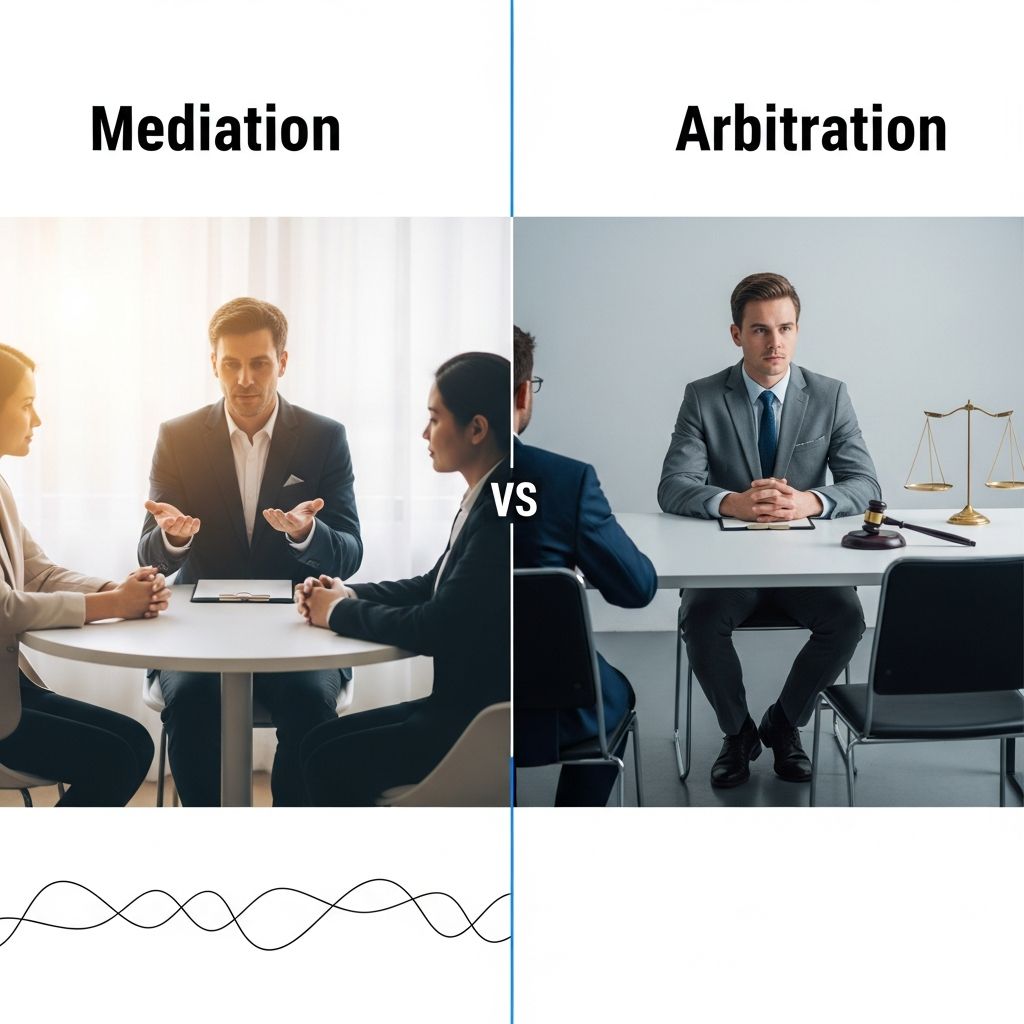
Alternative dispute resolution (ADR) methods like mediation and arbitration offer efficient alternatives to traditional courtroom battles, saving time, money, and relationships. These processes empower parties to handle conflicts outside public courts while maintaining privacy and control.
Understanding Alternative Dispute Resolution
ADR encompasses voluntary techniques where disputants collaborate with neutral facilitators to reach settlements. Unlike litigation’s adversarial nature, ADR emphasizes cooperation and customized solutions. Mediation and arbitration stand out as primary options, each suited to different conflict types.
Parties often select ADR for its speed—resolutions can occur in days or weeks versus years in court. Confidentiality protects sensitive information, and flexibility allows tailoring procedures to specific needs. Courts increasingly mandate ADR before trials, underscoring its reliability.
Exploring the Mediation Process
Mediation involves a neutral third party, the mediator, who guides discussions without imposing decisions. Parties retain full control over outcomes, fostering collaborative problem-solving.
The process typically unfolds in stages:
- Preparation: Parties gather documents and outline positions.
- Opening Session: Mediator explains rules; each side presents views.
- Private Caucuses: Mediator meets individually to explore interests and generate options.
- Negotiation: Joint sessions refine proposals toward consensus.
- Agreement: If reached, it’s documented as a binding contract.
Mediators use active listening and reframing to bridge gaps, focusing on underlying interests rather than positions. This approach excels in preserving ongoing relationships, such as in family or business disputes.
Delving into Arbitration Procedures
Arbitration resembles a private trial where a neutral arbitrator hears evidence and issues a decision. It’s more structured than mediation, providing finality through binding awards.
Key steps include:
- Agreement to Arbitrate: Parties sign a clause or submit post-dispute.
- Arbitrator Selection: Choose based on expertise, often from panels.
- Preliminary Hearing: Set schedules, discovery rules.
- Hearing: Present evidence, witnesses testify under oath.
- Award: Arbitrator deliberates and issues a written ruling.
Arbitration can be binding or non-binding, but binding is standard, enforceable like court judgments. Parties negotiate rules, discovery scope, and appeal limits upfront.
Core Distinctions: Mediation Compared to Arbitration
While both employ neutrals, their roles diverge sharply. Use this table for a clear overview:
| Aspect | Mediation | Arbitration |
|---|---|---|
| Neutral’s Role | Facilitator of dialogue | Judge-like decision-maker |
| Outcome Control | Parties decide voluntarily | Arbitrator imposes binding award |
| Formality | Informal, conversational | Formal hearings with evidence rules |
| Binding Nature | Non-binding unless agreed | Typically binding and enforceable |
| Timeframe | Hours to days | Weeks to months |
| Cost | Lower, fewer hours billed | Higher due to hearings |
| Appeal Rights | Not applicable | Limited grounds only |
This comparison highlights mediation’s flexibility versus arbitration’s structure. In mediation, impasse means no resolution; arbitration always concludes with a decision.
Advantages of Choosing Mediation
Mediation shines in scenarios valuing relationships and creativity. Benefits include:
- Cost savings: Often one-day sessions versus prolonged arbitration.
- Relationship preservation: Collaborative tone reduces animosity.
- Confidentiality: Discussions stay private, unprotected in court.
- High success rates: Over 70% of cases settle, per industry data.
- Custom solutions: Beyond legal remedies, like apologies or future cooperation.
Ideal for divorce, workplace issues, or contracts needing ongoing partnerships.
Benefits of Opting for Arbitration
Arbitration provides court-like certainty without public scrutiny. Strengths encompass:
- Finality: Binding awards end disputes decisively.
- Expertise: Select industry specialists for informed rulings.
- Speed over litigation: No crowded dockets delay proceedings.
- Privacy: Hearings closed to public and media.
- Enforceability: Awards upheld via federal law like the FAA.
Suited for commercial contracts, construction, or employment where predictability matters.
Potential Drawbacks and Risks
No method is flawless. Mediation risks impasse, wasting time if parties are intransigent. High-conflict cases may exploit the process. Arbitration’s cons include limited discovery, potentially hiding facts, and minimal appeals, risking errors. Costs can escalate with panels or complex hearings.
Parties must assess power imbalances; arbitration favors stronger evidence presenters.
When to Select Mediation Over Arbitration
Opt for mediation when:
- Maintaining relationships is crucial.
- Parties seek creative, non-monetary solutions.
- Early resolution conserves resources.
- Trust exists for good-faith negotiation.
It’s frequently court-ordered as a first step.
Ideal Scenarios for Arbitration
Choose arbitration if:
- A definitive, enforceable ruling is needed.
- Technical expertise ensures fair assessment.
- Confidentiality shields business secrets.
- Contract mandates it, avoiding court.
Prevalent in international trade via institutions like ICC.
Combining Mediation and Arbitration Strategically
Many agreements incorporate both: mediate first, arbitrate if failed. This hybrid maximizes settlement chances while ensuring closure. Courts endorse this sequencing for efficiency.
Legal Framework and Enforceability
U.S. Federal Arbitration Act (FAA) governs interstate arbitration, mandating enforcement. State laws vary but align. Mediation agreements are contracts; breaches litigable. Neutrals follow ethical codes from AAA or JAMS.
Frequently Asked Questions
Is mediation always confidential?
Yes, statements in mediation are privileged and inadmissible in court, promoting open dialogue.
Can arbitration decisions be appealed?
Limited to fraud, bias, or procedural errors; substantive review is rare.
How do I choose a mediator or arbitrator?
Via organizations like AAA; consider experience, impartiality, and fees.
Are lawyers needed in these processes?
Optional in mediation; recommended in arbitration for evidence presentation.
Which is cheaper, mediation or arbitration?
Mediation generally, due to shorter duration and no formal discovery.
Steps to Initiate ADR
1. Review contracts for clauses.
2. Propose process to opponent.
3. Select neutral from reputable lists.
4. Draft submission agreement.
5. Schedule sessions promptly.
Consult attorneys to protect rights.
References
- Arbitration vs Mediation — Pepperdine Online Graduate Programs. 2023. https://onlinegrad.pepperdine.edu/law/online-mdr/arbitration-vs-mediation/
- Arbitration vs. Mediation – Explaining the Differences — Office of Justice Programs (OJP). 1995-01-01. https://www.ojp.gov/ncjrs/virtual-library/abstracts/arbitration-vs-mediation-explaining-differences
- Mediation vs. Arbitration: Key Differences and Benefits — Duffy & Young. 2024. https://duffyandyoung.com/mediation-vs-arbitration-key-differences-and-benefits/
- Overview of Arbitration & Mediation — FINRA.org. 2024. https://www.finra.org/arbitration-mediation/about/arbitration-vs-mediation
- Arbitration vs. Mediation: What’s the Difference? — Purdue Global Law School. 2023. https://www.purduegloballawschool.edu/blog/news/arbitration-vs-mediation
- What is the Difference Between Mediation and Arbitration? — Edwards Mediation Academy. 2023. https://edwardsmediationacademy.com/what-is-the-difference-between-mediation-and-arbitration/
Similar Articles








Read full bio of medha deb


