
The McDonald’s Hot Coffee Lawsuit: Myths, Facts, and Legal Lessons
Discover what really happened in the McDonald’s hot coffee case and how it reshaped product liability, warnings, and corporate responsibility.
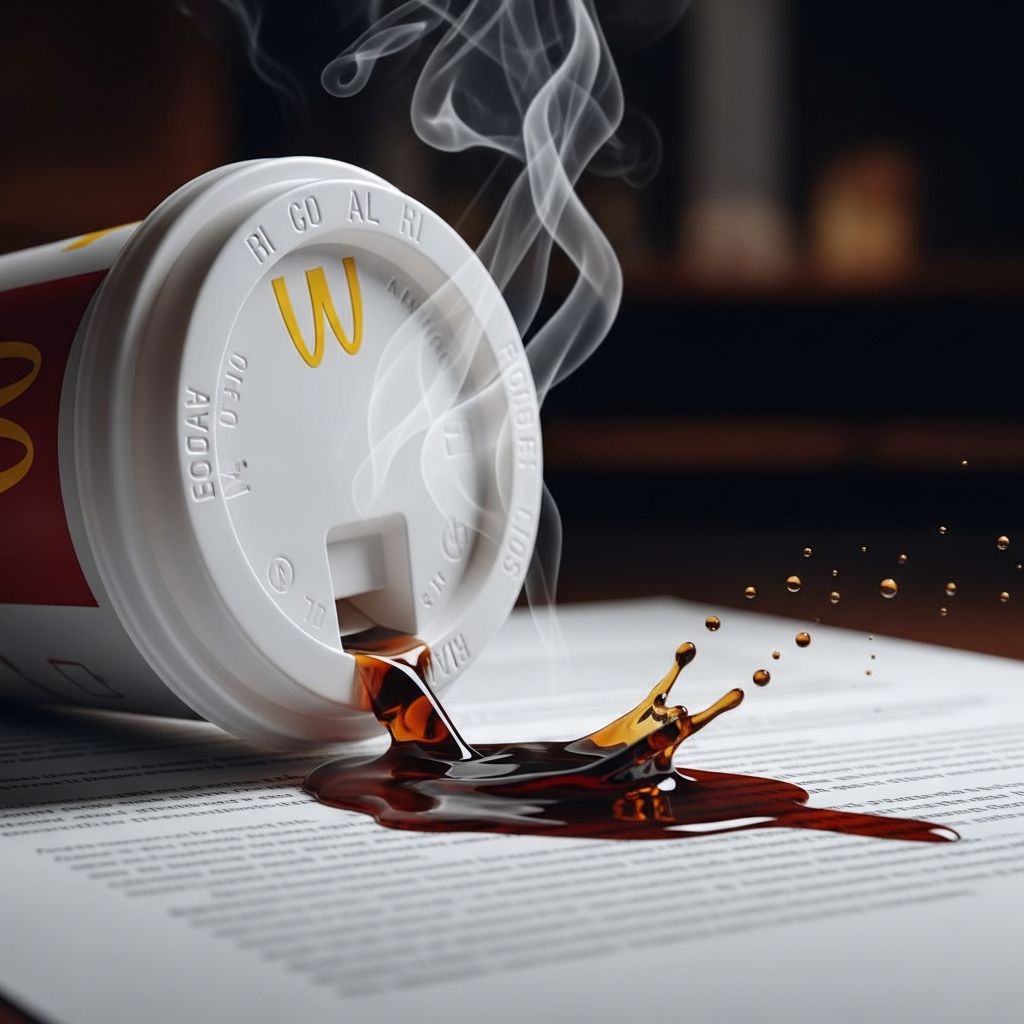
The McDonald’s hot coffee lawsuit has become one of the most misunderstood legal cases in modern American history. Often held up as the symbol of so-called “frivolous lawsuits,” the real story is much more complex, and far more serious, than the popular narrative suggests.
This article explains what actually happened, why the jury ruled the way it did, and what the case teaches about product safety, corporate risk decisions, and the civil justice system.
Background: What Sparked the Lawsuit?
The case is formally known as Liebeck v. McDonald’s Restaurants, a 1994 product liability lawsuit filed in New Mexico state court. The plaintiff, Stella Liebeck, was a 79-year-old woman who suffered severe burns when hot coffee from McDonald’s spilled onto her lap after purchase.
Contrary to the common belief that she was driving at the time, Liebeck was a passenger in a parked car when she attempted to remove the lid to add cream and sugar. The drink spilled, soaking her clothing and trapping scalding liquid against her skin.
Severity of the Injuries
The injuries were not minor burns. Medical evidence at trial showed:
- Third-degree burns (full-thickness burns) over a significant portion of her pelvic area, including the groin, inner thighs, and buttocks.
- About 6% of her body suffered third-degree burns, with additional areas suffering lesser burns.
- She required skin grafts, debridement, and was hospitalized for about eight days, followed by long-term follow-up care.
These were the kind of injuries typically seen in industrial accidents, not routine coffee spills.
How Hot Was the Coffee and Why Did It Matter?
One of the central issues in the case was the temperature at which McDonald’s required its restaurants to hold and serve coffee.
| Source | Approximate Holding Temperature | Risk of Third-Degree Burns |
|---|---|---|
| McDonald’s corporate specification | About 180–190°F (82–88°C) | Can cause third-degree burns in a matter of seconds |
| Safer drinking range suggested by experts | Around 140°F (60°C) or below | Much longer time required to cause the same severity of burns |
Expert testimony presented at trial established that liquid around 180–190°F can cause a full-thickness burn in just a few seconds of contact with skin. At lower temperatures, the skin has more time to react and pull away, significantly reducing the severity of injuries.
Evidence of Prior Incidents
The jury heard evidence that McDonald’s had long been aware of the risks associated with its coffee policy:
- From 1982 to 1992, McDonald’s had received more than 700 burn complaints from customers, many involving severe burns in sensitive areas.
- Some of those complaints had resulted in settlements or payments to injured customers.
- Despite this history, McDonald’s continued to require extremely high holding temperatures and did not meaningfully change its warnings.
This pattern played an important role in the jury’s decision that the company’s conduct went beyond ordinary negligence and justified punitive damages.
Legal Theories: Why McDonald’s Was Sued
The lawsuit was not simply about a spilled drink. It was framed as a product liability case alleging that the coffee was unreasonably dangerous as sold and that McDonald’s failed to provide adequate warnings.
Core Allegations
Liebeck’s legal team advanced several key arguments:
- The coffee was a defective product because it was held at a temperature that created a serious risk of catastrophic injury in foreseeable use.
- McDonald’s knew the coffee was served at temperatures that could cause severe burns in seconds yet did not adequately warn customers of this specific risk.
- The company had data on hundreds of similar incidents but chose not to reduce the temperature or change its policies.
In product liability law, a manufacturer or seller can be held responsible if a product is unreasonably dangerous when used as intended or in a reasonably foreseeable way. The jury concluded that customers could reasonably expect hot coffee, but not coffee so hot that a brief spill would cause life-altering burns.
Comparative Fault
New Mexico, like many states, follows a comparative negligence rule. Under this approach, the jury may assign fault to both the plaintiff and the defendant and adjust damages accordingly.
In Liebeck’s case, the jury allocated responsibility as follows:
- McDonald’s: 80% at fault
- Stella Liebeck: 20% at fault for how she handled the coffee
This finding reduced her compensatory damages by 20%.
Damages Awarded and the Media Reaction
The verdict had two main components: compensatory damages and punitive damages.
Compensatory Damages
The jury initially awarded:
- $200,000 in compensatory damages for medical bills, pain, suffering, and long-term impact.
- After reducing that number by 20% for comparative fault, the net compensatory award was $160,000.
Before trial, Liebeck had sought a modest settlement—around $20,000 to cover medical expenses—but McDonald’s declined to meaningfully negotiate.
Punitive Damages: Why the Number Was So Large
The headline-grabbing part of the verdict was the $2.7 million in punitive damages that the jury awarded to punish and deter what it viewed as reckless corporate behavior.
Jurors considered McDonald’s coffee revenues and pegged the punitive damages at roughly the value of two days of coffee sales — approximately $1.35 million per day at the time.
The trial judge later reduced the punitive award to around $480,000, and the parties ultimately reached a confidential settlement reported to be below $500,000.
National news coverage, however, often focused only on the initial $2.7 million figure, rarely explaining the underlying evidence or the subsequent reduction. That gap between perception and reality is a major reason the case entered popular culture as a supposed example of lawsuit excess.
Myth vs. Reality: Common Misconceptions
Several myths about the McDonald’s hot coffee case continue to circulate. Here is how they compare to the documented facts.
| Myth | Reality |
|---|---|
| “It was just a woman who spilled coffee on herself and hit the jackpot.” | Liebeck suffered severe third-degree burns, required surgery and hospitalization, and initially sought only enough to cover her medical costs. |
| “She was driving recklessly with hot coffee.” | She was a passenger in a parked car when the spill occurred. |
| “Everyone knows coffee is hot, so the case was frivolous.” | The issue was not that the coffee was hot, but that it was scalding at 180–190°F, enough to cause catastrophic burns in seconds, combined with McDonald’s knowledge of hundreds of prior injuries. |
| “She walked away with millions.” | The judge reduced the award significantly, and the final settlement was reported to be under $500,000 — not the multi-million-dollar payout often repeated in media sound bites. |
Why the Case Matters for Product Liability Law
Beyond its media reputation, the case remains an important illustration of several legal and policy principles.
1. Duty to Design Reasonably Safe Products
Manufacturers and sellers are not automatically liable for every accident, but they must take reasonable steps to avoid foreseeable, serious harm. When a product is sold in a way that makes severe injury likely in routine use, courts may treat it as defective.
In this case, holding coffee at near-boiling temperatures, combined with evidence of hundreds of prior burn incidents, convinced the jury that the risk was not just theoretical. Serving coffee at somewhat lower temperatures would have preserved its usefulness and taste while reducing the risk of catastrophic injury.
2. Importance of Warnings and Consumer Expectations
Product warnings must do more than mention the obvious. It is not enough to tell customers that coffee is “hot” if what truly distinguishes the risk is that it can cause third-degree burns in a matter of seconds.
Jurors concluded that the existing warning on the cup was inadequate for a product held at such extreme temperatures, especially given that consumers reasonably expect a hot drink, not an industrial-scale burn hazard.
3. Punitive Damages as a Deterrent
Punitive damages are not intended to compensate the injured person directly; they are meant to punish particularly reckless conduct and send a deterrent signal to others. In the McDonald’s case, the jury believed that only a substantial monetary penalty would get the company’s attention, given its large revenues and long history of similar incidents.
Importantly, the judge exercised oversight by reducing the punitive damages to a lower amount he considered more proportionate, demonstrating how checks and balances work in civil verdicts.
4. Impact on Corporate Practices
Following the verdict, there were reports that at least some McDonald’s locations reduced their coffee temperatures, thus increasing the “margin of safety” for customers. The case also led many businesses to reconsider both the temperatures at which hot beverages are served and the clarity of their warnings.
Practical Takeaways for Consumers
The McDonald’s coffee case offers several lessons for everyday consumers dealing with potentially hazardous products.
- Do not assume all products are equally safe. Two items that appear similar — for example, coffee from different chains — may be handled very differently behind the scenes.
- Read and understand warnings. Labels often reflect prior incidents or scientific evaluations of risk. While some may seem obvious, others highlight non-intuitive hazards.
- Document serious injuries promptly. In any significant product-related injury, medical records, photographs, and receipts can be critical if legal action becomes necessary.
- Seek legal advice early. Product liability cases can turn on technical evidence about design, temperature, manufacturing processes, or industry standards that are difficult to gather without legal assistance.
Practical Takeaways for Businesses
For businesses, the case is a cautionary example of how long-ignored risks can turn into major legal and reputational problems.
- Monitor complaints seriously. Hundreds of similar incident reports, even over many years, are a red flag that your product or practice may be unreasonably dangerous.
- Balance cost savings against safety. Operational choices that save small amounts of money but increase the risk of severe injury may be viewed harshly by juries.
- Review warnings and instructions regularly. As you learn more about how consumers use your product, warnings may need to be updated or made more prominent.
- Consider proactive design changes. Lowering temperature, strengthening packaging, or redesigning containers may significantly reduce risk — and legal exposure.
Frequently Asked Questions (FAQs)
Q1: Did Stella Liebeck really win millions of dollars?
The jury initially awarded $2.7 million in punitive damages plus $200,000 in compensatory damages, reduced to $160,000 for comparative fault. The judge then cut the punitive damages to about $480,000, and the parties later reached a confidential settlement reportedly under $500,000 — far less than the headline $2.7 million figure.
Q2: Was she driving when the coffee spilled?
No. Stella Liebeck was a passenger in a parked vehicle. She placed the cup between her knees to remove the lid and add cream and sugar when the spill occurred.
Q3: Why was McDonald’s found mostly at fault?
The jury concluded that McDonald’s knowingly served coffee at 180–190°F, knew of more than 700 prior burn complaints, and still did not reduce the temperature or provide stronger warnings. Because of this pattern, the jury found McDonald’s 80% responsible, with Liebeck bearing 20% of the blame.
Q4: Could this kind of case still succeed today?
Yes, under modern product liability principles, a case can still succeed where a company’s design choices or failure to warn create a foreseeable risk of severe harm. However, every case depends on the specific facts, including product design, prior complaints, warnings, and industry standards.
Q5: What was the long-term impact of the case?
The case influenced how courts, companies, and consumers think about hot beverage safety, warning labels, and punitive damages. It also became a focal point in public debates over tort reform, often cited (sometimes inaccurately) as an example of excessive litigation.
References
- Liebeck v. McDonald’s Restaurants — Wikipedia (summary of case facts and verdict). 2024-04-15. https://en.wikipedia.org/wiki/Liebeck_v._McDonald’s_Restaurants
- McDonald’s Coffee Case Facts — Texas Trial Lawyers Association. 2015-06-01. https://www.ttla.com/?pg=McDonaldsCoffeeCaseFacts
- Know the Facts: McDonald’s Hot Coffee Case — Consumer Attorneys of California. 2013-09-10. https://www.caoc.org/?pg=facts
- Legal Myths: The McDonald’s “Hot Coffee” Case — Public Citizen. 2011-08-01. https://www.citizen.org/article/legal-myths-the-mcdonalds-hot-coffee-case/
- Liebeck v. McDonald’s — The American Museum of Tort Law. 2015-01-01. https://www.tortmuseum.org/liebeck-v-mcdonalds/
- The Truth Behind the Infamous McDonald’s Coffee Lawsuit — Poole Law Group. 2020-03-15. https://www.poolelg.com/blog/the-truth-behind-the-mcdonald-s-hot-coffee-case-.cfm
Similar Articles








Read full bio of medha deb


