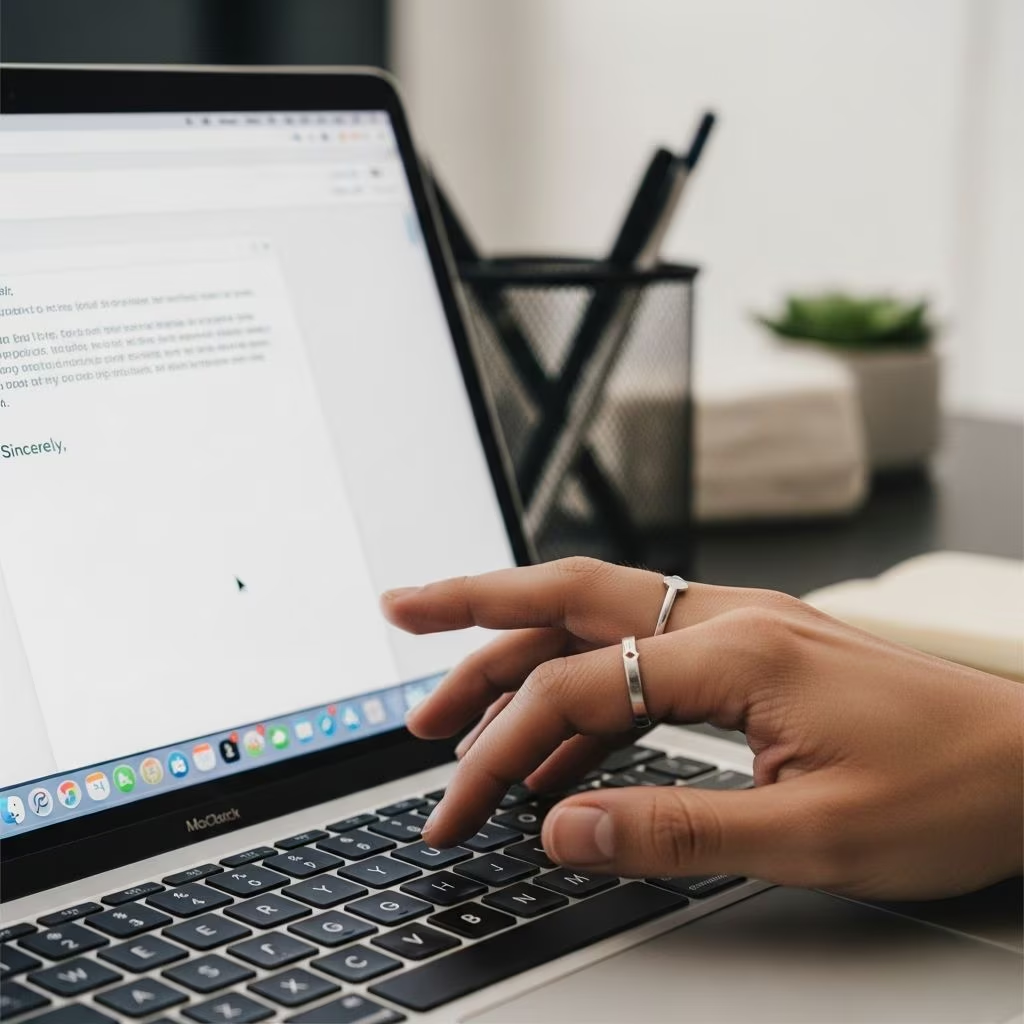
Effective email communication hinges on more than just the content; the way you end your message shapes perceptions and influences outcomes. A well-chosen closing reinforces your intent, maintains tone consistency, and leaves a lasting positive impression. In professional settings, where first impressions and ongoing relationships matter, selecting the right sign-off can differentiate polished communicators from the rest.
Why Email Sign-Offs Shape Your Professional Image
The closing line of an email serves as the final touchpoint, summarizing your message’s essence and signaling how you wish the interaction to proceed. Research shows that gratitude-based closings like ‘Thanks’ boost response rates, while mismatched tones can confuse recipients or undermine credibility. Consistent use of appropriate sign-offs builds familiarity and trust over time, making your emails more anticipated and effective.
Consider the psychology: recipients scan emails quickly, and the sign-off is often the last element they remember. A mismatched closing—such as ‘Cheers’ after a formal proposal—can dilute your authority. Conversely, a tailored one aligns with the email’s purpose, whether seeking action, expressing thanks, or fostering rapport.
Key Principles for Selecting the Perfect Closing
Choosing an email sign-off requires evaluating several factors to ensure alignment and impact. Start by assessing the recipient’s relationship to you, the email’s context, and your desired next steps.
- Recipient Relationship: For superiors or clients, opt for formal options like ‘Best regards’ to convey respect. With close colleagues, ‘Thanks’ or ‘Talk soon’ adds warmth without familiarity.
- Email Context: Match the tone—formal for contracts, casual for team updates. In sales or follow-ups, include subtle calls-to-action (CTAs) like ‘Looking forward to your thoughts’.
- Purpose and Action: If expecting a reply, use phrases that nudge gently, such as ‘Hoping to hear from you soon,’ to encourage engagement without pressure.
Maintaining consistency across threads fosters recognition. Once established with a contact, reuse the style to streamline processing. Always prioritize clarity: simple, legible formats ensure readability on mobile devices, where over half of emails are opened.
Top Professional Email Closing Categories and Examples
Closings fall into distinct categories, each suited to specific scenarios. Below is a table outlining versatile options, their ideal uses, and key benefits.
| Category | Examples | Best For | Key Benefit |
|---|---|---|---|
| Formal | Best regards, Sincerely, Regards | Clients, executives, initial contacts | Maintains professionalism and respect |
| Gratitude | Thank you, Thanks, Many thanks | After requests or help received | Increases response rates significantly |
| Action-Oriented | Looking forward to your feedback, Let me know your thoughts | Follow-ups, proposals | Encourages prompt replies |
| Friendly/Casual | Cheers, Best, Talk soon | Colleagues, ongoing teams | Builds rapport casually |
| Motivational | You’ve got this, Until next time | Supportive or closing updates | Leaves positive, encouraging vibe |
Gratitude closings like ‘Thank you’ are among the most effective across contexts, as they acknowledge the recipient’s time and effort. For nuanced situations, personalize: add a name or reference to prior discussions for deeper connection.
Context-Specific Strategies for Different Email Types
Client and Business Communications
In client interactions, err on formality to uphold professionalism. ‘Best regards’ paired with full contact details signals reliability. For proposals, end with ‘I appreciate your consideration and look forward to discussing further’ to prompt next steps. Avoid casual slang, as it risks appearing unpolished.
Internal Team and Colleague Emails
Team emails allow flexibility. ‘Thanks, team’ or ‘Cheers’ fosters camaraderie. In collaborative threads, ‘Review when ready’ gives space while signaling expectations. Consistency here prevents confusion in fast-paced group chats.
Sales, Follow-Ups, and Networking
These demand action nudges. ‘Thanks in advance for your input’ works for favors, though use cautiously to avoid presumption. Networking closings like ‘Excited to connect soon’ build bridges. Always include a CTA, such as calendar links for meetings.
Out-of-Office and Automated Replies
Auto-replies need clarity on availability. Example: ‘I’ll respond upon return on [date]. For urgents, contact [alternate]. Best, [Name]’. This sets boundaries professionally.
Signature Blocks: Enhancing Your Closing
A strong sign-off pairs with a concise signature: name, title, company, phone, and links. Keep it mobile-optimized—short lines, no heavy images. Tools like AI email writers can generate tailored signatures and closings for efficiency.
Common Mistakes to Avoid in Email Closings
Pitfalls can sabotage even strong messages. Steer clear of these:
- Inconsistent Tone: Formal body with ‘Cheers’ confuses.
- Overly Archaic Phrases: ‘Yours faithfully’ feels outdated.
- Passive-Aggressive Vibes: ‘Awaiting your response’ implies impatience. Interpretations include ‘Regards’ as aloof or ‘Thanks in advance’ as presumptuous.
- Redundancy: Repeating ‘Thanks’ if already in body.
- Excessive Casualness: Emojis or slang in professional contexts.
Negativity or slang erodes trust; always aim for positivity and clarity.
Advanced Techniques for Standout Closings
Elevate beyond basics with variation and personalization. Rotate closings to avoid monotony: ‘Warm regards’ for friendliness, ‘All the best’ for finals. Test performance—track which yield replies. For global audiences, neutral options like ‘Best’ transcend cultures.
Incorporate subtle personalization: ‘Looking forward to your NYC insights, Sarah.’ This boosts engagement. For long threads, ‘Catch you on the next thread’ keeps it light.
Frequently Asked Questions (FAQs)
What is the best professional email sign-off?
‘Best regards’ or ‘Thank you’ are safest and most effective for broad use, especially in business.
Can I use emojis in email closings?
Reserve for casual internal emails; avoid in client comms to maintain professionalism.
How do I sign off when no reply is needed?
Use ‘Thank you for your time’ or ‘Best’ to acknowledge without pressure.
Is ‘Thanks in advance’ rude?
It can seem presumptuous; opt for ‘I appreciate your help’ instead.
Should I vary my sign-offs?
Yes, matching context keeps emails dynamic while building familiarity.
Implementing Changes for Better Email Habits
Audit your recent emails: note patterns and responses. Draft templates for common types, customizing closings. Practice consistency—set reminders for signatures. Over time, refined closings will enhance your professional network and efficiency.
Mastering these elements transforms routine emails into strategic tools, driving better relationships and results in any career stage.
References
- How to Sign Off an Email: Best Professional and Polite Closings — Fyxer. 2024. https://www.fyxer.com/blog/how-to-sign-off-email
- 110 Best Ways to Sign Off an Email Correctly — Warmup Inbox. 2024. https://www.warmupinbox.com/blog/email-marketing/email-sign-offs/
- How to Sign Off on an Email Correctly — Rocketseed. 2024. https://www.rocketseed.com/blog/correct-way-to-sign-off-emails/
- How to end an email: a guide to professional sign-offs and closings — Spark Mail App. 2024. https://sparkmailapp.com/how-to-end-an-email-template
- How to End an Email Professionally (With Examples) — iConnect, UMass Isenberg. 2024-07-10. https://iconnect.isenberg.umass.edu/blog/2024/07/10/how-to-end-an-email-professionally-with-examples/
- How to End an Email (With Closing Examples) — Indeed.com. 2024. https://www.indeed.com/career-advice/career-development/how-to-end-an-email