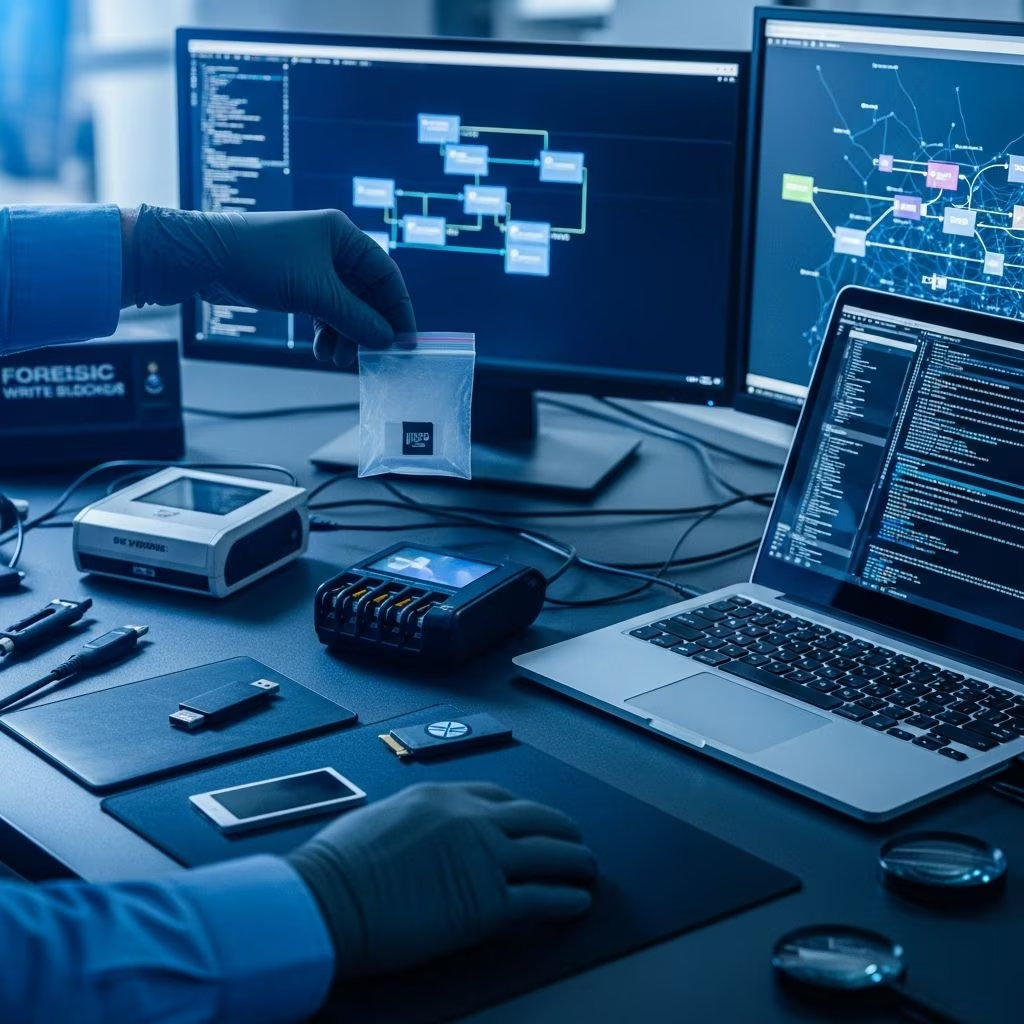
Digital evidence forms the backbone of modern investigations, powering cases from cybercrimes to civil disputes. With devices generating vast amounts of data daily, professionals must adopt rigorous protocols to capture, preserve, and present this information effectively. This guide delves into foundational strategies, advanced techniques, and emerging challenges, drawing on established best practices to ensure evidence withstands courtroom scrutiny.
Understanding the Digital Evidence Landscape
Digital evidence encompasses any data stored or transmitted electronically, including emails, social media posts, GPS logs, and device metadata. Its volatility—data can be altered, deleted, or overwritten—demands immediate and methodical handling. Unlike physical evidence, digital traces often include timestamps, geolocation, and user identifiers that authenticate origins and timelines.
Investigators face escalating data volumes; a single smartphone can hold terabytes of information, complicating analysis. Success hinges on balancing speed with precision, prioritizing sources likely to yield probative material while safeguarding integrity throughout the process.
Initial Scene Assessment and Preparation
Before touching any device, conduct a thorough scene evaluation. Identify potential evidence repositories: computers, mobiles, cloud-linked wearables, and peripherals. Review legal warrants to define collection scope, anticipating anti-forensic measures like encryption or remote wipes.
Clear the area of non-essential personnel to minimize contamination risks. Divide the scene into zones—e.g., workspaces, vehicle consoles—for systematic coverage. Note environmental factors: humidity can damage storage media, while magnetic fields erase data.
- Photograph devices in situ, capturing cables, screens, and surroundings without altering power states.
- Sketch layouts labeling item positions for reconstruction.
- Assess power levels; secure chargers but avoid plugging in unknown devices to prevent malware activation.
Capturing Evidence Without Compromise
Collection prioritizes non-invasive methods. For active devices, enable airplane mode to sever network connections, preserving volatile RAM data like open sessions or encryption keys. Powered-off devices remain untouched until forensic imaging in controlled environments.
Use hardware write-blockers—devices that prevent write operations—to access storage without modification. These tools ensure read-only interactions, critical for admissibility.
| Method | Purpose | Best For |
|---|---|---|
| Screenshots | Capture dynamic screens | Social media, chats |
| Full Device Imaging | Bit-for-bit duplication | Hard drives, phones |
| Metadata Extraction | Preserve timestamps, locations | All media files |
Social media and messaging require expanded captures: include full threads, commenter identities, likes, and profile details like usernames or linked emails. Chronological logging builds abuse patterns, strengthening narratives.
Preservation Techniques for Long-Term Integrity
Preservation transforms raw captures into court-ready artifacts. Create multiple copies: a forensic master image, working duplicate, and offsite backups. Employ drive imaging to replicate entire storage sectors, retaining deleted files and slack space.
Hashing verifies unchanged data using algorithms like SHA-256, generating unique ‘fingerprints.’ Compute hashes pre- and post-transfer; matches confirm integrity. Multiple algorithms mitigate collision risks.
Hashing Workflow
- Acquire original data.
- Run MD5, SHA-1, SHA-256 hashes.
- Document values with timestamps.
- Re-hash copies for validation.
Store in anti-static bags, Faraday pouches for mobiles (blocking signals), and climate-controlled vaults. Physical binders with printed screenshots supplement digital archives, including full web captures.
Maintaining an Ironclad Chain of Custody
The chain of custody logs every evidence handoff, detailing who, what, when, where, and why. Gaps invite tampering claims, undermining cases.
Implement digital logs with signatures, barcodes, or RFID tags for tracking. Each transfer generates entries: ‘Received SSD from Officer X on 2026-04-03 at 10:00 UTC, hash verified.’
- Secure facilities with access logs.
- Audit trails for analysis software.
- Court presentations include custody exhibits.
Handling Specialized Digital Sources
Cloud services demand provider-specific protocols; subpoena metadata alongside user data. Third-party uploads via secure portals like community request apps preserve originals, embedding metadata like resolution and frame rates.
Mobile dynamics—location pings, app caches—require swift action before overwrites. Cross-device correlations reveal networks: pairing logs link phones to cars or accounts.
Overcoming Common Collection Challenges
Data deluge overwhelms; tools like FileTSAR enable on-scene triage, extracting key files from networks. Encryption barriers necessitate warrants for keys or live analysis.
Sharing large files securely challenges teams; encrypted platforms with audit logs resolve this. Environmental hazards—heat, moisture—demand protective gear.
| Challenge | Solution |
|---|---|
| Encryption | Legal compulsion, key recovery |
| Volatility | Airplane mode, RAM dumps |
| Volume | Triage tools, selective imaging |
| Sharing | Secure portals, hashes |
Legal and Ethical Imperatives
Adhere to jurisdictional standards; U.S. Federal Rules of Evidence require authentication via testimony or hashes. Forensic soundness—repeatable, community-accepted methods—ensures reliability.
Ethical collection respects privacy; collect only authorized scopes. Training via NIJ programs equips teams for evolving threats.
Frequently Asked Questions (FAQs)
What is the first step in digital evidence collection?
Secure the scene and document the initial state photographically, without powering devices on or off.
Why use hashing for digital evidence?
Hashing creates verifiable fingerprints, proving data unaltered from collection to trial.
How do you handle mobile phone evidence?
Activate airplane mode immediately, image via write-blockers, and capture dynamic data promptly.
What role does chain of custody play?
It documents all handling, defending against tampering allegations in court.
Can deleted files be recovered?
Yes, forensic imaging often retrieves data from unallocated space or slack.
Future Trends in Digital Forensics
AI-driven triage accelerates analysis, while blockchain logs enhance custody transparency. Quantum threats loom, but standards evolve via bodies like SWGDE. Professionals must stay abreast via continuous education.
Integrating body cams with evidence systems streamlines uploads, embedding metadata automatically. As IoT proliferates, expect protocols for smart homes and vehicles.
References
- Best Practices for Collecting Digital Evidence of Technology-Facilitated Violence — BC Society of Transition Houses. 2023. https://bcsth.ca/digitalevidencetoolkit/best-practices-for-collecting-digital-evidence-of-technology-facilitated-violence/
- Best Practices for Digital Evidence Collection — Scientific Working Group on Digital Evidence. 2018-02-01. https://www.swgde.org/documents/published-complete-listing/18-f-002-best-practices-for-digital-evidence-collection/
- 10 Best Practices for Digital Evidence Collection — Cellebrite. 2023. https://cellebrite.com/en/blog/10-best-practices-for-digital-evidence-collection/
- Digital Evidence Management: The Definitive Guide — Axon. 2023. https://www.axon.com/resources/digital-evidence-management-guide
- How Is Digital Evidence Preserved in Modern Investigations? — American Military University. 2023. https://www.amu.apus.edu/area-of-study/criminal-justice/resources/how-is-digital-evidence-preserved/
- 5 Steps for Conducting Computer Forensics Investigations — Norwich University. 2023. https://online.norwich.edu/online/about/resource-library/5-steps-conducting-computer-forensics-investigations
- Improving the Collection of Digital Evidence — National Institute of Justice (.gov). 2023. https://nij.ojp.gov/topics/articles/improving-collection-digital-evidence
- 3 Methods to Preserve Digital Evidence for Computer Forensics — Lumifi Cyber. 2023. https://www.lumificyber.com/blog/3-methods-to-preserve-digital-evidence-for-computer-forensics/