
Understanding Massachusetts Traffic Laws
A practical, plain-language guide to Massachusetts traffic rules, penalties, and driver rights for safer and more informed driving.
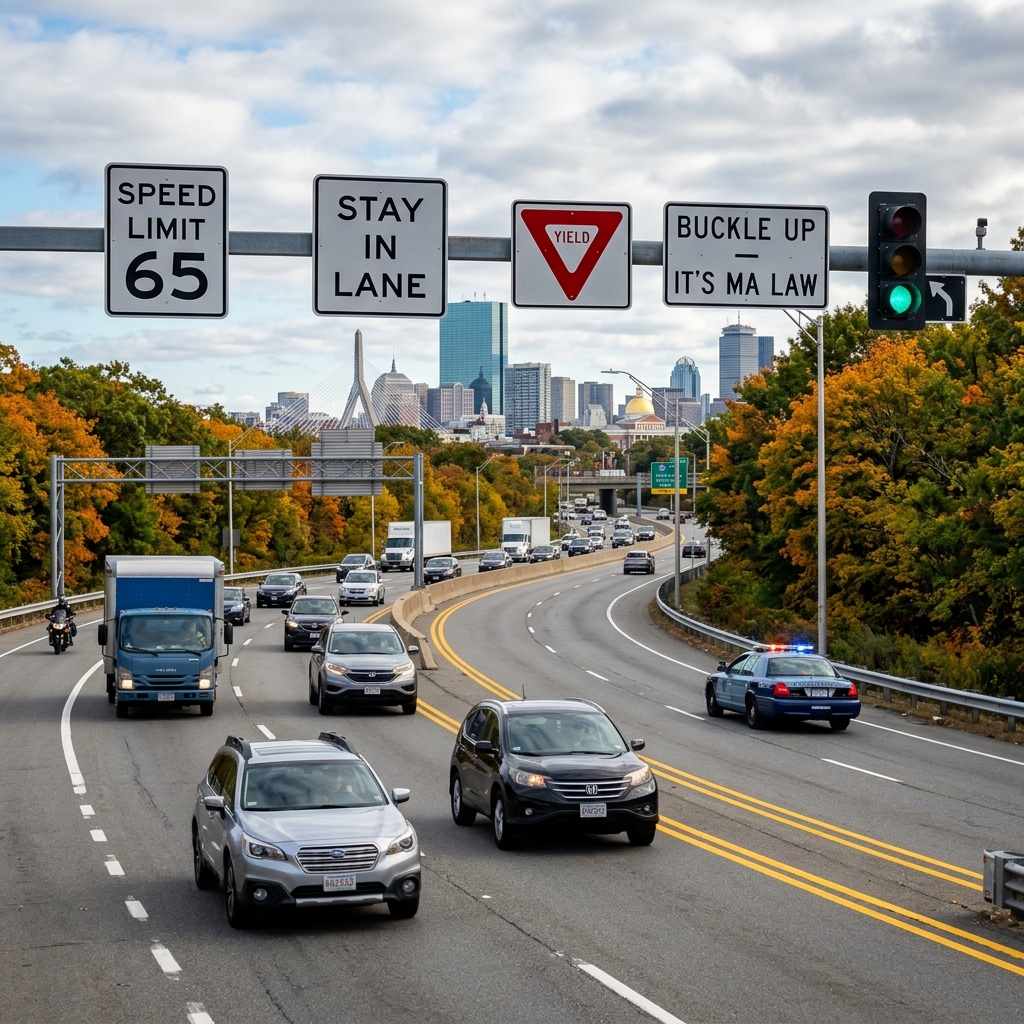
Driving in Massachusetts involves more than simply following road signs. The state has an extensive set of traffic rules, penalties, and administrative procedures that affect your license, insurance costs, and even your criminal record. Knowing the basics can help you avoid violations, reduce penalties, and protect your driving privileges.
This guide explains the most important aspects of Massachusetts traffic laws, including common violations, how fines and surcharges work, when your license can be suspended, and what to do if you receive a ticket.
1. Legal Framework for Traffic Rules in Massachusetts
Most Massachusetts traffic rules come from several sources:
- Massachusetts General Laws Chapter 90 (motor vehicles, licensing, registration).
- Massachusetts General Laws Chapter 89 (rules of the road, right of way, passing, and similar conduct rules).
- MassDOT regulations, such as 720 CMR 9.00, which implement traffic control rules (signals, lane use, etc.).
- Policies and procedures of the Registry of Motor Vehicles (RMV), which administers licensing, suspensions, and hearings.
These laws and regulations work together: a police officer enforces the statutes and regulations, the court (or clerk-magistrate) handles the citation, and the RMV enforces license consequences such as suspensions and revocations.
2. Common Moving Violations and How They Work
Massachusetts recognizes many kinds of traffic violations, but several categories appear most frequently on citations and in RMV records.
2.1 Speeding and Unsafe Speed
Speeding is one of the most commonly charged offenses. Massachusetts law requires drivers to obey posted limits and also to adjust speed for conditions (weather, traffic, road work, and visibility—even if you are below the posted limit).
Key points about speeding violations:
- Driving above the posted limit can result in a civil traffic citation and monetary fine.
- Driving too fast for conditions (e.g., heavy rain or snow) can also be a violation, even under the posted limit, under safe operation principles.
- Excessive speeds may lead to additional consequences, including license suspensions or criminal charges if they rise to the level of reckless or negligent operation.
2.2 Lane Usage, Signals, and Right of Way
Massachusetts rules of the road require drivers to:
- Drive within a single lane and avoid weaving, unless it is safe to change lanes.
- Stay in the lane nearest the right side of the road when available, except when passing or preparing to turn left.
- Obey traffic signals and stop at a red light or red arrow before the crosswalk or intersection, yielding to pedestrians with the right of way.
- Yield to pedestrians lawfully in crosswalks, as required by Chapter 89.
Violations in this category include running red lights, failing to yield, improper lane changes, and unsafe passing. These are typically civil offenses but can become criminal if they contribute to serious crashes.
2.3 Cell Phone Use and Distracted Driving
Massachusetts prohibits most use of handheld devices while driving. Adult drivers must use hands-free mode for phone calls, and texting while driving is universally banned. Violations usually lead to fines and may raise insurance costs. Repeated distracted driving violations can contribute to RMV actions when they become surchargeable events.
2.4 Special Rules for Vulnerable Road Users
Recent roadway safety legislation strengthened protections for vulnerable road users, such as pedestrians, bicyclists, and people using scooters or wheelchairs.
Among other things, the law:
- Requires drivers to allow at least 4 feet of clearance when passing a vulnerable road user.
- Clarifies municipalities’ ability to lower certain speed limits, subject to MassDOT review.
- Requires specific safety equipment on certain state-owned vehicles to reduce collision risks.
Failure to respect these requirements may lead to a citation and can be considered evidence of negligence in civil lawsuits after a crash.
3. How Traffic Fines and Surcharges Are Calculated
When you receive a traffic ticket in Massachusetts, you are usually facing two kinds of consequences:
- Immediate financial penalties (fines, fees, and surcharges).
- Longer-term insurance and RMV consequences based on “surchargeable events.”
3.1 Monetary Penalties
Many civil traffic violations carry a combination of:
- A base fine amount.
- Additional amounts that depend on the severity of the conduct.
- State and court surcharges added to almost every citation.
For example, when a driver is cited for speeding, the total assessed amount often reflects the posted limit, how far above the limit the driver was traveling, any special zone (such as a construction area or school zone), and mandatory state surcharges. Construction-zone penalties may be increased to emphasize worker safety.
3.2 Surchargeable Events and Insurance Impact
Massachusetts uses the concept of surchargeable events to track a driver’s history for both RMV and insurance purposes. These events generally include:
- At-fault crashes above certain damage thresholds.
- Moving violations such as speeding, red-light violations, and certain lane-use or right-of-way violations.
- Serious offenses such as operating under the influence or leaving the scene of a crash.
Insurers may raise premiums when a driver has one or more surchargeable events. The RMV also counts them toward mandatory driver education requirements and potential license suspensions.
4. License Suspensions and Revocations
The Massachusetts RMV may suspend or revoke your license for a wide range of reasons, not all of which involve criminal conduct. Suspension means a temporary loss of driving privileges; revocation is usually more serious and requires reapplication after a specified period.
4.1 Common Driving-Related Suspension Triggers
Under Massachusetts law and RMV policies, your license can be suspended or revoked for issues such as:
- Accumulating several moving violations or surchargeable events within a short time frame.
- Operating under the influence of alcohol or drugs (OUI), including chemical test refusals.
- Serious traffic offenses such as reckless operation or leaving the scene of a crash involving injury or property damage.
- Driving on a suspended or revoked license.
Some suspensions are mandatory and have minimum periods; others are discretionary and may depend on your prior history.
4.2 Suspensions for OUI and Chemical Test Refusal
Operating under the influence is treated as a criminal offense, but it also has significant administrative consequences handled by the RMV.
Key features of Massachusetts OUI-related license consequences include:
- Administrative suspension when a driver refuses a breath or chemical test, even before the criminal case is resolved.
- Additional court-ordered suspensions if convicted of OUI, with durations that increase for repeat offenses.
- Reinstatement requirements such as fees, completion of alcohol education programs, or installation of an ignition interlock device, depending on the case.
4.3 Non-Driving Reasons for RMV Action
Massachusetts may also suspend a driver’s license for non-driving issues, such as failure to pay certain obligations or comply with court orders. Examples include:
- Unpaid child support or certain unpaid court-ordered obligations.
- Non-compliance with specific drug-related offense statutes.
While these are not traffic violations, their impact on driving privileges can be just as serious as a suspension for speeding or OUI.
5. Responding to a Traffic Ticket in Massachusetts
Most traffic tickets in Massachusetts are civil motor vehicle infractions (CMVIs), which are not criminal but can still carry steep penalties and insurance consequences. Serious charges like OUI, reckless operation, and leaving the scene are criminal matters and follow a different process in court.
5.1 Options When You Receive a Civil Citation
When you receive a civil traffic citation, you typically have two basic options:
- Pay the citation by the deadline listed on the ticket.
- Request a hearing to contest the violation or the amount of the civil assessment.
Failing to respond by the deadline can result in additional late fees and may eventually lead to license suspension for non-payment or default.
5.2 Hearings and Appeals
If you request a hearing, your case usually first goes to a clerk-magistrate. In that hearing, you can present evidence, explain your circumstances, or argue that the officer made a mistake. If you disagree with the clerk’s decision, you may be able to appeal to a judge for further review.
In criminal traffic cases, such as OUI, you have constitutional rights, including the right to counsel and the right to a trial. These cases proceed like other criminal matters, with arraignment, pretrial hearings, and a possible trial.
6. Points, Driver Training, and Habitual Offender Consequences
Massachusetts does not use a simple “points” system like some other states, but it closely tracks your record of surchargeable events and serious violations.
6.1 Mandatory Driver Education After Multiple Events
When a driver accumulates several surchargeable events within a set period, the RMV may require completion of a driver retraining program. Failure to complete this program can itself lead to license suspension. The goal is to reduce repeat violations and improve safety.
6.2 Habitual Traffic Offenders
Drivers who accumulate multiple serious traffic offenses within a given timeframe can be classified as habitual traffic offenders, which may trigger long-term license revocations and stricter reinstatement conditions.
Serious offenses can include:
- OUI convictions.
- Driving on a suspended or revoked license.
- Leaving the scene of a crash with injury or significant property damage.
7. Safety-Oriented Rules You Might Overlook
Beyond the obvious requirements like stopping at red lights and obeying speed limits, Massachusetts has several safety-related rules that drivers sometimes overlook but that can still lead to citations or liability.
7.1 Move Over and Emergency Vehicle Rules
Massachusetts law requires drivers to yield to emergency vehicles with lights and sirens, and to move over or slow down when approaching stationary emergency or maintenance vehicles on the roadside. Failing to do so can result in fines and may increase the severity of penalties if a collision occurs.
7.2 Headlights, Wipers, and Visibility
Drivers must use headlights at night and during periods of poor visibility. In Massachusetts, if road conditions require the use of windshield wipers, drivers must also turn on their headlights, enhancing visibility and safety.
7.3 Child Passenger and Seat Belt Requirements
Massachusetts requires:
- Young children up to a specified age or height (often framed as 8 years old or 57 inches tall) to ride in federally approved child restraint systems, properly fastened in the vehicle.
- Older children and adults to wear seat belts, with limited exceptions, to improve safety and reduce injury in crashes.
Violations may result in fines and can be considered in civil cases after an accident.
8. Quick Reference Table: Civil vs. Criminal Traffic Matters
| Type of Matter | Typical Examples | Handled As | Possible Consequences |
|---|---|---|---|
| Civil Motor Vehicle Infraction (CMVI) | Speeding, red light, failure to yield, improper lane change | Civil; clerk-magistrate hearing if contested | Fines, fees, surchargeable event, insurance premium increases |
| Criminal Traffic Offense | OUI, reckless operation, leaving the scene of a crash with injury | Criminal court, with right to counsel and trial | Fines, probation, possible jail, license suspension or revocation |
| Administrative RMV Action | License suspension for too many surchargeable events, chemical test refusal | RMV decision; often with right to hearing | Loss of driving privileges, reinstatement fees, required programs |
9. Practical Tips to Stay Compliant on Massachusetts Roads
To reduce your risk of tickets, surcharges, and license problems, consider the following habits:
- Monitor your speed, especially in construction and school zones, where enforcement and penalties are often higher.
- Leave extra room when passing cyclists, pedestrians, and other vulnerable road users; Massachusetts law requires at least 4 feet when passing them.
- Use hands-free technology for calls and never text while driving.
- Keep your license and registration current and resolve tickets quickly to avoid suspension for non-payment or defaults.
- Take driver education seriously; for newer drivers, it can prevent early surchargeable events and, for experienced drivers, retraining may be required after multiple violations.
10. Frequently Asked Questions About Massachusetts Traffic Laws
10.1 Are all traffic tickets in Massachusetts criminal offenses?
No. Most traffic tickets are civil motor vehicle infractions that carry fines and insurance consequences but are not criminal. Criminal offenses include OUI, reckless operation, and leaving the scene of a crash with injury, which can result in a criminal record and possible jail time.
10.2 Can my license be suspended even if I never go to court?
Yes. The RMV can suspend your license administratively for reasons such as too many surchargeable events, OUI-related chemical test refusals, or failure to pay required assessments. These actions may occur separately from any court process.
10.3 Do Massachusetts traffic violations affect my insurance rates?
They often do. Many moving violations are considered surchargeable events, and insurers may raise premiums when such events appear on your driving record. Serious violations and at-fault crashes typically have the largest impact.
10.4 What happens if I ignore a Massachusetts traffic ticket?
If you ignore a ticket and do not pay or request a hearing by the deadline, you may face late fees, default judgments, and eventually a license suspension for failure to pay or respond. Reinstatement normally requires payment of the ticket, additional fees, and possibly a reinstatement fee at the RMV.
10.5 Do I need a lawyer for a traffic case?
For routine civil infractions, many drivers handle matters on their own. However, for criminal offenses (such as OUI or charges involving serious crashes) or when facing a long-term suspension, consulting a lawyer experienced in Massachusetts traffic and criminal law can be very important because of the potential long-term consequences.
References
- Massachusetts General Laws, Chapter 90: Motor Vehicles and Aircraft — Massachusetts General Court. Accessed 2026. https://malegislature.gov/Laws/GeneralLaws/PartI/TitleXIV/Chapter90
- Massachusetts General Laws, Chapter 89: Law of the Road — Massachusetts General Court. Accessed 2026. https://malegislature.gov/Laws/GeneralLaws/PartI/TitleXIV/Chapter89
- 720 CMR 9.00: Rules and Regulations of the Department of Highways — Code of Massachusetts Regulations. Accessed 2026. https://regulations.justia.com/states/massachusetts/720-cmr/title-720-cmr-9-00/section-9-06/
- Massachusetts law about traffic violations — Mass.gov. Updated 2023. https://www.mass.gov/info-details/massachusetts-law-about-traffic-violations
- Traffic safety law takes effect — Massachusetts Municipal Association. 2023-04-01. https://www.mma.org/traffic-safety-law-takes-effect/
- Massachusetts Traffic Laws You Might Not Realize You’re Breaking — Jason Stone Injury Lawyers. 2022. https://www.stoneinjurylawyers.com/blog/massachusetts-traffic-laws/
Similar Articles








Read full bio of medha deb


