
Massachusetts Insurance Fraud Laws Explained
A clear guide to how Massachusetts defines, investigates, and punishes insurance fraud.
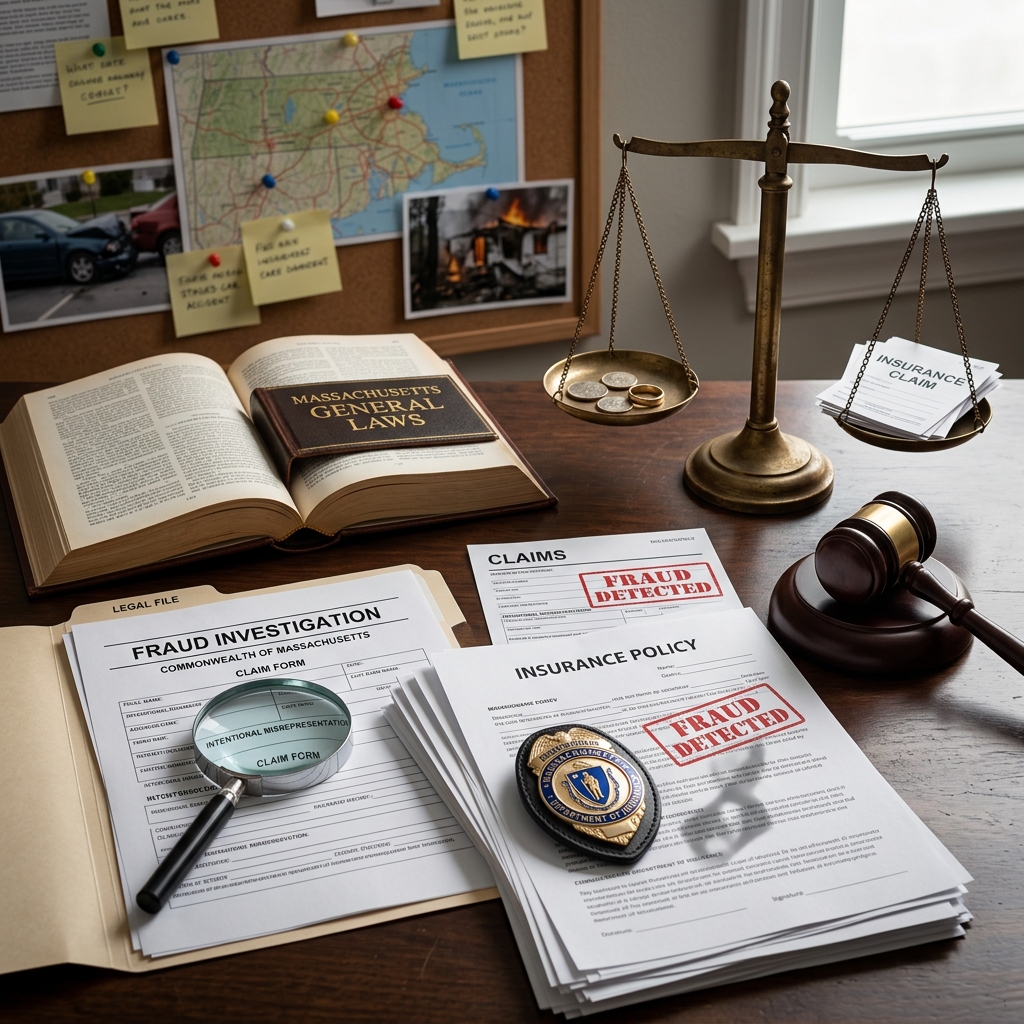
Insurance fraud in Massachusetts is not limited to one type of scheme. It can involve false claims, altered documents, inflated losses, hidden facts, or staged events intended to obtain money or benefits that were never actually owed. The state treats these cases seriously because fraud can raise premiums, distort claim handling, and undermine trust in the insurance system.
This guide explains the main legal concepts behind Massachusetts insurance fraud laws, the conduct that can trigger criminal charges, how investigators and insurers respond, and the kinds of consequences a person may face if a case is proven. It also highlights practical issues such as reporting obligations, proof problems, and the difference between fraud and an honest mistake.
How Massachusetts Defines Insurance Fraud
At a basic level, insurance fraud involves a deliberate deception used to obtain an insurance benefit. That deception may occur during the purchase of a policy, while submitting a claim, or when providing supporting records after a loss. Massachusetts authorities describe the conduct broadly, which means a case may involve not only the person who directly files a false claim, but also anyone who helps prepare or present it.
State law focuses on intent. A simple error, a misunderstanding, or a clerical problem is not the same as fraud. Prosecutors generally must show that the accused knowingly made a false statement or concealed a material fact with the purpose of influencing the insurer.
Common Conduct That Can Lead to Charges
Insurance fraud cases often begin with a suspicious claim pattern or a statement that does not match other evidence. While each case is different, the following types of conduct frequently appear in investigations:
- Submitting a claim for a loss that never happened.
- Exaggerating the value of repairs, injuries, or stolen property.
- Using false invoices, forged receipts, or altered records.
- Leaving out facts that would matter to the insurer’s decision.
- Staging a vehicle accident, theft, or property loss.
- Misstating where a vehicle is kept or how it is used.
- Giving false information in an application for coverage.
Not every suspicious claim is criminal. Insurance companies sometimes deny or dispute claims because of incomplete documentation, bad estimates, or credibility concerns. The legal question is whether the person acted with deception and intended to influence the insurer by using false information.
The Statutes That Matter Most
Massachusetts law addresses insurance fraud through multiple provisions rather than a single all-purpose statute. Two of the most important provisions are found in Chapter 266 of the Massachusetts General Laws, including Section 111A and Section 111B. These provisions cover fraudulent statements and claims made in connection with insurance matters, especially motor vehicle, theft, and comprehensive policies.
Section 111B is especially significant because it specifically addresses knowingly false or fraudulent statements made in support of an application or claim. The law also authorizes punishment ranging from jail or state prison time to fines, restitution, and in some cases licensing consequences for appraisers or repair shops involved in inflated damage estimates.
Massachusetts also uses administrative and reporting systems alongside criminal law. The state’s insurance-fraud reporting framework allows insurers to notify the Insurance Fraud Bureau when they suspect a fraudulent transaction, which can lead to further review and possible referral.
What Prosecutors Usually Have to Prove
To convict someone of insurance fraud, the government generally must prove more than a false statement. It must show that the person acted knowingly and intentionally. In practice, that means the evidence should support several key points:
| Element | What It Means |
|---|---|
| Intent | The person meant to deceive the insurer or help someone else do so. |
| False statement or claim | There was an inaccurate or misleading statement, document, or representation. |
| Materiality | The false information was important enough to affect the insurer’s decision-making. |
| Connection to insurance | The conduct related to a policy application, claim, proof of loss, or similar insurance transaction. |
Materiality is especially important. A minor inconsistency may be suspicious, but it may not be enough to support a fraud charge if it would not have affected coverage, payment, or claim evaluation. Defense lawyers often focus on this point because it can separate criminal fraud from a dispute over the details of a claim.
Examples of Fraud in Everyday Insurance Cases
Insurance fraud is often associated with large, complicated schemes, but it can also arise in routine claims. A person may be accused of inflating the amount of damage after a car accident, reporting items as stolen that were never missing, or submitting medical bills tied to treatment that was not actually provided. In property cases, investigators may compare repair estimates, photographs, witness statements, and weather records to test whether the claimed loss happened as described.
Vehicle-related matters are a major focus in Massachusetts because the statute specifically addresses claims involving motor vehicle, theft, and comprehensive coverage. A false statement about who was driving, where a vehicle was garaged, or how the damage occurred can become a criminal issue if the falsehood was intentional and material.
How Fraud Investigations Typically Begin
Insurance fraud investigations often start inside the insurance company. A claims adjuster, special investigations unit, or outside investigator may notice a mismatch between the claimed loss and the physical evidence. If the insurer believes the transaction may be fraudulent, Massachusetts reporting rules may require notification to the Insurance Fraud Bureau within a specified period after that determination.
Once a matter is reported, investigators may gather photographs, statements, repair estimates, medical records, policy documents, and payment histories. They may also compare a claimant’s version of events with witness accounts, electronic records, or prior claims. If the facts suggest intentional deception, the case may be referred for criminal prosecution.
Possible Penalties and Collateral Consequences
The consequences of a fraud conviction can be severe. Under Massachusetts law, a person convicted of presenting a fraudulent insurance claim may face imprisonment, fines, and restitution. For some motor vehicle-related violations, the penalties can include state prison time of up to five years, house of correction time, or substantial fines, depending on the charge and the facts proved.
Restitution is a common part of sentencing. Courts may order the defendant to repay the insurer for financial losses tied to the fraud. In certain cases, especially where licensed appraisers or repair businesses are involved, the law also allows additional consequences such as revocation of a license or registration for a period of time.
There can also be indirect effects beyond the criminal case. A conviction may damage professional reputation, make it harder to obtain coverage in the future, and create problems in civil disputes over the same claim.
How a Fraud Case Differs From a Claim Dispute
Not every rejected or reduced claim is fraudulent. Insurance claims are often messy, and disagreements over value, causation, and documentation are common. A damaged car may be worth less than the owner believes. Medical treatment may be questioned by the insurer. A policy may contain exclusions the policyholder did not fully understand. None of those issues automatically prove a crime.
The key difference is deception. A claim dispute usually involves disagreement over facts or coverage. Fraud involves intentionally misleading the insurer. That distinction matters because criminal liability requires proof of knowing dishonesty, not merely a bad outcome or a weak claim.
Possible Defense Themes in a Massachusetts Fraud Case
Defense strategies depend on the facts, but several themes appear often in insurance fraud cases:
- Lack of intent: The accused made an honest mistake or relied on incorrect information from another source.
- No material falsehood: Any inaccuracy was minor and not important to the insurer’s decision.
- Insufficient proof: The state cannot connect the defendant to the false statement beyond a reasonable doubt.
- Alternative explanation: Damage, injury, or loss occurred, but the insurer is disputing the amount or cause.
- Problematic investigation: Key evidence was misunderstood, incomplete, or taken out of context.
In many cases, records become the central battleground. Repair estimates, text messages, photographs, medical notes, and recorded statements can all be interpreted differently. A strong defense often turns on careful reconstruction of what happened and when.
Why Reporting Rules Matter
Massachusetts relies on reporting as one way to detect fraudulent activity early. When insurers identify suspicious transactions, they may be required to notify state fraud authorities rather than simply denying the claim and moving on. That reporting process helps create a trail for investigators and may reveal repeated conduct across different claims or companies.
For consumers, this means a suspicious claim can become more serious than a routine coverage dispute. What begins as an adjuster’s concern may evolve into a formal investigation involving records requests, interviews, or subpoenas.
Practical Steps If You Are Accused
If someone is accused of insurance fraud, the most important step is to treat the matter seriously from the start. Statements made to investigators, insurers, or police can be used later, so it is important to review documents before responding. A person should gather policy records, claim forms, correspondence, photographs, estimates, receipts, and any communications that help show what really happened.
It is also useful to preserve evidence that may be overlooked, such as calendar entries, location data, third-party invoices, or names of witnesses. In a fraud investigation, details that look small at first can become central later.
Frequently Asked Questions
Is every false statement in an insurance claim fraud?
No. A false statement usually becomes fraud only when it is intentional and material. Honest mistakes, confusion, or minor inaccuracies are not automatically criminal.
Can someone be charged for helping another person file a false claim?
Yes. Massachusetts law can reach people who aid, abet, or otherwise help present a fraudulent claim, not just the person who signs the paperwork.
What types of insurance are most often involved?
Vehicle, theft, comprehensive, property, and bodily injury claims are common areas of concern, although fraud can arise in many different kinds of insurance transactions.
Does the insurer have to prove a large dollar loss?
Not necessarily. The size of the alleged loss can affect sentencing or negotiation, but the core issue is whether the defendant intentionally used false information in a material way.
Can a person face both criminal and civil consequences?
Yes. A fraud allegation can lead to criminal prosecution, restitution, claim denial, policy cancellation, or a separate civil dispute over payment and damages.
References
- General Law – Part IV, Title I, Chapter 266, Section 111B — Massachusetts Legislature. 2026-07-10. https://malegislature.gov/Laws/GeneralLaws/PartIV/TitleI/Chapter266/Section111b
- Identifying and Reporting Insurance Fraud — Massachusetts Division of Insurance. 2026-07-10. https://www.mass.gov/info-details/identifying-and-reporting-insurance-fraud
- Massachusetts-Mandatory Reporting-Chapter 76 Section 88 — Insurance Fraud Bureau of Massachusetts. 2026-07-10. https://insurancefraud.org/regulations/massachusetts-mandatory-reporting-chapter-76-section-88-chapter-26-section-8b/
- Frequently Asked Questions (FAQ) — Insurance Fraud Bureau of Massachusetts. 2026-07-10. https://www.ifb.org/faqs
- Detect & Prevent Insurance Fraud Today — Insurance Fraud Bureau of Massachusetts. 2026-07-10. https://www.ifb.org/
- Insurance Fraud Statute and Defense Strategies — BMSW Law. 2026-07-10. https://www.bmswlaw.com/blog-1-1/understanding-mgl-c-266-111a-the-massachusetts-insurance-fraud-statute-and-defense-strategies
Similar Articles








Read full bio of medha deb




