
Maryland Wage and Hour Rules: A Practical Guide
Understand Maryland’s wage, overtime, breaks, and leave rules so employers and workers can avoid costly disputes.
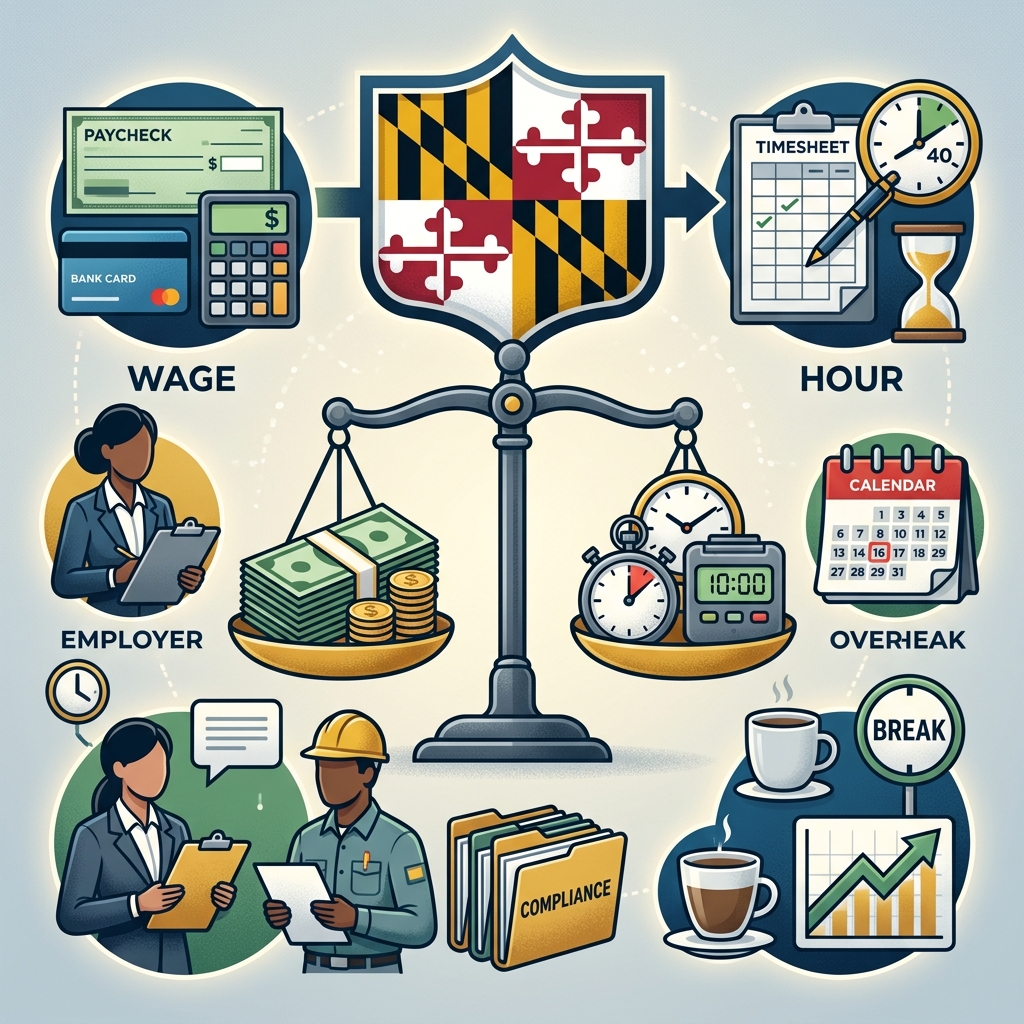
Maryland has its own set of wage and hour protections that work alongside federal rules such as the Fair Labor Standards Act (FLSA). These state laws govern minimum wage, overtime pay, youth employment, paydays, and more, and they are enforced primarily by the Maryland Department of Labor’s Division of Labor and Industry. Understanding these rules helps both employers and workers prevent violations and resolve disputes more efficiently.
This guide explains the core features of Maryland wage and hour law in plain language, focusing on what you must pay, when you must pay it, and which special protections apply in common situations.
1. How Maryland Minimum Wage Works
Maryland sets its own statewide minimum wage, and when state and federal law differ, employees are entitled to the higher rate. For most workers in Maryland, the state minimum wage is $15.00 per hour. Some special categories, such as tipped employees and certain minors, have different rules.
1.1 Standard minimum wage
For most non-exempt employees (those covered by wage and hour laws), employers must pay at least the state minimum wage for every hour worked. Local ordinances may impose higher rates, so employers operating in different Maryland jurisdictions should check for city or county-specific requirements in addition to state law.
- Base minimum wage: $15.00 per hour for most employees.
- Coverage: Applies to most full-time and part-time workers, with specific exemptions listed in Maryland’s wage and hour law.
- Higher local rates: Some local governments may set higher minimum wages; in those areas the higher rate controls.
1.2 Tipped employees
Employees who regularly earn tips have a different minimum cash wage, but their overall compensation must still reach at least the full state minimum wage when tips are included.
- Tipped minimum cash wage: $3.63 per hour.
- Tip requirement: The combination of hourly wage plus tips must average at least $15.00 per hour across the pay period.
- Shortfall duty: If tips plus the tipped cash wage do not reach $15.00 per hour, the employer must make up the difference.
Only workers who regularly receive more than a small threshold amount in tips (commonly referenced as more than $30 per month) qualify for the tipped minimum wage.
1.3 Young workers
Maryland allows a reduced minimum wage for some workers under 18, but this reduction is limited.
- Sub-minimum wage for minors: Employers may pay workers under 18 at 85% of the state minimum wage, if they meet the statutory conditions.
- Hazardous work restrictions: Separate youth employment rules restrict the types of jobs and hours minors can work, regardless of the wage rate.
2. Overtime Pay and Work Hours
Maryland’s wage and hour law incorporates the familiar concept of overtime after 40 hours in a workweek. In many cases, the rules echo federal law, but state enforcement and remedies may differ.
2.1 When overtime is owed
Most non-exempt employees in Maryland must receive overtime when they work more than 40 hours in a defined workweek.
- Overtime threshold: More than 40 hours in a single workweek.
- Rate of pay: At least 1.5 times the employee’s regular hourly rate for each overtime hour.
- Workweek definition: A fixed and recurring period of 168 hours (7 consecutive 24-hour periods), which the employer sets for payroll purposes.
Not every worker is entitled to overtime. Certain categories of employees may be exempt under federal or state law (for example, some executive, administrative, or professional employees), but exemptions are narrowly defined and require careful analysis.
2.2 Common overtime issues
- Off-the-clock work: If an employer knows or should know that an employee is working, those hours generally count, even if the employee did not explicitly record them.
- Multiple locations or roles: Hours at different worksites or in multiple roles for the same employer usually must be combined to determine overtime obligations.
- Flat salaries for non-exempt workers: Paying a salary does not automatically eliminate overtime; the employer still must calculate the regular rate and pay overtime for hours over 40.
3. Meal and Rest Breaks
Break rules in Maryland differ depending on factors such as whether the employee is a minor and the type of employer. State law provides specific protections in certain situations, while federal law focuses on whether short breaks count as paid time.
3.1 Breaks for adult workers
Maryland does not generally require employers to provide meal or rest breaks for adult, non-minor employees, except in certain industries such as retail. However, if the employer chooses to offer short breaks, federal law usually treats these as paid time.
- Retail employees: If a retail employee works at least four hours in a shift, Maryland law requires a 15-minute nonworking rest break, and longer shifts may trigger a required 30-minute break.
- Paid versus unpaid breaks: Under the FLSA, breaks lasting between about 5 and 20 minutes are typically counted as paid work time.
- Unpaid meal periods: Meal breaks of 30 minutes or more can be unpaid only if the employee is completely relieved from duty and not required to perform work-related tasks.
3.2 Breaks and limits for minors
Maryland has stricter scheduling rules for workers under 18, designed to protect their health and educational needs.
- Mandatory meal break: Minors generally may not work more than five consecutive hours without at least a 30-minute nonworking break.
- Total daily limits: In any single day, the total of school hours plus work hours cannot exceed 12, and the minor must have at least 8 consecutive hours free from both school and work.
- Night and weekly limits: Young minors (14 and 15) face further limits on how early and late they can work and how many hours they may work on school days and non-school days.
4. Youth Employment and Work Permits
In addition to wage rules, Maryland has detailed requirements when hiring minors, including work permits, banned occupations, and hour limits.
4.1 Work permits
Most minors under 18 must secure a work permit before starting work for an employer in Maryland. These permits help ensure that the job and schedule are appropriate for the minor’s age and meet state safety standards. Employers should keep a copy of the permit on file during the minor’s employment.
4.2 Restricted occupations
Maryland and federal law prohibit minors from working in especially dangerous jobs.
- Minors are generally barred from hazardous occupations such as certain manufacturing roles, heavy machinery operation, and other high-risk tasks.
- Additional restrictions apply to minors younger than 16, including limitations in industrial and construction environments.
4.3 Hour limits for young workers
Time-of-day and total hours restrictions vary by age group. As one example, minors aged 14–15 are subject to strict limits on early morning, evening, and school-day work.
| Situation | Typical Limit |
|---|---|
| Time of day (school year) | Not before 7:00 a.m. or after 8:00 p.m. |
| Time of day (summer) | Not before 7:00 a.m. or after 9:00 p.m. between Memorial Day and Labor Day. |
| Hours on a school day | Maximum of 4 hours when school is in session. |
| Hours in a non-school week | Up to 40 hours when school is not in session. |
Employers should consult Maryland’s official youth employment guidance or contact the Maryland Department of Labor for the complete rules.
5. Paydays, Paychecks, and Final Wages
Maryland regulates how and when employers must pay wages, and what must be included on employees’ pay stubs.
5.1 Regular pay schedules
- Regular paydays: Employers must set regular paydays and follow them consistently.
- Allowed frequency: Many employees are paid at least twice a month (biweekly or semimonthly), while some exempt employees may be paid less frequently.
- Payday on a nonworking day: If a payday falls on a weekend or legal holiday, wages generally must be paid on the preceding workday.
5.2 Forms of payment
Maryland allows several forms of wage payment, subject to certain conditions.
- Cash or check: Wages may be paid in cash or by a check that can be converted into cash at face value on demand.
- Direct deposit: Direct deposit is permitted if it complies with state requirements and the employee’s consent rules.
- Payroll cards: Paycards may be used under specific conditions, including clear access to the full wage amount and limited fees.
5.3 Written wage notices and pay stubs
Maryland has strengthened its wage transparency rules, including requirements for written notice of pay information and detailed pay statements.
- New hires must receive written notice of their pay rate, regular paydays, and leave benefits at the time of hiring.
- Employers must provide advance written notice—at least one pay period—before changing an employee’s pay rate or regular payday.
- Each pay period, pay stubs or online pay statements must disclose information such as employer name, pay period dates, rates of pay, gross and net wages, deductions, and additional bases of pay like bonuses or commissions.
5.4 Final pay when employment ends
When an employee is terminated or resigns, Maryland requires that all earned wages be paid by the next regular payday. This includes overtime and, in many cases, earned vacation pay if the employer’s policy treats it as wages. Maryland does not mandate severance pay; any severance obligations arise from contracts, policies, or agreements.
6. Sick Leave and Other Time Off
Maryland has multiple leave-related laws that intersect with wage and hour issues, including sick and safe leave and parental leave. These laws do not always require paid time off, but they often protect job security and prohibit retaliation for lawful leave use.
6.1 Sick and safe leave
Under the Maryland Healthy Working Families Act, many employees earn sick and safe leave based on the hours they work.
- Accrual rate: At least one hour of sick and safe leave for every 30 hours worked.
- Annual cap: Accrual may be capped at 40 hours per year.
- Covered uses: Addressing the employee’s own illness, caring for certain family members, or addressing issues related to domestic violence, sexual assault, or stalking.
- Paid versus unpaid: Larger employers typically must provide paid leave, while some smaller employers may allow unpaid but job-protected leave.
6.2 Flexible use of paid leave
Maryland’s Flexible Leave Act allows employees of some employers to use earned paid leave (such as vacation) to care for ill immediate family members instead of only for their own illness. This law does not require employers to provide new types of leave, but it can affect how employees are permitted to use existing paid time off.
6.3 Parental leave for small and mid-sized employers
The Maryland Parental Leave Act (PLA) requires certain employers with 15 to 49 employees to offer eligible employees up to six workweeks of unpaid parental leave in a 12-month period for the birth, adoption, or foster placement of a child. Although PLA leave is generally unpaid, employers may allow or require employees to use available paid leave during this time.
7. Equal Pay and Pay Transparency
Maryland’s Equal Pay for Equal Work law bans pay discrimination based on sex or gender identity for employees performing comparable work in the same establishment. The law also includes pay transparency provisions that affect hiring and job postings.
- Equal pay requirement: Employers may not pay one sex or gender identity less than another for comparable work, with limited exceptions such as seniority systems, merit systems, and bona fide factors unrelated to sex or gender identity.
- Pay transparency in postings: Maryland requires employers to disclose the wage range (minimum and maximum salary or hourly rate) and general benefits or other compensation for a position in internal and external job postings.
- Protection for discussing wages: Employees generally have the right to inquire about, discuss, or disclose their wages or the wages of other employees, subject to limited restrictions on those whose job duties involve handling pay information.
8. Enforcing Your Rights and Avoiding Violations
Both employees and employers have strong incentives to comply with Maryland’s wage and hour laws. Unpaid wages, failure to provide required notices, or misclassification issues can result in significant liability, including back pay and potential penalties.
8.1 Steps employees can take
- Keep detailed records: Track hours worked, including overtime, breaks, and any off-the-clock work, as well as copies of pay stubs and written notices.
- Raise concerns internally: Many payroll issues result from error. Written communication with HR or management can resolve problems quickly.
- Contact the Maryland Department of Labor: If you cannot resolve the problem internally, you may file a complaint with the Maryland Department of Labor’s Division of Labor and Industry, which publishes the official Maryland Guide to Wage Payment and Employment Standards.
- Consider legal counsel: For complex or high-dollar disputes, consulting an attorney familiar with Maryland wage and hour law can be helpful.
8.2 Compliance tips for employers
- Review job classifications regularly to ensure workers treated as exempt from overtime actually meet exemption tests.
- Verify that pay practices reflect the current state minimum wage and tipped wage, and monitor local wage ordinances.
- Implement timekeeping systems that accurately capture all hours worked, including short breaks that must be paid.
- Train managers on youth employment limits, required breaks for minors, and documentation of work permits.
- Maintain standardized written notices of pay, clear pay policies, and itemized pay stubs that meet Maryland’s disclosure requirements.
9. Frequently Asked Questions About Maryland Wage and Hour Laws
Do Maryland employers have to provide lunch breaks for adults?
For most adult workers, Maryland law does not require meal or rest breaks, although federal law generally requires that short breaks of about 5–20 minutes be treated as paid work time. However, certain retail workers must receive specific rest and meal breaks depending on shift length.
What is the minimum wage for tipped servers in Maryland?
The cash minimum wage for tipped employees is $3.63 per hour, but their total hourly earnings including tips must reach at least $15.00 per hour. If tips do not bring them up to this level, the employer must make up the difference.
Are employers required to pay overtime after eight hours in a day?
Maryland overtime is generally based on hours worked in the workweek, not on a daily threshold. Most non-exempt employees are entitled to 1.5 times their regular rate after 40 hours in a workweek, even if no single day exceeds eight hours.
When must final wages be paid after termination in Maryland?
In Maryland, an employer typically must pay all earned wages by the next regular payday after an employee’s employment ends. This includes overtime and, in many cases, accrued vacation treated as wages under the employer’s policy.
Can an employer in Maryland reduce my pay without telling me?
Maryland employers must provide written notice of an employee’s pay rate and regular paydays at the time of hire and must also provide advance written notice—at least one pay period—before changing the pay rate or payday. Reducing pay without such notice may violate Maryland wage payment rules.
Who enforces Maryland wage and hour laws?
The Maryland Department of Labor, through its Division of Labor and Industry and Employment Standards Service, investigates complaints and publishes guidance on wage payment and wage and hour laws. Federal wage and hour claims may also involve the U.S. Department of Labor.
References
- Maryland Employment and Labor Laws — Paylocity. 2024-01-01. https://www.paylocity.com/resources/tax-compliance/state-laws/maryland/
- Employment and labor laws in Maryland: 2026 Guide — Multiplier. 2024-12-01. https://www.usemultiplier.com/us-state-guides/maryland
- The Maryland Guide to Wage Payment and Employment Standards — Maryland Department of Labor. 2023-07-01. https://labor.maryland.gov/labor/wagepay/wpgenl.shtml
- Wage Laws — Maryland People’s Law Library. 2024-03-15. https://www.peoples-law.org/wage-laws
- Quick and Easy Guide to Labor & Employment Law: Maryland — Baker Donelson. 2024-04-01. https://www.bakerdonelson.com/easy-guide-maryland
- Maryland Employment Law Overview — Brightmine. 2024-06-01. https://www.brightmine.com/us/resources/hr-compliance/maryland-employment-law/
- Maryland Employers: Six Must-Know Employment Law Changes — HR Law Watch. 2024-10-09. https://www.hrlawwatch.com/2024/10/09/maryland-employers-six-must-know-employment-law-changes/
- The Maryland Guide to Wage Payment and Employment Standards (Main Page) — Maryland Department of Labor. 2023-07-01. https://labor.maryland.gov/labor/wagepay/
Similar Articles








Read full bio of Sneha Tete




