
Maryland’s Social Media Password Law and Workplace Privacy
How Maryland’s pioneering law protects employees and applicants from employer demands for social media and personal account passwords.
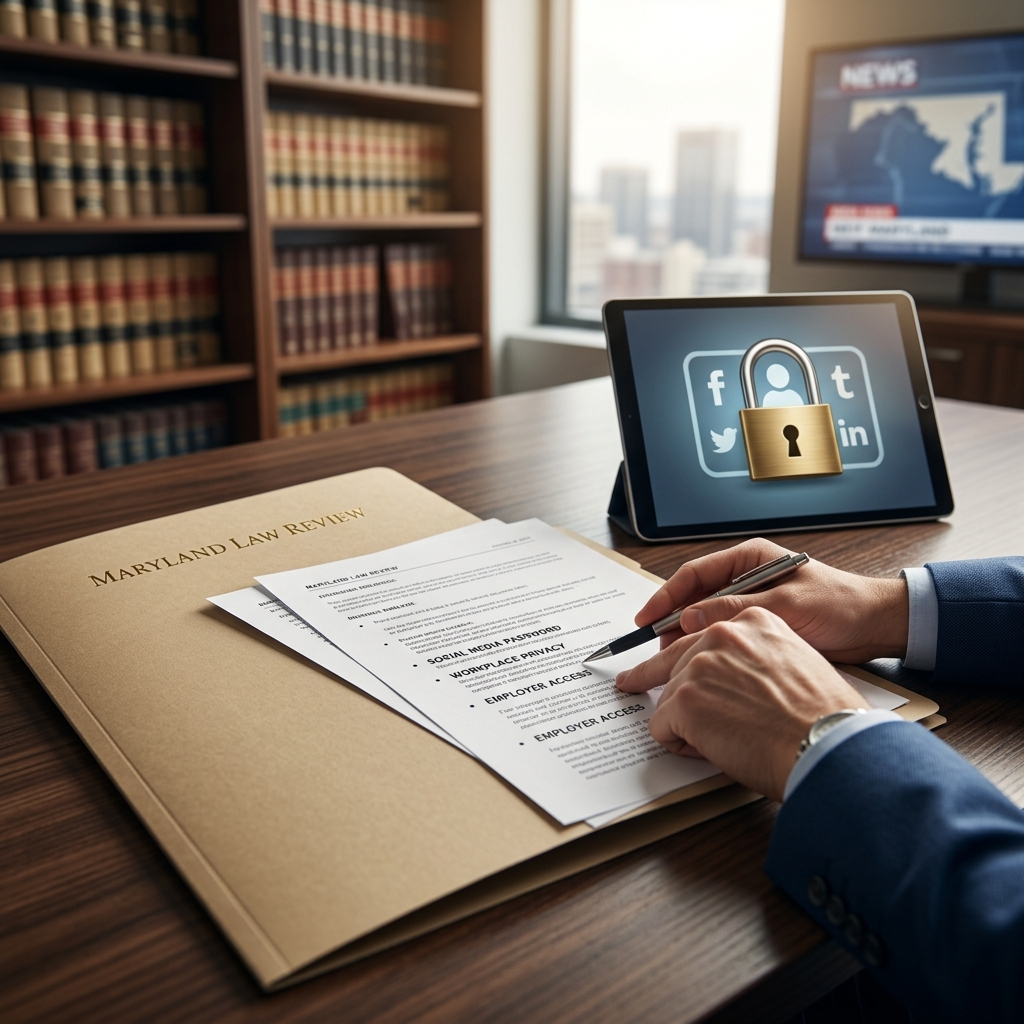
Maryland became the first U.S. state to clearly restrict employers from demanding access to workers’ personal social media and online accounts, marking a significant milestone in modern employment privacy law. This article explains what the law does, why it was enacted, how it balances employee privacy with legitimate employer interests, and what practical steps both sides should take in response.
Background: Why Social Media Passwords Became a Legal Issue
As social media became central to people’s personal and professional lives, some employers began asking job applicants and employees to provide their login credentials or to log in while a manager observed their accounts. These practices raised serious concerns about privacy, discrimination, and fairness.
Maryland lawmakers responded by passing a statute that specifically regulates when an employer may request or require access to a personal account or service through an electronic communications device, such as a private Facebook profile, personal email, or other password‑protected account.
- Employees argued that forced access to private accounts violated personal privacy and chilled free expression.
- Advocacy groups warned that employers could see sensitive information (for example, medical conditions, religious beliefs, or union activity), potentially leading to unlawful discrimination.
- Employers claimed they sometimes needed access to investigate misconduct, data theft, or regulatory violations.
Maryland’s law aims to strike a balance between these competing concerns.
Core Protections: What Employers Are Prohibited from Doing
The Maryland statute sets out a broad general rule: subject to limited exceptions, an employer may not request or require an employee or applicant to disclose any username, password, or other means of accessing a personal account or service.
Key prohibitions
- No password demands for personal accounts — Employers cannot request or require employees or job applicants to provide login information that gives access to a personal social networking site, personal email, or other personal online account.
- No retaliation or penalties — Employers are barred from discharging, disciplining, or otherwise penalizing an employee, or threatening to do so, because the employee refused to disclose login credentials.
- No adverse hiring decisions — Employers cannot refuse to hire an applicant based on the applicant’s refusal to provide any username or password for a personal account.
These protections apply regardless of whether the request is presented as a condition of hire, a condition of continued employment, or part of an internal investigation. In practice, they largely eliminate the use of private, password‑protected personal accounts as a formal screening tool in Maryland.
Personal vs. Nonpersonal Accounts: Where Employers Still Have Access
Maryland’s law draws a clear distinction between personal accounts and nonpersonal, employer‑related accounts. Employers retain the right to ensure the security of their own systems and business data.
| Type of Account | Typical Examples | Employer Access Rights |
|---|---|---|
| Personal account | Private Facebook page, personal Gmail account, personal Twitter/X profile, personal cloud storage | Employer may not request or require username or password, and may not punish refusal to disclose. |
| Nonpersonal (employer‑related) account | Company email account, employer‑owned collaboration tools, accounts created for business use | Employer may require disclosure of login information that allows access to internal computer or information systems. |
Under the statute, an employer may require an employee to disclose credentials for nonpersonal accounts or services that provide access to the employer’s internal systems. This recognizes that companies must maintain control over their networks, data, and official communication channels.
Important Exceptions: When Employer Investigations Are Allowed
Maryland’s law includes targeted exceptions designed to address situations where an employer has credible information that business‑related misconduct has occurred, and where access to an account is necessary to investigate specific concerns.
Compliance with securities and financial laws
If an employer receives information indicating that an employee used a personal website or online account for business purposes in a way that may violate applicable securities or financial laws or regulatory requirements, the employer may conduct an investigation focused on those concerns.
- The exception is tailored to industries subject to strict regulatory oversight, such as financial services.
- It allows employers to seek relevant information and comply with regulatory obligations without broadly overriding the statute’s privacy protections.
Investigating unauthorized downloading of proprietary information
The law also permits employers to investigate reports of unauthorized downloading of proprietary or financial data to a website or web‑based account.
- For example, if a company receives credible allegations that a worker uploaded trade secrets to a personal cloud account for misuse, an employer may investigate the incident.
- This exception reflects the legislature’s intent to protect both employee privacy and the employer’s legitimate interest in guarding confidential information.
Even within these exceptions, employers must act carefully: the law does not grant unrestricted authority to demand passwords for general purposes, and investigations should be reasonably related to the specific concerns raised.
Broader Legal Context: Other States and Emerging Norms
After Maryland enacted its social media password law, other states began considering similar protections. For example, states such as California, Illinois, New York, and Washington have pursued or adopted laws limiting employer access to personal social media accounts.
According to research compiled by the National Conference of State Legislatures, multiple states have now enacted legislation creating privacy rights for employee and student social media accounts, often including bans on requiring passwords or login information. Maryland’s law is widely cited as a pioneering model.
Implications for Employers: Policy and Practice Changes
Maryland’s law requires employers to re‑evaluate how they use social media in recruitment, discipline, and investigations, as well as how they manage proprietary information.
Policy updates
- Revise application and onboarding materials to remove any request for personal social media or email passwords.
- Update employee handbooks to clearly state that the company does not require or request access to personal accounts, while reserving the right to access employer‑owned systems.
- Define investigation protocols that respect the statute’s limits, particularly when dealing with suspected data theft or regulatory violations.
Training HR and managers
- Ensure hiring teams understand that asking for social media passwords is prohibited and could create legal risk.
- Train managers to differentiate between personal accounts and nonpersonal accounts used for company business.
- Teach staff to rely primarily on publicly available information and job‑related criteria when evaluating candidates.
Protecting proprietary information
Maryland’s law reminds employers of the importance of proactive strategies to keep confidential data out of employees’ personal accounts.
- Restrict the use of personal devices and accounts for handling sensitive business information.
- Use clear agreements and technical controls (for example, access management, monitoring of internal systems) to safeguard proprietary data.
- Implement incident‑response procedures that comply with legal limits on employee monitoring and account access.
Implications for Employees and Job Applicants
For workers and job seekers, Maryland’s law provides concrete legal protections and reinforces the principle that private digital spaces are not automatically open to employer scrutiny.
Practical benefits
- Explicit right to refuse — Employees and applicants may lawfully decline to provide passwords for personal accounts without fear of discipline or rejection based solely on that refusal.
- Clear boundaries — Workers can separate personal online activity from professional responsibilities more confidently.
- Reduced risk of discrimination — Limiting password demands helps prevent employers from accessing sensitive information that could lead to discriminatory decisions.
Responsible use of personal accounts
Although the law restricts employer access, it does not insulate all personal online activity from consequences. Public posts, or posts that violate lawful company policies, can still be considered in employment decisions.
- Employees should continue to exercise judgment when posting about their employer or workplace.
- Publicly accessible content may be reviewed and used by employers, especially where it relates to job performance or misconduct.
- Workers should understand that privacy settings, while helpful, may not fully prevent public exposure of controversial content.
Balancing Privacy and Regulation: A Policy Perspective
Maryland’s approach reflects a broader policy debate: how to regulate employer access to digital information in a way that protects individual privacy while acknowledging legitimate business needs.
- Privacy as a baseline — The law presumes that personal accounts, particularly those accessed through personal devices, belong to the individual, not the employer.
- Narrow exceptions — Exceptions are crafted around specific regulatory or data‑protection concerns, not general curiosity or broad monitoring.
- Encouraging best practices — By prohibiting password demands, the statute nudges employers toward more sophisticated compliance and security strategies, rather than simple access to employees’ private accounts.
Frequently Asked Questions (FAQs)
1. Can a Maryland employer ask me to log into my social media account in front of them?
While the statute focuses on requests for usernames and passwords, the spirit of the law is to prevent employer demands for access to personal accounts. A request that effectively forces you to log in and display private content may raise the same concerns as a password demand and could be challenged. Workers should consider consulting legal counsel if faced with such a request.
2. Does the law apply to publicly visible information?
Maryland’s law does not prevent employers from viewing information that is publicly available online. Public posts on social media, blogs, or other websites may still be used by employers in hiring and disciplinary decisions, subject to other applicable laws (such as anti‑discrimination statutes).
3. What if I use a personal account for both work and personal purposes?
Hybrid use of personal accounts can complicate matters. The law allows employer investigations when they receive information that an employee has used a personal website or account for business purposes in ways that may violate securities or financial laws, or has downloaded proprietary data without authorization. Employees should avoid using personal accounts to store or transmit sensitive employer information and adhere to company policies that separate business and personal activity.
4. Can my employer access my company email or accounts?
Yes. The statute specifically permits employers to require employees to disclose login information for nonpersonal accounts or services that provide access to internal computer or information systems. Company email, employer‑issued collaboration tools, and accounts created for business use generally fall into this category.
5. Are similar laws in place outside Maryland?
Several other states have enacted laws protecting employee and student social media accounts from password demands or other intrusive access requests. The National Conference of State Legislatures reports ongoing legislative activity in this area, with multiple states adopting or considering restrictions on employer access to social media login information. Workers should check the laws in their own state for specific rules.
6. What should I do if my employer violates the law?
Employees who believe their rights have been violated may wish to document the request, note any threats or adverse actions, and seek legal advice. Because the statute sets clear rules on password demands and retaliation, an attorney can help assess potential remedies under Maryland law and other applicable employment protections.
References
- Maryland Legislature Passes Bill Prohibiting Employers from Requesting Social Media Passwords — Whiteford, Taylor & Preston LLP. 2012-04-06. https://www.whitefordlaw.com/news-events/maryland-legislature-passes-bill-prohibiting-employers-from-requesting-social-me
- Maryland Passes Bill Ensuring Social Media Password Privacy for Employees — Keller and Heckman LLP. 2012-04-02. https://www.khlaw.com/insights/maryland-passes-bill-ensuring-social-media-password-privacy-employees
- Maryland’s New Social Media Law Should Remind Employers to Protect Confidential Information — Holland & Knight LLP. 2012-05-23. https://www.hklaw.com/en/insights/publications/2012/05/marylands-new-social-media-law-should-remind-emplo
- Laws – Statute Text: Md. Code, Labor and Employment § 3-712 — Maryland General Assembly. (current through latest session). https://mgaleg.maryland.gov/mgawebsite/Laws/StatuteText?article=gle§ion=3-712&enactments=false
- Privacy of Employee and Student Social Media Accounts — National Conference of State Legislatures. 2021-07-28. https://www.ncsl.org/technology-and-communication/privacy-of-employee-and-student-social-media-accounts
- Can You Be Required to Turn Over Your Social Media Passwords? — The Spiggle Law Firm. (accessed 2026). https://spigglelaw.com/can-you-be-required-to-turn-over-your-social-media-passwords/
Similar Articles








Read full bio of Sneha Tete




