
Strategies to Bypass Probate in Maryland
Discover effective methods to transfer assets in Maryland without the delays and costs of probate proceedings.
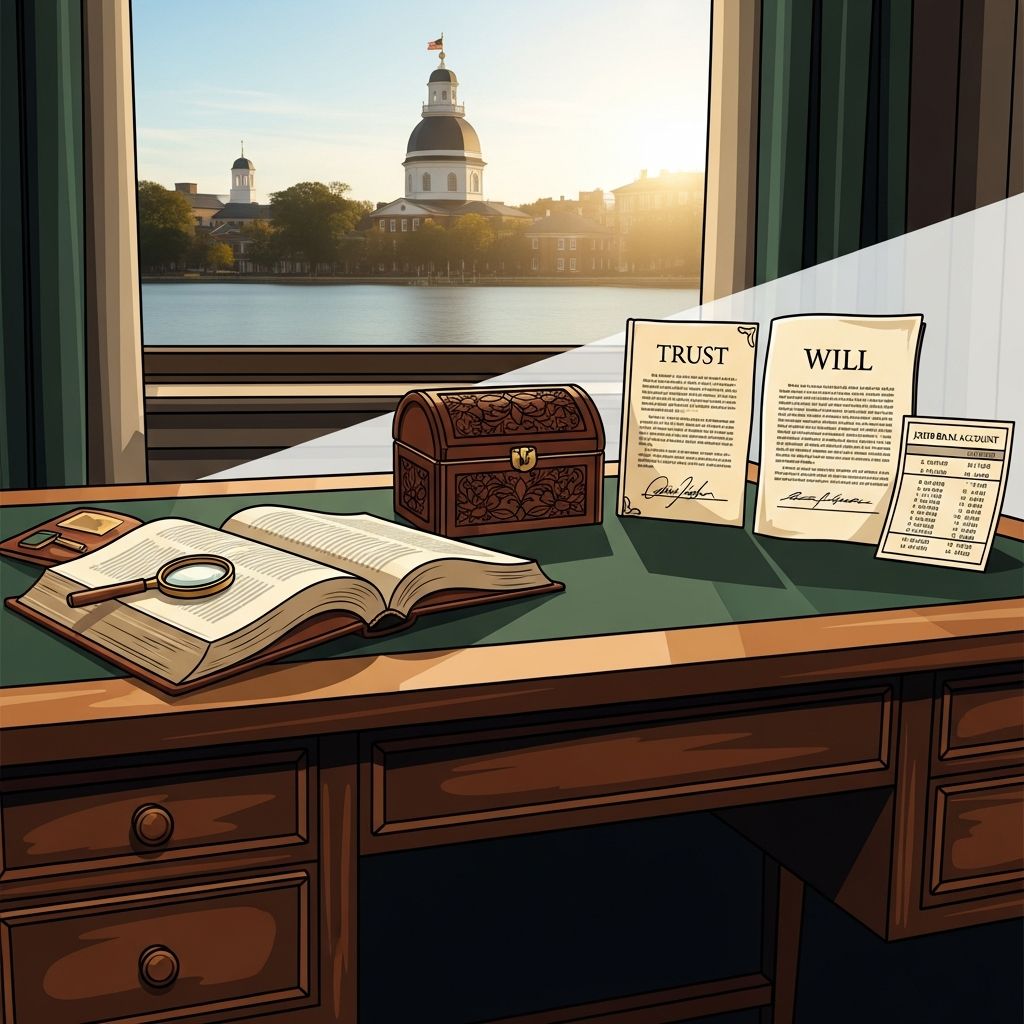
Probate serves as the court-supervised process to validate wills, settle debts, and distribute a deceased person’s assets in Maryland. While necessary for many estates, it often involves significant time, public disclosure, and fees that can burden survivors. Maryland residents can employ several legal tools to transfer property directly to beneficiaries, sidestepping this process entirely. These methods preserve privacy, accelerate inheritance, and cut administrative costs, making them essential for effective estate planning.
Understanding Probate Thresholds and Timelines in Maryland
Maryland distinguishes between small and regular estates based on asset values subject to administration. Estates valued at $50,000 or less qualify as small estates, or up to $100,000 if the surviving spouse is the sole heir. These require simpler procedures, but even they demand court filings and lists of interested persons, such as heirs under intestacy laws. Regular estates exceeding these limits face more rigorous steps, including appointing a personal representative and extended timelines once probate opens.
Recent legislative proposals, like House Bill 17 introduced in January 2026, aim to refine venue rules for probate of non-domiciled decedents and adjust inheritance tax applications, potentially impacting cross-border asset handling. Families should monitor these changes, as they could alter where estates are probated and how intangibles are taxed, emphasizing proactive planning before 2026 deadlines.
Joint Ownership: A Simple Path to Direct Transfer
One of the most straightforward ways to avoid probate involves holding property jointly with rights of survivorship. In Maryland,
joint tenancy with right of survivorship (JTWROS)
ortenancy by the entirety
for married couples ensures that upon one owner’s death, the asset automatically passes to the surviving co-owner without court involvement.- Real Estate: Title deeds can be retitled to include a spouse or family member, bypassing probate for homes or land.
- Bank Accounts: Joint accounts transfer instantly to the survivor, ideal for immediate liquidity needs.
- Vehicle Titles: Maryland allows joint titling, enabling quick re-registration by the survivor.
Caution is advised: this approach relinquishes control during life, as co-owners have equal access. It suits stable relationships but risks complications in blended families or disputes. Maryland intestacy laws prioritize spouses and children, so mismatched joint ownership could conflict with broader estate goals.
Transfer-on-Death and Payable-on-Death Designations
Maryland permits
transfer-on-death (TOD)
deeds for real property andpayable-on-death (POD)
ortransfer-on-death (TOD)
for financial accounts. These beneficiary designations override wills and probate.| Asset Type | Designation Tool | Key Benefits | Limitations |
|---|---|---|---|
| Real Estate | TOD Deed | Revocable; private transfer | Not for all property types |
| Bank/CDs | POD | Easy setup; no fees | Bank policy varies |
| Brokerage | TOD | Securities pass directly | Must update beneficiaries |
| Retirement | Primary/Contingent Beneficiaries | Tax-deferred growth | Spousal waivers needed |
These tools are revocable, allowing changes anytime. For instance, a TOD deed filed with the county land records ensures property vests in named beneficiaries upon death, maintaining owner control in life. Financial institutions handle POD seamlessly, often requiring only a form.
Revocable Living Trusts: Comprehensive Asset Control
A
revocable living trust
stands out for flexibility, holding assets during life and distributing them post-death without probate. The grantor serves as trustee, retaining full management, then names successors.- Drafting: Work with an attorney to create the trust document outlining distributions.
- Funding: Retitle assets—deeds, accounts, investments—into the trust’s name.
- Operation: Manage as usual; upon incapacity, a successor steps in seamlessly.
- Distribution: Assets pass privately to beneficiaries per trust terms.
Trusts excel for complex estates, multiple beneficiaries, or out-of-state property, avoiding ancillary probate. Costs include setup ($1,500–$3,000) and funding efforts, but savings in time and fees justify it, especially with Maryland’s $5 million state estate tax exemption unchanged for 2026.
Lifetime Gifting and Maryland Tax Implications
Gifting assets during life reduces probate-eligible property. Maryland lacks a gift tax, making transfers advantageous, though federal limits apply. Annual exclusions ($18,000 per recipient in 2025) and lifetime exemptions shield gifts.
- Direct gifts of cash or property to heirs.
- 529 plans or tuition payments, exempt from tax.
- Irrevocable trusts for larger transfers, removing assets from estate.
With federal exemptions halving to ~$6.8 million in 2026, strategic gifting before year-end preserves wealth amid Maryland’s $5M/$10M spousal threshold. Portability elections on estate tax returns double exemptions for couples.
Small Estate Procedures: A Simplified Alternative
For modest estates, Maryland’s small estate process minimizes probate. Heirs file affidavits after 60 days if assets ≤$50,000 ($100,000 spousal), listing interested persons per Estates and Trusts §5-601.
This avoids full administration but still requires court oversight. Combining with non-probate transfers optimizes outcomes for blended or low-asset scenarios.
Recent Legislative Updates Shaping 2026 Planning
Maryland’s 2026 session introduces bills refining probate venues (HB17) and will interpretations (SB190), plus federal sunset pressures. Venue shifts prioritize decedent ties like grandparents or siblings, easing non-resident cases. Tax reforms target intangibles, urging reviews of domicile and asset situs.
Business owners should update LLC operating agreements and buy-sell terms ahead of tax hikes, integrating non-probate tools like family limited partnerships.
Potential Pitfalls and Professional Guidance
Avoiding probate demands precision: unfunded trusts fail, outdated designations cause disputes, and tax oversights erode savings. Maryland’s order of heirs (spouse, children, etc.) influences strategies.
Consult attorneys for personalized plans, especially with 2026 changes. Costs pale against probate fees (3-7% of estate value).
Frequently Asked Questions
Can all Maryland assets use TOD designations?
No, vehicles and certain business interests have limits; trusts offer broader coverage.
How does joint ownership affect Medicaid eligibility?
It may count as available assets, impacting long-term care planning.
Are living trusts protected from creditors?
Revocable trusts are not; irrevocable ones provide stronger shields.
What if I own out-of-state property?
Ancillary probate applies; trusts or TOD deeds prevent it.
Does avoiding probate save on estate taxes?
No direct link, but it speeds distributions; pair with tax strategies.
References
- Estate Administration – Step-by-Step Guide and Timeline — Maryland People’s Law Library. Accessed 2026. https://www.peoples-law.org/estate-administration-step-step-guide-and-timeline
- House Bill 17 First Reader — Maryland General Assembly. 2026-01-14. https://mgaleg.maryland.gov/2026RS/bills/hb/hb0017f.pdf
- Senate Bill 190 First Reader — Maryland General Assembly. 2026. https://mgaleg.maryland.gov/2026RS/bills/sb/sb0190f.pdf
- 2026 Maryland Legal Predictions — Z Mat Law. 2026. https://zmatlaw.com/2026-maryland-legal-predictions-7-changes-every-family-and-business-owner-must-know/
- HB17 Legislative Tracking — TrackBill. 2026. https://trackbill.com/bill/maryland-house-bill-17-estates-and-trusts-venue-for-administrative-and-judicial-probate-and-application-of-inheritance-tax/2767490/
- Maryland & Federal Estate Taxes — Seltzer Gurvitch. 2025. https://www.selzergurvitch.com/maryland-federal-estate-taxes-what-families-need-to-know-in-2025/
- Federal and Maryland Estate Tax Law Updates — McNamee Hosea. Accessed 2026. https://mhlawyers.com/federal-and-maryland-estate-tax-law-update/
Similar Articles








Read full bio of Sneha Tete


