
Why Marijuana Can Be Legal in States but Still Illegal Federally
How federal drug laws, state legalization measures, and constitutional principles combine to make cannabis both legal and illegal at the same time.
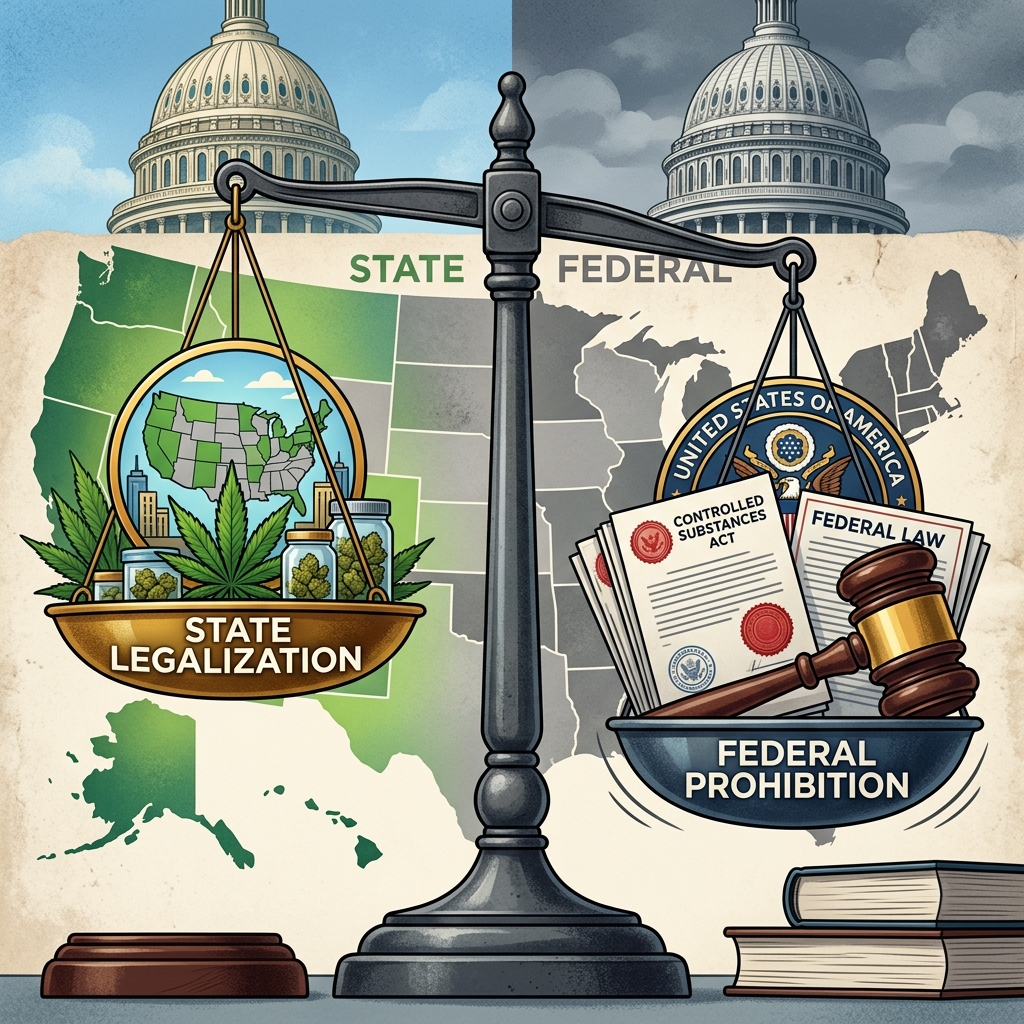
Across the United States, many people can lawfully buy and use marijuana under state law, yet the same conduct remains a federal crime. This apparent contradiction arises from the interaction between the federal Controlled Substances Act, state legalization measures, and core constitutional principles like the Supremacy Clause and the Tenth Amendment.
This article explains why cannabis can be legal and illegal at the same time, what that means for individuals and businesses, and how courts and policymakers have managed this ongoing conflict.
1. The Basic Legal Conflict: Federal Prohibition vs State Legalization
Marijuana sits at the center of a unique legal tension. On one side is federal law, which continues to treat cannabis as a serious illegal drug; on the other side, a growing number of states have legalized medical and adult-use cannabis and built regulated markets.
1.1 Federal Status of Marijuana
Under the federal Controlled Substances Act (CSA), marijuana is classified as a Schedule I controlled substance alongside heroin and LSD. This schedule is reserved for drugs that Congress has deemed to have:
- High potential for abuse
- No currently accepted medical use in treatment in the United States (under federal standards)
- Lack of accepted safety for use even under medical supervision
Because of this classification, federal law makes it a crime to possess, manufacture, distribute, or traffic marijuana, with penalties that can include prison and substantial fines.
1.2 Rapid Expansion of State Legalization
In contrast, most states have departed from strict prohibition. As of the early 2020s:
- At least 24 states allow recreational (adult-use) marijuana under state law
- Dozens of states authorize medical cannabis for qualifying patients
- Many other states have decriminalized possession of small amounts, reducing penalties to civil infractions or minor misdemeanors
In total, a large majority of states permit at least some cannabis conduct that remains illegal at the federal level.
2. Constitutional Foundations: Supremacy Clause and Dual Sovereignty
The coexistence of federal prohibition and state legalization turns on how the U.S. Constitution structures the relationship between federal and state governments.
2.1 The Supremacy Clause
The Supremacy Clause in Article VI of the U.S. Constitution states that federal law is the “supreme Law of the Land,” meaning that valid federal statutes take priority over conflicting state laws. When a direct conflict arises, federal law controls and the inconsistent portion of state law may be unenforceable or preempted.
Importantly, supremacy does not automatically erase every state law that touches on the same subject. Instead, courts examine whether there is a conflict that makes it impossible to comply with both, or whether Congress intended to occupy the entire regulatory field.
2.2 Dual Sovereignty and the Role of States
The United States operates under a system of dual sovereignty, where both federal and state governments have independent authority to make and enforce laws. States are not merely subdivisions of the federal government; they retain broad police powers over public health, safety, and welfare, including criminal law and drug policy.
This structure allows states to serve as “laboratories of democracy,” experimenting with different policy approaches, even in areas where federal law also applies. Cannabis regulation is a prominent example of this experimentation.
3. The Controlled Substances Act and Preemption Doctrine
Whether state marijuana laws are overridden by federal prohibition depends on preemption—the legal doctrine that determines when federal law displaces state law. The CSA itself addresses this issue, and courts have developed specific standards for applying it.
3.1 Preemption Clause in the CSA
The CSA contains a provision, 21 U.S.C. § 903, stating that Congress did not intend to occupy the entire field of drug regulation and that state laws are only preempted when there is a “positive conflict” so that the two laws “cannot consistently stand together”.
This language signals that Congress anticipated concurrent state and federal drug laws and sought to limit preemption to genuine conflicts rather than generalized disagreement over policy.
3.2 When Courts Find Preemption
Courts typically find a state law is preempted by the CSA only in narrow circumstances, such as when:
- It is physically impossible to comply with both state and federal requirements at the same time
- A state law poses an obstacle to achieving Congress’s specific objectives in the CSA
For example, a state law that required police officers to return seized marijuana to a defendant after a court case might be preempted, since returning the cannabis would itself constitute distribution of a controlled substance under federal law. In such a situation, compliance with state law would force officers to violate federal law.
3.3 Why Broad Legalization Measures Are Usually Not Preempted
State legalization statutes generally do not force anyone to break federal law; they instead:
- Remove state criminal penalties for certain marijuana-related conduct
- Create licensing systems and regulations for businesses under state law
- Set rules for possession, cultivation, sales, and taxation within the state
Because these laws do not require individuals or officials to violate federal law, and because Congress did not intend to erase all state drug policy through the CSA, courts and the federal government have largely allowed state legalization systems to operate without claiming they are categorically preempted.
| Aspect | Federal Law (CSA) | Typical State Legalization Law |
|---|---|---|
| Legal status of marijuana | Schedule I, illegal for all purposes | Legal for medical and/or adult use under state law |
| Possession | Criminal offense, with potential prison and fines | Allowed within state-set limits (e.g., ounces or plants) |
| Commercial sales | Illegal distribution and trafficking | Licensed, taxed, and regulated markets |
| Enforcement | Federal agencies (DEA, FBI, U.S. Attorneys) | State and local law enforcement and regulators |
| Preemption effect | Can preempt state laws that require federal violations | Generally not preempted when merely removing state penalties |
4. The Tenth Amendment and the Anti-Commandeering Principle
The question is not only whether federal law overrides state legalization, but also whether the federal government can compel states to help enforce federal prohibition. Here the Tenth Amendment plays a central role.
4.1 What the Tenth Amendment Protects
The Tenth Amendment reserves to the states (or the people) powers not granted to the federal government. Supreme Court decisions have interpreted this to prohibit the federal government from “commandeering” state officials—forcing them to implement or enforce federal regulatory programs.
Applied to cannabis, this means that although federal authorities may enforce the CSA themselves, they cannot require state police, prosecutors, or regulators to carry out federal marijuana policy.
4.2 States Choosing Not to Criminalize Marijuana
Because the federal government cannot compel states to criminalize conduct, states are free to:
- Repeal their own marijuana prohibition laws
- Reduce penalties or decriminalize possession of small amounts
- Establish systems for legal medical and adult-use cannabis under state law
The result is a legal environment where:
- An individual may be fully compliant with state cannabis law
- The same individual remains exposed to federal criminal liability
- State officials are not obligated to arrest or prosecute the person for federal violations
This is the core reason why marijuana can be “legal” in a state yet remain illegal under federal law.
5. Practical Consequences of the Federal–State Conflict
The divided legal status of cannabis is not just theoretical; it creates real-world risks and obstacles for individuals, businesses, and institutions.
5.1 Enforcement Risk: Can You Be Prosecuted Federally?
Anyone involved in marijuana activities—even where fully licensed and compliant under state law—could, in principle, be prosecuted under the CSA. However, federal enforcement has generally focused on:
- Large-scale trafficking organizations
- Operations linked to other serious crimes
- Conduct that violates both state and federal law
Policy memoranda and shifting enforcement priorities have influenced how aggressively federal authorities target state-legal markets, but none of these policies change the underlying legal fact: cannabis remains illegal under federal law.
5.2 Banking and Financial Services Challenges
Because marijuana remains a Schedule I drug, financial institutions subject to federal regulation face significant risks when serving cannabis businesses. Many banks hesitate to open accounts, process payments, or extend credit to marijuana-related companies due to concerns about money-laundering laws and regulatory scrutiny.
This often forces cannabis businesses to operate largely in cash, which raises security issues and complicates tax compliance and auditing.
5.3 Immigration and Professional Licensing Risks
The conflict also affects:
- Noncitizens, whose admitted marijuana use or participation in state-legal cannabis businesses can negatively impact immigration status, since federal law still treats marijuana as an illegal drug
- Professionals in fields such as law, medicine, or education, who may face questions from licensing boards about involvement with federally illegal activities
These collateral consequences mean that even when state law protects cannabis-related activity, federal policies in other domains (immigration, licensing, grants) may not.
5.4 Criminal Records and Expungement
Many states now provide mechanisms to clear or seal records related to cannabis offenses, especially for conduct that would be legal under current state law. As of 2023, the vast majority of states and several territories have record-clearing provisions, and many specifically target marijuana convictions.
These reforms, however, apply only to state offenses. Federal marijuana convictions remain on the books unless addressed through federal mechanisms such as clemency, pardons, or legislative action.
6. Why States Can Keep Legalizing Despite Federal Prohibition
One of the most striking developments in U.S. drug policy is that, despite federal prohibition, the number of states legalizing or decriminalizing marijuana continues to grow. Several legal and political reasons explain this trend.
6.1 No Broad Federal Preemption Claim
The federal government has not successfully argued in court that state legalization schemes are categorically preempted by the CSA. Instead, federal authorities have largely accepted that:
- States may repeal their own criminal penalties for marijuana
- States are not required to assist in enforcing federal prohibition
- Concurrent regulatory systems can exist, even if they conflict in policy goals
This has left room for states to “chart their own paths” on cannabis, developing medical and adult-use markets despite ongoing federal illegality.
6.2 Public Opinion and Political Dynamics
Changing public attitudes toward cannabis have encouraged state legislatures and voters to adopt legalization, decriminalization, and record-clearing reforms. Federal law has not changed as quickly, creating a policy gap between levels of government.
State-level reforms often reflect local preferences and priorities, while federal policy is shaped by national political processes that may be slower to respond.
6.3 Federalism as a Policy Testing Ground
Federalism allows states to experiment with different regulatory models—such as varying possession limits, home-grow rules, licensing structures, and taxation schemes—without waiting for comprehensive federal reform.
These experiments can provide data and experience that inform future federal decisions, demonstrating how legalization affects issues like public health, criminal justice, and tax revenues.
7. Frequently Asked Questions
7.1 If my state has legalized marijuana, can I still be arrested by federal agents?
Yes. Even if you follow all state cannabis laws, your conduct remains illegal under federal law because marijuana is a Schedule I substance under the CSA. Federal agencies have the legal authority to investigate and prosecute marijuana offenses, although enforcement priorities and resource constraints shape how often they do so.
7.2 Why doesn’t federal law automatically invalidate state legalization statutes?
Federal law is supreme, but preemption is limited. The CSA explicitly states that it does not intend to occupy the entire field of drug regulation and only preempts state laws when there is a direct, positive conflict. State legalization laws typically remove state penalties rather than require violations of federal law, so they can coexist with federal prohibition.
7.3 Can the federal government force state police to enforce federal marijuana law?
No. The Tenth Amendment, as interpreted by the Supreme Court, prohibits the federal government from commandeering state officials to implement federal regulatory programs. Federal agents may enforce the CSA, but they cannot compel state law enforcement to do so.
7.4 Is it safe to invest in or work for a state-legal cannabis business?
Legally, there is always some federal risk because the underlying activity violates the CSA. Practically, many investors and workers do participate in state-legal markets, but they should be aware of potential federal enforcement, banking limitations, and immigration or professional licensing consequences. Consulting knowledgeable legal counsel is strongly recommended.
7.5 Will the conflict end if marijuana is rescheduled or legalized federally?
If Congress removes marijuana from Schedule I or legalizes it at the federal level, many of the current conflicts would diminish or disappear. However, the exact impact would depend on how new federal laws are written, how they treat state regulatory systems, and whether states choose to maintain stricter rules or remain prohibitive.
8. Key Takeaways for Individuals and Businesses
For those navigating the complex legal environment around cannabis, several practical points stand out:
- State legality does not equal federal legality: Compliance with state cannabis law does not shield you from federal prosecution.
- Preemption is limited: The CSA does not automatically invalidate state legalization measures; it only preempts laws that directly conflict with federal requirements.
- States cannot be forced to enforce federal law: The Tenth Amendment protects states from being commandeered into federal marijuana enforcement.
- Risk varies with federal priorities: Enforcement choices by federal agencies significantly influence day-to-day risk, even though legal exposure under the CSA remains.
- Collateral consequences matter: Banking, immigration, licensing, and record-clearing issues can be heavily affected by the federal–state divide.
Understanding these principles helps explain why marijuana can be widely available in state-legal storefronts while still being treated as a serious crime in the U.S. Code. Until Congress reforms federal law or courts significantly reinterpret the CSA, this dual system—legal in many states, illegal federally—is likely to continue.
References
- State Marijuana Regulation Laws Are Not Preempted By Federal Law — Marijuana Policy Project. 2023-06-01. https://www.mpp.org/issues/legalization/state-marijuana-regulation-laws-are-not-preempted-by-federal-law/
- Cannabis Overview — National Conference of State Legislatures. 2023-08-30. https://www.ncsl.org/civil-and-criminal-justice/cannabis-overview
- Marijuana: Federal Laws vs. State Laws — Nolo / CriminalDefenseLawyer.com. 2023-11-15. https://www.criminaldefenselawyer.com/resources/criminal-defense/federal-crime/medical-marijuana-federal-laws.htm
- How Marijuana Is Both Legal and Illegal in the U.S. — Vox (YouTube). 2016-07-25. https://www.youtube.com/watch?v=I4n3F9IU0ig
- In the Weeds: States In Conflict with Federal Marijuana Law — Rockefeller Institute of Government. 2019-01-14. https://rockinst.org/intheweeds/
Similar Articles








Read full bio of medha deb




