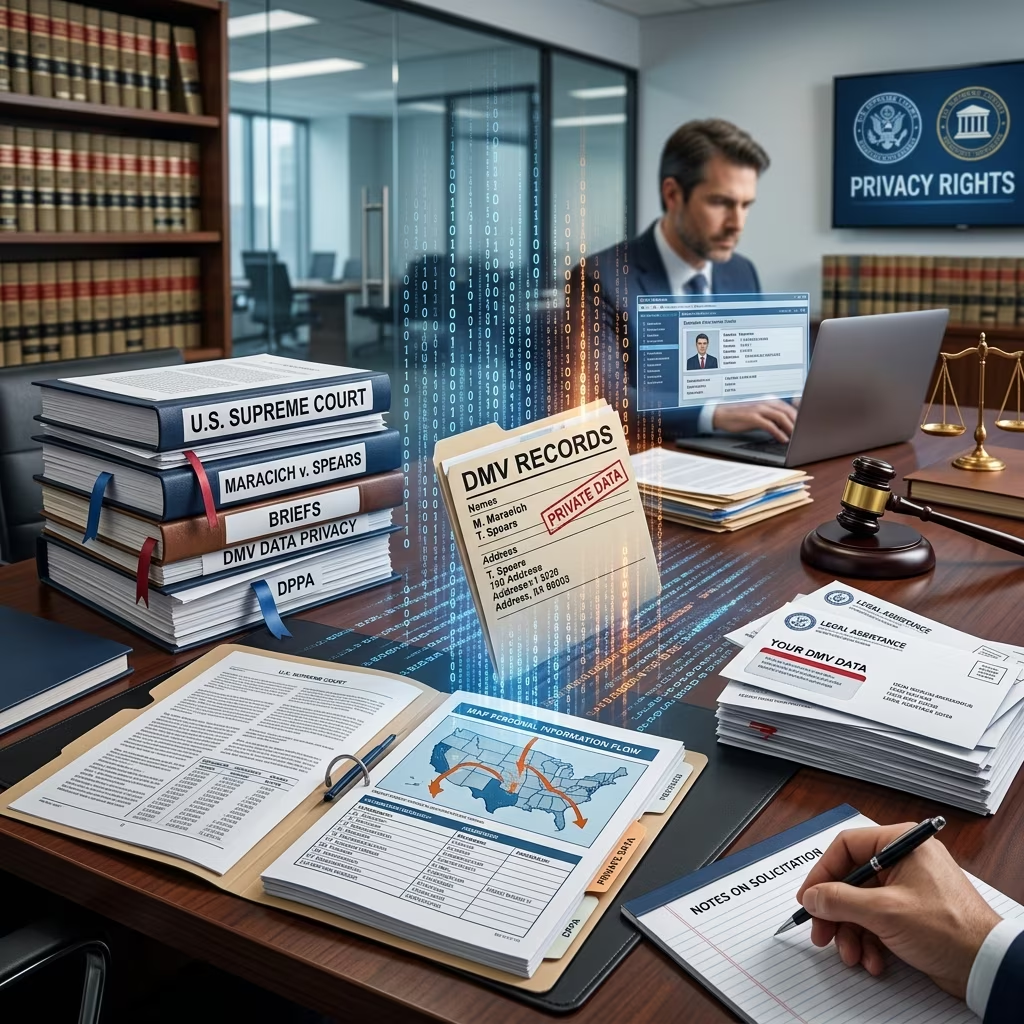
The Supreme Court’s decision in Maracich v. Spears fundamentally clarified how lawyers may, and may not, use information obtained from state departments of motor vehicles when contacting potential clients. At the center of the case is the Driver’s Privacy Protection Act (DPPA), a federal statute that restricts access to personal data maintained by DMVs and sets narrow exceptions for when that data can be used.
This article explains the background of the dispute, the Supreme Court’s reasoning, and the practical consequences for trial attorneys, law firms, and consumers whose data sits in DMV databases.
Understanding the Driver’s Privacy Protection Act (DPPA)
The DPPA was enacted by Congress in 1994 to respond to growing concerns about how easily personal information, such as addresses and driver’s license numbers, could be obtained from DMVs and used for marketing, stalking, or other harmful purposes. The statute limits the disclosure of DMV records and creates specific, enumerated exceptions.
Core Purpose of the DPPA
- Protect individual privacy by restricting access to personal information contained in motor vehicle records.
- Prevent misuse of DMV data for bulk solicitation, harassment, and other non-legitimate uses.
- Regulate state DMVs by prohibiting them from disclosing personal information except for defined permissible purposes.
Under the DPPA, DMVs may not “knowingly disclose or otherwise make available” personal information except as allowed by the statute’s exceptions. Among those exceptions are provisions for government functions, public safety, research, and certain commercial activities.
Litigation and Solicitation Exceptions
Two exceptions are central to the Maracich decision:
- Litigation exception (18 U.S.C. § 2721(b)(4)) – permits disclosure and use of DMV records “for use in connection with” judicial and administrative proceedings, including “investigation in anticipation of litigation.”
- Solicitation exception (18 U.S.C. § 2721(b)(12)) – allows DMVs to disclose personal information for bulk solicitations, but only when the individual has provided express, affirmative consent (an opt-in regime adopted in 1999).
Maracich v. Spears required the Court to determine whether attorneys could rely on the litigation exception as a way to sidestep the more restrictive solicitation exception when contacting thousands of individuals using DMV data.
The Facts Behind Maracich v. Spears
The dispute arose out of a series of lawsuits filed against car dealerships in South Carolina, alleging violations of state law in their handling of vehicle sales. Attorneys representing buyers sought to expand their client base and evidence by contacting other purchasers whose names and addresses were found in DMV records.
How the Attorneys Used DMV Records
The attorneys obtained personal information from the South Carolina DMV and used it to send mass mailings to vehicle buyers. These letters:
- Identified ongoing litigation against certain dealerships.
- Invited recipients to join the lawsuits as additional plaintiffs.
- Were sent to thousands of individuals whose data came from DMV records without their express consent.
Recipients of the letters filed suit, arguing that the attorneys violated the DPPA by using DMV data for the prohibited purpose of solicitation without consent.
Lower Court Rulings
The case traveled through the federal courts before reaching the Supreme Court:
- District Court – found that the mailings were not solicitations and that the attorneys’ use of data was covered by the litigation exception.
- Fourth Circuit Court of Appeals – agreed that the letters were solicitations but held that they were nonetheless permissible under the litigation exception because they were “inextricably intertwined” with litigation-related purposes.
The Fourth Circuit’s interpretation created a split with other circuits that had read the litigation exception more narrowly, prompting Supreme Court review to resolve how far the exception extends.
The Supreme Court’s Holding
In a closely divided decision, the Supreme Court held that an attorney’s solicitation of clients is not a permissible purpose under the DPPA’s litigation exception. The Court vacated the judgment of the Fourth Circuit and sent the case back for further proceedings consistent with this interpretation.
Key Rule From Maracich v. Spears
The Court articulated a central test for determining whether use of DMV data is prohibited:
- Courts must ask whether the predominant purpose of obtaining, using, or disclosing DMV personal information was solicitation.
- If solicitation is the predominant purpose, the litigation exception does not apply, even if the communication has some litigation-related aspects.
According to the Court, using DMV records to find and recruit clients is fundamentally different from investigating facts or identifying witnesses in an existing case. The former is a commercial activity—client development—rather than the work of an officer of the court representing current clients.
Why the Letters Were Considered Solicitation
Looking at the content and context of the mass mailings, the Court concluded that the attorneys primarily sought to:
- Increase the number of plaintiffs.
- Generate additional fee opportunities.
- Use personal contact information to recruit new clients on a broad scale.
Even though the letters referenced ongoing litigation and potential evidentiary value, the dominant goal was to persuade recipients to join lawsuits, which fits squarely within the concept of solicitation.
Litigation vs. Solicitation: A Comparative View
The decision in Maracich clarifies the boundary between legitimate litigation activity and prohibited solicitation when attorneys use DMV data.
| Use of DMV Data | Typical Characteristics | DPPA Treatment After Maracich |
|---|---|---|
| Litigation-related use |
| Generally covered by the litigation exception, if the predominant purpose is investigation or case management. |
| Solicitation of clients |
| Not covered by the litigation exception; requires compliance with the solicitation exception, including express consent. |
Practical Implications for Trial Attorneys
Maracich sends a clear message to lawyers who might view DMV databases as a convenient way to build class actions or mass torts. While the DPPA allows certain litigation-related uses, attorneys face substantial risk if they rely on DMV data to run marketing campaigns or client recruitment drives.
Guidance for Law Firms Using DMV Data
Attorneys should apply the following principles:
- Limit use to investigation – DMV data should be used to support existing claims, such as verifying addresses for service or identifying witnesses, not to find completely new clients.
- Assess predominant purpose – Before sending any communication based on DMV data, ask whether its main objective is to gather evidence or to solicit legal representation.
- Seek alternative sources – Where possible, obtain customer lists or transaction records directly from defendants (for example, through discovery of dealership sales records) instead of relying on DMV databases.
- Document legitimate uses – Maintain internal records showing that DMV data was accessed for specific litigation tasks, which can help demonstrate a proper purpose if challenged.
Failure to follow these guidelines can expose attorneys to DPPA claims, with statutory damages that can multiply quickly when thousands of records are involved.
Potential Liability Exposure
The DPPA allows for monetary relief when personal information is misused. In mass-mail scenarios, statutory damages can reach extremely high totals because each violation may carry a per-person amount. In the context described by the FindLaw analysis, this could theoretically lead to liabilities in the hundreds of millions of dollars if DMV data is used improperly for bulk solicitation.
- Statutory damages per individual under the DPPA can compound in class actions.
- Punitive damages may be available where violations are willful or reckless.
- Attorneys’ fees and costs can increase the overall exposure in DPPA litigation.
For trial attorneys, the financial risk alone justifies caution when contemplating direct mail campaigns built on DMV records.
Impact on Privacy and Consumer Protection
Beyond its effect on legal practice, Maracich reinforces the DPPA’s goal of safeguarding personal data against commercial exploitation. By rejecting broad use of the litigation exception for client solicitation, the Court strengthened the privacy framework surrounding DMV records.
Strengthening the Opt-In Model
Congress originally structured the DPPA’s solicitation exception as an opt-out regime but shifted to an opt-in approach in 1999, requiring affirmative consent before DMV data can be used for marketing purposes. Maracich complements that change by ensuring that attorneys cannot bypass consent requirements simply by framing their outreach as litigation-related.
- Individuals retain control over whether their DMV data can be used for bulk solicitations.
- DMVs must honor that consent framework when disclosing records.
- Lawyers must treat solicitation via DMV data as consent-dependent, not automatically covered by litigation needs.
Balancing Access and Privacy
The Court recognized a tension between legitimate litigation needs and privacy interests. Access to accurate contact information can be crucial in many cases, but unrestricted use for client recruitment risks turning protected data into a marketing resource.
Maracich strikes a balance by:
- Preserving access to DMV data for core litigation functions, such as investigations and proceedings.
- Restricting commercial solicitation, even when it is loosely related to existing lawsuits.
- Encouraging the use of less sensitive, non-DPPA-protected sources for marketing activities.
Common Pitfalls and Compliance Tips
Lawyers who operate in areas like consumer protection, insurance, or automotive litigation should be particularly mindful of DPPA constraints. The following pitfalls and best practices can help avoid violations.
Frequent Mistakes
- Assuming all litigation-adjacent uses are exempt – Maracich makes clear that simply linking an activity to a lawsuit does not automatically qualify it under the litigation exception.
- Relying on bulk data pulls – Large-scale acquisition of DMV records for nationwide or statewide mail campaigns is a red flag for DPPA purposes.
- Blending investigative and marketing goals – Communications that mix evidentiary inquiries with invitations to join a case may still be treated as solicitations if recruitment is the dominant objective.
Best Practices for Compliance
- Use narrow, targeted DMV requests aligned with specific litigation needs.
- Develop internal DPPA policies covering when and how staff may access DMV records.
- Train attorneys and support personnel on the predominant purpose standard introduced in Maracich.
- When in doubt, consult ethics counsel or privacy specialists before launching any outreach effort based on DMV data.
Frequently Asked Questions (FAQs)
1. Can a lawyer ever use DMV records to contact individuals directly?
Yes, but only when the predominant purpose is genuinely litigation-related investigation, such as locating witnesses or parties in an already-filed case, and not client solicitation. Even then, attorneys should consider whether alternative, non-DPPA sources can meet their needs.
2. Does Maracich completely prohibit lawyer mailings based on DMV data?
Maracich does not impose a total ban, but it excludes bulk solicitation from the litigation exception. If the primary aim of a mailing is to recruit clients, the DPPA’s solicitation rules—including express consent—apply.
3. What if a communication serves both investigative and solicitation purposes?
Courts look at the predominant purpose of the communication and the overall course of conduct. If recruitment of new clients is the dominant objective, the litigation exception will not shield the use of DMV data.
4. Are there differences among federal circuits on this issue?
Prior to Maracich, circuits were split on whether the litigation exception permitted client solicitation. The Supreme Court’s ruling resolves that conflict by firmly rejecting solicitation as a permissible use under the litigation exception.
5. How does the decision affect state-level regulation?
Maracich reinforces the federal DPPA framework across all states, limiting DMVs’ ability to share personal data for solicitation unless the individual has opted in. States remain free to enact additional privacy protections, but they cannot loosen DPPA’s baseline requirements.
References
- Maracich v. Spears – Supreme Court Opinion (570 U.S. 48) — Supreme Court of the United States. 2013-06-17. https://supreme.justia.com/cases/federal/us/570/48/
- Maracich v. Spears – United States Reports — U.S. Government Publishing Office (U.S. Reports). 2013-06-17. https://tile.loc.gov/storage-services/service/ll/usrep/usrep570/usrep570048/usrep570048.pdf
- Maracich v. Spears Case Summary — Legal Information Institute, Cornell Law School. 2013-2014. https://www.law.cornell.edu/supct/cert/12-25
- Supreme Court Decides Maracich v. Spears — Faegre Drinker Biddle & Reath LLP. 2013-06-18. https://www.faegredrinker.com/en/insights/publications/2013/6/supreme-court-decides-maracich-v-spears
- Maracich v. Spears Case Materials — Electronic Privacy Information Center (EPIC). 2012-2013. https://epic.org/documents/maracich-v-spears/