
Making Your Postnuptial Agreement Truly Enforceable
Learn how to design, review, and maintain a postnuptial agreement that courts are far more likely to uphold when it matters most.
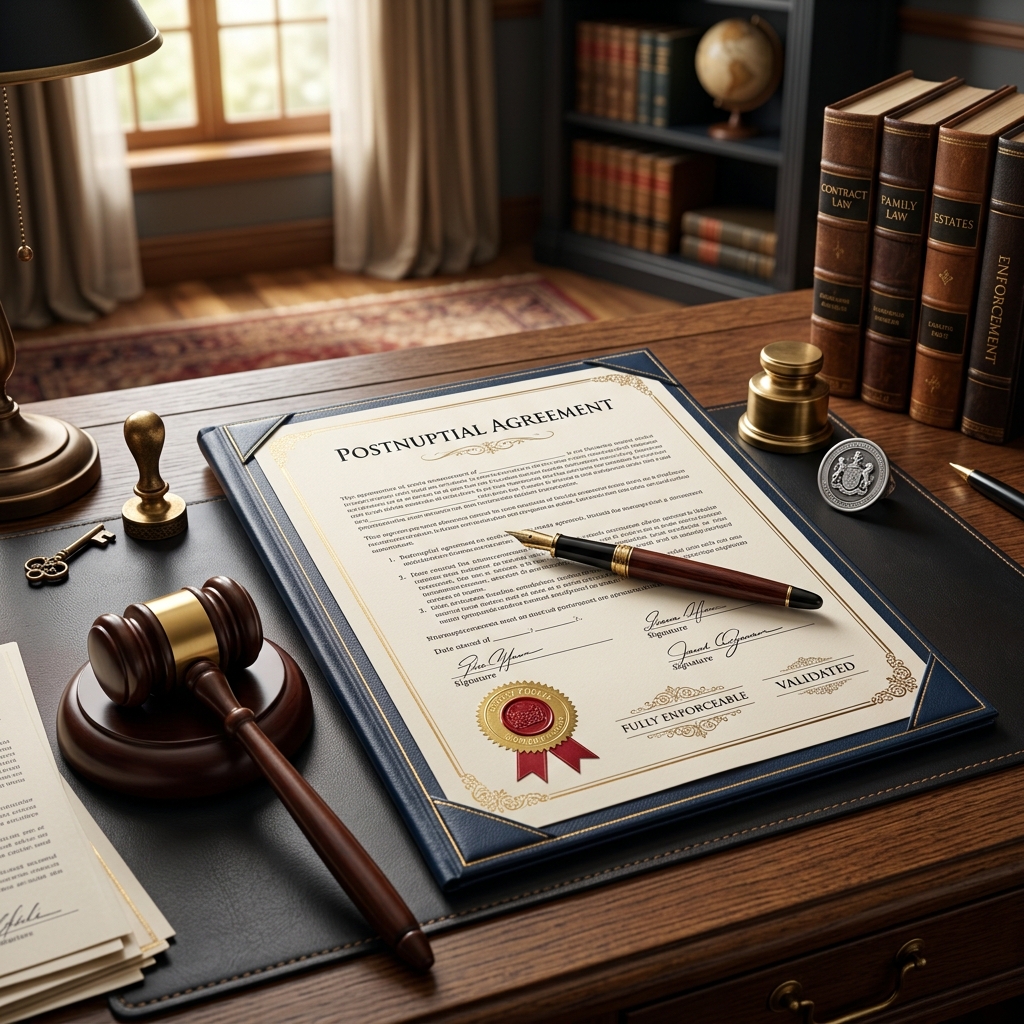
Postnuptial agreements can safeguard wealth, define financial expectations, and reduce conflict if a marriage ends. Yet many of these documents fail at the moment they are most needed: when a court is asked to enforce them. Understanding what makes a postnuptial agreement legally sound is crucial for anyone considering one, whether you are a high‑net‑worth executive, a small business owner, or simply a spouse who wants clarity and fairness.
What Is a Postnuptial Agreement and Why Enforceability Matters
A postnuptial agreement is a contract signed by spouses after they are already married, setting out how assets, debts, and sometimes spousal support will be handled if the marriage ends through divorce or death.[10] It is similar to a prenuptial agreement but negotiated during the marriage rather than before it.
Courts typically treat postnuptial agreements as contracts, but they examine them carefully because of the sensitive context in which they are created. Judges often look beyond the words on the page to ask whether the agreement was fair, transparent, and truly voluntary. If the agreement fails those tests, it may be partially or completely invalid, exposing both spouses to expensive litigation and uncertain outcomes.
- Primary purpose: Define property division and financial obligations if the marriage ends.[10]
- Key benefit: Reduce disputes and provide clear expectations.
- Main risk: If not properly drafted and executed, the agreement may be rejected by the court, leaving spouses with default state law instead of their negotiated terms.
Core Legal Requirements Across Many Jurisdictions
Each state has its own rules, but certain themes recur. While the terminology and details vary, most jurisdictions require postnuptial agreements to meet several foundational standards before they will enforce them.
| Requirement | What It Means | Why Courts Care |
|---|---|---|
| Written and signed | The agreement must be in writing and signed by both spouses. | Ensures clarity and avoids disputes over what was agreed. |
| Voluntary | Spouses must sign without threats, coercion, or undue pressure. | Protects against exploitation within the marriage. |
| Full financial disclosure | Each spouse must share complete and accurate information about assets, debts, and income. | Prevents hidden wealth and unfair bargaining. |
| Fair and not unconscionable | Terms must be reasonable and not shockingly one‑sided. | Courts refuse to enforce contracts that are grossly unfair. |
| Compliance with state law formalities | Notarization, witnesses, or court approval may be required depending on the jurisdiction. | Verifies authenticity and protects third‑party interests. |
Some states add more specific conditions. For example, in Louisiana, notarization and witness signatures are required to create an authentic act. In Michigan and Utah, courts look for valid consideration—the idea that each spouse gives up or gains something of value—beyond simply promising to remain married.
Designing a Postnuptial Agreement That Courts Respect
Enforceability does not happen by accident. It requires careful planning, transparent negotiation, and ongoing attention. Below is a practical roadmap to help spouses move from the idea of a postnuptial agreement to a document more likely to withstand judicial scrutiny.
1. Clarify Your Goals Before Drafting
Before talking to lawyers or drafting clauses, spouses should have an honest conversation about why they want a postnuptial agreement. Clear goals help keep negotiations focused and reduce suspicion that one spouse is seeking an unfair advantage.
- Protect a business or professional practice from being disrupted by divorce.
- Preserve separate property for children from a prior relationship.
- Manage debt responsibility, such as student loans or business liabilities.
- Reduce uncertainty by agreeing in advance on spousal support parameters.
When courts later review the agreement, a coherent and mutual purpose can support the perception of fairness and good faith.
2. Commit to Full and Verifiable Financial Disclosure
Complete disclosure is often the single most critical factor in enforceability. Many cases challenging postnuptial agreements revolve around claims that one spouse hid assets or understated wealth. To reduce that risk, disclosures should be thorough and documented.
Best practices include:
- Preparing detailed lists of all assets, including real estate, retirement accounts, investments, business interests, and valuable personal property.
- Listing all debts, such as mortgages, credit card balances, loans, and tax liabilities.
- Providing recent account statements, tax returns, and business financials where relevant.
- Attaching schedules or exhibits to the agreement summarizing this information.
Courts are more willing to enforce agreements where the disclosure process is clear, documented, and acknowledged by both spouses in the text of the contract.
3. Ensure Truly Voluntary Consent
Judges are skeptical of agreements that appear to arise from leverage or emotional pressure. To demonstrate voluntariness, spouses should create conditions that show each had genuine freedom to say no.
- Avoid deadlines tied to major events, such as an imminent business transaction, that could create pressure.
- Allow ample time for review and discussion, rather than presenting a final draft at the last minute.
- Hold negotiations calmly, without threats to end the marriage if the agreement is not signed.
- Document in the agreement that each spouse had the opportunity to consult independent legal counsel.
Although independent representation is not legally mandatory in all jurisdictions, it can powerfully support the argument that each spouse understood the terms and signed willingly.
4. Craft Terms That Are Fair at Signing and at Enforcement
Fairness is not a fixed formula. Courts look at the circumstances when the agreement was signed and sometimes at the situation at the time of divorce. An arrangement that seemed balanced decades ago may appear harsh after major life changes, such as disability, career sacrifice, or withdrawal from the workforce to care for children.
To enhance the appearance of fairness:
- Avoid terms that leave one spouse with almost nothing while the other retains the bulk of wealth.
- Consider including safeguards, such as minimum financial protections if the marriage lasts beyond a certain number of years.
- Review whether spousal support waivers are reasonable in light of both spouses’ current and expected earning capacity.
- Revisit the agreement periodically to see if adjustments are needed as circumstances change.
Courts are more comfortable enforcing agreements that appear balanced and were created with mutual respect for both spouses’ contributions and needs.
5. Follow State‑Specific Formalities Meticulously
Even a fair and voluntary agreement can fail if it ignores formal legal requirements. Some jurisdictions require notarization, witnesses, court approval, or filing in public records, especially where community property regimes or real estate are involved.
Examples of formalities that may apply, depending on the state, include:
- Executing the agreement before a notary public.
- Signing in the presence of one or more independent witnesses.
- Seeking judicial approval if the contract changes the marital property regime.
- Recording the agreement in land records when it affects real property interests.
Failing to comply with these technical requirements can give a court a straightforward basis to decline enforcement, even if the substance of the agreement is sound.
Common Mistakes That Undermine Enforceability
Learning from frequent errors helps spouses avoid repeating them. Family law practitioners regularly identify a set of recurring problems that lead courts to reject postnuptial agreements or limit their effect.
- Incomplete financial disclosure – Omitting assets or understating value is a major ground for invalidation.
- One‑sided terms – Agreements that heavily favor one spouse may be attacked as unconscionable.
- Lack of independent legal advice – While not always required, the absence of counsel can make a court skeptical that a weaker spouse understood their rights.
- Inclusion of child‑related provisions – Clauses setting child custody or child support are often unenforceable; courts reserve those decisions for the child’s best interests.
- Pressure tactics – Threats to withhold financial support or to end the marriage if the agreement is not signed can support claims of duress.
- Failure to update – Major changes—such as inheritance, sale of a business, or serious illness—can make an old agreement seem unfair and vulnerable to challenge.
Practical Checklist for a Strong Postnuptial Agreement
The following checklist summarizes many of the best practices discussed above. While it cannot replace legal advice, it can help spouses evaluate whether their existing agreement—or a proposed draft—addresses key enforceability issues.
- Is the agreement clearly written, organized, and free of ambiguous language?
- Are both spouses identified accurately, with reference to the date and place of marriage?
- Does the agreement contain a detailed property division scheme that accounts for both current and anticipated assets?
- Are separate and marital assets clearly distinguished?
- Is there a comprehensive disclosure exhibit listing assets, debts, and income for each spouse, with supporting documents?
- Does the agreement expressly confirm that both parties had the opportunity to consult independent counsel?
- Are spousal support provisions, if any, reasonable and not obviously punitive?
- Does the agreement avoid setting child custody or child support in a way that conflicts with public policy?
- Have all required formalities—such as notarization, witnesses, judicial approval, or recording—been satisfied according to state law?
- Has the agreement been reviewed every few years, or after major life events, to ensure it remains fair and realistic?
Frequently Asked Questions About Enforceable Postnuptial Agreements
Do courts generally enforce postnuptial agreements?
Many courts do enforce postnuptial agreements that meet key standards: written form, voluntariness, full disclosure, fairness, and compliance with state formalities. However, judges scrutinize these contracts more closely than ordinary business agreements because of the marital context and potential power imbalances between spouses.
Is it necessary for each spouse to have a lawyer?
In most states, hiring separate attorneys is not strictly required, but it is strongly recommended. Independent legal advice helps each spouse understand their rights, improves the quality of the drafting, and provides persuasive evidence of fairness and voluntariness if the agreement is later challenged.
Can we include child custody or child support in our postnuptial agreement?
Spouses may discuss their preferences, but provisions that attempt to fix child custody or child support are often unenforceable. Courts retain ultimate authority over these issues and base decisions on the best interests of the child, which may conflict with contractual arrangements.
What happens if one spouse hid assets when the agreement was signed?
Hidden assets, misleading valuations, or incomplete disclosure can be grounds for a court to set aside all or part of a postnuptial agreement. Judges expect full and honest financial transparency, and any evidence of fraud or concealment can significantly damage enforceability.
Can a postnuptial agreement be changed later?
In many jurisdictions, spouses can modify or revoke a postnuptial agreement by mutual consent, often through a written amendment that meets the same formal requirements as the original contract. Periodic review and updating can help keep the agreement aligned with current circumstances and reduce the risk that a court views it as outdated or unfair.
Is a handshake or oral promise between spouses ever enough?
No. Oral understandings about property division or spousal support are rarely enforceable in the context of marital agreements. Courts require written, signed documents to create binding postnuptial agreements, and many insist on additional formalities such as notarization or witnesses.
Final Thoughts: Turning Intent Into Enforceable Protection
A postnuptial agreement is not just a theoretical document; it is a tool that may determine the outcome of some of the most important financial decisions in your life. Spouses who approach the process thoughtfully—prioritizing full disclosure, fairness, voluntariness, and legal compliance—are far more likely to end up with an agreement that courts respect.
For complex situations, especially where there are significant business interests, large estates, or children from prior relationships, consulting experienced family law counsel in your state is essential. Statutes and case law evolve, and local courts may have specific views on what constitutes fairness or adequate disclosure. Investing in careful drafting now can prevent costly and emotionally draining litigation later.
References
- What is a Postnuptial Agreement? — FindLaw. 2023-05-15. https://www.findlaw.com/family/marriage/what-is-a-postnuptial-agreement.html
- Postnuptial Agreement Template — LawDepot. 2024-01-10. https://www.lawdepot.com/us/family/postnuptial-agreement/
- Are Postnuptial Agreements Enforceable? 7 Mistakes to Avoid — Provinziano & Associates. 2023-09-08. https://provinziano.com/blog/are-postnuptial-agreements-enforceable-7-mistakes-to-avoid/
- Building Enforceable Post-Nuptial Agreements After Marriage — Ivy Graham Law. 2022-11-14. https://www.ivygrahamlaw.com/blog/building-enforceable-post-nuptial-agreements-after-marriage/
- Michigan Postnuptial Agreement Lawyer — Friedman Law Firm. 2023-02-21. https://friedmanlawfirm.com/michigan-divorce-lawyers/postnuptial-agreements/
- The Legal Reality of Postnuptial Agreement Validity — Ogden Divorce Attorney. 2024-03-05. https://www.ogdendivorceattorney.net/the-legal-reality-of-postnuptial-agreement-validity/
- Postnuptial Agreements — New York City Bar Association. 2021-07-01. https://www.nycbar.org/get-legal-help/article/family-law/marital-agreements/postnuptial-agreements/
Similar Articles








Read full bio of Sneha Tete


