
License Plate Scans, Public Records, and Privacy
Exploring how automated license plate readers reshape public records law, transparency, and privacy rights in modern policing.
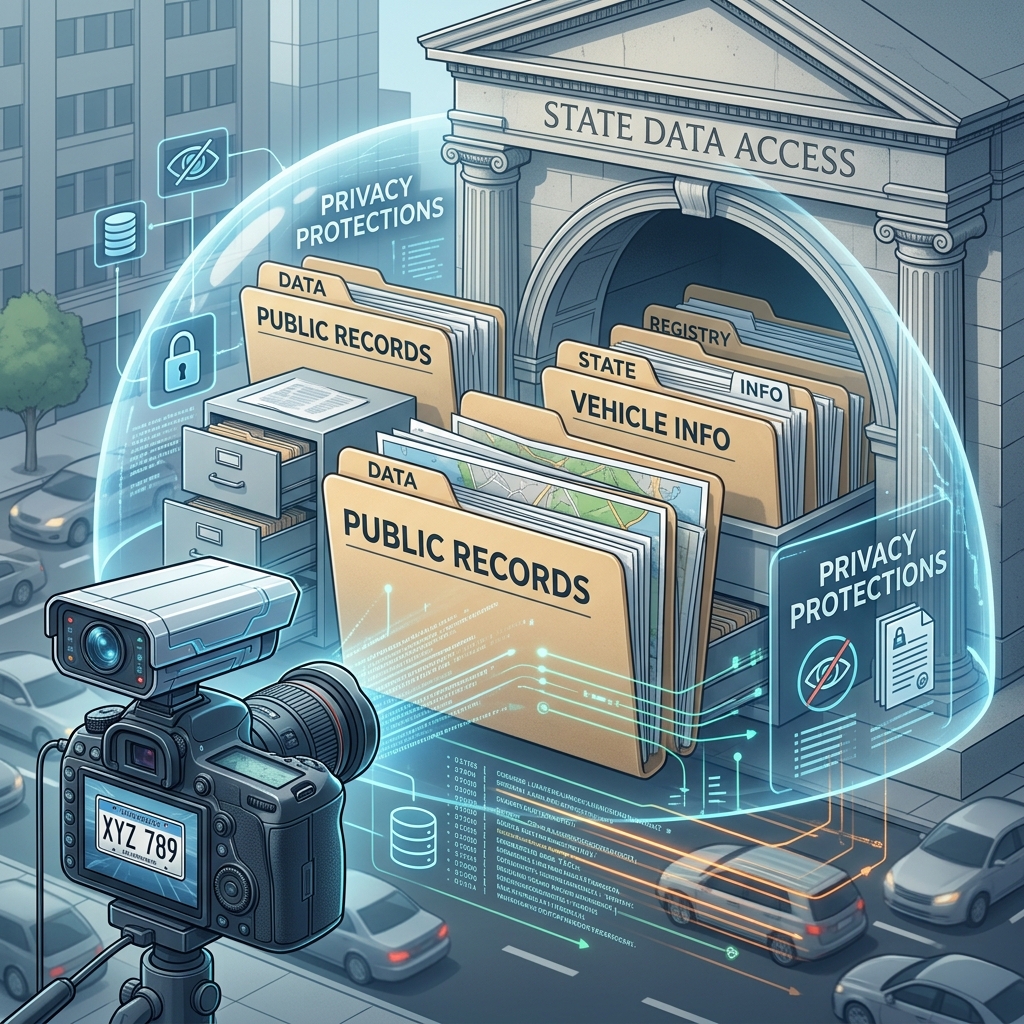
Automated license plate readers (ALPRs) have quickly become a core tool of modern law enforcement, quietly recording the movements of millions of vehicles on public roads. At the same time, open-records laws in many states presume that information collected by government agencies is a
public record
unless a specific exemption applies. When those two trends collide, courts must answer a difficult question: Are license plate scans public records that anyone can obtain, or confidential investigative data that should stay hidden?This article explores that question by explaining how ALPR technology works, why public records laws are implicated, how different states and courts have approached disclosure, and what is at stake for both government transparency and individual privacy.
Understanding Automated License Plate Readers
ALPR systems are networks of cameras, often mounted on patrol cars, street poles, or at fixed locations, that automatically capture images of passing vehicles and extract license plate numbers using optical character recognition. These systems typically also record time, date, and GPS location information for each scanned vehicle.
- Data collected: license plate number, image of the vehicle, time stamp, and location data.
- Core purpose: compare plate numbers against databases of interest (stolen vehicles, warrants, Amber Alerts, etc.) to aid investigations and public safety.
- Scale: large agencies can collect millions of data points, creating a detailed historical record of where many vehicles have been.
According to a U.S. Congressional research report, ALPR systems are widely used across the country and increasingly integrated with other databases, which raises complex questions about data retention, sharing, and constitutionally protected privacy expectations.
What Counts as a Public Record?
Most states have a general open-records statute (often called a public records, freedom of information, or sunshine law) that starts with a presumption: records held by government agencies are public unless an explicit exemption applies. These laws are designed to promote
transparency
, allow public oversight of government activity, and support journalism, advocacy, and academic research.At a high level, a public record usually includes any information prepared, owned, used, or retained by a public agency in the scope of its official business. However, there are common categories of exemptions, including:
- Ongoing law enforcement investigations.
- Personal privacy and confidentiality protections.
- Trade secrets or sensitive security information.
- Situations where the government can show that nondisclosure clearly outweighs the public interest in access.
Whether ALPR data sits on the “public” or “exempt” side of this line depends on how courts interpret these statutory exemptions and how legislators choose to regulate the technology.
ALPR Data: Surveillance Log or Investigative File?
One central legal dispute is how to characterize ALPR data. Some courts and policymakers see it as part of a broad surveillance log that exists independent of any particular investigation. Others view the technology as integrated into the investigative process, meaning the data should be treated like an investigative file and therefore exempt from disclosure.
| View of ALPR Data | Key Characteristics | Implications for Public Access |
|---|---|---|
| Surveillance log | Bulk collection, not tied to specific incidents; records routine movements on public roads. | More likely to be treated as public record unless a specific privacy or security exemption applies. |
| Investigative record | Data collected and used for crime detection, matching plates against hot lists, and building cases. | More likely to be exempt under law enforcement or investigatory exemptions. |
A California appellate court decision illustrates the investigative view: it held that ALPR data generated by large police agencies are records created in the course of investigating suspected crimes and are therefore exempt from disclosure under that state’s law enforcement investigative records exemption. The court reasoned that the system’s “core function” is crime investigation, and the automated nature of the data collection does not diminish its investigative character.
By contrast, public records advocates have argued that bulk ALPR data—especially when requested without identifying individual license plates—does not resemble traditional investigative files because it covers nearly all drivers on certain roads rather than specific suspects.
State-by-State Approaches to ALPR Disclosure
There is no single national rule on whether ALPR data is a public record. States have adopted different statutes, regulations, and policies governing retention and access.
Explicit Confidentiality Statutes
Some states have taken the explicit route and declared that ALPR data is confidential. For example, one state statute cited in a news analysis provides that images and data captured through automated license plate recognition systems are confidential and exempt from release under its public records law. In such jurisdictions, there is little room for courts to treat ALPR scans as public records, because the legislature has already made the confidentiality policy choice.
Law Enforcement Use-Only Policies
Other jurisdictions rely on administrative or statewide policy documents to limit ALPR use and access. A model policy from New York’s Division of Criminal Justice Services, for instance, states that ALPR data is “for official use only” and may only be shared for legitimate law enforcement purposes, with extensive logging and retention rules.
- Data is categorized as law enforcement sensitive, not as a routine public record.
- Use is restricted to authorized public safety objectives, such as locating vehicles connected to an investigation.
- Queries and dissemination must be documented and subject to audit, with long-term log retention.
These policies do not necessarily settle public records disputes by themselves, but they strongly signal that agencies view ALPR data as investigatory information, not open data.
Retention Limits and Open-Records Presumptions
A legislative survey by the National Conference of State Legislatures (NCSL) shows that multiple states regulate ALPR data by imposing retention time limits and restricting collection and access to law enforcement purposes. Some statutes specify that license plate data must be destroyed after a set period (for example, within 30 months), and may not be used for non-law-enforcement purposes such as monitoring lawful protest activity.
These laws seek a middle ground: they allow ALPR technology for public safety but limit long-term surveillance and misuse. They also create clearer boundaries for what could be requested and disclosed under public records laws by curbing the volume of data that agencies can retain.
Open Records Requests and Litigation Strategies
When journalists, civil liberties groups, or private citizens file public records requests for ALPR data, agencies often invoke investigative or catch-all exemptions to deny disclosure. The California Public Records Act, for example, includes both a law enforcement investigative exemption and a “catch-all” provision allowing nondisclosure when the public interest in confidentiality clearly outweighs the interest in disclosure.
A public records advisory overview notes that while non-anonymized ALPR data has been found not exempt under the investigative records exemption in some contexts, agencies have successfully relied on the catch-all exemption to withhold it based on privacy and safety concerns.
Common Arguments for Disclosure
- Transparency in surveillance: Access to ALPR data helps the public understand how often and where police deploy surveillance tools.
- Oversight of bias: Location and frequency data can reveal whether cameras are disproportionately concentrated in certain neighborhoods.
- Policy evaluation: Researchers and advocates can analyze retention and use patterns to assess whether ALPR programs are effective and proportionate.
Common Arguments Against Disclosure
- Privacy risks: Bulk release of location data about vehicles can expose sensitive travel patterns, including visits to medical, religious, or political locations.
- Safety concerns: Abusers or stalkers could misuse ALPR data to monitor victims if the data is broadly accessible.
- Operational risk: Public knowledge of camera locations and hot-list usage could undermine investigations or allow criminals to evade detection.
In practice, many courts weigh these competing interests on a case-by-case basis. Some have ordered partial disclosure—such as anonymized or aggregated data—while others have upheld blanket denials.
Privacy Concerns and Civil Liberties
Civil liberties organizations warn that treating ALPR data as fully public records with unrestricted access could create substantial privacy harms. Because the scans show where vehicles have been over time, they can reveal patterns of personal movement even when the individuals have done nothing wrong.
The American Civil Liberties Union (ACLU) has recommended a nuanced approach: treating ALPR system logs and non-individualized data as public records, while requiring redaction of specific license plates and vehicle identifiers, and allowing people to request their own data directly. The ACLU also emphasizes the risk that abusers could misuse police surveillance systems to track partners, calling for consent requirements and other safeguards when data pertains to vehicles used by multiple people.
Key Privacy Risks
- Location tracking: Long-term retention allows reconstruction of detailed travel histories.
- Sensitive associations: Trips to clinics, places of worship, or political meetings may expose private information.
- Function creep: Data collected for legitimate law enforcement purposes might be repurposed for unrelated surveillance or profiling.
These concerns are amplified if ALPR data is treated as fully open public records, but they also exist even when data is restricted to law enforcement use if safeguards and oversight are weak.
Balancing Transparency and Privacy
Policymakers and courts are engaged in a delicate balancing act: preserving the core values of open government while respecting privacy and preventing abuse of powerful surveillance technologies.
Potential Middle-Ground Solutions
- Redacted disclosure: Release aggregate statistics and system usage logs while redacting individual plate numbers and identifying metadata.
- Anonymized datasets: Provide anonymized location and volume data for auditing and research, subject to careful de-identification standards.
- Individual access rights: Allow vehicle owners to obtain ALPR records tied to their own plates to check accuracy and understand government-held information.
- Strict retention limits: Mandate deletion of data after a short period unless it is linked to a specific, documented investigation.
- Robust audit trails: Require logging of every ALPR query, including who accessed the data and why, with regular external audits.
These measures can help reconcile the goals of transparency and privacy by ensuring that the public can scrutinize how ALPR systems are used without turning raw surveillance data into an easily exploitable public database.
Policy Trends and Future Legal Questions
As ALPR technology becomes more sophisticated and more widely deployed, several trends are emerging:
- More states are adopting specific statutes that address ALPR collection, retention, and disclosure, rather than relying solely on general public records and privacy laws.
- Agencies are issuing detailed policies that treat ALPR data as law enforcement-sensitive information with limited sharing, while still grappling with public records obligations.
- Civil liberties organizations and journalists continue to push for greater transparency about how and where these systems are used, even if raw data is not fully public.
Future legal questions are likely to include how constitutional privacy doctrines apply to long-term, bulk vehicle tracking; whether anonymization techniques can make disclosure sufficiently safe; and how courts will treat efforts to obtain ALPR data for civil litigation, research, or policy advocacy.
Frequently Asked Questions (FAQ)
Is ALPR data always a public record?
No. Whether ALPR data is considered a public record depends heavily on the state’s statutes and how courts interpret investigative and privacy exemptions. Some states explicitly classify ALPR images and data as confidential, while others apply general public records laws with case-by-case balancing tests.
Can members of the public request anonymized ALPR data?
In some jurisdictions, it may be possible to request anonymized or aggregated ALPR data that does not include specific license plate numbers or obvious identifiers. Legal analyses suggest that the status of anonymized data under catch-all public records exemptions is still unsettled, but such requests are more likely to succeed than demands for raw, identifiable data.
How long do agencies keep ALPR records?
Retention periods vary widely. Some police policies require retention for at least one year, along with long-term storage of query logs for audit purposes. State statutes surveyed by NCSL show retention limits ranging up to around 30 months, with requirements to destroy data after that period if it is not linked to a specific law enforcement purpose.
What can individuals do if they are concerned about ALPR surveillance?
People concerned about ALPR use can review local policies, engage with city councils or state legislators, and support efforts to enact laws that limit retention, require transparency reports, and provide access to personal data. Civil liberties groups have proposed model rules allowing individuals to request their own ALPR records while protecting others’ privacy through redaction and consent safeguards.
Do ALPRs only affect people suspected of crimes?
No. ALPR systems routinely scan every visible plate within range, including vehicles driven by people who are never suspected of any wrongdoing. The resulting databases can therefore contain extensive information about ordinary drivers’ travel patterns, which is why privacy advocates emphasize strict limits on retention, sharing, and disclosure.
References
- License Plate Readings Shouldn’t Be Public Data — American Civil Liberties Union. 2024-02-06. https://www.aclu.org/news/privacy-technology/tracking-alpr-cameras/alpr-as-public-data
- Court Rules That Data From Automated License Plate Reader Systems Are Exempt From Disclosure — Lozano Smith. 2015-03-30. https://www.lozanosmith.com/news/cnb/CNB352015.pdf
- Sheriff Denied My Request For Data From Automated License Plate Readers — First Amendment Coalition. 2019-06-13. https://firstamendmentcoalition.org/asked-and-answered/sheriff-denied-my-request-for-data-from-automated-license-plate-readers/
- License plate readers: Is the data collected public record? — WJXT / News4JAX (YouTube). 2016-09-13. https://www.youtube.com/watch?v=hXQFcxpgtxk
- License Plate Readers Model Policy 2021 — New York State Division of Criminal Justice Services. 2021-02-01. https://www.criminaljustice.ny.gov/crimnet/ojsa/standards/MPTC%20LPR%20Model%20Policy%202021.pdf
- Automated License Plate Readers: Background and Legal Issues — Congressional Research Service. 2023-05-05. https://www.congress.gov/crs-product/IF13068
- Automated License Plate Readers: State Statutes — National Conference of State Legislatures. 2025-07-10. https://www.ncsl.org/technology-and-communication/automated-license-plate-readers-state-statutes
Similar Articles








Read full bio of medha deb


