
License Plate Scanners and the Battle Over Driver Privacy
How automated license plate readers turn everyday driving into data and why that raises serious privacy and civil liberties questions.
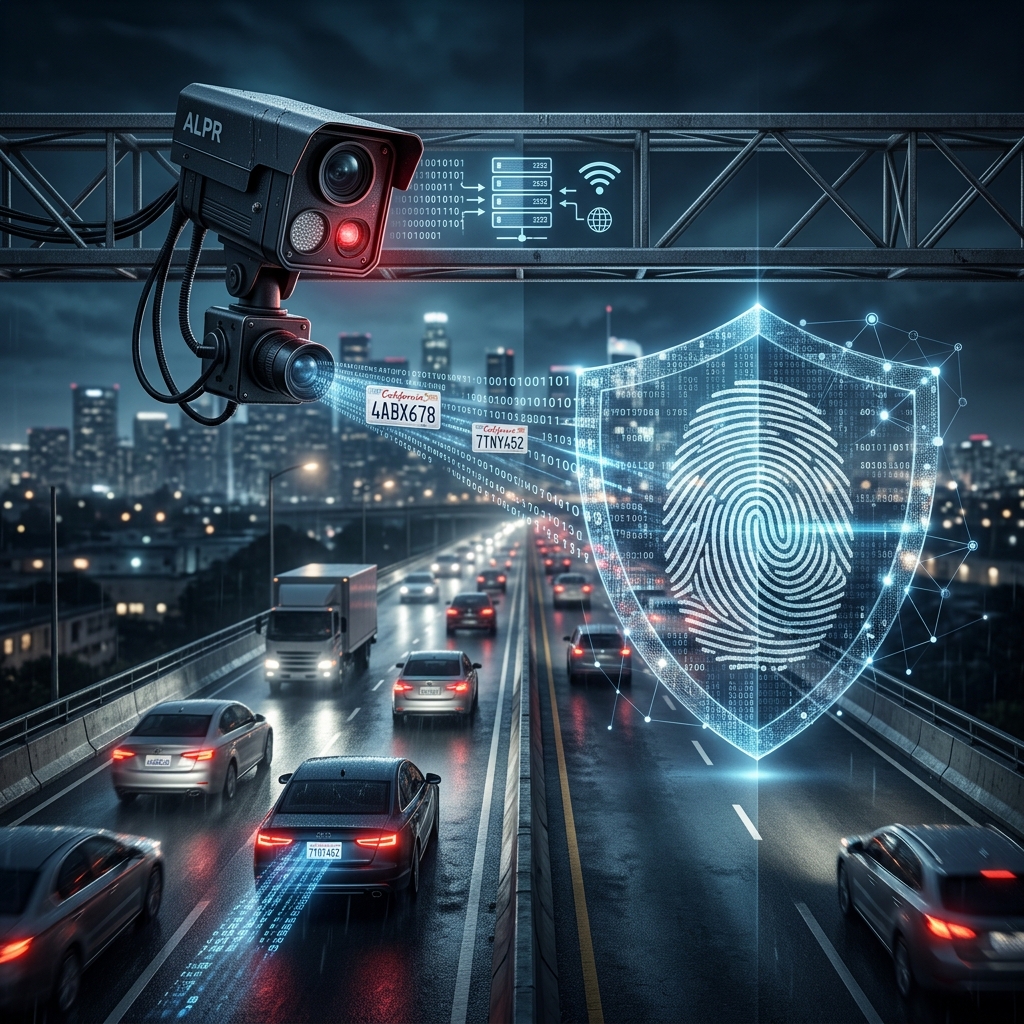
Automatic license plate readers have quietly become one of the most widely deployed surveillance tools on American roads, reshaping what it means to drive in public while raising hard questions about privacy, data retention, and constitutional protections.
Mounted on police cruisers, highway overpasses, and even privately owned cameras, these systems can record the movements of millions of vehicles with little human involvement and, in many places, limited oversight.
What Are Automated License Plate Readers?
Automated License Plate Readers (ALPRs) are camera-based systems that capture images of vehicle license plates and convert them into searchable text using optical character recognition software.
Modern ALPR systems typically perform several functions at once:
- Continuously photograph passing vehicles at high speed.
- Extract plate numbers and sometimes state or country of registration.
- Record the date, time, and geographic location of each scan.
- Upload data to local or cloud-based databases, where it is stored, searched, and shared.
Law enforcement organizations often deploy ALPRs in two basic configurations:
- Fixed systems installed on poles, traffic lights, bridges, and entry points such as neighborhood gateways or highway exits.
- Mobile systems attached to patrol cars, allowing officers to collect plate data as they drive their regular routes.
How ALPR Technology Works Behind the Scenes
Although they may look like ordinary roadside cameras, ALPRs operate through a tightly integrated technical chain. Understanding that chain helps explain why they are such powerful tools for both policing and surveillance.
Step-by-Step Data Collection Process
- Image capture: Cameras take rapid-fire photos of passing vehicles, often in all lighting and weather conditions.
- Character recognition: Software isolates the license plate from the image and converts characters to machine-readable text.
- Metadata tagging: Each plate read is stamped with location coordinates, date, and time.
- Database comparison: The system automatically checks plates against watchlists, such as stolen vehicles, outstanding warrants, or Amber Alerts.
- Alert generation: If there is a match, officers receive a near real-time notification with location and time, potentially enabling rapid interdiction.
- Storage and reuse: Non-hit data is still often stored, forming large archives of routine vehicle movements.
What Information Is Collected?
On paper, ALPR systems are designed to collect only plate numbers and associated metadata. In practice, the photos and logs can reveal much more.
| Type of Information | Description | Potential Implications |
|---|---|---|
| Plate number | Alphanumeric sequence from the license plate converted to text. | Can be used to identify the registered owner via DMV or other databases. |
| Date & time | Exact timestamp of when the plate was recorded. | Allows reconstruction of movement patterns over days, months, or years. |
| Location | GPS coordinates or street-level location of the scan. | Enables mapping of visits to homes, workplaces, and sensitive locations. |
| Vehicle image | Photo that may show the car, passengers, and surroundings. | Can reveal identities, physical appearance, and associations. |
| Hit or non-hit status | Whether the plate matches a watchlist entry. | Determines if an immediate enforcement action is triggered. |
While the raw data may not list driver names, police and many private users can connect plate data to individuals by cross-referencing registries and other databases.
Why Police and Cities Use License Plate Scanners
Law enforcement agencies and municipalities often highlight ALPRs as efficiency tools that modernize traffic and criminal investigations.
Commonly Cited Benefits
- Recovering stolen vehicles: Rapid alerts when a stolen car’s plate is detected, sometimes leading to immediate recovery.
- Locating suspects and fugitives: Tracking vehicles associated with ongoing investigations or outstanding warrants.
- Responding to emergencies: Helping locate vehicles in Amber Alerts or other time-sensitive search efforts.
- Automating routine checks: Replacing manual plate-by-plate checks with automated comparison against large datasets.
- Analyzing crime patterns: Using historical movement data to link vehicles to locations of reported crimes.
Proponents argue that ALPRs expand the reach of traffic enforcement and investigations without requiring substantially more personnel. Professional policing organizations describe them as an aid to public safety and operational efficiency.
Beyond Serious Crime: Routine and Low-Level Enforcement
Civil liberties groups, however, note that ALPRs are not confined to major investigations. Data has been used for bulk enforcement of minor issues such as lapsed registration, lack of insurance, or overdue fines.
Because every scanned plate is checked against various lists, the same technology that helps recover a stolen car can also trigger cascading consequences for minor administrative violations. This dual use lies at the heart of debates over proportionality and fairness.
Privacy Risks and Civil Liberties Concerns
ALPR technology raises privacy concerns not only because it tracks the movements of vehicles, but because it does so indiscriminately, collecting data on millions of ordinary drivers who are not suspected of wrongdoing.
Mass Location Tracking
When ALPR data is stored for long periods and aggregated across large areas, it can reveal detailed patterns of daily life.
- Regular routes between home, work, school, and other routine destinations.
- Visits to sensitive locations such as medical facilities, religious institutions, immigration clinics, or political protests.
- Associations between different vehicles that repeatedly appear at the same locations.
Constitutional scholars and courts have increasingly recognized that long-term tracking of movements, even in public spaces, can infringe on reasonable expectations of privacy when it reveals the “whole of an individual’s movements” over time.
Chilling Effects on Freedom of Expression
Knowing that every trip to a protest, union meeting, or community gathering may be recorded and stored can discourage people from exercising rights related to speech, association, and religious practice.
Civil liberties advocates warn that ALPR databases could be used to:
- Identify and monitor attendees at demonstrations or political events.
- Track worshippers at specific religious congregations over time.
- Target visitors to clinics or support centers that handle sensitive issues.
These risks are not hypothetical; they stem from the capability to link vehicle movements to specific communities or causes in a way that was difficult to achieve before automated mass surveillance.
Data Retention and Secondary Use
Another central concern is how long ALPR data is kept and how it is reused. In many jurisdictions, data retention rules were either absent or extremely permissive until civil liberties campaigns began pushing for reform.
Key issues include:
- Length of retention: Some agencies previously retained records for years or indefinitely, even if plates never matched a crime-related watchlist.
- Bulk sharing: Databases may be combined regionally, enabling cross-jurisdiction searches and larger scale tracking.
- Access by private parties: Private companies can operate ALPR networks and sell or share data with government agencies.
- Function creep: Data originally collected for one purpose may later be used for unrelated investigations or civil enforcement.
These practices create a system where simply driving on public roads can leave a long-lasting digital footprint, with uncertain rules about who can see it and for what reasons.
Legal and Policy Responses in the United States
The rapid expansion of ALPR technology has prompted a patchwork of legal and policy responses at the state and local level, alongside emerging constitutional case law.
State-Level Statutes and Regulations
Several states have enacted laws to regulate ALPR use, focusing on limiting purposes, requiring policies, and addressing retention.
- Permitted uses: Some laws restrict ALPR use to public safety or specific law enforcement functions, prohibiting broader commercial uses.
- Confidentiality requirements: Statutes may classify ALPR data as confidential and restrict disclosure except under defined circumstances.
- Policy and transparency mandates: Legislatures have required agencies to adopt written usage and privacy policies, hold public meetings, and maintain access logs when deploying ALPR systems.
- Data protection obligations: Certain states require reasonable security measures to prevent unauthorized access or misuse.
One notable early law required ALPR operators to implement privacy policies, log access to data, and provide public notice before launching new ALPR programs, reflecting the view that mass location tracking warrants explicit safeguards.
Constitutional Considerations and Case Law
Courts are grappling with how longstanding constitutional protections apply to modern, automated tracking. Recent decisions have examined whether prolonged monitoring of vehicle movements via networked sensors constitutes a “search” requiring a warrant.
Key themes emerging from these cases include:
- The idea that a comprehensive map of a person’s movements over weeks or months reveals information far beyond individual public observations.
- Recognition that aggregated data from multiple sensors can cross the line from routine policing into invasive surveillance.
- Judicial concern that warrantless access to large-scale movement data may violate reasonable expectations of privacy under constitutional search and seizure provisions.
Although courts vary in their reasoning, there is increasing acknowledgment that modern surveillance capabilities require updated analysis of what counts as a “search” in the digital era.
Private ALPR Networks and Data Sharing
ALPR systems are not limited to police agencies. Private companies now install camera networks in residential areas, shopping centers, and business districts, often marketing them as security solutions.
These networks introduce additional layers of complexity:
- Commercial data collection: Companies may collect and store vehicle data on behalf of clients, with their own terms of service and retention policies.
- Law enforcement access: Private operators can share or grant access to government agencies, sometimes raising questions about oversight and consent.
- Cross-jurisdiction reach: Networks covering multiple cities or regions can aggregate vehicle movements across wide areas.
Instances of unauthorized or unexpected access, where agencies tapped private ALPR data without adequate permission, have underscored the need for clear rules governing how public and private actors may use and share location information.
Balancing Safety, Efficiency, and Privacy
The policy debate over license plate scanners is not simply about banning or embracing the technology. It is fundamentally about how to calibrate surveillance powers to ensure safety while preserving civil liberties.
Potential Safeguards and Best Practices
Legal scholars, advocacy groups, and some policing organizations have suggested a range of safeguards to mitigate privacy risks while retaining legitimate uses.
- Strict retention limits: Automatically delete non-hit records after a short, clearly defined period unless there is a specific investigative reason to retain them.
- Warrant requirements for bulk queries: Require judicial authorization before accessing large datasets to reconstruct an individual’s movements over time.
- Transparent policies and public reporting: Make usage rules, retention schedules, and statistics on ALPR queries publicly available.
- Robust access controls and logging: Enforce role-based access, keep detailed logs, and audit for misuse or unauthorized searches.
- Limited watchlists: Narrow the categories of plates subject to alerts to serious offenses and urgent safety needs, avoiding routine mass enforcement of minor infractions.
Implementing such measures can help align ALPR use with constitutional principles and community expectations, though the adequacy of safeguards remains an active area of dispute.
Frequently Asked Questions About License Plate Scanners
Do license plate readers record every car they see?
In most deployments, ALPR cameras are designed to capture and process every plate within their field of view, regardless of whether the vehicle is associated with any crime. The vast majority of scans relate to drivers who are not suspected of wrongdoing.
Can police identify me personally from ALPR data?
On its own, ALPR data contains plate numbers and location information, not names. However, officers can connect plates to registered owners using motor vehicle registries and other databases, making it possible to identify individuals indirectly.
How long is ALPR data kept?
Retention periods vary widely. Some jurisdictions now limit how long non-hit data can be stored, while others maintain archives for months or years. State laws and local policies increasingly address this issue, but practices remain uneven.
Are ALPR systems only used by police?
No. Private companies deploy ALPR cameras for security, parking management, and neighborhood monitoring, and may share data with law enforcement or other clients. This private sector involvement complicates oversight and accountability.
Does using ALPRs require a warrant?
Requirements for judicial authorization differ by jurisdiction and context. While routine real-time scans often occur without a warrant, courts are increasingly considering whether accessing prolonged or aggregated movement data should be treated as a search requiring judicial approval.
References
- Eyes on the Road: AI, Privacy, and Automated License Plate Readers — Boston Bar Association Journal. 2025-06-01. https://bostonbar.org/journal/eyes-on-the-road-ai-privacy-and-automated-license-plate-readers/
- Automated License Plate Readers (ALPRs) — Electronic Frontier Foundation, Street Level Surveillance. 2024-03-01. https://sls.eff.org/technologies/automated-license-plate-readers-alprs
- Privacy concerns raised about license plate readers — KMBC / Hearst Television (YouTube transcript). 2023-08-15. https://www.youtube.com/watch?v=QUbTZIE4BT0
- You Are Being Tracked: How License Plate Readers Are Being Used to Record Americans’ Movements — American Civil Liberties Union. 2013-07-01. https://www.aclu.org/you-are-being-tracked
- Automated License Plate Recognition — International Association of Chiefs of Police. 2020-01-01. https://www.theiacp.org/projects/automated-license-plate-recognition
- Automated License Plate Readers: State Statutes — National Conference of State Legislatures. 2025-07-10. https://www.ncsl.org/technology-and-communication/automated-license-plate-readers-state-statutes
- License Plate Readers — Flock Safety Product Page. 2024-05-01. https://www.flocksafety.com/products/license-plate-readers
Similar Articles








Read full bio of Sneha Tete


