
Legal Solutions for Noisy Neighbor Pool Pumps
Understand your rights, local noise laws, and practical legal options when a neighbor’s loud pool pump disrupts your home life.
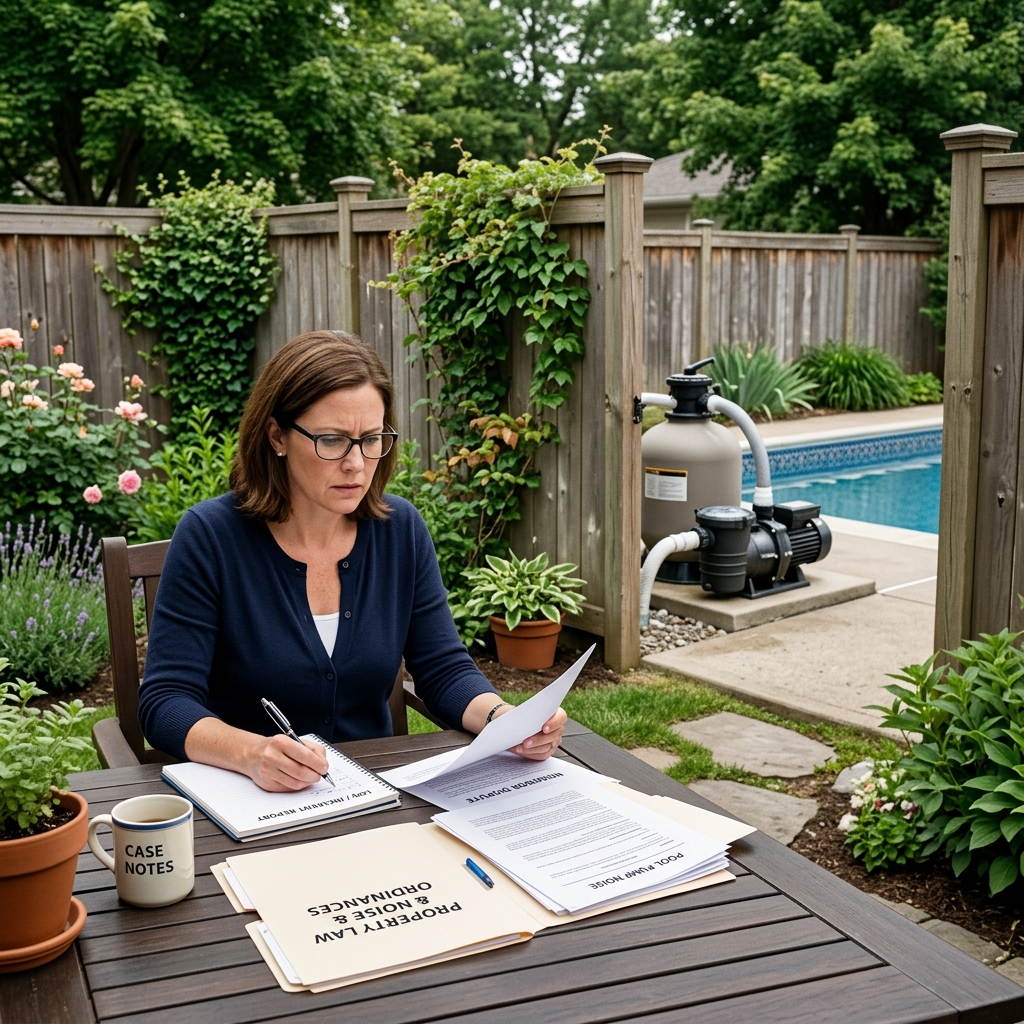
A loud pool pump on the other side of your fence can turn a peaceful backyard or bedroom into a constant source of irritation. When the noise becomes frequent, persistent, or especially intrusive at night, you may have legal options to protect your comfort and your property rights.
This guide explains how noise laws work, what counts as a legal nuisance, how to document the problem, and which steps to take before and during legal action. It also covers practical solutions that may help you resolve the issue without going to court.
Why Pool Pump Noise Becomes a Legal Issue
Pool pumps are designed to circulate and filter water, usually running for several hours a day. Under normal conditions, they generate a steady mechanical hum that rarely rises to the level of a legal problem. Noise becomes a legal concern when it interferes with the ordinary use and enjoyment of neighboring property.
Common reasons a pool pump may cause disputes include:
- Improper installation close to a property line or bedroom window
- Defective or poorly maintained equipment that rattles or squeals
- Continuous operation, including overnight cycles
- Lack of noise shielding, enclosures, or vibration control
In many jurisdictions, excessive noise can be addressed under local noise ordinances or under broader nuisance law, both of which aim to balance a homeowner’s right to use their property with neighbors’ right to reasonable quiet enjoyment.
Understanding Noise Ordinances and Local Rules
Most cities and towns adopt noise regulations that set limits on sound levels or restrict noisy activities during certain hours. These rules may appear in municipal codes, zoning regulations, or health and safety laws and are often enforced by local police or code enforcement officers.
Typical Features of Noise Ordinances
While rules vary by location, noise ordinances commonly include:
- Decibel limits for residential properties, often lower at night than during the day.
- Time-of-day restrictions on continuous mechanical noise, such as HVAC or pool equipment.
- Location-based standards, measuring noise at the property line or inside affected buildings.
- Enforcement mechanisms, such as warnings, fines, or orders to abate the noise.
For example, some U.S. cities cap typical residential noise around the mid–60 decibel range during daytime, with lower limits at night, though the exact thresholds differ across municipalities. Many local codes also reference standards from agencies such as the U.S. Environmental Protection Agency, which has published guidance on environmental noise levels that protect public welfare.
Where to Find Your Local Noise Rules
To understand whether your neighbor’s pool pump violates local law, you must identify the rules that apply in your area. You can usually find this information by:
- Searching your city or county’s online municipal code for “noise” or “sound” provisions
- Calling your local planning, zoning, or code enforcement office
- Checking HOA or condominium rules if you live in a governed community
Local government websites and public health agencies sometimes also publish guidance on acceptable noise levels and neighborhood noise control policies.
When Noise Becomes a Legal Nuisance
Even if there is no clear ordinance violation, extreme or persistent noise can still be addressed under nuisance law. A nuisance, in legal terms, is an unreasonable interference with another person’s use and enjoyment of their property.
Elements of a Private Nuisance Claim
Courts generally look for the following elements when evaluating a nuisance claim related to noise:
- Substantial interference: The noise is more than a minor inconvenience; it materially affects daily life.
- Unreasonable under the circumstances: The interference is not justified by normal neighborhood activities.
- Ongoing or recurring: The issue is repeated or continuous, rather than a one-time event.
- Causation by the neighbor’s activity: The disturbance can be traced to the specific pool pump and its operation.
Many state courts and legal standards treat noise as a classic example of potential nuisance, particularly where it affects sleep, work, or health.
Factors Courts Consider in Noise Cases
In evaluating whether a pool pump constitutes a nuisance, courts may weigh:
- The character of the neighborhood (quiet residential versus mixed commercial-residential)
- The intensity and duration of the noise, including measured decibel levels
- Whether technical fixes or relocation of equipment were reasonably available
- Any prior attempts to resolve the issue informally
- Compliance or non-compliance with specific municipal or HOA rules
Building a Strong Record: Measuring and Documenting Noise
Successful resolution—whether through local enforcement or litigation—often depends on detailed documentation. Instead of relying only on subjective descriptions, gather objective evidence showing the nature and impact of the pool pump noise.
Practical Steps to Document the Problem
- Measure sound levels
Use a sound level meter or a reliable smartphone app to record decibel readings at your property line and inside affected rooms. Note time, duration, and readings during both day and night. - Maintain a noise log
Keep a written log listing dates, start and end times, descriptions of the noise (e.g., “grinding,” “loud hum”), and how it affected your ability to sleep, work, or relax. - Capture audio or video
Record short clips showing the noise and its proximity to your home. Ensure that your recordings comply with local privacy laws and do not capture sensitive personal conversations. - Preserve correspondence
Save copies of texts, letters, or emails to your neighbor, your HOA, or local authorities describing the issue and their responses.
Sample Noise Documentation Table
| Date | Time | Location of Measurement | Decibel Reading | Impact |
|---|---|---|---|---|
| 2026-06-01 | 11:30 PM | Bedroom near fence | 63 dB | Unable to sleep; had to use earplugs |
| 2026-06-03 | 7:15 AM | Back patio | 68 dB | Too loud for outdoor breakfast, moved indoors |
| 2026-06-08 | 10:45 PM | Property line | 65 dB | Noise audible above indoor TV level |
This type of record can be very helpful for local noise investigators, mediators, HOAs, and courts when assessing whether intervention is justified.
Starting with Communication: Talking to Your Neighbor
Many disputes over pool pumps can be solved without legal action. An open, respectful conversation often leads to simple technical or scheduling adjustments that reduce noise to acceptable levels.
Tips for a Constructive Discussion
- Pick a calm time of day and avoid starting the conversation when frustrated or angry.
- Describe how the noise affects you (lost sleep, inability to enjoy your yard) rather than attacking your neighbor’s choices.
- Bring factual information, such as approximate decibel readings or specific times, to avoid general complaints.
- Ask whether they would consider moving the equipment, adjusting operating hours, or adding acoustic shielding.
- Express openness to reasonable compromise and avoid threats of immediate legal action.
In some cases, offering to share or fully cover the cost of noise mitigation measures—such as an acoustic enclosure—can encourage cooperation, especially where the pump was installed in good faith and the owner did not realize its impact.
Technical and DIY Noise Reduction Measures
Even while you explore legal options, technical solutions may provide faster relief. Some fixes involve the neighbor’s equipment; others focus on blocking sound that reaches your property.
Measures on the Neighbor’s Side (With Their Consent)
- Maintenance and repair
Many loud pumps are simply worn or misaligned. Professional servicing, replacement of bearings or impellers, and proper mounting can drastically reduce noise. - Acoustic housings
Purpose-built pump covers, soundproof boxes, or small enclosures can absorb and deflect sound. These should provide ventilation to prevent overheating. - Relocation
Moving the pump farther from shared property lines or bedroom windows may bring it into compliance with ordinance limits and reduce perceived noise. - Scheduling adjustments
Running the pump primarily during daytime hours and avoiding overnight cycles can mitigate the most disruptive impacts.
Noise Control Measures on Your Property
When direct changes to the neighbor’s equipment are not possible, you may still reduce exposure by improving sound barriers on your side of the fence.
- Solid fencing or walls
Dense materials such as masonry or thick wood reflect and absorb sound more effectively than thin panels. - Sound-absorbing materials
Mass-loaded vinyl, acoustic panels, and specialized insulation can be attached to fences or walls to enhance sound blocking. - Outdoor sound blankets
Heavy acoustic blankets can be hung temporarily to dampen sound from specific directions, especially for short-term relief. - Interior soundproofing
Upgrading windows, installing heavy curtains, or adding insulation to walls facing the pump can make interior spaces quieter.
Using Local Authorities and Community Rules
If informal discussion does not resolve the problem, your next step is typically to seek help from local authorities or, if applicable, your homeowners association.
Filing a Noise Complaint
Many municipalities allow residents to report excessive noise through a non-emergency phone line or an online portal. The process usually involves:
- Contacting a non-emergency police number or code enforcement office
- Providing details about the source, timing, and nature of the noise
- Supplying any measurements, recordings, or logs you have collected
- Allowing an officer or inspector to visit and independently assess the noise
If the pump exceeds legal limits or clearly violates local rules, authorities may issue warnings, citations, or orders requiring the owner to correct the problem.
Homeowners Associations and Private Rules
In communities governed by HOAs or similar bodies, the governing documents often include specific provisions regarding nuisances, mechanical equipment, and exterior modifications. These may:
- Prohibit “nuisance” activities that disrupt other owners’ peaceful enjoyment
- Require approval for placement of pool equipment or structures near property lines
- Empower the board to order corrective action, impose fines, or pursue enforcement
If you believe the pump violates HOA rules, you can typically file a written complaint with the association, request a hearing, and ask the board to consider enforcement measures.
Considering Formal Legal Action
When discussion, technical fixes, and local enforcement all fail—or when the noise is severe—formal legal remedies may be appropriate. Before proceeding, it is wise to consult a local attorney experienced in property or housing law.
Common Legal Remedies
- Injunction or court order
A court may order the neighbor to reduce, relocate, or shield the pump, or limit the hours of operation, if it finds a legal nuisance or ordinance violation. - Damages
In some cases, a successful plaintiff can recover monetary compensation for loss of use, reduced property value, or related harms. - HOA or deed restriction enforcement
If the issue violates recorded covenants, the association or, in some jurisdictions, individual owners may seek judicial enforcement, depending on state law.
Key Considerations Before Suing
- The cost of litigation relative to the practical benefit of quieter conditions
- The strength of your evidence, including measurements, logs, and witness testimony
- Potential expert testimony on acoustics or property impact
- Time limits or procedural requirements for HOA and covenant enforcement
Because noise disputes are highly fact-specific, outcomes can vary. A local attorney can evaluate your situation under state law and advise whether a formal claim is likely to succeed.
Balancing Rights and Expectations in Shared Neighborhoods
Resolving pool pump noise disputes ultimately requires balancing two legitimate interests: your neighbor’s right to maintain and enjoy a pool, and your right to use your home without unreasonable disturbance. Law, technology, and communication all play a role in striking that balance.
In many cases, the quickest and least adversarial resolution comes from combining modest technical measures with clear communication and, where necessary, gentle pressure from local authorities or HOAs. Legal action remains a last resort, but it is available when informal and administrative paths fail to protect your right to reasonable quiet enjoyment.
Frequently Asked Questions (FAQs)
Is my neighbor’s pool pump automatically illegal if I find it annoying?
Not necessarily. For noise to be legally actionable, it usually must exceed local noise limits or amount to an unreasonable interference under nuisance law. Mild annoyance alone rarely meets this threshold; detailed evidence and comparisons with local standards are important.
Do I need professional equipment to measure noise levels?
Professional sound level meters are more accurate, but many smartphone apps provide reasonable approximations for initial documentation. For formal investigations or court cases, you may need official measurements taken by local authorities or qualified consultants.
Can my HOA force my neighbor to move or quiet their pool pump?
It depends on your HOA’s governing documents and state law. If the pump placement or noise violates covenants or rules, the board may have authority to require changes or impose fines. Your state may also regulate how and when HOAs enforce deed restrictions.
What should I include in a complaint to local authorities?
Provide the address and location of the pump, dates and times of the noise, any decibel readings, and descriptions of how the noise affects daily life. Attach your log or recordings if the reporting system allows it; this helps officials assess the seriousness and persistence of the issue.
When is it time to speak with a lawyer?
Consider consulting an attorney when:
- The noise is severe and persistent
- Local authorities or your HOA will not act, or their efforts have failed
- You have gathered substantial documentation but the problem continues
- You are considering seeking court orders or damages for nuisance
An attorney can explain your options, evaluate your evidence, and help you decide whether litigation or alternative dispute resolution is appropriate.
References
- Neighbor’s lawnmower, air conditioner, or pool pump too loud? — Sun & Sound Windows. 2023-05-01. https://sunandsoundwindows.com/neighbors-lawnmower-air-conditioner-or-pool-pump-too-loud/
- Information on Levels of Environmental Noise Requisite to Protect Public Health and Welfare with an Adequate Margin of Safety — U.S. Environmental Protection Agency. 1974-03-01. https://www.epa.gov/indoor-air-quality-iaq/information-levels-environmental-noise-requisite-protect-public-health-and
- Neighbor’s noisy pool pump creates disturbance — Las Vegas Review-Journal (Barbara Holland). 2022-08-28. https://www.reviewjournal.com/business/business-columns/barbara-holland/neighbors-noisy-pool-pump-creates-disturbance-2770624/
- How to Block Neighbors Pool Pump Noise — PoolPartsToGo. 2023-04-10. https://poolpartstogo.com/blogs/articles/how-to-block-neighbors-pool-pump-noise
- Noisy neighbor pool pump – advice please — Trouble Free Pool Forum. 2023-07-15. https://www.troublefreepool.com/threads/noisy-neighbor-pool-pump-advice-please.319390/
- Community Noise — World Health Organization. 1999-01-01. https://www.who.int/docstore/peh/noise/Comnoise-1.pdf
Similar Articles








Read full bio of medha deb


