
The Legal Landscape of License Plate Scanners
How automated license plate readers work, why they raise privacy alarms, and what current U.S. laws say about their use.
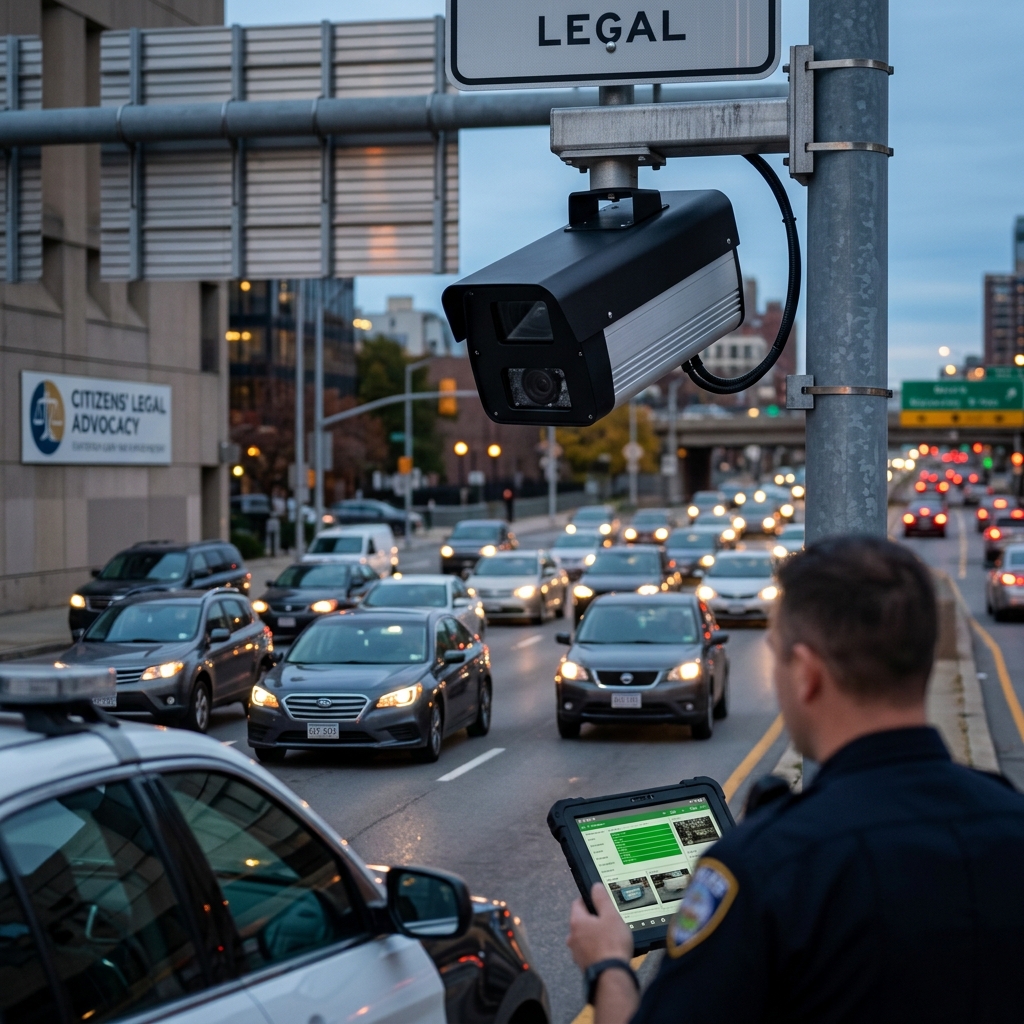
Automated license plate readers (ALPRs), often called license plate scanners, have rapidly become a common tool for law enforcement and, increasingly, for private entities. These systems can log thousands of plates per minute, building detailed records of where vehicles travel and when they were seen. As the technology spreads, questions about its legality, appropriate use, and impact on privacy and criminal defense grow more urgent.
This article explains how license plate scanners work, how police and others use them, why they raise civil liberties concerns, and what current U.S. law says about their deployment and data handling. It also outlines practical considerations for drivers and key issues defense lawyers may raise when scanner data is involved in a criminal case.
What Are Automated License Plate Readers?
Automated license plate readers are high‑speed cameras paired with optical character recognition software. Mounted on patrol cars, streetlights, highway overpasses, or building exteriors, they automatically capture images of passing vehicles and convert the license plate characters into machine‑readable data. Alongside the plate number, the system typically records:
- Date and time of the scan
- GPS or other location information
- Identifier of the specific camera or unit
- A contextual photo of the rear or side of the vehicle
By design, ALPR systems generally do not include personally identifiable information about the occupants of the vehicle, nor do they directly reveal the registered owner’s name. However, when combined with motor vehicle registration databases or other law enforcement systems, the plate information can be linked to individuals and used to reconstruct their movements.
Core Uses of License Plate Scanners
Many agencies justify ALPR deployment as a way to enhance public safety and improve efficiency. Common law enforcement and governmental uses include:
- Locating stolen vehicles by comparing passing plates against hotlists of reported thefts.
- Finding vehicles associated with wanted or missing persons, including Amber or Silver alerts.
- Supporting criminal investigations by placing scanners near crime scenes or routes suspects are likely to travel.
- Enforcing tolls and parking, particularly in cities and toll road systems where automated billing is common.
- Identifying registration or insurance violations by flagging vehicles that appear unregistered or uninsured.
Some states explicitly define permissible uses. For example, certain statutes allow ALPRs only to identify vehicles associated with a missing person, an outstanding warrant, ongoing investigations, or reported theft, and to support parking, toll, or trucking enforcement. These limits reflect legislative efforts to curb broad tracking of ordinary drivers.
Privacy Concerns and Civil Liberties
Despite their utility, license plate scanners raise significant privacy and civil liberties issues. The technology’s key risks stem from how much data is collected, how long it is stored, and who can access it.
Mass Collection of Location Data
Because ALPRs capture every plate that passes—often thousands per minute—databases can grow to include millions of scans, most involving drivers who are not suspected of any wrongdoing. The American Civil Liberties Union has warned that the technology is increasingly being used for routine location tracking, with records often kept for years or indefinitely.
When data is retained for long periods, it can be used to reconstruct detailed travel histories, revealing sensitive information such as visits to medical facilities, places of worship, political meetings, or intimate partners. From a civil liberties perspective, this type of systematic monitoring risks chilling lawful behavior and undermining the expectation that ordinary movement in public is not cataloged by the government.
Data Retention and Sharing Practices
One of the most contentious issues is how long ALPR data is kept and how widely it is shared. There is currently no comprehensive federal law that explicitly governs law enforcement use of ALPR technology, including retention periods or sharing arrangements. Instead, states and localities have adopted a patchwork of rules.[10]
Common concerns include:
- Retention of scans involving drivers not linked to any investigation.
- Pooling of data into regional or multi‑agency systems, making it easier to track movements across jurisdictional lines.
- Access by private companies that operate scanners and then share data with law enforcement.
- Limited transparency about who can query the systems and for what purposes.
The Colorado Division of Criminal Justice, for example, notes that ALPR data may be stored for up to three years, even though not every plate is constantly monitored. Other states set much shorter retention limits—sometimes measured in days or even minutes—but practices vary widely.
State‑Level Regulation: A Patchwork of Rules
Without federal legislation, state lawmakers have taken very different approaches to ALPR regulation. The National Conference of State Legislatures reports that at least 16 states have enacted specific statutes addressing license plate reader use, including restrictions on government use, data retention limits, and rules about public access to records.
Key areas of regulation include:
- Authorized purposes: Some states narrowly define when scanners can be used (e.g., stolen vehicles, missing persons, active investigations).
- Retention periods: Statutes may set maximum retention times, ranging from minutes to months, with longer retention allowed if data is evidence in a case.
- Access control: Laws can restrict access to trained law enforcement personnel and require audit trails for queries.
- Public records exemptions: Some states exempt ALPR data from freedom of information laws to prevent mass disclosure.
Recent legislative efforts show interest in tightening rules. Multiple states have considered bills to limit or ban roadside ALPR installations, confine use to specific purposes, or shorten retention periods.[10] At the same time, some proposals seek to expand authorized uses, such as red‑light enforcement or broader traffic monitoring.[10]
Example Regulatory Approaches
| Regulatory Focus | Typical State Approach | Privacy Impact |
|---|---|---|
| Authorized Uses | Limited to stolen vehicles, warrants, missing persons, or ongoing criminal investigations. | Reduces risk of routine mass tracking but still allows extensive data capture during investigations. |
| Data Retention | Retention periods ranging from minutes to several months; longer if data is evidence. | Shorter retention protects privacy; longer periods enable detailed movement histories. |
| Access and Sharing | Access limited to authorized law enforcement; audit logs required in some states. | Audit trails deter misuse but do not fully prevent broad inter‑agency sharing. |
| Public Records Status | Some states exempt ALPR data from public records laws. | Protects individuals from public exposure but may reduce transparency about system use. |
Policy Requirements and Oversight Mechanisms
Beyond statutory limits, some jurisdictions require agencies to adopt and publish detailed ALPR policies. In California, for example, entities that deploy ALPRs or access ALPR data must post a privacy and usage policy online, unless they are transportation agencies covered by other law. These policies must describe:
- Authorized purposes for using the ALPR system and collecting information.
- Which employees or contractors may access the system and what training they must receive.
- Measures used to monitor the system and protect data security.
- Rules for selling, sharing, or transferring ALPR information to other parties.
- How data accuracy is ensured and errors are corrected.
- Retention periods and destruction procedures for stored information.
Requiring public policies can enhance transparency and provide benchmarks for assessing whether a particular use of ALPR data was lawful. However, the level of detail and enforcement of these policies vary, and not all jurisdictions impose such requirements.
Legal Issues in Criminal Cases
When ALPR data is used in criminal investigations or prosecutions, it raises several legal questions. Courts have generally allowed law enforcement access to license plate databases, but some decisions caution that extensive, long‑term tracking may implicate constitutional protections.
Search and Seizure Considerations
Traditional doctrine holds that individuals have a reduced expectation of privacy in what is visible from public roadways. Snapshot observations of a license plate, whether by an officer or a camera, are therefore often treated differently from searches of private spaces. But as scanners create cumulative records over time, courts may consider whether long‑term aggregation of location data amounts to a search requiring heightened protections.
Factors that can become relevant include:
- The duration over which a vehicle’s movements are captured.
- The comprehensiveness of coverage (e.g., citywide vs. limited locations).
- Whether data is used to reveal patterns about home, work, or sensitive visits.
- Whether access requires a warrant, court order, or is based solely on agency policy.
Evidentiary and Reliability Questions
Defense attorneys may challenge ALPR evidence on grounds of accuracy, chain of custody, and compliance with statutory requirements. Issues include:
- Whether the scanner misread the plate due to lighting, angle, or damage.
- Whether data was retained beyond legally permitted periods.
- Whether officers or agencies followed required policies and training protocols.
- Whether queries were appropriately logged and justified under agency rules.
In some jurisdictions, statutes explicitly state that a plate reader “hit” alone does not constitute reasonable suspicion for a stop; officers must develop independent grounds or visually confirm the plate before acting. Such provisions aim to prevent unjustified stops based solely on potentially faulty automated matches.
Practical Implications for Drivers
For most drivers, ALPR systems operate invisibly. They may not realize their plate has been scanned or that their movements are stored in a database. While individual rights vary by state, there are some general implications to keep in mind:
- Your plate can be scanned whenever you drive on public roads, especially near major intersections, toll facilities, or areas targeted for enforcement.
- Data may be retained for months or years, depending on local rules.
- Scans can be shared with other agencies, potentially broadening the geographic scope of tracking.
- Private operators (such as parking or security firms) may collect and share plate data with law enforcement.
If you face criminal charges where ALPR data played a role, it can be important to consult an attorney familiar with surveillance technologies and local statutes. Counsel can examine whether scanner use complied with state law, whether a warrant or court order was required, and whether the data is reliable and admissible.
Key Debates Shaping Future Regulation
Legislators, courts, and advocates continue to debate how to balance the public safety benefits of ALPRs against their privacy costs. Major points of contention include:[10]
- Whether scanners should be allowed near sensitive locations such as hospitals, schools, and places of worship.
- How short retention periods must be to meaningfully protect privacy.
- Whether broad sharing between agencies and private firms should be limited or prohibited.
- What level of judicial oversight is appropriate for accessing historical ALPR records.
- Whether the technology should be restricted to serious crimes or allowed for routine traffic enforcement.
Some proposals seek near‑total bans on fixed roadside ALPR installations, while allowing limited use on police vehicles or for specific emergency purposes. Others aim to standardize retention and access rules statewide, reducing the current patchwork of local policies.[10]
Frequently Asked Questions (FAQ)
Are license plate scanners legal?
In most U.S. jurisdictions, ALPRs are legal, but their use is regulated to varying degrees by state statutes, agency policies, and court decisions. There is no single national rule, so legality depends on where and how the system is deployed.
Can police store data on every driver they scan?
Many departments do store scans from drivers not suspected of a crime, sometimes for long periods. However, some states restrict retention or require that data on uninvolved drivers be purged quickly.
Do license plate readers reveal who is driving?
ALPR systems typically capture the plate and a contextual photo of the vehicle but not a clear image of the occupants. The plate can be linked to a registered owner, but that does not always identify the actual driver.
Is a scanner “hit” enough to justify pulling me over?
In some jurisdictions, a scanner hit by itself is not considered sufficient reasonable suspicion for a stop; officers must visually confirm the plate or develop additional grounds. The exact rule depends on local law and policy.
Can I find out whether my plate has been scanned?
Access to ALPR records varies by state and agency. In places where policies must be published, they may specify whether individuals can request information about their own records. Freedom of information laws may apply, but some states exempt ALPR data from public disclosure.
References
- ORS Research Brief: Automated License Plate Readers (ALPR) — Colorado Division of Criminal Justice. 2022-06-01. https://dcj.colorado.gov/dcj-offices/ors/doc-res/brf-alpr2
- You Are Being Tracked: How License Plate Readers Are Being Used to Record Americans’ Movements — American Civil Liberties Union. 2013-07-17. https://www.aclu.org/you-are-being-tracked
- California Automated License Plate Reader Policies — Electronic Frontier Foundation. 2016-01-05. https://www.eff.org/pages/california-automated-license-plate-reader-policies
- Automated License Plate Readers: State Statutes — National Conference of State Legislatures. 2024-03-20. https://www.ncsl.org/technology-and-communication/automated-license-plate-readers-state-statutes
- Seven States Pursue Rules for License Plate Readers — Land Line Media. 2024-02-15. https://landline.media/seven-states-pursue-rules-for-license-plate-readers/
- Automated License Plate Readers: Background and Legal Issues — Congressional Research Service. 2023-11-01. https://www.congress.gov/crs-product/IF13068
- 46-5-117. Use of License Plate Reader Prohibited — Exceptions — Montana Code Annotated. 2024-01-01. https://mca.legmt.gov/bills/2024/mca/title_0460/chapter_0050/part_0010/section_0170/0460-0050-0010-0170.html
Similar Articles








Read full bio of medha deb




