
Legal Consequences of Destroying Criminal Evidence
Why swallowing, hiding, or destroying evidence can turn one criminal charge into several far more serious problems.
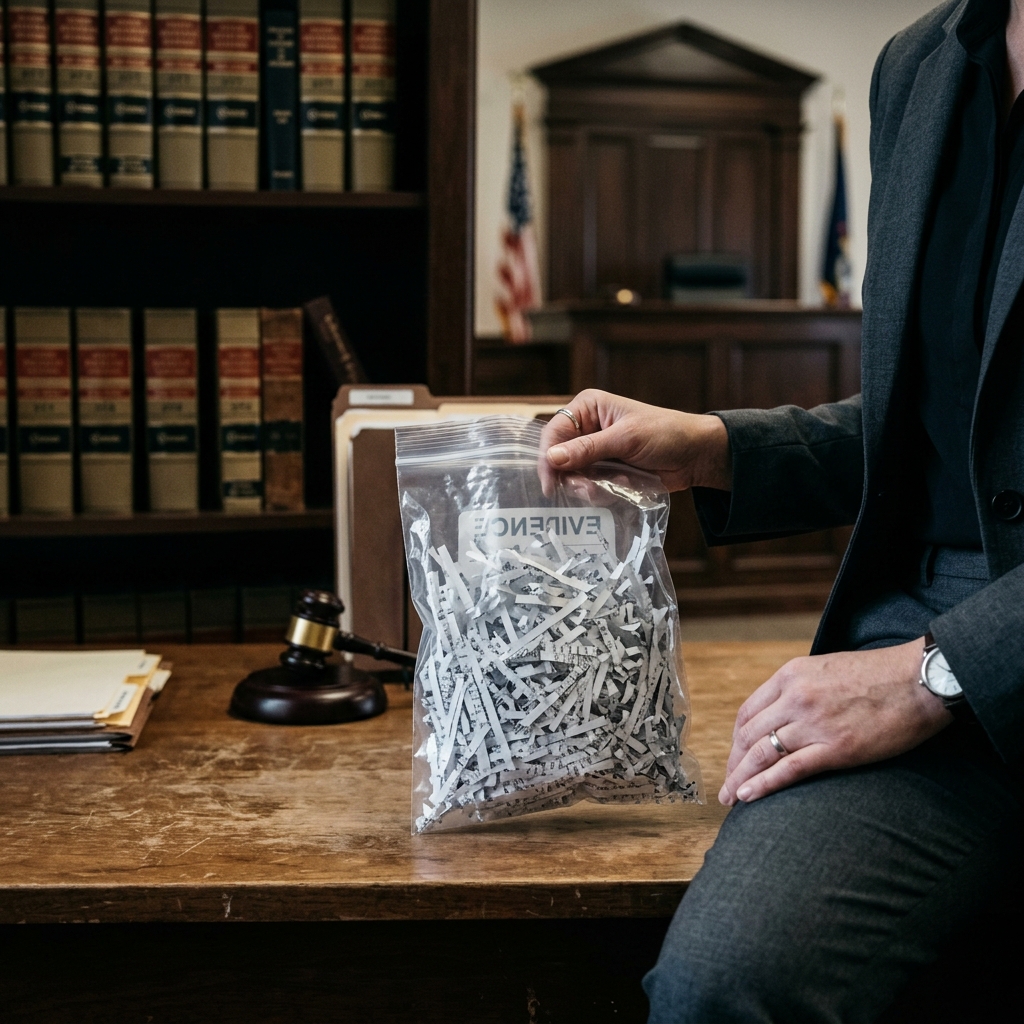
In movies and television, suspects sometimes try to escape consequences by swallowing drugs, tearing up documents, or tossing incriminating items out of sight. In real life, these split-second decisions rarely help. Instead, they often trigger additional criminal charges such as tampering with evidence and obstruction of justice, and can lead to harsher penalties than the underlying offense itself.
This article explains what the law typically says about destroying evidence, why “eating” or hiding it almost never works, how courts treat perishable or destroyed items, and what options defendants may still have after evidence has been tampered with.
Understanding What Counts as “Evidence” in Criminal Cases
Before looking at the consequences of destroying evidence, it helps to understand what counts as evidence in a criminal case. Evidence is anything that can be used to prove or disprove a fact in court. It can be physical, digital, or testimonial.
- Physical evidence: items like drugs, weapons, clothing, fingerprints, or documents.
- Digital evidence: phone records, emails, text messages, GPS data, or surveillance video.
- Biological evidence: blood samples, DNA swabs, bodily fluids, or hair.
- Testimonial evidence: witness statements, police reports, and expert testimony.
Once law enforcement has reason to believe an item is relevant to a crime, that item can be treated as evidence. If a suspect destroys or alters it, the law may view that behavior as a separate offense, even if the original crime is minor.
Common Charges for Destroying or Altering Evidence
Jurisdictions use different labels and statutes, but the same core idea appears everywhere: intentionally interfering with evidence can be a crime in its own right. Below are some of the most common charges that may arise.
Tampering with or Destroying Evidence
Many states have specific laws prohibiting the intentional destruction, alteration, or concealment of evidence that might be used in an official investigation or court proceeding. The key elements often include:
- The person knows or reasonably should know that an investigation, arrest, or prosecution is underway or imminent.
- The person acts with the purpose of impairing the item’s availability or usefulness as evidence.
- The conduct involves destroying, altering, hiding, or removing the item.
For example, a North Carolina case known as State v. James involved a suspect who swallowed suspected drugs during a traffic stop, leading to a separate conviction for evidence-tampering in addition to the drug offense. The court treated the act of eating the drugs as deliberate interference with the investigation.
Obstruction of Justice and Related Offenses
In some jurisdictions, destroying evidence may fall under broader crimes such as obstruction of justice, hindering prosecution, or interfering with law enforcement. These statutes generally penalize conduct that:
- Interferes with lawful police duties, like executing a search or arrest.
- Prevents the production of evidence or witnesses.
- Misleads authorities through false information or deceptive behavior.
For instance, a person who flushes drugs down a toilet while officers are entering the home may face both drug charges and obstruction-related counts for deliberately thwarting the investigation.
Additional Penalties on Top of the Original Charge
Lawyers commonly note that eating or destroying evidence “does not help” and frequently makes the situation worse. Even when the underlying offense is minor—such as possession of drug paraphernalia—tampering or obstruction can raise the overall exposure to jail time, fines, and probation conditions. In some cases, the tampering charge is graded as a felony even if the original crime is a misdemeanor.
Does Eating Evidence Ever Help Avoid Conviction?
Instinctively, some people believe that getting rid of the physical item prevents prosecutors from proving the crime. In limited circumstances, destroying evidence may complicate the case, but modern policing and evidentiary rules make it far less effective than many suspect.
Circumstantial vs. Direct Evidence
Courts allow both direct evidence (such as an officer seeing a suspect hold a bag of drugs) and circumstantial evidence (facts from which guilt is inferred). Circumstantial evidence can be enough to convict even when the physical object no longer exists.
For example, jurors might rely on:
- Officers’ observations of the suspect handling a substance.
- Statements admitted by the suspect before or during the incident.
- Video footage showing the suspect with the item.
- Witness testimony describing the item and its disappearance.
California law, for instance, explicitly permits convictions based solely on circumstantial evidence when the jury draws reasonable inferences from the facts presented. Destroying the physical item therefore does not automatically eliminate the prosecution’s case.
Health Risks and Medical Records as Evidence
Eating drugs or other harmful substances can lead to emergency medical treatment and hospitalization. Those medical records—such as toxicology reports—may themselves become evidence showing what was ingested and why. The attempt to destroy evidence thus generates new evidence about the suspect’s conduct and the substance involved.
Perishable Evidence and Photographic Documentation
Even where an item cannot practically be stored long-term, police and crime-scene teams rely on photographs and documentation rather than preserving every physical object. For example, perishable food items may be photographed and then discarded according to department procedures. The photo, description, and chain-of-custody paperwork can still be presented in court, limiting any benefit from destroying the item afterwards.
Government Duties to Preserve Evidence vs. Private Conduct
The law draws an important line between the government’s obligation to preserve evidence and the conduct of private individuals. These rules are grounded in constitutional due process and fair trial rights.
Government Duty to Preserve Material, Exculpatory Evidence
Under U.S. constitutional law, prosecutors and law enforcement are required to preserve certain categories of evidence that could significantly aid a defendant’s case. This duty focuses on:
- Material evidence: evidence that is directly relevant to an important issue in the case.
- Exculpatory evidence: evidence that tends to show the defendant is not guilty or supports a valid defense.
The duty begins when any state actor has collected and taken possession of the evidence as part of a criminal investigation, and it continues even after conviction for evidence that might be used in appeals.
When Failure to Preserve Can Help the Defendant
If the government loses or destroys material, exculpatory evidence, the defendant can ask the court to apply remedies such as:
- Suppressing related evidence.
- Limiting or excluding testimony about missing items.
- Dismissing charges in severe cases.
However, defendants must prove both that the evidence had potential exculpatory value and that authorities acted in bad faith—meaning intentional misconduct or deceit, not mere carelessness. This is a demanding standard, and courts will not grant relief automatically.
No Preservation Duty for Private Individuals
Private people generally have no legal obligation to preserve evidence for the government unless they are formally working with law enforcement. Nevertheless, when private individuals deliberately destroy or conceal evidence in an ongoing investigation, they can still be charged with tampering or obstruction. The absence of a preservation duty does not shield them from criminal liability for destructive acts.
How Destroyed Evidence Is Treated in Practice
Police, prosecutors, and courts handle destroyed or missing evidence through established procedures. The impact on a case depends on what was destroyed, why, and by whom.
| Scenario | Who Destroyed It? | Typical Legal Impact |
|---|---|---|
| Suspect eats or flushes drugs during arrest | Defendant | Added tampering/obstruction charge; case may still proceed on officer testimony and other evidence. |
| Police mishandle and lose potential DNA sample | Government | Possible motion for sanctions if sample was material and exculpatory, plus showing of bad faith required. |
| Restaurant discards food linked to a crime after photos taken | Third party / police | Photos and documentation used in place of the physical item; limited impact if food is not exculpatory. |
| Witness deletes text messages before turning phone over | Private witness | Potential obstruction issues; court may consider adverse inferences, depending on circumstances. |
Strategic and Sentencing Consequences
Even when the prosecution can still prove its case, evidence destruction affects how judges and juries view the defendant. It often signals consciousness of guilt and willingness to interfere with justice.
Impact on Plea Negotiations
Defense attorneys frequently see worse plea offers when their clients have tampered with evidence. Prosecutors may be less inclined to reduce charges or recommend lenient sentences because they view the defendant as uncooperative and deceptive.
Sentencing Considerations
Judges can treat evidence destruction as an aggravating factor at sentencing, especially when it endangers others—such as ingesting large quantities of drugs around children or in a crowded public space. Additional jail time, stricter probation conditions, and higher fines are all possible outcomes if the court believes the defendant deliberately hindered the investigation.
What Defendants Should Do Instead of Destroying Evidence
When faced with possible criminal charges, reacting impulsively by destroying evidence is rarely a sound choice. Several safer, legally protected options exist.
Exercise the Right to Remain Silent
Defendants have a constitutional right to remain silent and avoid self-incrimination. Politely declining to answer questions and refraining from tampering with evidence is far better than taking actions that add crimes to the list.
Request Legal Counsel Promptly
Speaking with a qualified criminal defense attorney allows suspects to understand their options, including whether certain items should be voluntarily surrendered, how to handle existing evidence, and whether any constitutional violations may affect the case.
Avoid Destroying or Altering Anything
Once a person suspects an investigation might occur, intentionally deleting files, tearing up documents, or discarding physical items can be construed as tampering. The safer course is to preserve the status quo and obtain legal advice. In some cases, defense counsel may even rely on existing evidence to demonstrate innocence or mitigate charges.
Frequently Asked Questions
Can I be charged if I swallowed drugs before the police saw them?
Possibly. If officers have reason to believe you possessed drugs and then intentionally destroyed them to avoid arrest, they may still charge you with possession based on circumstantial evidence and add a tampering or obstruction charge. The exact outcome depends on local law and the facts of the incident.
What if the police destroy evidence that could prove my innocence?
If the government destroys evidence that is both material and potentially exculpatory, and does so in bad faith, your lawyer can ask the court to suppress related evidence, limit testimony, or— in serious situations— dismiss the case or overturn a conviction. These remedies are not automatic and require careful proof in court.
Is it illegal to throw away something that might later become evidence?
If you have no reason to believe an investigation or prosecution is underway or imminent, simply discarding an item is usually not a crime. However, once you know or should know that authorities consider the item relevant to a case, destroying it can lead to tampering or obstruction charges.
Do courts treat food or other perishable items differently as evidence?
Perishable items like food are often photographed, documented, and then disposed of according to police procedures. The focus is on preserving accurate information rather than the item itself. Destroying such items after law enforcement has already documented them generally does not erase the evidentiary record.
If the prosecution loses evidence, will my case automatically be dismissed?
No. Courts first examine whether the lost evidence was material and exculpatory, and whether the government acted in bad faith. Only if those standards are met might the judge consider dismissal; more commonly, courts apply lesser sanctions such as limiting testimony or suppressing related evidence.
Key Takeaways
- Destroying evidence—whether by eating, hiding, or deleting—almost always increases legal risk.
- Modern criminal cases rely heavily on circumstantial evidence, documentation, and witness testimony, so the absence of an item rarely stops prosecution.
- Government agencies have strict duties to preserve certain forms of exculpatory evidence, and violations can sometimes benefit the defense.
- Private individuals, meanwhile, can face tampering or obstruction charges when they intentionally interfere with evidence during an investigation.
- The safest approach when confronted with potential criminal liability is to remain calm, avoid altering or destroying anything, and seek immediate legal counsel.
References
- Eating the Evidence — UNC School of Government. 2011-03-02. https://www.sog.unc.edu/blogs/nc-criminal-law/eating-evidence
- Will I get any jail time for eating evidence? — Avvo Legal Answers. 2012-03-03. https://www.avvo.com/legal-answers/will-i-get-any-jail-time-for-eating-evidence-3264932.html
- Preserving Evidence in Criminal Law Cases — Justia. 2022-01-01. https://www.justia.com/criminal/procedure/discovery-in-criminal-cases/preserving-evidence/
- Preservation of Evidence in Criminal Cases — Indiana State Medical Association. 2020-06-01. https://www.anthemeap.com/isma/find-legal-support/resources/criminal-law/legal-assist/preservation-of-evidence-in-criminal-cases
- Circumstantial Evidence in Criminal Cases — Eisner Gorin LLP. 2023-03-15. https://www.egattorneys.com/circumstantial-evidence-in-criminal-cases
- Perishable evidence? — Reddit r/ProtectAndServe (professional discussion). 2023-04-21. https://www.reddit.com/r/ProtectAndServe/comments/12uosga/perishable_evidence/
- When You See the Government’s Evidence Against You — Grabel & Associates. 2019-05-10. https://www.grabellaw.com/when-you-see-the-governments-evidence-against-you.html
Similar Articles








Read full bio of medha deb




