
Legal Basics of Video Monitoring Employees
Understand when workplace cameras are lawful, how to respect employee privacy, and how to build compliant surveillance policies.
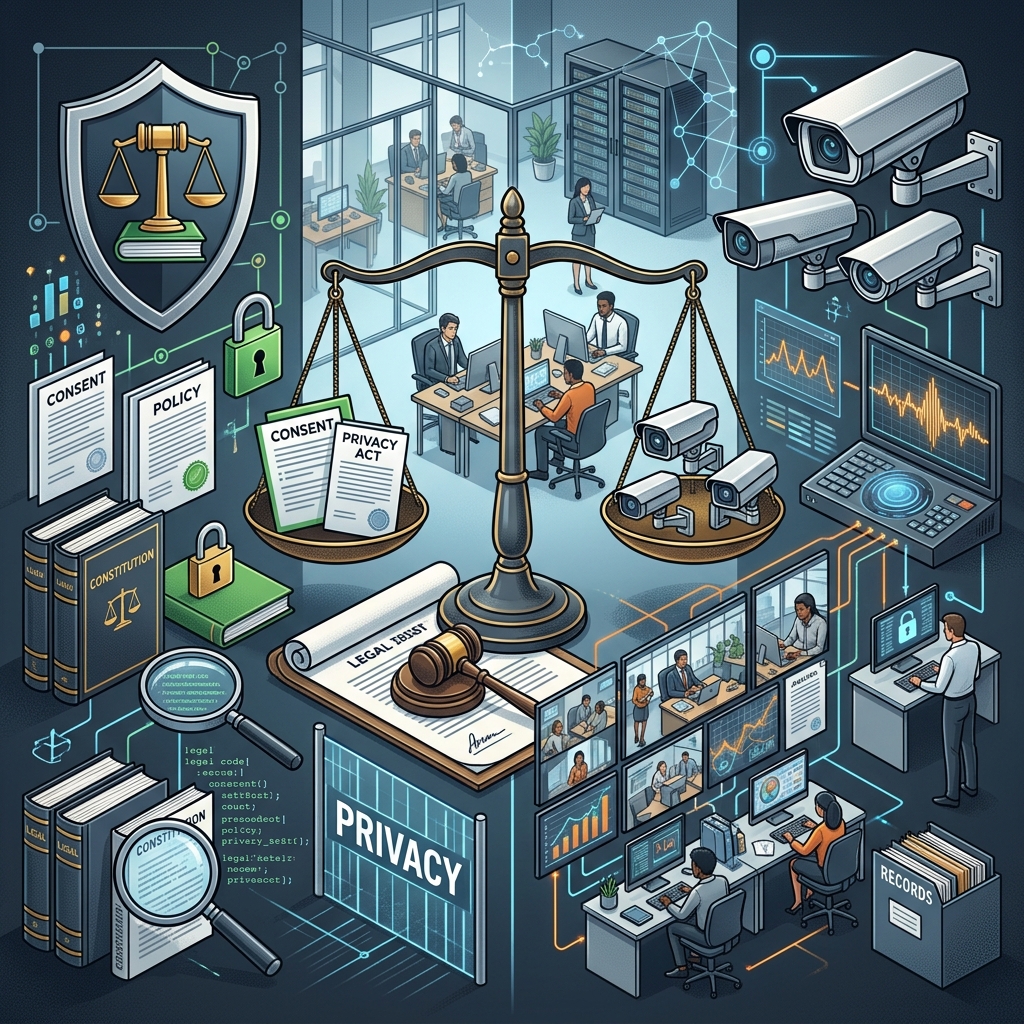
Many small business owners consider installing cameras or other monitoring tools to deter theft, improve safety, or evaluate performance. While workplace surveillance can provide real benefits, it also raises serious legal and privacy questions. Missteps in how you record employees may lead to lawsuits, regulatory problems, or damaged morale. This guide explains the core legal principles behind video and audio monitoring in the workplace and offers practical steps to implement compliant, transparent surveillance policies.
Why Employers Use Video Surveillance at Work
Video monitoring is widely used across industries, from retail and hospitality to manufacturing and professional offices. Employers typically adopt cameras for a mix of business reasons, many of which are legally recognized as legitimate.
Common objectives include:
- Security and loss prevention – Detecting theft, vandalism, or unauthorized access to premises.
- Safety monitoring – Observing high-risk areas such as loading docks, production lines, or cash-handling points.
- Incident documentation – Keeping visual records of accidents, workplace conflicts, or customer interactions.
- Operational efficiency – Studying workflows and processes to improve scheduling, staffing, or training.
- Compliance and integrity – Ensuring adherence to company policies, quality standards, and regulatory requirements.
Courts and regulators generally accept video surveillance when it serves legitimate business needs and is not used to harass, discriminate, or intrude on private activities.
Core Legal Concepts: Privacy and Reasonable Expectations
Most legal rules around workplace surveillance revolve around whether employees have a reasonable expectation of privacy in the area being monitored. In simple terms, the more an area looks and feels like a public or shared workspace, the more likely cameras will be allowed. Conversely, workers are legally entitled to privacy in places designed for personal use.
As a general principle in the United States:
- Common or semi-public areas – Surveillance is typically allowed, especially if the monitoring supports safety or security.
- Private areas – Recording is usually prohibited or heavily restricted where privacy expectations are strong.
Examples of areas where cameras are commonly allowed include:
- Store floors and customer service counters
- Warehouse aisles and production lines
- Building entrances, hallways, and parking lots
- Conference rooms and shared office spaces, when clearly disclosed
Areas where employees generally have a legally protected expectation of privacy include:
- Restrooms and locker rooms
- Changing rooms and lactation rooms
- Designated wellness or medical spaces
Federal and state authorities consistently treat recording in these private spaces as inappropriate and often illegal, regardless of business justification.
Video Versus Audio: Different Rules, Different Risks
Business owners often assume that video and audio recording are regulated in the same way. In reality, they fall under different legal frameworks, and audio creates significantly more risk. Understanding the distinction is essential before deploying any surveillance system.
Visual Recording (Video Only)
There is no broad federal statute that specifically bans video surveillance in workplaces. Instead, legality is assessed through privacy, employment, and sometimes state criminal laws.
- Employers generally may record video in work-related areas where employees do not reasonably expect privacy.
- Notice and consent for video are often recommended and sometimes required by state law or practical risk management.[10]
- Recording must not be used for illegal purposes, such as coercion, discrimination, or stalking.
Even when not strictly required, many regulators and legal experts advise that visible cameras and written policies are best practice for minimizing liability.[10]
Audio Recording and Wiretapping Laws
Audio recording implicates federal and state wiretap and eavesdropping laws, which are often stricter than rules for video-only systems.
Key points:
- The federal Electronic Communications Privacy Act (ECPA) generally prohibits intercepting oral, wire, or electronic communications without consent.
- An exception allows recording where at least one party to the conversation consents, commonly called a one-party consent rule.
- States are divided between one-party consent and all-party consent regimes; in all-party consent states, everyone in the conversation must agree before recording is lawful.
Because audio captures actual spoken content, regulators view unauthorized recording of conversations as a serious invasion of privacy that can give rise to criminal charges or civil damages.
| Aspect | Video (No Audio) | Audio (With or Without Video) |
|---|---|---|
| Primary law involved | Privacy, employment, and state surveillance laws | Federal ECPA and state wiretap/eavesdropping laws |
| Consent requirements | Often recommended; may be required in some states and contexts[10] | One-party or all-party consent, depending on state; explicit consent usually needed |
| Privacy risk level | Moderate, tied to location and purpose of monitoring | High, because conversations and personal information may be captured |
| Typical business uses | Security, safety, and process monitoring | Customer service review, call recording, internal investigations |
Federal Framework: What the Law Allows and Restricts
Federal law does not regulate every detail of workplace monitoring, but it provides important boundaries, particularly around audio and telephone recording.
Electronic Communications Privacy Act
The ECPA and related wiretap statutes limit how employers may intercept communications such as phone calls, in-person conversations, and electronic messages.
- Recording is generally allowed when at least one party to the conversation consents.
- Employers may monitor business communications on devices they own, but the monitoring must be tied to legitimate business purposes.
- Recording purely personal calls without consent is prohibited; employers must cease listening when they realize a call is personal.
These rules apply regardless of whether the workplace is unionized or non-union, though labor law may offer additional protections for certain employee recordings.
Telephone and Electronic Monitoring
Federal guidance allows significant employer access to business-related phone and computer activity, particularly where employees are clearly informed of monitoring.
- Employers may track internet usage, emails, and system activity on company-owned devices, subject to privacy and data-protection constraints.
- Written acknowledgement of monitoring policies helps establish consent and reduces disputes.
State Law Variations: One-Party and All-Party Consent
While federal law sets a baseline, state statutes often control the practical realities of workplace recording. The most important distinction is whether a state follows one-party or all-party consent for audio.
One-Party Consent States
In roughly three-quarters of states, only one participant in a conversation must be aware of and agree to recording.
- An employer who is part of the conversation may record it, or may authorize a recording, without informing the other party, as long as no other law is violated.
- Covert recording by employees who are part of the conversation may also be lawful under state criminal law, though it may raise workplace policy issues.
- Some states, such as Georgia, additionally criminalize recording private conversations of others when the recorder is not a participant, unless consent exists.
All-Party Consent States
About a dozen states require everyone in a conversation to consent before it is recorded.
- Employers in all-party states must obtain explicit agreement from workers and clients before recording audio.
- Standard practice includes written policies, consent forms, and visible signage to ensure informed agreement.
- Violations can lead to criminal charges, statutory damages, and reputational harm.
Employee-Recorded Conversations and Labor Rights
Legal questions arise not only when employers record employees, but also when employees record one another or supervisors. Labor law can protect certain employee recordings, especially when they relate to organizing or documenting potential violations.
Recent decisions by the National Labor Relations Board (NLRB) have held that:
- Employees may be protected when they secretly record conversations as part of concerted activity for their mutual aid and protection.
- Recording can be lawful when used to collect evidence of harassment, discrimination, or interference with labor rights.
- In some cases, federal labor law may preempt state consent requirements when employees are engaged in protected activity.
For employers, this means that policies banning all recording must be carefully drafted to leave room for legally protected employee conduct.
Designing a Legally Sound Workplace Surveillance Policy
To manage legal risk and employee expectations, small businesses should adopt a clear, written policy governing all forms of monitoring, from cameras to email tracking.
Key Principles for a Strong Policy
- Define legitimate purposes – Clearly state why surveillance is used, such as security, safety, or compliance.
- Specify locations and technologies – Describe where cameras are placed, whether audio is captured, and what digital monitoring occurs.
- Respect privacy zones – Explicitly forbid recording in bathrooms, locker rooms, and other sensitive spaces.
- Explain consent – Outline how employees are informed, how they acknowledge the policy, and what kind of signage is used for visitors.
- Limit access to recordings – Identify who may view, use, or share recordings and set retention periods to avoid unnecessary collection or disclosure.[10]
- Address employee recordings – Prohibit unauthorized recordings while carving out protections for legally protected concerted activity under labor law.
Communication and Training
A surveillance policy is effective only if employees understand it. Good practice includes:
- Providing the policy in the employee handbook and obtaining written acknowledgement at hiring.
- Conducting training on privacy expectations, acceptable device use, and how recordings may be used.
- Reviewing the policy periodically to ensure alignment with changes in technology and law.
Practical Steps for Implementing Cameras at Your Business
Small business owners contemplating video or audio monitoring should take concrete steps to reduce legal risk and maintain trust with employees.
Before Installation
- Consult legal counsel – Obtain advice on federal and state laws applicable to your location and industry.
- Audit your premises – Identify which areas are suitable for recording and which must remain camera-free due to privacy considerations.
- Decide on audio vs. video only – Because audio carries added legal obligations, many businesses opt for video-only equipment in employee areas.
- Update policies and contracts – Incorporate clear language into employment agreements and handbooks describing surveillance practices.
During Installation
- Ensure cameras are visible where appropriate, rather than hidden, to support transparency and reduce privacy complaints.
- Place signage at entrances informing employees and visitors that surveillance is in use, especially where audio may be recorded.[10]
- Configure systems to limit retention periods and protect stored footage from unauthorized access.[10]
Ongoing Operation and Review
- Conduct periodic reviews of camera placement and audio settings to ensure ongoing compliance with legal and internal standards.
- Restrict viewing of recordings to authorized personnel and use footage only for legitimate business purposes, such as investigations or safety analysis.[10]
- Respond promptly to employee concerns about surveillance, and adjust practices where they raise credible privacy or fairness issues.
Common Mistakes and How to Avoid Them
Despite good intentions, employers sometimes violate privacy or surveillance rules, often because they underestimated the legal implications of recording.
Frequent missteps include:
- Installing cameras in private areas such as restrooms or locker rooms.
- Recording audio in all-party consent states without obtaining explicit, informed consent.
- Listening to or storing personal phone calls recorded on business lines beyond what is allowed under federal law.
- Allowing unauthorized personnel to view or share surveillance footage, exposing the business to defamation or privacy claims.[10]
- Implementing blanket bans on employee recordings that violate labor protections for concerted activity.
Small businesses can avoid most of these issues by combining basic legal research, professional advice, and written policy controls.
Frequently Asked Questions
Can I install cameras without telling my employees?
In many jurisdictions, employers may legally use visible cameras in non-private work areas even if employees are not formally notified, provided the monitoring serves a legitimate business purpose and does not violate other laws. However, best practice is to disclose surveillance through signage and written policies to reduce claims of secret monitoring or invasion of privacy.[10]
Is audio recording at work always illegal?
No. Audio recording is allowed under federal law and many state laws when consent requirements are met and monitoring is tied to business needs. Nonetheless, because audio implicates wiretap and eavesdropping statutes, employers should obtain written consent and avoid recording purely personal conversations.
Are security cameras allowed in break rooms?
Cameras may be permissible in break rooms if the space functions largely as a common area and employees are informed of monitoring. However, if the room includes changing areas, restroom access, or other features that heighten privacy expectations, recording may be inappropriate or unlawful.
Do I need different rules for remote workers?
Monitoring remote workers often involves tracking company laptops or phones, which employers can legally review for business purposes. Recording audio or video in a home environment, however, raises additional privacy concerns. Employers should rely on clear consent, limit monitoring to work tasks on company devices, and avoid using tools that capture personal life beyond what is necessary.
What should I do if an employee secretly records conversations at work?
Whether discipline is appropriate depends on state law and labor protections. In one-party consent states, employee-created recordings may be lawful under criminal law, and federal labor law may protect recordings linked to concerted activity or evidence-gathering about workplace conditions. Employers should review the situation with counsel before taking action.
References
- Workplace Surveillance Rights — Workplace Fairness. 2023-05-01. https://www.workplacefairness.org/workplace-surveillance/
- Can Employers Use Video Cameras to Monitor Workers? — FindLaw. 2020-08-12. https://www.findlaw.com/employment/workplace-privacy/can-employers-use-video-cameras-to-monitor-workers.html
- How Employers Should Handle Audio and Video Recording in the Workplace — Purdue Global Law School. 2022-11-15. https://www.purduegloballawschool.edu/blog/news/audio-video-recording-in-the-workplace
- Is Audio Recording in the Workplace Legal? — Solink. 2023-04-10. https://solink.com/resources/industry-insights/is-audio-recording-in-the-workplace-legal/
- Workplace Recordings and Eavesdropping: Limiting Criminal and Legal Liabilities — Seyfarth Shaw LLP. 2023-07-20. https://www.seyfarth.com/news-insights/workplace-recordings-and-eavesdropping-limiting-criminal-and-legal-liabilities.html
- Video Surveillance – Texas Guidebook for Employers — Texas Workforce Commission. 2021-06-30. https://efte.twc.texas.gov/video_surveillance.html
- Understanding the Laws Behind Employer Surveillance of Employees in Georgia — LOSO LLC. 2023-09-05. https://losollc.com/understanding-the-laws-behind-employer-surveillance-of-employees-in-georgia/
Similar Articles








Read full bio of medha deb




