
Indiana Child Custody: A Complete Guide To Best-Interest Rules
Understand how Indiana courts decide child custody by focusing on the child’s best interests, legal standards, and practical family dynamics.
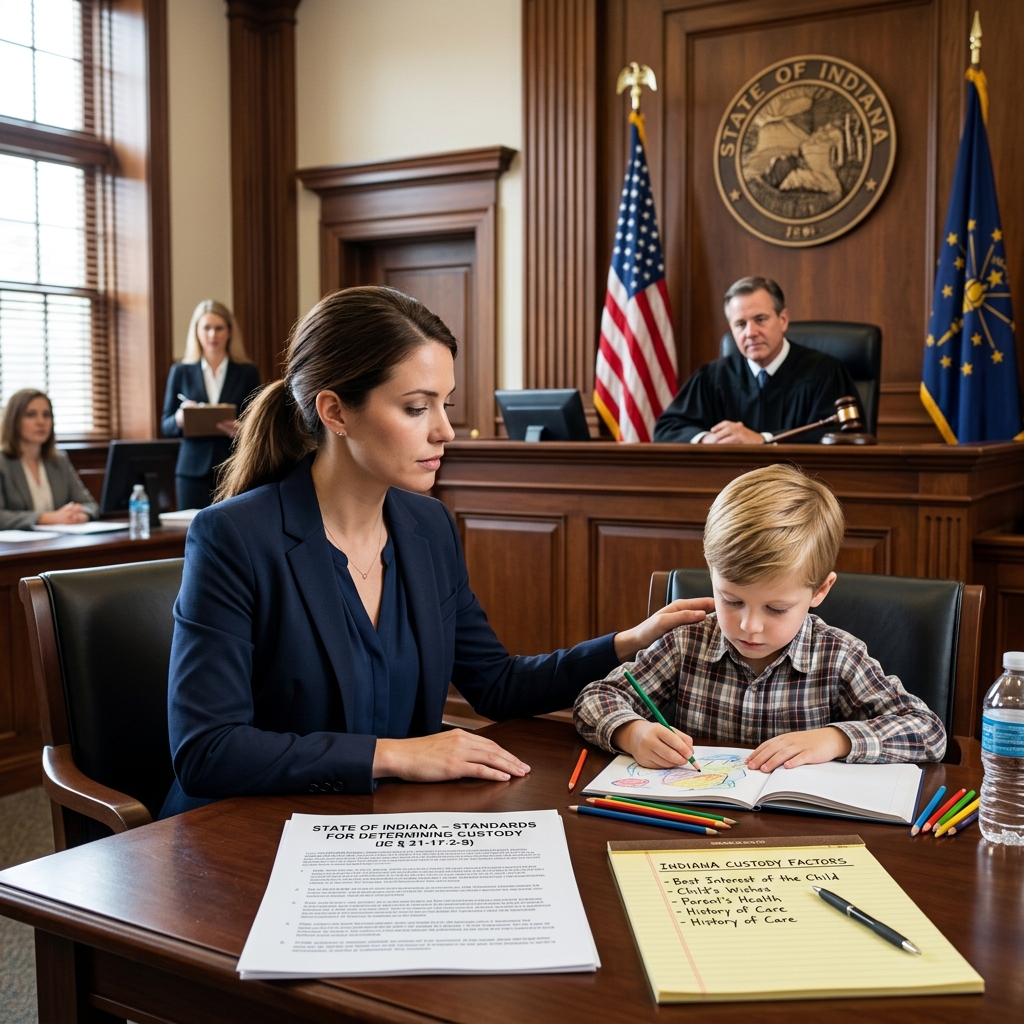
Child custody decisions in Indiana are guided by a single overarching standard: what arrangement serves the best interests of the child. Indiana law does not automatically favor mothers or fathers, nor does it presume one type of custody is better than another. Instead, judges look at a list of statutory factors, practical parenting considerations, and the family’s circumstances to craft a custody order.
Understanding Types of Custody in Indiana
Before looking at the factors that influence custody, it is important to understand how Indiana categorizes custody itself.
Physical Custody
Physical custody refers to where the child lives most of the time. The parent with primary physical custody is responsible for the child’s day-to-day supervision and routine.
- Primary physical custody – the child resides mainly with one parent.
- Joint physical custody – the child spends substantial, structured time living with each parent, often on a near 50/50 schedule.
- Parenting time – the time the noncustodial parent spends with the child; this is governed by parenting time guidelines and court orders.
Legal Custody
Legal custody concerns who has the authority to make major decisions about the child’s upbringing.
- Health care choices, including medical and mental health treatment.
- Education, such as school enrollment and special services.
- Religious and cultural upbringing.
Parents may share joint legal custody, where both must participate in important decisions, or one parent may have sole legal custody if joint decision-making is not practical or safe.
Joint vs. Sole Custody
| Custody Type | Key Features | When It May Be Used |
|---|---|---|
| Joint legal custody | Both parents share authority over major decisions; must communicate and cooperate. | When parents can work together and there is no significant safety risk. |
| Sole legal custody | One parent has final decision-making authority. | When conflict, distance, or unsafe behavior makes joint decisions impractical. |
| Primary physical custody | Child lives mostly with one parent; the other has parenting time. | Common when parents live far apart or work schedules prevent equal time. |
| Joint physical custody | Child spends substantial, structured time with each parent. | Used when parents live near each other and can maintain a stable, shared schedule. |
The “Best Interests of the Child” Standard
Indiana Code § 31-17-2-8 sets out the framework judges must follow when deciding custody. This statute requires courts to make custody decisions solely based on the child’s best interests and explicitly states there is no presumption favoring either parent.
Core Statutory Factors
Under Indiana law, judges must consider all relevant information, including the following principal factors when determining custody:
- Age and sex of the child
- Parents’ wishes regarding custody and parenting time
- Child’s own wishes, giving more weight if the child is at least 14 years old
- Child’s relationships with each parent, siblings, and other significant people
- Adjustment to home, school, and community
- Mental and physical health of the child, parents, and other involved parties
- Evidence of domestic or family violence by either parent
- Evidence of care by a de facto custodian (a non-parent acting like a parent)
- Any power of attorney naming a parent or de facto custodian and its terms
These factors are not exclusive. A judge can weigh any other issue that reasonably affects the child’s welfare.
How Indiana Courts Apply These Factors
Although the law lists specific factors, judges have considerable discretion in how they balance those considerations in individual cases. The same factor may be more or less important depending on the family’s situation.
Age, Sex, and Developmental Needs
The child’s age and sex often influence what kind of parenting arrangement will be most stable and supportive.
- Infants and toddlers may need frequent, shorter visits with the noncustodial parent to maintain continuity and attachment.
- School-age children may benefit from predictable routines aligned with school schedules and extracurricular activities.
- Teens may have more input on the schedule and can handle longer stays with each parent.
Sex of the child is referenced in the statute but does not permit gender-based discrimination; instead, it relates to the child’s specific needs and how each parent can meet them.
Wishes of the Parents and the Child
Both the parents’ preferences and the child’s wishes are considered, though neither is decisive on its own.
- Parents may propose a parenting plan detailing custody, holidays, transportation, and decision-making responsibilities.
- A child’s preference is given greater weight at age 14 or older, but judges still must evaluate whether the preferred arrangement truly serves the child’s best interests.
- The court may hear the child’s views in chambers or through other procedures designed to protect the child from pressure or conflict.
Family Relationships and Stability
Judges look closely at the depth and quality of the child’s relationships with parents, siblings, and other caregivers.
- Frequency and consistency of contact with each parent.
- History of involvement in daily routines, schoolwork, medical appointments, and extracurricular activities.
- Supportive bonds with siblings and extended family members.
The child’s adjustment to home, school, and community is equally important. A move to a new school or a distant city may disrupt friendships, activities, and academic progress, and courts will analyze whether such changes are justified.
Mental and Physical Health
The mental and physical health of everyone involved can significantly affect custody decisions.
- Serious health issues may limit a parent’s ability to provide certain types of care or supervision.
- Untreated mental illness or substance abuse can raise safety concerns.
- Parents who actively seek treatment and demonstrate stability may still be considered capable caregivers, depending on the circumstances.
Domestic Violence and Safety Concerns
Evidence of domestic or family violence is a critical factor that can strongly influence the outcome of a custody case. Courts prioritize safety and may limit or supervise parenting time in such situations.
- Patterns of physical, emotional, or psychological abuse are considered, not just isolated incidents.
- Orders for protection, police reports, and prior findings by other courts may be relevant.
- Judges may order supervised contact or restrict overnight visits if necessary to protect the child.
De Facto Custodians
Indiana law recognizes the concept of a de facto custodian—a non-parent who has effectively stepped into a parental role as the primary caregiver and financial supporter for a significant period.
- For children under age three, the person must have served as primary caregiver and financial supporter for at least six months.
- For children age three or older, the period must be at least one year.
- Only time before a custody case is filed counts toward these periods.
If the court finds sufficient evidence that someone is a de facto custodian, it must consider additional factors related to that person’s relationship with the child when deciding custody.
Parenting Time and Indiana Guidelines
In addition to custody determinations, Indiana courts must decide how much time the child will spend with each parent. The Indiana Parenting Time Guidelines provide a detailed framework for scheduling time based on the child’s age and developmental needs.
General Approach to Parenting Time
The Guidelines are designed to promote frequent, meaningful contact with both parents when it is safe to do so. They cover regular weekly schedules, holidays, school breaks, and special occasions.
- For very young children, parenting time is typically more frequent but shorter in duration.
- As children grow older, longer visits and overnight stays become more common.
- School-aged children often follow schedules that respect school calendars and activities.
Age-Based Parenting Time Examples
While courts may adjust schedules to fit the family’s situation, the Guidelines offer typical patterns that judges often use as a starting point.
- Children up to four months old – noncustodial parents usually receive very brief, regular visits (often a couple of hours) to avoid long separations that might disrupt feeding and sleep routines.
- Children between 10 and 18 months old – longer visits, such as up to eight hours on certain holidays, may be appropriate.
- Children between 19 and 36 months old – visits may extend up to 10 hours on holidays and may include occasional overnights.
- Children three years and older – noncustodial parents typically receive time on all scheduled holidays, along with regular weekly visits and extended time during school breaks.
Additional Factors in Parenting Time Decisions
Courts may modify the guideline schedule based on several considerations:
- Distance between parents’ homes – long travel times may reduce the feasibility of frequent exchanges.
- Parental cooperation – judges may look at how willing each parent is to support the child’s relationship with the other parent.
- Work schedules – shift work, travel, or irregular hours may require creative scheduling.
- Special needs – children with medical or educational needs may require customized, stable arrangements.
Modifying Custody and Parenting Time
Court orders are not necessarily permanent. Indiana allows custody and parenting time orders to be modified if there has been a substantial change in circumstances and the change would be in the child’s best interests.
Common Reasons for Modification
- A parent relocates, especially to a distant city or state.
- Changes in the child’s needs, such as new medical conditions or schooling requirements.
- Emerging concerns about safety, stability, or domestic violence in one parent’s household.
- Persistent inability of parents to cooperate on decisions, undermining joint legal custody.
Courts will reapply the best-interest factors to decide whether the new circumstances justify altering an existing order.
Practical Tips for Parents in Indiana Custody Cases
Although each case is unique, certain practical steps can help parents present their situation clearly and support arrangements that serve their child’s welfare.
- Document involvement – keep records of school meetings, medical appointments, extracurricular activities, and time spent with the child.
- Prioritize stability – propose schedules that maintain consistent routines, especially during school weeks.
- Encourage safe contact with the other parent when appropriate – cooperation can be a positive factor in custody decisions.
- Address health or substance issues through treatment and support, and be prepared to show progress.
- Seek legal advice – family law in Indiana can be complex, and an attorney or legal aid organization can explain your options in more detail.
Indiana Child Custody FAQs
Does Indiana favor mothers or fathers in custody decisions?
No. Indiana law explicitly states there is no presumption favoring either parent in custody cases. The court must focus solely on the child’s best interests.
At what age can a child choose which parent to live with?
A child cannot make the final decision, but the court must consider the child’s wishes and give those wishes more weight when the child is at least 14. The judge still evaluates whether the preferred arrangement is in the child’s best interests.
What is the difference between legal custody and physical custody?
Legal custody involves authority over major decisions about the child’s life (health care, education, religion), while physical custody determines where the child lives most of the time. Parents can share one or both types of custody, or one parent can be awarded sole custody.
Can a non-parent get custody in Indiana?
Yes, in limited situations. If a non-parent has been the child’s primary caregiver and financial supporter for the required time, the court may find that person is a de facto custodian and consider awarding custody or significant parenting time based on the child’s best interests.
How do Indiana Parenting Time Guidelines affect my case?
The Guidelines provide a default framework for parenting schedules that courts often use as a starting point. Judges may follow them closely or adjust them based on the child’s age, safety concerns, parents’ schedules, and other best-interest factors.
References
- Indiana Code § 31-17-2-8, Custody Order — State of Indiana / Justia summary. 2023-01-01. https://law.justia.com/codes/indiana/title-31/article-17/chapter-2/section-31-17-2-8/
- Indiana Custody — WomensLaw.org. 2023-05-01. https://www.womenslaw.org/laws/in/custody/all
- Indiana Child Custody Laws: FAQs, Guidelines & Legal Advice — Cordell & Cordell. 2023-06-01. https://cordellcordell.com/blog/indiana-child-custody-questions/
- Understanding Child Custody Laws in Indiana — Lacy Law Office, LLC. 2022-09-15. https://www.lacylawoffice.com/blog/understanding-child-custody-laws-in-indiana
- Indiana Parenting Time Guidelines (PDF) — Indiana Supreme Court. 2022-01-01. https://rules.incourts.gov/pdf/PDF%20-%20Parenting/parenting.pdf
- Indiana Parenting Time Guidelines — Indiana Courts. 2022-01-01. https://rules.incourts.gov/Content/parenting/default.htm
- Custody – General — Indiana Legal Services, Inc. 2021-04-10. https://www.indianalegalservices.org/custody-general/
Similar Articles








Read full bio of Sneha Tete


