
Kansas Overtime Law: 5 Practical Compliance Tips For Employers
A clear guide to Kansas overtime rules, exemptions, and how state and federal standards interact for employers and workers.
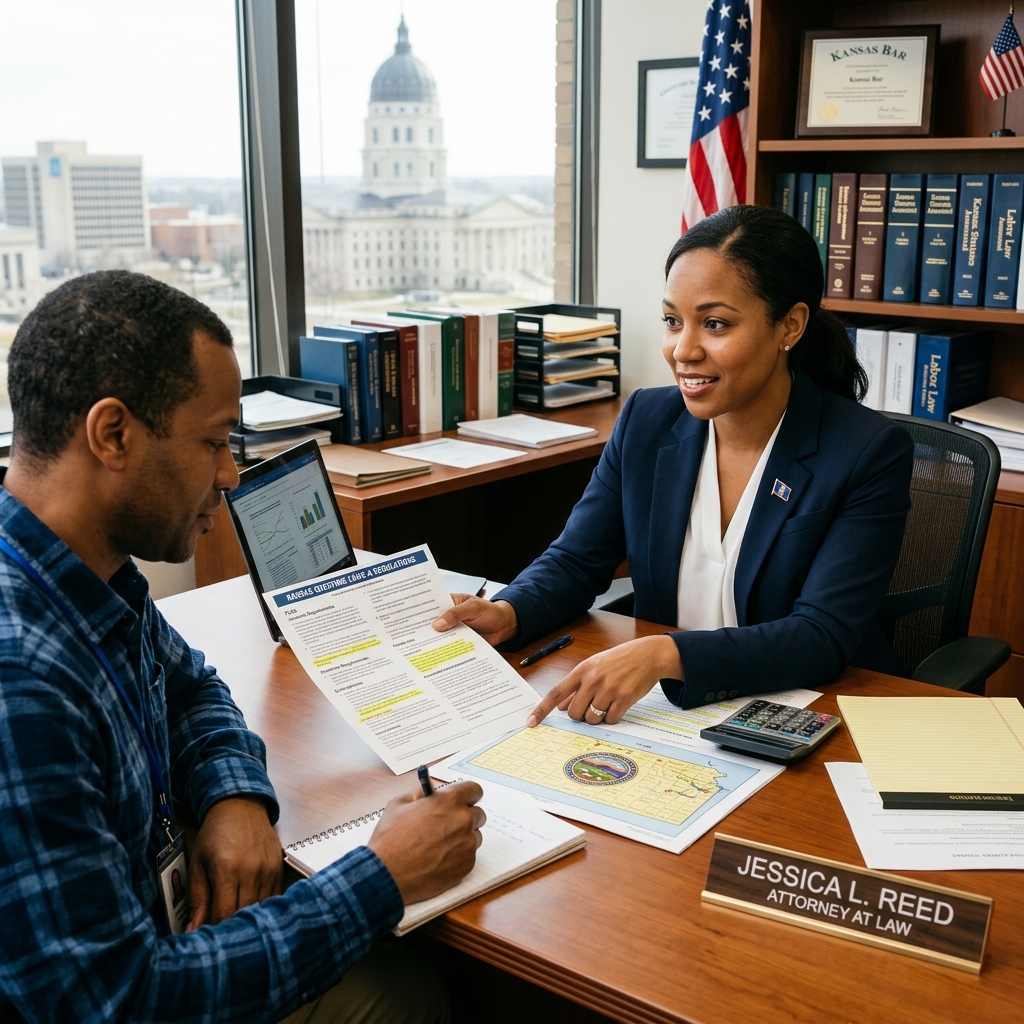
Kansas overtime law is not always the same as the federal overtime rule, and that difference matters for both employers and workers. In many situations, Kansas law requires overtime pay only after 46 hours in a workweek, while federal law generally requires overtime after 40 hours for covered nonexempt employees.
That overlap can make compliance confusing, especially for employers that operate across state lines or have employees whose duties may fall into different exemption categories. The safest approach is to identify which law applies first, then calculate pay using the rule that gives the worker the stronger protection.
How Kansas overtime differs from federal law
Kansas has its own overtime provision that sets a higher weekly threshold than the federal Fair Labor Standards Act in many cases. Under Kansas law, overtime pay is due after 46 hours in a week, not after 40.
Federal law still applies when the employer is covered by the FLSA and the employee is nonexempt under that statute. Because federal law generally requires time-and-a-half after 40 hours, many Kansas workers are ultimately protected by the federal standard instead of the state threshold.
In practical terms, the 46-hour state rule becomes most important when an employee is not covered by the federal overtime rule but is covered by Kansas law. For employers, that means the overtime analysis should not stop at state law alone.
When overtime starts
For employees covered by Kansas overtime rules, the premium rate is generally triggered once the employee works more than 46 hours in a workweek.
For employees covered by the FLSA, overtime generally begins after 40 hours worked in a workweek. The overtime premium is one and one-half times the employee’s regular rate of pay.
The key point is that the applicable standard depends on coverage. A worker may be protected by federal law, state law, or both, and the employer must follow whichever rule requires the higher level of pay protection.
Employees covered by special Kansas overtime rules
Kansas law includes a specific overtime rule for certain public safety and emergency response personnel. This rule applies to employees engaged in emergency medical services, fire protection, law enforcement activities, and certain correctional security personnel.
For these employees, overtime pay at one and one-half times the regular rate is required when tours of duty exceed 258 hours in a span of 7 to 28 consecutive days.
This structure is different from the standard weekly overtime rule and reflects the unusual schedules often used in public safety work. Employers in these sectors need to pay close attention to how work periods are measured, because the overtime trigger is based on the longer duty cycle rather than a simple seven-day week.
Who is exempt from Kansas overtime law
Not every worker is covered by Kansas overtime protections. The state excludes several categories of employees from its overtime rules.
- Administrative employees
- Professional employees
- Executive employees
- Employees who sell motor vehicles
- Jail inmates serving a sentence in county jail
- Persons sentenced to the custody of the secretary of corrections
These exemptions matter because a person who is not entitled to overtime under state law may still be entitled to overtime under federal law, depending on the employer’s business activities and the employee’s actual job duties.
Job title alone does not control whether an employee is exempt. In wage and hour law, the real question is usually what the employee actually does on the job and whether the legal requirements for an exemption are met.
How employers determine which rule applies
To decide whether Kansas law or the FLSA controls, courts and regulators look at the employer’s annual revenue and interstate commerce activity.
That matters because the FLSA does not reach every workplace in exactly the same way. Some businesses may fall outside federal coverage, but still be subject to Kansas overtime law. Others may be covered by both laws, which usually means the federal rule will set the baseline after 40 hours.
For payroll teams, this means overtime compliance is not a one-size-fits-all exercise. The employer should review the size and nature of the business, the worker’s duties, and the relevant workweek records before deciding how to pay overtime.
Common payroll issues that create mistakes
Overtime errors often happen when employers rely on a job label instead of a legal classification. An employee may be called a manager, but if the actual duties do not satisfy the exemption tests, overtime may still be owed.
Another common mistake is counting paid leave, holidays, or other non-working time as hours worked for overtime purposes. Overtime is generally based on actual hours worked, not simply hours paid.
Employers also sometimes use the wrong workweek definition or fail to apply the federal rule when it is more protective than the Kansas rule. Because the law can shift depending on coverage, careful recordkeeping is essential.
Overtime calculation basics
Under the standard overtime formula, the employee receives one and one-half times the regular hourly rate for each overtime hour.
| Example | Calculation | Result |
|---|---|---|
| Regular rate | $20 per hour | — |
| Overtime rate | $20 x 1.5 | $30 per hour |
| Overtime hours | 6 hours | $180 overtime pay |
This example is only illustrative, but it shows how overtime premium pay is normally calculated once the applicable threshold is crossed.
Comp time and public employers
Government workplaces sometimes use compensatory time or equivalent time off instead of immediate overtime pay, depending on the governing rules and the employee’s status. Kansas administrative rules addressing overtime for certain state employees describe compensation, comp time limits, and equivalent time off procedures.
Those rules are more specialized than the general private-sector overtime framework. Employers in the public sector should check the specific regulations that govern their workforce before assuming the same payroll method applies across all employees.
What happens when an employer gets overtime wrong
When an employer fails to pay overtime correctly, the employee may be entitled to recover the unpaid premium amount. Under federal law, wage disputes can also lead to additional liability if the violation is found to be willful or repeated, so mistakes can become expensive quickly.
For workers, the first step is often to compare actual hours worked against the applicable weekly threshold and review pay stubs or time records. For employers, fixing the issue promptly is usually better than waiting for a formal complaint or investigation.
If there is uncertainty about coverage or exempt status, the employer should review the duties test, the pay structure, and the company’s business coverage under federal law before deciding that overtime is not owed.
Practical compliance tips for Kansas employers
- Track actual hours worked each workweek.
- Confirm whether the employee is covered by federal, state, or both overtime rules.
- Review exempt classifications regularly instead of relying on old job descriptions.
- Apply the rule that gives the employee the stronger overtime protection.
- Keep payroll records that support the regular rate and overtime calculation.
These steps reduce the chance of underpayment and make it easier to defend a payroll decision if questions arise later.
Frequently asked questions
Does Kansas always require overtime after 46 hours?
No. Kansas law uses a 46-hour threshold, but federal law may require overtime after 40 hours for covered nonexempt employees. In many workplaces, the federal rule is the one that actually controls.
Can an employer count paid vacation as hours worked?
Generally, overtime depends on actual hours worked, not paid time off. That means vacation, holiday, or sick time usually does not count toward the overtime threshold.
Are salaried employees automatically exempt?
No. Salary alone does not determine exempt status. The employee’s duties and the legal exemption requirements matter more than the pay method.
Do Kansas overtime rules apply to public safety workers differently?
Yes. Kansas has a special rule for certain emergency medical, fire, law enforcement, and correctional security employees, with overtime based on hours worked over a longer duty cycle.
What should a worker do if overtime is missing from a paycheck?
The worker should compare the hours worked to the applicable threshold and ask the employer for a correction. If the issue is not resolved, the worker can contact the Kansas Department of Labor for guidance.
Why the Kansas rule still matters
Even though federal overtime law often governs day-to-day payroll decisions, Kansas law remains important because it can apply in cases where federal coverage is limited or disputed. It also creates special rules for certain emergency and public safety jobs that do not fit neatly into the ordinary 40-hour model.
For that reason, both workers and employers benefit from checking the state rule, the federal rule, and the employee’s exemption status together rather than looking at any single source in isolation.
References
- Kansas Overtime Laws — FindLaw. 2026. https://www.findlaw.com/state/kansas-law/kansas-overtime-laws.html
- Kansas employment law overview — Brightmine. 2026. https://www.brightmine.com/us/resources/hr-compliance/kansas-employment-law/
- Kansas Labor Law Posters — J. J. Keller. 2026. https://www.jjkellerlaborlawposters.com/labor-law-posters/State-Posters/kansas
- Overtime and Other Compensation — Kansas Adjutant General’s Department. 2026. https://www.kansastag.gov/DocumentCenter/View/566/03407-Overtime-and-Other-Compensation-PDF
- Kansas Overtime Laws — Kansas Department of Labor. 2026. https://www.dol.ks.gov/employers/workplace-laws/workplace-laws-faqs
- K-A.R. 1-5-24 – Overtime — Cornell Legal Information Institute. 2026. https://www.law.cornell.edu/regulations/kansas/K-A-R-1-5-24
- Workplace Laws and Requirements — Kansas Department of Labor. 2026. https://www.dol.ks.gov/employers/workplace-laws
Similar Articles








Read full bio of Sneha Tete




