
Juvenile Status Offenses and Age Limits Explained
A clear guide to status offenses, age boundaries, and how the juvenile justice system responds to youth misbehavior.
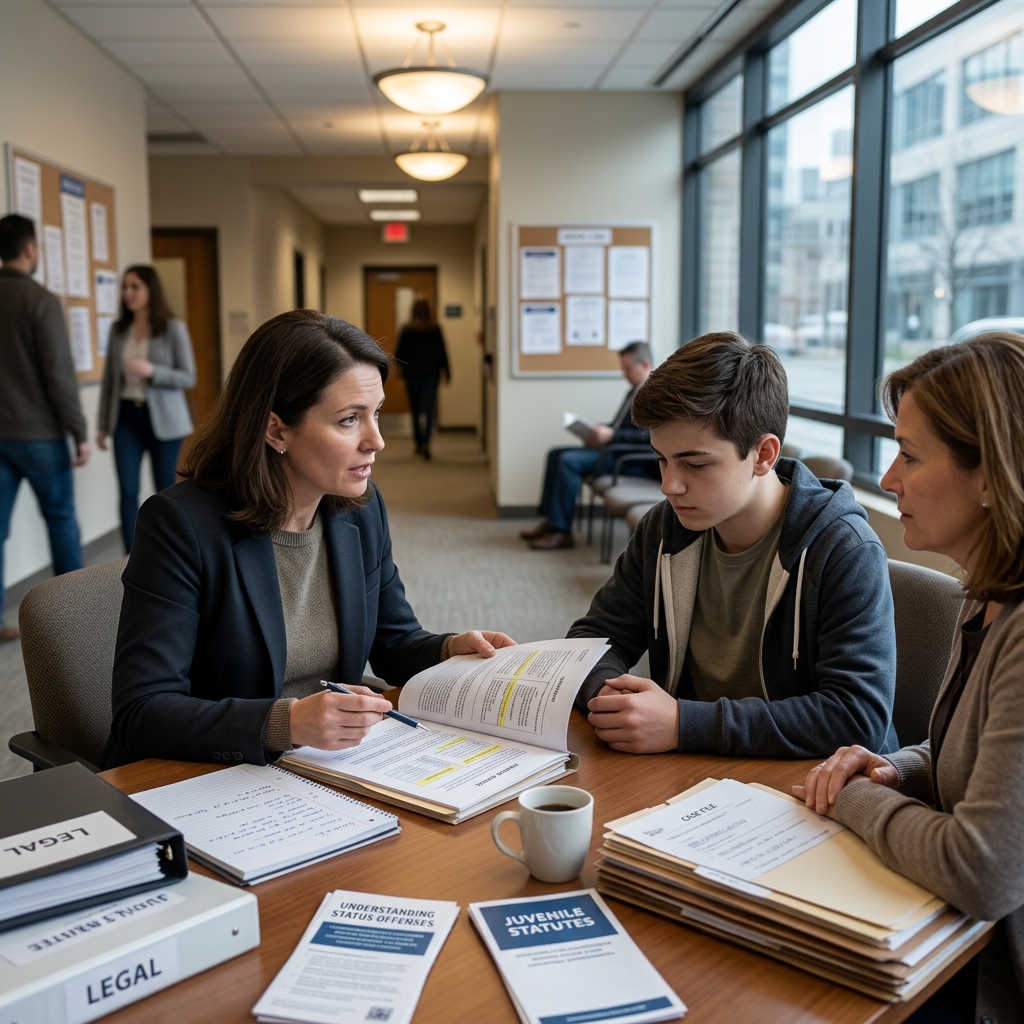
Young people sometimes engage in risky or defiant behavior, but not all misbehavior is treated the same way by the law. Some acts are illegal only because the person involved is underage. These are known as juvenile status offenses, and they sit at the intersection of parenting, education, and the justice system.
This article explains what status offenses are, how age boundaries shape juvenile court jurisdiction, what typically happens when a minor is accused of a status offense, and how families and communities can respond in ways that support youth rather than push them deeper into the justice system.
Understanding Juvenile Status Offenses
A status offense is conduct that is a violation of law solely because of the person’s age. If an adult did the same thing, it would not be a crime or delinquent act.
- Only applies to minors (usually under 18 years old).
- Not considered criminal behavior for adults.
- Historically treated as non-delinquent, non-criminal misbehavior.
Because these acts are tied to youth status, they are usually processed in juvenile courts or handled through diversion programs rather than adult criminal courts.
Common Types of Status Offenses
While details vary by state, several behaviors are widely recognized as status offenses across the United States.
Frequent Examples
- Truancy (skipping school regularly)
- Running away from home
- Violating a curfew imposed by a city, county, or state
- Underage drinking or possession of alcohol
- Underage tobacco use or possession in some jurisdictions
- Ungovernability, sometimes defined as being beyond the reasonable control of parents or guardians
Some states group these behaviors under labels like “children in need of services” (CHINS) or “unruly” youth, emphasizing support rather than punishment.
Status Offenses vs. Delinquent Acts
It is important to distinguish status offenses from delinquency. Delinquent acts are behaviors that would be crimes even if an adult committed them, such as theft or assault.
| Feature | Status Offense | Delinquent Act |
|---|---|---|
| Illegality | Illegal only because of youth’s age | Would be criminal regardless of age |
| Typical examples | Truancy, curfew violations, underage drinking | Theft, drug distribution, assault |
| Primary goal of intervention | Behavioral guidance, family support, community services | Public safety, accountability, rehabilitation |
| Court label | Often “in need of supervision” or similar | “Delinquent” or “juvenile offender” |
Age Boundaries in the Juvenile Justice System
Every state sets its own age limits for when juvenile courts can exercise jurisdiction and when youth can be treated as adults for criminal purposes.
Lower and Upper Age Limits
States typically define a range of ages during which a person can be treated as a “juvenile” for court purposes:
- Lower age of jurisdiction: the minimum age at which a child can be processed in juvenile court for delinquency, often between 6 and 10 years old depending on the state.
- Upper age of jurisdiction: usually under 18, though some states extend juvenile court authority for certain dispositions slightly beyond age 18.
For example, one policy review found that as of 2014, states had minimum ages for delinquency jurisdiction ranging from 6 to 10 years old. Other statutes, such as in Texas, define a juvenile as a person who was at least 10 but not yet 17 when the act occurred.
Transfer to Adult Court
In serious delinquency cases, some states allow youth to be “certified” or transferred to adult court, particularly for violent or serious felony-level offenses. This mechanism does not apply to status offenses, but understanding it shows how age interacts with the seriousness of behavior.
How Status Offense Cases Enter the System
Status offense cases can start in several different ways, and much depends on local practices, school policies, and law enforcement discretion.
Typical Pathways
- School reports for repeated truancy or disruptive conduct.
- Police contacts for curfew violations, running away, or public misbehavior.
- Family complaints when parents feel unable to manage a child’s behavior.
- Referrals from social service agencies working with the family.
Law enforcement and other officials often have discretion. For instance, an officer who encounters a youth out after curfew may issue a warning, take the young person home, or initiate formal proceedings.
Diversion and Informal Handling
Many status offense matters are never formally petitioned in juvenile court. Instead, communities rely on diversion and informal responses.
- Verbal warnings or written notices.
- School-based interventions (counselors, attendance programs).
- Community or nonprofit programs for runaway or ungovernable youth.
- Supportive services delivered in the home or local community.
Nonetheless, thousands of cases each year move forward in juvenile courts. Federal data show that in 2022, courts with juvenile jurisdiction formally disposed roughly 62,000 status offense cases nationwide.
What Happens in Juvenile Court?
When a status offense case is formally filed, the young person appears in juvenile court, which has special procedures and terminology distinct from adult criminal courts.
Key Court Concepts
- Petition: a formal document alleging the youth committed a specific status offense.
- Adjudication: the juvenile court’s determination whether the allegations are true.
- Disposition: the court’s response, including any supervision or services ordered.
Potential Court Responses
Court-ordered responses to status offenses vary widely by state law. Common dispositions include:
- Suspension or restriction of the youth’s driver’s license.
- Payment of fines or restitution.
- Required participation in counseling, education, or skills programs.
- Placement with relatives, foster care, or group homes when home conditions are unsafe or unmanageable.
- Community service or participation in after-school programs.
In some jurisdictions, courts may also require parents to attend counseling or parenting classes to address family dynamics linked to the youth’s behavior.
Detention and Court Order Violations
Although status offenses are noncriminal behaviors, failing to comply with a court order (such as ignoring mandated counseling or curfew) can lead to more serious consequences. Many courts have authority to place youth in secure facilities when they violate court orders.
Advocates caution that relying on detention for noncriminal misbehavior can disrupt schooling, family relationships, and long-term outcomes, and recommend stronger emphasis on community-based services instead.
Why Status Offenses Matter
Status offenses may appear minor, but they are important for several reasons.
Impact on Youth and Families
- Educational consequences: Truancy is closely tied to poor academic performance and higher dropout risk.
- Family stress: Running away or ungovernability can signal deeper conflict or safety issues at home.
- System involvement: Court processing, even for minor misbehavior, can expose youth to more serious justice involvement.
- Long-term records: Some jurisdictions maintain records of juvenile court contacts that can affect future opportunities.
Policy Debates
Researchers and policymakers continue to debate how status offenses should be handled.
- Whether very young children should ever be brought into juvenile court for misbehavior.
- How to balance school attendance requirements with supportive services.
- When court involvement helps families and when it harms them by adding stress or stigma.
- How to ensure equitable treatment across racial and ethnic groups within juvenile systems.
Alternatives to Punitive Responses
Many experts argue that status offenses are better addressed through prevention and support rather than punitive sanctions.
Community-Based Strategies
- School engagement initiatives to reduce truancy, such as mentoring and flexible learning options.
- Family counseling to address conflict underlying running away or ungovernability.
- Youth development programs that build skills, resilience, and pro-social connections.
- Targeted support for youth experiencing housing instability, trauma, or mental health challenges.
Studies and policy reports recommend reframing status offense cases as signals of support needs, not as precursors to criminality, and keeping interventions in the youth’s home and community whenever possible.
Role of Families and Caregivers
Parents and guardians play a central role in preventing and responding to status offense behavior:
- Staying actively involved in school communication and attendance monitoring.
- Creating consistent yet fair rules about curfew, technology use, and peer relationships.
- Seeking early help from counselors or social workers when behavior becomes difficult to manage.
- Working collaboratively with schools and community organizations instead of relying solely on court involvement.
Frequently Asked Questions (FAQ)
Are status offenses crimes?
No. Status offenses are not crimes in the traditional sense. They are behaviors that are illegal only because the person is a minor; adults who engage in the same conduct generally face no criminal consequences.
Can a teenager go to jail for a status offense?
Typically, status offenses do not lead directly to incarceration. However, if a youth violates a juvenile court order related to a status offense, the court may in some jurisdictions place the youth in a secure facility.
Do all states treat the same behaviors as status offenses?
No. Each state defines status offenses differently. Common behaviors include truancy, curfew violations, running away, and underage alcohol possession, but the exact list and labels vary.
What is the minimum age to be processed in juvenile court?
The minimum age for delinquency jurisdiction differs by state. A review of state laws found minimum ages ranging from 6 to 10 years old for delinquency jurisdiction, while some statutes define a juvenile as starting at age 10.
How can families avoid court involvement for status offenses?
Families can focus on early communication, involvement in school, community-based programs, and professional counseling when needed. Many communities offer diversion and support services that address the underlying issues without formal court processing.
References
- Status Offenses: Literature Review — Office of Juvenile Justice and Delinquency Prevention (OJJDP), U.S. Department of Justice. 2023-01-01. https://ojjdp.ojp.gov/model-programs-guide/literature-reviews/status-offenses
- Status Offenses and Delinquencies – Children’s Law and Juvenile Court — Emory University School of Law Library. 2020-06-01. https://guides.libraries.emory.edu/law/children/children_status_offenses
- Juvenile Law: Status Offenses — Nolo Legal Encyclopedia. 2022-05-01. https://www.nolo.com/legal-encyclopedia/juvenile-law-status-offenses-32227.html
- Status Offense Issues — Juvenile Justice, Geography, Policy, Practice & Statistics (JJGPS). 2019-01-01. http://www.jjgps.org/status-offense-issues
- When Misbehaving Is a Crime — Vera Institute of Justice. 2017-10-01. https://www.vera.org/when-misbehaving-is-a-crime
- Setting a Minimum Age for Juvenile Justice Jurisdiction in California — Barnert et al., International Journal of Prisoner Health (policy brief via PMC). 2018-03-01. https://pmc.ncbi.nlm.nih.gov/articles/PMC5841225/
- The Juvenile Justice System in Texas — Texas Juvenile Justice Department. 2020-01-01. https://www.tjjd.texas.gov/about-the-tjjd/the-juvenile-justice-system-in-texas/
Similar Articles








Read full bio of medha deb




