
Juvenile Curfew Laws and Constitutional Challenges
How juvenile curfews work, why they are challenged, and what courts consider.
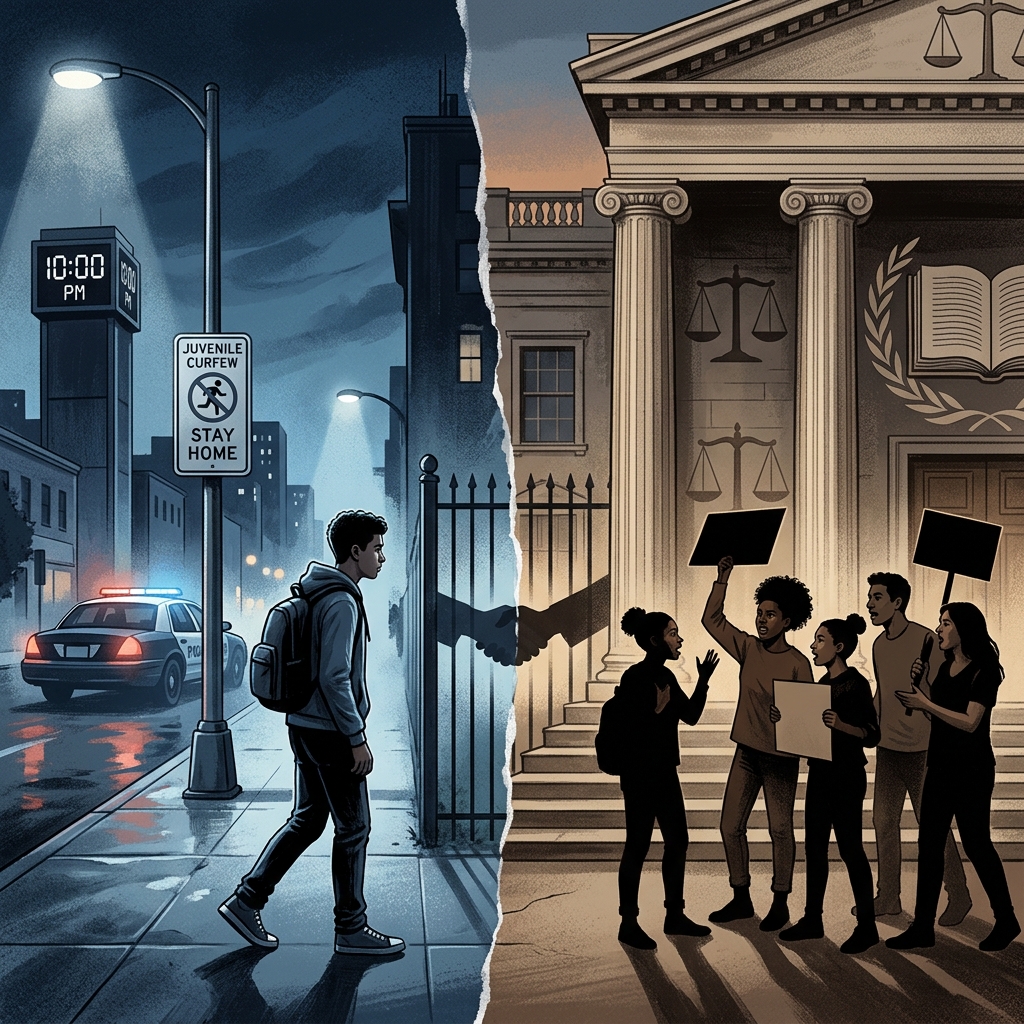
Juvenile curfew laws limit when minors can be in public places, usually during late-night hours. Supporters describe them as tools for public safety, while critics argue that they can burden constitutional rights, invite uneven enforcement, and do little to solve the underlying causes of youth crime.
What a Juvenile Curfew Law Does
A juvenile curfew ordinance generally bars children and teenagers from certain public spaces during specified hours unless they fit within an exception. These laws may apply to streets, parks, shopping areas, entertainment districts, or other public locations. They often also reach business premises if the minor is there during curfew hours without a valid reason.
Although the details vary by city or state, curfews usually identify an age group, set a start and end time, and assign consequences for violations. Some ordinances focus on nighttime restrictions, while others are narrower and cover only school nights or specific risk zones.
Why Governments Adopt Curfews
Local governments often justify juvenile curfews as a way to reduce crime, protect young people from victimization, and make policing easier during vulnerable hours. The basic theory is straightforward: if fewer minors are roaming public areas at night, there may be fewer opportunities for disorder, theft, violence, or exposure to danger.
Advocates also argue that curfews give officers a practical tool for intervening before a situation escalates. In that view, the ordinance is not only about punishment; it is also about deterrence and prevention.
Why Curfew Laws Face Resistance
Opposition to juvenile curfews is built on both constitutional and policy concerns. Civil liberties groups and other critics argue that these laws can restrict innocent movement, interfere with family life, and create criminal penalties for conduct that is not itself harmful. They also question whether curfews actually reduce youth crime in a meaningful way.
Research and policy commentary have long noted that courts have reached different results when evaluating curfew challenges, which reflects the tension between public safety goals and individual rights. The constitutional debate tends to center on freedom of expression, due process, privacy, equal protection, and the limits of police authority.
The Constitutional Issues Courts Commonly Review
Legal challenges to juvenile curfew laws often rely on multiple constitutional provisions. The most frequently raised arguments involve the First, Fourth, Ninth, and Fourteenth Amendments.
| Constitutional claim | Common argument | Typical judicial concern |
|---|---|---|
| First Amendment | Curfews can limit assembly, speech, and expressive activity. | Whether the law blocks protected conduct more than necessary. |
| Fourth Amendment | Police may stop or question minors without enough suspicion. | Whether enforcement leads to unreasonable seizures or searches. |
| Ninth Amendment / parental rights | Families have a protected role in raising children. | Whether the ordinance intrudes too far into family decision-making. |
| Fourteenth Amendment | The law may be vague, overbroad, or unfairly target minors. | Whether it violates due process or equal protection. |
First Amendment Concerns
One of the strongest objections to curfew laws is that they may interfere with a minor’s right to speak, associate, assemble, or participate in expressive activity. A curfew can affect teenagers who are attending a protest, leaving a religious meeting, joining a community event, or traveling to an activity that involves protected expression.
Because these rights are fundamental, governments must usually show that the law is carefully designed and not broader than needed. That is why many curfew ordinances include exceptions for First Amendment-protected conduct. Even so, critics argue that the need to request permission or prove an exception can still chill lawful activity.
Fourth Amendment Objections
Critics also contend that juvenile curfews can lead to arbitrary stops. If an officer can detain a young person simply because it is late and the person appears underage, the officer may be exercising power without probable cause or individualized suspicion. That raises questions under the Fourth Amendment’s protection against unreasonable searches and seizures.
Supporters respond that curfew checks are a practical way to enforce the law and protect minors. Still, the enforcement process matters. If an ordinance invites broad discretion or suspicious targeting, it may be more vulnerable to constitutional attack.
Due Process, Vagueness, and Family Rights
Many challenges also focus on due process. A law can be attacked if it is too vague for ordinary people to understand or too broad because it sweeps in far more behavior than needed. A vague ordinance can leave families uncertain about what is allowed, especially when exceptions are difficult to interpret or prove.
Another recurring argument is that curfews intrude on the liberty interests of parents. Critics say parents should decide when their children may be out, subject to ordinary safety and welfare laws. Courts examining these claims often have to balance parental authority against the government’s interest in reducing harm to minors and the public.
Equal Protection Challenges
Some critics say juvenile curfews create an age-based classification that treats minors differently from adults without enough justification. Under equal protection analysis, the key question is whether the age-based distinction is reasonably related to a legitimate objective or, in some cases, whether it must satisfy a more demanding test.
Courts have not always agreed on the proper level of scrutiny. Some opinions suggest strict scrutiny, while others favor an intermediate approach or another standard that gives cities some room to regulate while still requiring meaningful justification. That disagreement helps explain why similar ordinances can survive in one jurisdiction and fail in another.
What Exceptions Usually Appear in the Law
Most juvenile curfew laws are not absolute. To reduce constitutional problems and practical unfairness, they often contain exceptions for ordinary and necessary activities. Common exceptions include the following:
- Adult-supervised events
- Travel to or from school-related activities
- Religious observance
- Lawful employment
- First Amendment-protected activity
- Emergencies or urgent circumstances
These exceptions matter because they show that lawmakers are trying to tailor the ordinance to real risks rather than ban all nighttime movement by minors. At the same time, critics argue that exception-heavy laws can still be hard to understand and inconsistently enforced.
How Courts Think About the Level of Review
When a law affects constitutional rights, courts often ask whether the government has a sufficiently strong reason for the law and whether the law is narrowly tailored to achieve that reason. In the curfew context, this means judges may look at both the purpose of the ordinance and the way it operates in practice.
Some scholars argue that an intermediate level of scrutiny is the best fit because juvenile curfews do not fit neatly into the usual categories of constitutional review. Others say strict scrutiny is appropriate because the laws can burden fundamental liberties. The practical result is that curfew cases often turn on the specific wording of the ordinance, the quality of the evidence supporting it, and the scope of the exceptions.
Do Curfews Actually Reduce Crime?
The policy case for curfews is not as clear as the legal case for them. Public officials often defend these laws as crime-prevention tools, but empirical findings have been mixed. A number of studies and reviews have questioned whether curfews reliably reduce juvenile offending or victimization.
That uncertainty matters because a city defending a challenged ordinance may need to show that the law is not just well-intentioned but also connected to a real and demonstrable problem. If the evidence is weak, a court may be less persuaded that the ordinance is narrowly tailored to the government’s goal.
Drafting a Stronger Curfew Ordinance
For lawmakers, the lesson is not necessarily that curfews can never work. Rather, it is that poorly drafted curfew laws are more likely to be struck down. Courts and legal commentators have repeatedly emphasized the importance of precise language, meaningful exceptions, and careful enforcement standards.
Practical drafting choices can make a major difference:
- Define the covered age group clearly.
- State the prohibited hours with precision.
- List exceptions in plain language.
- Limit officer discretion where possible.
- Avoid penalties that are disproportionate to the offense.
- Provide notice to parents and minors before enforcement becomes punitive.
These steps do not guarantee that a curfew will be upheld, but they can reduce the risk of a successful challenge.
What Parents and Minors Should Know
Families dealing with a curfew citation should review the local ordinance carefully. The most important questions are often practical: Was the minor within an exception? Was the youth traveling to or from a protected activity? Did an emergency justify being outside? Was the police stop based on a proper legal standard?
Because curfew laws vary widely, the answer may depend on the exact wording of the ordinance and the facts of the stop. A case involving a teenager leaving a church event may be very different from one involving a youth wandering downtown at 2 a.m. without a clear reason.
Frequently Asked Questions
Are juvenile curfew laws automatically unconstitutional?
No. Courts have upheld some curfew laws and invalidated others. The outcome usually depends on the ordinance’s wording, the rights it affects, and whether the government can justify it with enough evidence.
Why do critics focus so much on the Constitution?
Because curfews can affect movement, association, family autonomy, and police encounters. Those issues trigger constitutional review under several amendments, especially the First and Fourteenth Amendments.
Do curfews always apply to every minor?
No. Many ordinances contain exceptions for school, work, religion, emergencies, and expressive activities. Those exceptions are important because they limit the reach of the law.
What is the main legal weakness of a curfew ordinance?
A common weakness is overbreadth: the law may sweep in too much conduct or give too much discretion to law enforcement. Vagueness and weak evidence supporting the law’s effectiveness can also create problems.
Do studies prove that curfews reduce juvenile crime?
Not consistently. Research has produced mixed results, and several reviews have found limited evidence that curfews significantly reduce juvenile offending or victimization.
References
- Curfew — Office of Juvenile Justice and Delinquency Prevention. n.d. https://ojjdp.ojp.gov/sites/g/files/xyckuh176/files/pubs/reform2/ch2_c.html
- Legal Challenges to Juvenile Curfew Laws — FindLaw. n.d. https://www.findlaw.com/criminal/criminal-charges/legal-challenges-to-juvenile-curfew-laws.html
- Purpose or Portrayal: The Dangers of Youth Curfew Laws on Public Safety and Youth Delinquency — Juvenile Justice Information Exchange. n.d. https://juvjustice.org/blog/purpose-or-portrayal-the-dangers-of-youth-curfew-laws-on-public-safety-and-youth-delinquency/
- Guidelines for Avoiding Pitfalls When Drafting Juvenile Curfew Laws — University of Maryland Law. n.d. https://digitalcommons.law.umaryland.edu/cgi/viewcontent.cgi?article=2551&context=fac_pubs
- Scrutinizing Juvenile Curfews: Constitutional Standards & the Appropriate Level of Review — Vanderbilt Law Review. n.d. https://scholarship.law.vanderbilt.edu/vlr/vol53/iss2/4/
- Juvenile Curfews: Are They an Effective and Constitutional Means of Combating Juvenile Crime? — PubMed. n.d. https://pubmed.ncbi.nlm.nih.gov/11241685/
Similar Articles








Read full bio of Sneha Tete




