
Jury Duty Email Scams: How to Spot and Stop Them
Fraudsters pose as courts and marshals using fake jury duty emails and calls—learn the warning signs before they reach your inbox.
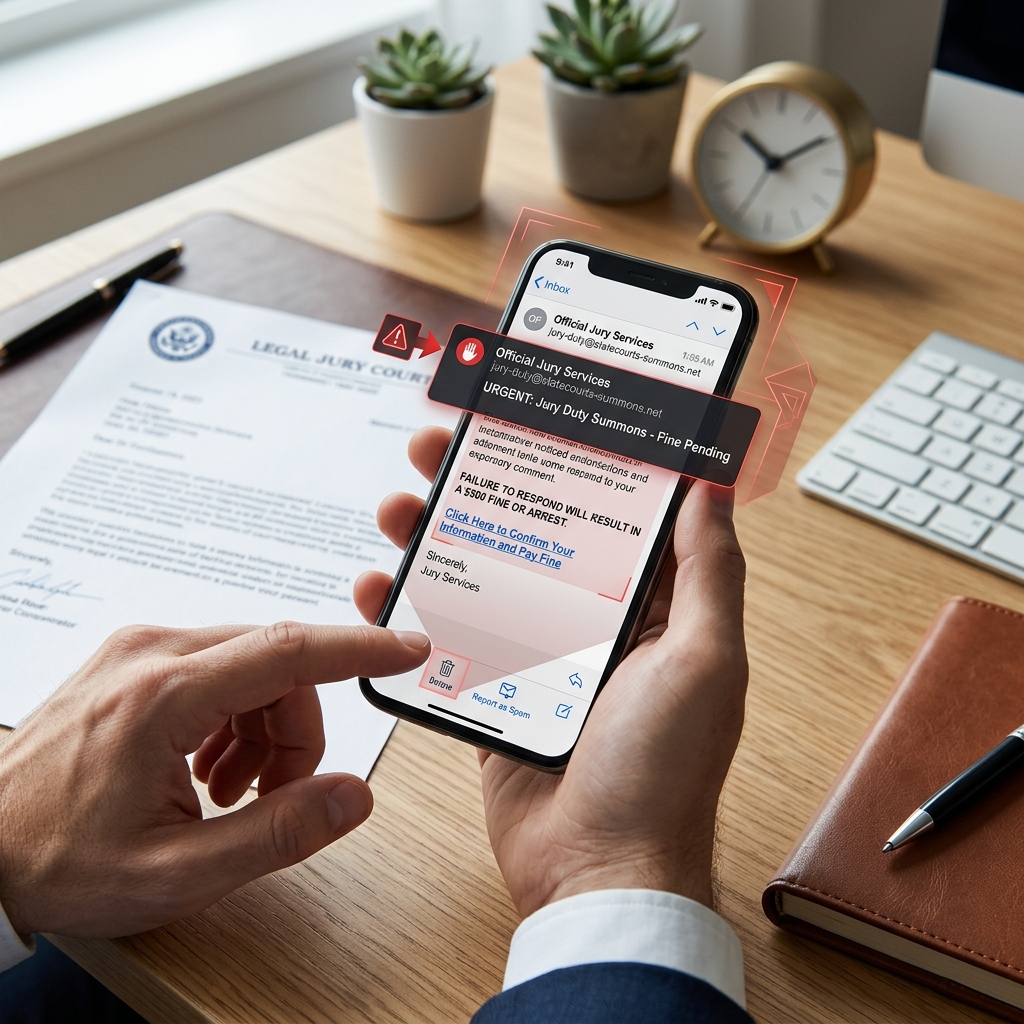
Across the United States, scammers are sending bogus jury duty emails and making fake phone calls that look and sound like they are coming from a court or law enforcement officer. These schemes have been reported in numerous federal districts and state court systems and are designed to steal money or sensitive personal information from unsuspecting citizens. Understanding how legitimate jury duty communication works, and how scams operate, is essential to protecting yourself and your family.
Why Jury Duty Scams Are So Effective
Jury service is one of the few civic obligations that most adults know they must comply with, and people commonly worry about penalties for missing it. Scammers exploit that worry by creating a false sense of urgency and authority.
- They know people fear fines, arrest warrants, or contempt of court.
- They imitate official language and court-style formatting in emails.
- They spoof caller IDs or email addresses to look like they come from a court or government agency.
Public alerts from courts and federal agencies show that these scams range from simple phishing emails to highly sophisticated operations involving forged documents and AI-generated voices.
How Legitimate Jury Duty Contact Really Works
To recognize a scam, it helps to know what real jury duty contact looks like. Federal courts and most state courts follow clear, predictable procedures.
Official Summons Methods
For federal courts, prospective jurors are usually contacted through the U.S. mail, not by unexpected phone calls or random emails. Many districts now offer an online questionnaire system (such as eJuror), but the initial summons that directs you to that system typically arrives in physical mail.
- Mail is the primary method for federal jury summons.
- Online access portals are reached using instructions in that mailed summons.
- Legitimate court websites use secure addresses you can independently look up, rather than random links sent in an unsolicited email.
What Courts Do Not Do
Federal court guidance and consumer protection alerts emphasize several practices that courts and government agencies never use when dealing with jurors.
- They do not ask for payment over the phone or by email for missing jury duty.
- They do not request sensitive data such as full Social Security numbers, bank account details, or credit card numbers by phone or email.
- They do not demand payment via gift cards, cryptocurrency, wire transfers, or payment apps.
- They do not serve arrest warrants by phone and do not accept money in exchange for avoiding arrest.
Common Types of Jury Duty Scams
Jury duty scams generally fall into two broad categories: email-based phishing attacks and telephone impostor scams. Both can be dangerous, but they operate in different ways and target different vulnerabilities.
Phishing Emails Impersonating Courts
In one widely reported variant, recipients receive an email with a subject line such as “Notice to Appear in Court” or “Hearing of your case in Court.” The message often claims that the person failed to appear for jury duty or court and must open an attachment or click a link to view case details.
According to official court alerts, these emails may do the following:
- Include attachments that install malware or viruses when opened.
- Contain links to fake websites designed to capture login credentials or personal data.
- Ask the recipient to reply with personal details like date of birth, Social Security number, or bank information.
These emails are not connected to federal courts or to legitimate online juror systems such as eJuror.
Phone Calls Threatening Arrest
Another widespread form involves a call from someone claiming to be a U.S. Marshal, sheriff, or court official, insisting that you missed jury duty and face immediate arrest unless you pay a fine.
Consumer alerts highlight recurring features of these calls:
- Calls arrive unexpectedly and are labeled as urgent emergencies.
- The caller may know your name or address, obtained from public records or data breaches.
- Payment is demanded through hard-to-trace methods such as gift cards, payment apps, or cryptocurrency.
- The caller warns that police are on the way or that an arrest warrant is active.
Reports from victims show that scammers sometimes use AI-generated voices and forged documents to make the scheme more convincing.
Red Flags: How to Tell a Jury Duty Message Is a Scam
While scammers continually refine their tactics, certain warning signs appear again and again in jury duty scams. Recognizing these red flags can help you safely ignore or report suspicious messages.
| Red Flag | Why It Indicates a Scam |
|---|---|
| Demand for immediate payment to avoid arrest | Courts do not take payment by phone or email and do not trade money for freedom from arrest. |
| Request for sensitive personal data by email or phone | Legitimate court officials will not ask for full Social Security numbers, bank details, or credit card numbers via unsolicited contact. |
| Use of gift cards, cryptocurrency, or wire transfers | These payment methods are favored by scammers because they are hard to reverse and difficult to trace. |
| Threatening or aggressive tone | Scammers rely on fear and urgency; real court staff follow formal, documented processes and allow time to respond. |
| Unsolicited email attachments or links | Surprise attachments or links may install malware or lead to fake login pages; courts warn jurors not to open such content from unknown senders. |
| Instructions not to contact the court directly | Real officials will encourage you to verify information using official court contact details and websites. |
Steps to Take If You Receive a Suspicious Jury Duty Email or Call
If you suspect an email or call about jury duty may be fraudulent, it is important to act calmly and cautiously. The goal is to avoid giving scammers any information or money while preserving useful evidence for reporting.
Immediate Protective Actions
- Do not reply to the email or engage with the caller.
- Do not open attachments or click on links in suspicious emails.
- Hang up if the caller becomes threatening or demands payment.
- Do not provide personal or financial information, even if the caller knows partial details about you.
Verify Directly With the Court
When in doubt, independent verification is critical. Do not use phone numbers or links provided in the suspicious communication.
- Look up your local federal or state court’s official website using a search engine or a known address.
- Use the court’s publicly listed phone number for the Clerk’s Office or jury services department.
- Ask whether you are currently summoned for jury duty and whether any contact they have made matches what you received.
Federal court guidance encourages jurors, interpreters, reporters, and attorneys to validate any questionable communication directly through official systems rather than relying on unsolicited messages.
Report the Scam
Reporting scams helps authorities track patterns and warn others. Several agencies accept reports of jury duty-related fraud.
- Federal Trade Commission (FTC): You can report scams and suspicious communications to the FTC through its ReportFraud portal.
- Local Federal Court: Contact the Clerk’s Office of your nearest federal district court to notify them of the fraudulent message.
- U.S. Marshals Service or FBI: Alerts from U.S. Attorneys’ Offices and Marshals encourage victims to contact these agencies when they receive jury duty impostor calls.
Protecting Your Identity and Finances After a Scam
If you have already responded to a fake jury duty message, provided information, or sent money, you may still be able to limit the damage. Acting quickly is essential.
If You Shared Personal Information
Court advisories recommend that anyone who replied to fraudulent emails with personal details take steps to safeguard their identity and financial accounts.
- Consider placing a fraud alert or security freeze with major credit bureaus.
- Monitor your bank and credit card statements for unauthorized transactions.
- Review your credit reports for new accounts opened in your name.
If You Sent Money
- Immediately contact your bank, card issuer, or payment service to report the transaction.
- Ask whether the payment can be reversed or disputed, explaining that it was made to a scammer.
- File a report with the FTC and local law enforcement, providing documentation such as receipts, emails, and phone numbers.
Staying Safe: Practical Tips to Avoid Jury Duty Scams
While no single measure can guarantee complete protection, adopting a few practical habits can greatly reduce your risk of falling prey to jury duty fraud.
- Treat unsolicited contact with skepticism. If you did not receive an official summons in the mail, be cautious about any call or email claiming you missed jury duty.
- Verify instructions independently. Instead of following links or phone numbers in a message, use known official channels to confirm what you are told.
- Limit what you share. Never provide full Social Security numbers, bank information, or card details in response to an unsolicited contact.
- Update security software. Keep antivirus and anti-malware tools current to help block malicious attachments associated with scam emails.
- Talk to family members. Older adults and busy professionals may be more vulnerable to high-pressure tactics; share information about scams so they know what to expect.
Frequently Asked Questions About Jury Duty Email and Phone Scams
Can a court ever email me about jury duty?
Some courts may send legitimate reminders or provide online questionnaires, but these are typically tied to a summons first delivered by mail. A random email claiming you missed jury duty and demanding you open an attachment or click a link is a major warning sign. When in doubt, verify directly with the court using contact information from its official website.
What should I do if I opened a suspicious attachment?
If you have already opened an attachment from a questionable jury duty email, run a full antivirus and anti-malware scan on your device immediately. Then change important passwords, starting with your email account and financial logins. Consider consulting a trusted IT professional if you suspect your system has been compromised.
Is it possible to get arrested for ignoring an email or phone call about jury duty?
Legitimate consequences for failing to respond to a jury summons arise from ignoring official notices, not from refusing to comply with a suspicious phone call or email. Courts do not issue arrest warrants through phone calls, nor do they allow people to avoid arrest by paying money over the phone or by email. If you are worried, contact the court directly to confirm your status.
How can I confirm whether I truly have jury duty?
Use the official website of your local court or the phone number listed on past correspondence or public directories. Many courts provide online tools or automated phone systems that let you check your juror status. Avoid any link or phone number sent in a suspicious message; instead, navigate independently to the court’s website.
Why do scammers prefer gift cards and cryptocurrency?
Gift cards, cryptocurrency, and certain wire transfer services are difficult to trace and often impossible to reverse. Once you share a gift card number or send cryptocurrency, the funds can quickly be moved or combined, making it hard for law enforcement to recover them. Requests for these forms of payment are a strong indicator that you are dealing with a scammer, not a court.
References
- Public Alert: Beware of “Court” Scams — Maryland Judiciary. 2014-08-15. http://www.mdcourts.gov/media/news/2014/pr20140815
- That call or email saying you missed jury duty and need to pay? It’s a scam — Federal Trade Commission. 2025-03-24. https://consumer.ftc.gov/consumer-alerts/2025/03/call-or-email-saying-you-missed-jury-duty-need-pay-its-scam
- Federal Court Scams — Administrative Office of the U.S. Courts. 2023-11-07. https://www.uscourts.gov/data-news/news/federal-court-scams
- United States Attorney’s Office and the U.S. Marshals Service Warn Public of Jury Duty Scam — U.S. Department of Justice, Middle District of Alabama. 2018-06-27. https://www.justice.gov/usao-mdal/pr/united-states-attorneys-office-and-us-marshals-service-warn-public-jury-duty-scam
- Scam Emails & Fraudulent Phone Calls — New York State Unified Court System. 2021-05-10. https://www.nycourts.gov/about-us/scam-emails-fraudulent-phone-calls
- Beware of Fake Jury Duty Scams: Woman Warns Others — CBS News (YouTube video description). 2024-04-15. https://www.youtube.com/watch?v=mNz-mAO1jFQ
Similar Articles








Read full bio of medha deb




