
Judicial Impartiality in the Social Media Era
Exploring how social media connections between judges and attorneys impact courtroom fairness and recusal standards.
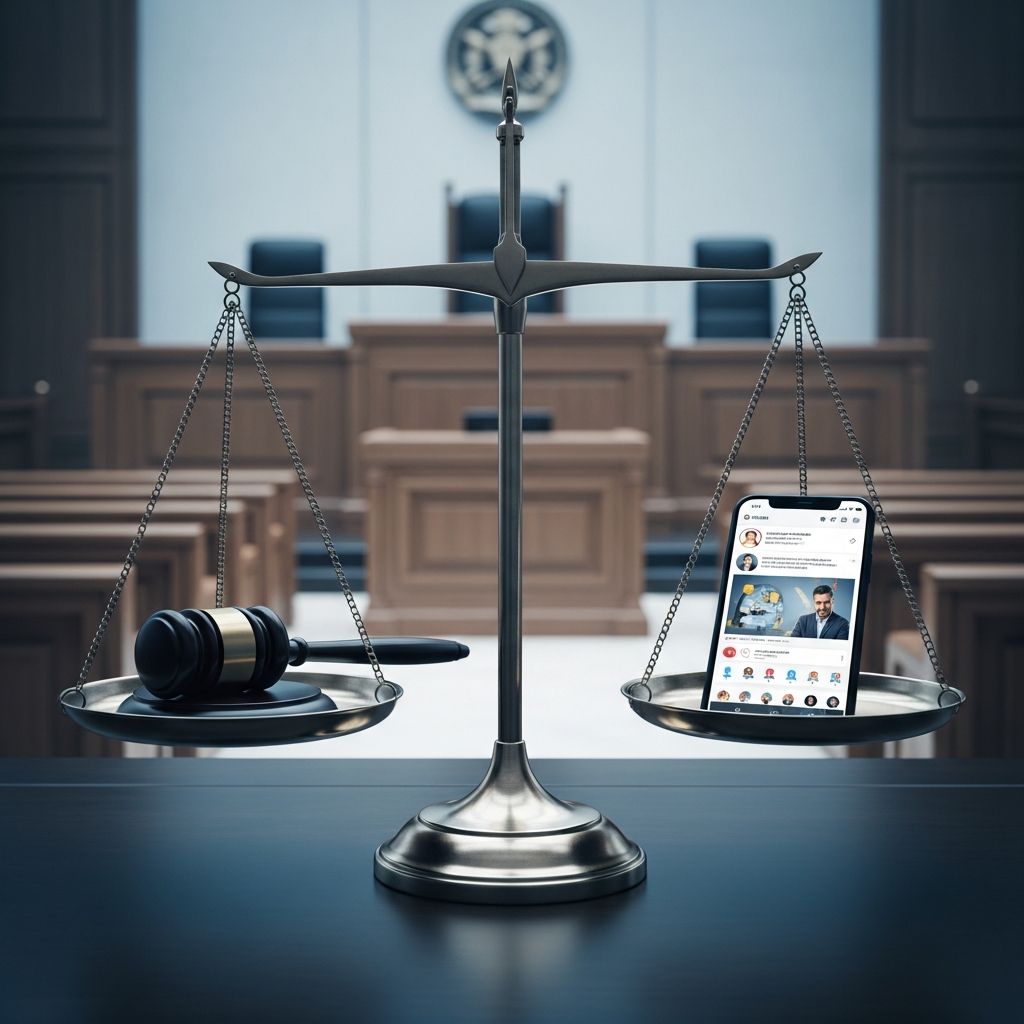
Social media platforms have transformed personal and professional interactions, including those within the legal profession. As judges and attorneys increasingly connect online, questions arise about the potential for perceived bias in the courtroom. A pivotal ruling from the Florida Supreme Court has clarified that a mere online friendship does not automatically disqualify a judge from presiding over a case involving a connected lawyer. This decision underscores the need to evaluate the actual nature of such relationships rather than relying on digital labels alone.
The Rise of Digital Connections in Legal Circles
Over 40% of judges maintain active Facebook profiles, often mirroring their professional networks in the digital realm. Lawyers frequently extend friend requests to these judicial figures as part of networking or promotional efforts, sharing content like case victories, seminar photos, or legal commentary. While these interactions seem innocuous, they can spark concerns about impartiality when those same individuals face each other in court.
The integration of social media into daily life means that what was once a private friendship might now be publicly visible, amplifying perceptions of favoritism. Courts must navigate this landscape by distinguishing superficial online ties from substantive relationships that could undermine public confidence in judicial fairness.
Key Precedent: Florida Supreme Court’s Landmark Decision
In a closely divided 4-3 ruling, the Florida Supreme Court determined that a Facebook friendship between a judge and an attorney, absent additional evidence of closeness, does not necessitate recusal. The court emphasized that such connections are often “of an indeterminate nature,” failing to signal an intimate bond to a reasonable observer.
This stemmed from a case where a law firm challenged a trial judge’s impartiality upon discovering the judge’s online link to opposing counsel. The high court aligned this with longstanding Florida precedent, where allegations of casual friendships alone do not suffice for disqualification. The opinion explicitly rejected the notion that digital friending inherently implies bias, noting that platforms like Facebook host connections ranging from acquaintances to close allies without revealing interaction depth.
Evaluating the Nature of Online Relationships
To assess whether a social media link warrants concern, courts consider factors beyond the friend status:
- Interaction Frequency: Likes, comments, shares, or private messages indicate engagement levels.
- Content Shared: Posts involving case discussions or professional endorsements could suggest influence.
- Network Size: A judge with thousands of friends dilutes the significance of any single connection.
- Public Visibility: Private profiles versus open ones affect perceptions of transparency.
Without record evidence detailing these elements, mere friending remains legally insufficient for recusal motions.
| Aspect | Traditional Friendship | Digital Friendship |
|---|---|---|
| Proof Required | Evidence of intimacy or influence | Specific interactions beyond connection |
| Legal Threshold | Mere allegation insufficient | Indeterminate nature not disqualifying |
| Precedent Example | Florida cases on casual ties | Herssein v. USAA (2018) |
Ethical Guidelines and Advisory Opinions
Florida’s Judicial Ethics Advisory Committee has cautioned judges against friending attorneys likely to appear before them, citing potential violations of Canon 2B, which prohibits lending judicial prestige to private interests or implying special influence. However, the Supreme Court deemed this stance overly cautious, aligning instead with the majority of state ethics bodies that view isolated friending as non-problematic.
Even a concurring justice, while upholding the majority, urged judges to avoid social media entirely to sidestep unnecessary scrutiny. This reflects a broader tension: while law permits such connections, prudence may dictate restraint to preserve the judiciary’s aura of neutrality.
Broader Implications for Judicial Recusal Standards
Recusal ensures public trust by mandating judges step aside when impartiality might reasonably be questioned. Traditional triggers include financial interests, familial ties, or prior involvement in a case. Social media introduces a new layer, where passive connections could be weaponized in motions to disqualify.
The Florida ruling narrows this avenue, requiring litigants to substantiate claims with concrete evidence rather than speculation. This protects judicial efficiency but raises challenges: probing a judge’s online activity can feel intrusive, complicating discovery of disqualifying interactions.
Nationally, approaches vary. Some states echo Florida’s leniency, while others impose stricter social media protocols during campaigns or active cases. The American Bar Association notes rising judicial Facebook use, prompting calls for uniform guidelines.
Best Practices for Judges and Attorneys
To mitigate risks, legal professionals can adopt proactive measures:
- Judges: Limit friending to non-litigants; regularly audit profiles for conflicts; consider private or professional-only accounts.
- Attorneys: Disclose known connections early; avoid engaging judicial profiles publicly; use platforms judiciously for marketing.
- Courts: Develop local rules clarifying social media’s role in recusal; train on digital ethics.
Ultimately, the safest path may involve minimal overlap between professional duties and personal online networks, prioritizing perceived impartiality over digital convenience.
Potential Risks and Dissenting Perspectives
Dissenters in the Florida case argued that social media friending inherently creates an appearance of impropriety, potentially eroding trial fairness. They highlighted difficulties in proving deeper ties without invasive scrutiny, suggesting a blanket recusal rule for such links.
Critics worry this precedent could embolden unchecked relationships, especially as platforms evolve with features like stories or groups fostering closer virtual bonds. In high-stakes litigation, even subtle biases can sway outcomes, making vigilance essential.
Frequently Asked Questions
Does a social media friendship automatically disqualify a judge?
No, according to the Florida Supreme Court; it must be accompanied by evidence of a close relationship affecting impartiality.
Should judges avoid friending lawyers on Facebook?
Ethics committees recommend caution, and some advise complete avoidance to prevent any perception of bias.
How do courts determine if a friendship is ‘close enough’ for recusal?
They examine interaction details like messages, shares, and context, not just the existence of a connection.
Are there national standards for judicial social media use?
No uniform rules exist; states vary, with many following Florida’s lead on indeterminate friendships.
What if a judge and lawyer interact privately online?
Private communications could trigger recusal if they suggest influence or ex parte discussions.
Future Trends in Judicial Digital Ethics
As platforms like Instagram, LinkedIn, and TikTok gain traction among professionals, courts will face analogous issues. Emerging technologies, including AI-driven networking, may further blur lines. Legal scholars advocate for updated canons explicitly addressing digital conduct, ensuring adaptability to technological shifts.
Educational initiatives, such as those from the Conference of Chief Justices, emphasize digital literacy for judges. By fostering awareness, the judiciary can maintain its cornerstone role in democratic fairness amid evolving communication norms.
This analysis, drawing from established precedents and ethical frameworks, highlights that while social media connections pose challenges, they do not inherently compromise justice when properly contextualized. Legal actors must balance modern connectivity with timeless principles of neutrality.
References
- Judge’s Facebook friendship with lawyer doesn’t necessarily require recusal — ABA Journal. 2018-11-15. https://www.abajournal.com/news/article/judges_facebook_friendship_with_lawyer_doesnt_necessarily_require_recusal_s
- Can Judges Be Facebook “Friends” With Lawyers? — Five Minute Law. 2018-11-19. https://fiveminutelaw.com/2018/11/19/florida-man-friends-judge-on-facebook-defeats-motion-to-disqualify/
- Can Judges and Attorneys Be Facebook Friends? — Milles Law. 2018-11. https://www.injuryrightslaw.com/blog/2018/november/can-judges-and-attorneys-be-facebook-friends-/
- Face Off on Facebook: Judges and Lawyers as Social Media “Friends” — The Florida Bar Journal. 2019. https://www.floridabar.org/the-florida-bar-journal/face-off-on-facebook-judges-and-lawyers-as-social-media-friends-in-a-post-herssein-world/
- Judges and Lawyers Must Exercise Caution as Facebook “Friends” — State Appellate Defender Office. N/A. https://www.sado.org/articles/article/100
- Social Media “Friending” Between Judges and Lawyers — Hinshaw & Culbertson LLP. 2018-09. https://www.hinshawlaw.com/a/web/n1deyfWKXEF4jAGrcPg6mE/a15AD8/lawyerslawyer_0918.pdf
Similar Articles








Read full bio of medha deb




