
Joint Tenancy vs Tenants in Common Explained
Understand how joint tenancy and tenants in common shape co‑ownership, inheritance and control over property rights.
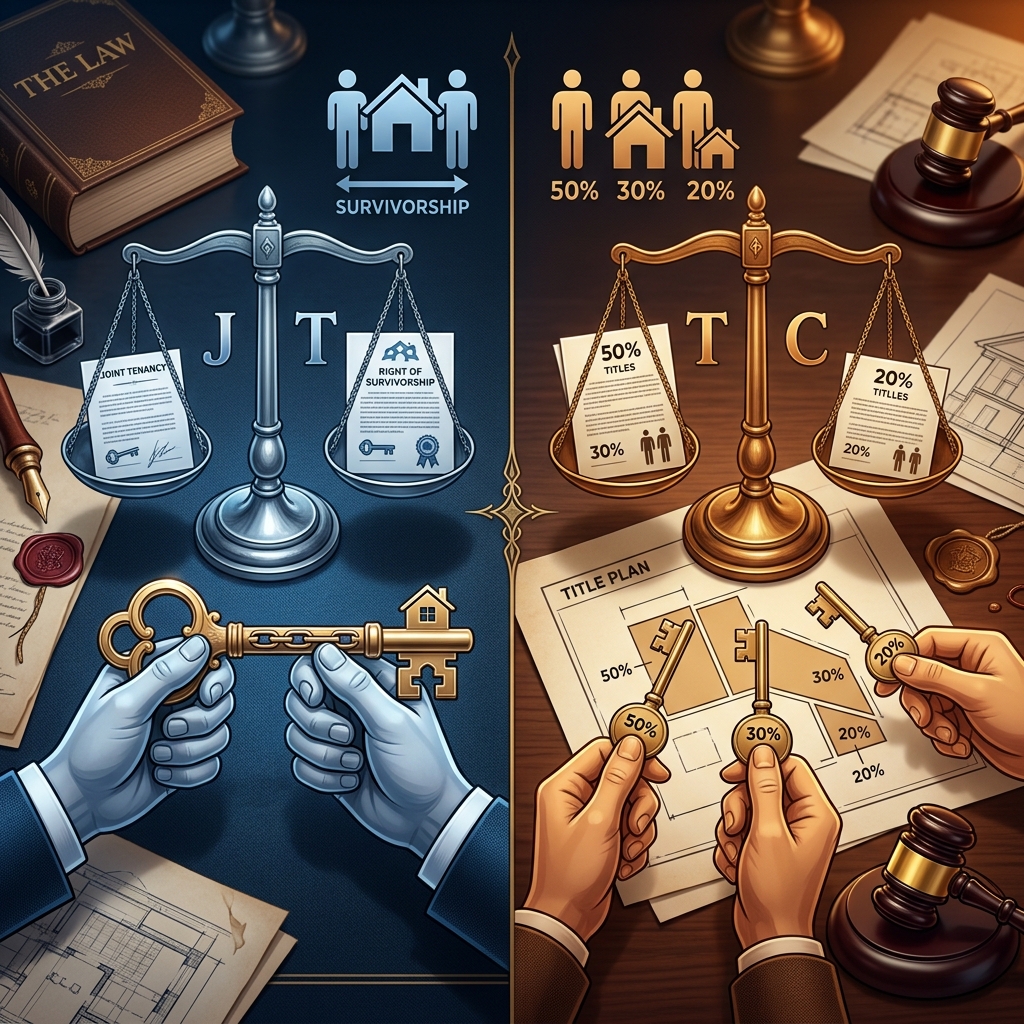
When two or more people buy property together, the way title is held is just as important as the price, location, or mortgage terms. Choosing between joint tenancy and tenants in common determines what happens to the property if one owner dies, how decisions are made, and how flexible each owner’s rights are.
This guide explains both forms of co‑ownership in clear, practical terms so you can better understand which structure fits your goals and risk tolerance before you sign a deed or update your estate plan.
Co‑Ownership Basics: What Does It Mean to Share Title?
In modern real estate law, both joint tenancy and tenants in common are forms of concurrent ownership, meaning more than one person holds rights in the same property at the same time. Each owner has a stake in the entire property, rather than owning specific rooms or physical portions of land.
Key shared features include:
- Every co‑owner has the right to occupy and use the whole property, subject to reasonable agreement with others.
- Each owner’s interest can be described as a percentage or share of the property’s value, even though no one owns a specific corner or unit.
- Co‑owners typically share responsibilities for major decisions, like selling, refinancing, or making substantial improvements.
The differences between joint tenancy and tenants in common arise in how those shares are structured, whether they can be unequal, and what happens when one owner’s life circumstances change.
What Is Joint Tenancy?
Joint tenancy is a form of co‑ownership where each owner holds an equal, undivided interest in the property along with an important feature called the right of survivorship. When one joint tenant dies, their share automatically passes to the surviving joint tenants, outside of the probate process.
Core Characteristics of Joint Tenancy
- Equal shares only: All joint tenants must own identical shares (for example, two owners at 50% each, four owners at 25% each).
- Same deed, same time: Owners must generally acquire title together, from the same source and at the same time, with explicit language creating a joint tenancy.
- Right of survivorship: On death, a joint tenant’s interest is absorbed automatically by the surviving joint tenant(s); their will cannot redirect that specific share to someone else.
- Unified control of major decisions: Selling or encumbering the property usually requires agreement of all joint tenants, because each has an equal stake.
Because of the right of survivorship, joint tenancy is often attractive to married couples and close family members who want a simple mechanism for the property to pass to the survivor without court involvement.
The Four Unities in Joint Tenancy
Traditional property law describes joint tenancy using four “unities.” If they are not satisfied, a court may treat the arrangement as a tenancy in common instead.
- Unity of time: Each joint tenant’s interest is acquired at the same moment.
- Unity of title: All joint tenants derive their interest from the same deed or instrument, which specifically states that the vesting is a joint tenancy.
- Unity of interest: Every joint tenant has the same type and amount of interest (for example, an equal percentage and identical legal rights).
- Unity of possession: Each joint tenant has the right to possess and use the whole property, not just a portion of it.
Breaking one of these unities, such as by transferring a share to a third party, can convert the arrangement into a tenancy in common and eliminate the right of survivorship for that portion.
What Are Tenants in Common?
Tenants in common are co‑owners who each hold a distinct share of the same property, which can be equal or unequal, and which does not automatically pass to other owners on death. Instead, each share is treated like a separate asset that can be sold, gifted, or transferred through an estate plan.
Core Characteristics of Tenants in Common
- Flexible shares: Ownership percentages can vary widely (for example, 70%–30%, 99%–1%) based on how the parties agree to divide contributions, risk, or control.
- No right of survivorship: A deceased co‑owner’s share becomes part of their estate and passes according to their will, trust, or intestate succession rules, rather than directly to other co‑owners.
- Independent transfer rights: Each tenant in common can typically sell or mortgage their share, subject to contractual limitations, without needing unanimous agreement from the others for that particular transfer.
- Entry at different times: New co‑owners can acquire a share years after others, by buying into the property or receiving a transfer of part of an existing owner’s interest.
Because of this flexibility, tenancy in common is often used for investment properties, arrangements among siblings or friends with different financial contributions, or situations where each person wants to control who ultimately inherits their share.
Side‑by‑Side Comparison
| Feature | Joint Tenancy | Tenants in Common |
|---|---|---|
| Ownership shares | Always equal shares among co‑owners. | Shares can be equal or unequal, as agreed. |
| Right of survivorship | Yes. A deceased owner’s share automatically passes to surviving joint tenants. | No. A deceased owner’s share passes through their estate to heirs or beneficiaries. |
| Estate planning impact | Share cannot usually be redirected by will; survivorship controls the outcome. | Owner can direct their share by will or trust; intestate succession applies if no plan exists. |
| How interests are acquired | Owners typically acquire title at the same time under the same deed, with explicit joint tenancy language. | Co‑owners may acquire interests at different times, under different instruments. |
| Default rule | Often requires clear language to be created; otherwise courts may presume tenancy in common. | Commonly treated as the default form of co‑ownership when no special wording is used. |
| Transfer of a share | Transferring a share can sever the joint tenancy and create a tenancy in common with the new owner. | Each owner can transfer their share without affecting the structure of other shares. |
| Typical use cases | Married couples, long‑term partners, closely aligned family members planning to leave the property to one another. | Investors, business partners, co‑owners contributing unequally, or anyone who wants control over who inherits their share. |
How Death Affects Each Form of Ownership
From an estate planning perspective, the most critical difference between these two structures is what happens when a co‑owner dies.
Death of a Joint Tenant
- Automatic transfer: The deceased owner’s share passes directly to the surviving joint tenant(s), typically without going through probate for that interest.
- Not controlled by will: Even if a will attempts to leave the share to someone else, the survivorship feature usually prevails for that particular property.
- Concentration of ownership: Over time, surviving joint tenants may become sole owners as others pass away, simplifying title but concentrating control.
Death of a Tenant in Common
- Estate owns the share: The deceased owner’s share becomes part of their estate for distribution under a will or trust, or under intestate succession if there is no estate plan.
- Potential involvement of heirs: New owners may join the ownership group, which can change dynamics and decision‑making on the property.
- Probate exposure: If the owner did not use tools like a living trust, the share may need to pass through probate, which can be slower and more public.
For families and co‑owners, understanding these consequences is essential to avoid unintended disputes, delays, or surprises when transferring valuable property.
Pros and Cons: Choosing the Right Structure
Advantages of Joint Tenancy
- Simplified transfer on death: The right of survivorship streamlines succession by automatically vesting ownership in surviving co‑owners.
- Clarity of equal shares: All joint tenants know they hold the same proportion and rights, simplifying internal arrangements.
- Common for couples: Many couples prefer joint tenancy to ensure the home passes to the surviving partner without extra steps.
Drawbacks of Joint Tenancy
- Limited control over inheritance: You cannot easily direct your share to someone outside the group, which may conflict with broader estate planning goals.
- Risk if co‑owners’ lives diverge: Relationship changes, financial pressures, or disputes can make a structure with equal rights and survivorship less desirable over time.
- Severance complications: Breaking a joint tenancy (for example, to sell a share independently) can create complex legal consequences and convert part of the ownership to a tenancy in common.
Advantages of Tenants in Common
- Customizable shares: Parties can allocate shares in line with financial contributions or negotiated control, including very unequal percentages.
- Full inheritance control: Each owner can decide who inherits their share and can use wills, trusts, or other planning tools to match family needs.
- Flexible entry and exit: New owners can be added and existing owners can transfer shares without reshaping the entire ownership framework.
Drawbacks of Tenants in Common
- Potential for conflict: Different heirs or investors may join the ownership group over time, increasing the risk of disagreements on use, sale, or improvements.
- Possible probate delays: Without an estate plan, transfers of shares at death may be delayed by court proceedings.
- Complex decisions: Co‑owners with unequal shares might disagree over how costs, profits, or sale decisions should be handled.
Practical Factors to Consider Before Choosing
Deciding between joint tenancy and tenants in common should be guided by your relationships, financial situation, and long‑term goals. Consider these factors:
- Family dynamics: Do you want the property to stay within a specific group, such as a spouse or partner, or should your share pass to children or other heirs even if they are not co‑owners now?
- Contribution levels: Are all co‑owners contributing equally to the down payment, mortgage, and maintenance, or do contributions vary significantly?
- Investment vs home: Is the property primarily a family residence, or is it a business or investment asset where flexible shares and independent transfer rights may matter more?
- Estate planning strategy: Are you using wills, living trusts, or other planning tools? Tenants in common align more easily with individualized estate planning, while joint tenancy prioritizes survivorship.
- Risk tolerance: How comfortable are you with future changes, such as heirs stepping into ownership or co‑owners needing to liquidate their share?
Because property law and tax consequences vary by jurisdiction, it is wise to review these choices with a qualified real estate or estate planning attorney in your area, especially for high‑value assets.
Frequently Asked Questions
Can I change a joint tenancy into a tenancy in common?
In many jurisdictions, a joint tenant can sever the joint tenancy by transferring their interest to another party, which transforms that portion into a tenancy in common and removes the right of survivorship for that share. The exact steps and consequences depend on local law, so professional advice is important.
Is tenancy in common the default if the deed is silent?
In several legal systems, if a deed does not clearly state that owners hold as joint tenants, courts may presume a tenancy in common by default. Deeds often need specific wording to create a joint tenancy with right of survivorship.
Does joint tenancy avoid all probate?
Joint tenancy can avoid probate for the specific property interest subject to the right of survivorship, because that interest passes directly to surviving co‑owners. However, it does not avoid probate for other assets, nor does it replace comprehensive estate planning.
Can tenants in common force a sale if they disagree?
Where co‑owners cannot agree, some jurisdictions allow a court process (often called partition) that can lead to a sale and division of proceeds among tenants in common. The procedures, costs, and outcomes are highly jurisdiction‑specific and should be discussed with a lawyer.
Which is better for unmarried partners buying a home?
There is no single “best” option. Joint tenancy may be preferable if partners want the home to pass automatically to the survivor, while tenants in common may suit partners who contribute unequally or want flexibility to leave their share to other family members. Evaluating contribution levels, relationship stability, and estate planning goals can help inform the choice.
References
- Joint Tenancy vs. Tenants in Common: What’s the Difference? — Super Lawyers. 2023-05-01. https://www.superlawyers.com/resources/real-estate/joint-tenancy-vs-tenants-in-common-whats-the-difference/
- Joint tenancy | Wex — Legal Information Institute, Cornell Law School. 2024-02-15. https://www.law.cornell.edu/wex/joint_tenancy
- What’s the Difference Between Joint Tenancy and Tenancy in Common? — FindLaw. 2022-11-10. https://www.findlaw.com/realestate/buying-a-home/difference-between-joint-tenancy-and-tenancy-in-common.html
- Tenancy in Common vs Joint Tenancy — First Integrity Title Company. 2021-09-01. https://www.firstintegritytitle.com/tenancy-in-common-vs-joint-tenancy/
- Tenancy in Common vs. Joint Tenancy: When a Co-Owner Dies — Drazen Rubin Law. 2023-03-20. https://www.drazenlaw.com/blog/tenancy-in-common-vs-joint-tenancy-owner-die
Similar Articles








Read full bio of Sneha Tete


