
JD vs. Esq.: Understanding Legal Titles Clearly
Learn how JD and Esq. differ, when each is used, and what these common legal titles actually say about a lawyer’s training and license.
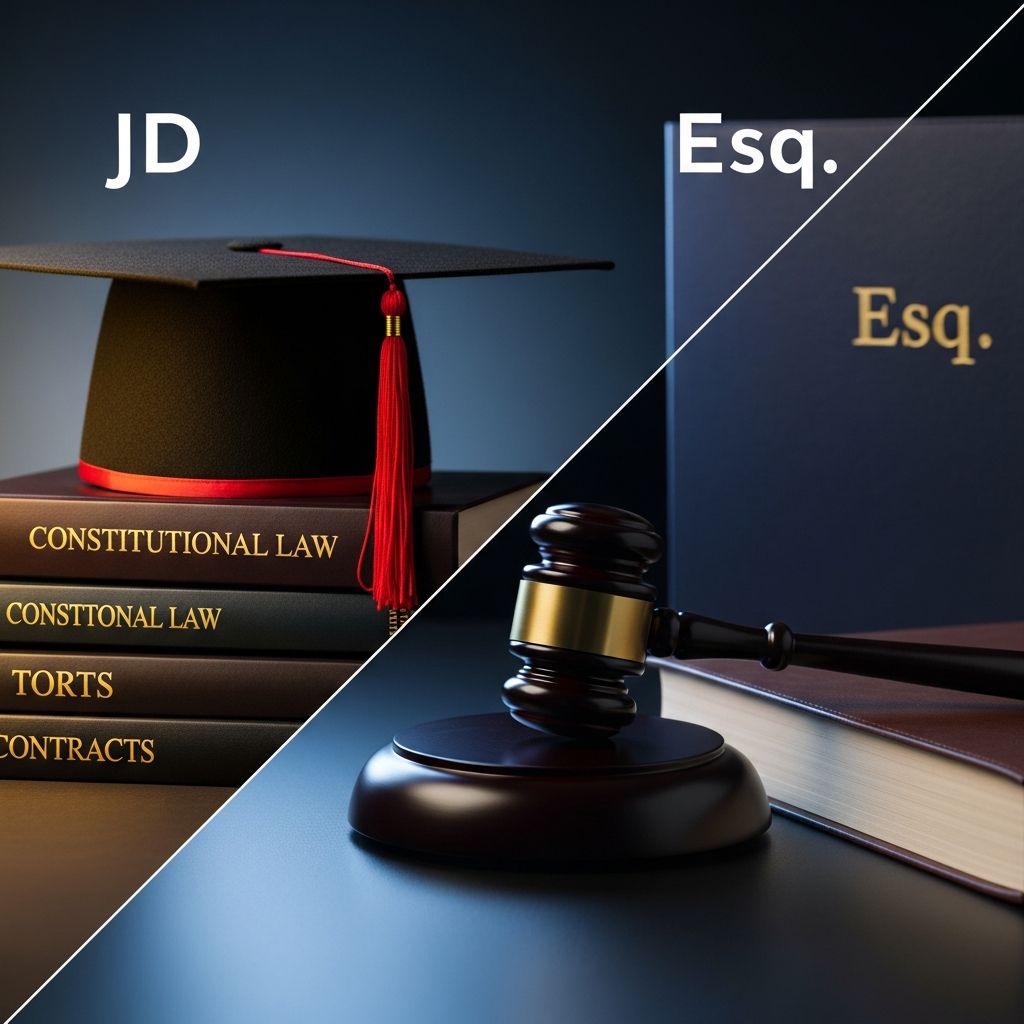
People often see JD and Esq. attached to names and assume they are interchangeable. In reality, they refer to different things: one is an academic degree, and the other is a professional status tied to a law license. Understanding the difference helps you read résumés, business cards, and legal documents more accurately—and avoid misusing titles yourself.
Big Picture: Education vs. License
At the broadest level, the distinction can be summarized in one line:
- JD (Juris Doctor) — shows someone completed law school.
- Esq. (Esquire) — shows someone is licensed to practice law.
Every U.S. attorney starts by earning a JD from an approved law school, then usually passes a bar exam and meets character and fitness requirements set by a state bar authority before being admitted to practice. Only after admission to the bar is it appropriate, in U.S. practice, to use Esq. after one’s name.
What Is a JD (Juris Doctor)?
The Juris Doctor (JD) is the standard professional degree in law in the United States. It typically takes three years of full-time study after a bachelor’s degree and is offered by law schools that meet accreditation standards, most notably those approved by the American Bar Association.
Key characteristics of the JD
- Type of credential: Graduate-level professional degree, not a job title.
- Purpose: Provides the academic foundation needed to sit for a bar exam and to work in legal or law-adjacent roles.
- Curriculum: Core subjects such as contracts, torts, criminal law, civil procedure, constitutional law, property, legal research and writing, and ethics, along with electives and possibly clinical work.
- Outcome: Graduate may call themselves a law school graduate or hold the JD degree, but is not automatically a licensed attorney.
What a JD allows you to do
Holding a JD opens the door to several paths:
- Apply to sit for a state bar exam (subject to each jurisdiction’s rules).
- Work in compliance, policy, regulation, or consulting roles where legal training is useful but a law license is not strictly required.
- Pursue advanced law degrees, such as an LL.M. (Master of Laws) or S.J.D./J.S.D. (Doctor of Juridical Science).
A JD communicates intensive legal training but does not communicate authority to appear in court on behalf of clients or to provide certain forms of legal representation in a jurisdiction where licensure is required.
What Does Esq. (Esquire) Mean?
Esquire, almost always abbreviated as Esq., is a courtesy title used after a person’s name to indicate they are a licensed attorney in at least one U.S. jurisdiction. It is not an academic degree and does not appear on diplomas.
How someone becomes an Esquire
Although each state sets its own rules, the usual sequence in the U.S. is:
- Earn a JD from a qualifying law school.
- Pass a bar examination that tests knowledge of substantive and procedural law.
- Meet character and fitness requirements evaluated by the jurisdiction’s bar authority.
- Take an oath and be formally admitted to the bar of that state or jurisdiction.
After admission, a lawyer is authorized to practice law as defined by that jurisdiction’s statutes and court rules, and may appropriately use Esq. in legal correspondence and professional contexts.
Usage patterns for Esq.
- Commonly seen on letters, pleadings, and email signatures when the writer represents clients in legal matters.
- Often not used when referring to oneself verbally; a lawyer will more likely say “I’m an attorney” than “I’m an Esquire.”
- Generally unnecessary when the lawyer’s role is already obvious (e.g., a law firm website biography or a court caption listing counsel).
Because the title signals licensure, using Esq. without being admitted to a bar can be misleading and, in some situations, risk being treated as unauthorized practice of law under state rules.
Side-by-Side: JD vs. Esq.
The following table highlights the main differences between the two labels:
| Feature | JD (Juris Doctor) | Esq. (Esquire) |
|---|---|---|
| What it is | Academic degree | Professional courtesy title |
| How it is earned | Completing law school and receiving a diploma | Passing a bar exam, meeting character and fitness, and being admitted to the bar |
| What it signals | Legal education and training | Authority to practice law in at least one jurisdiction |
| Where it appears | Diplomas, résumés, academic and professional bios | Letters, pleadings, email signatures, client-facing documents |
| License implied? | No — a JD alone does not imply bar admission | Yes — customarily indicates bar membership in the U.S. |
Who Can Call Themselves a Lawyer or Attorney?
In everyday English, people sometimes use lawyer, attorney, JD, and Esq. as if they all meant the same thing. Legally and professionally, they do not.
- Lawyer / Attorney — typically refers to a person who is licensed to practice law and may represent clients in legal matters.
- JD — properly refers to someone’s education, not their license or job title.
- Esq. — used in writing to signal that the person is an attorney admitted to at least one bar.
State regulators, such as bar associations and supreme courts, define and enforce rules on who may practice law and which titles may be used without misleading the public. Misrepresenting one’s status can trigger professional discipline or other penalties.
Real-World Scenarios: How the Titles Are Used
The JD/Esq. distinction becomes clearer when you look at typical career and credential combinations.
1. Law school graduate, bar exam pending
- Has earned a JD from an accredited law school.
- Has not yet passed the bar exam or been admitted.
- May accurately describe themselves as a JD or “law school graduate,” but not as an attorney or Esquire.
2. JD who never seeks bar admission
- Holds a JD but chooses non-attorney work, such as compliance, consulting, business, or policy research.
- May use the JD in résumés and bios to reflect legal training.
- Should not use Esq. because they are not admitted to the bar.
3. Licensed attorney in active practice
- Has a JD, passed the bar, and is admitted to practice.
- May appear as “Name, Esq.” in correspondence and may accurately be called a lawyer or attorney.
- Might not mention the JD at all in everyday practice, since the license is usually more important than the degree label.
4. Attorney working outside traditional practice
- Admitted to at least one bar, but may work in-house, in government, or in a role that is partly legal and partly business.
- May or may not use Esq., depending on employer preferences and context.
- Often highlights both the JD and bar admission where licensure matters to the role (for instance, in government counsel positions).
Professional Etiquette: When to Use JD vs. Esq.
In many situations, either title is optional. Where they are used, certain conventions help avoid confusion.
When JD is usually appropriate
- Academic settings — law review mastheads, academic publications, and conference programs frequently list degrees.
- Non-attorney roles — compliance officers, consultants, or policy analysts may emphasize their JD when licensure is not central to the job.
- Applications and résumés — law graduates applying to clerkships, fellowships, or non-bar-required positions often highlight the degree.
When Esq. is more common
- Client correspondence — letters, emails, and legal opinions where the writer’s role as a lawyer needs to be clear.
- Court-related documents — pleadings, motions, and briefs sometimes list counsel as “Name, Esq.” to identify the filing attorney.
- Formal communications between counsel — opposing counsel or co-counsel may address one another using “Esq.” as a professional courtesy.
Common etiquette points
- Avoid stacking titles — writing “Name, JD, Esq.” is generally discouraged as redundant and unfamiliar in legal practice.
- Stay truthful — never use Esq. unless you are admitted to at least one bar and in good standing.
- Respect jurisdictional limits — bar membership is state-specific, and practicing in a jurisdiction where you are not licensed can raise regulatory issues.
Why the Distinction Matters
While the difference between JD and Esq. might sound technical, it serves important functions for clients, courts, and the public.
- Transparency for clients — clients can better understand whether someone is merely educated in law or actually licensed to represent them in court or in negotiations.
- Regulatory clarity — states regulate the practice of law to protect the public, and titles like Esquire help signal who is subject to those regulations.
- Professional accountability — licensed attorneys are bound by codes of professional conduct and may be disciplined for misconduct, while a JD without a license is not under the same professional oversight.
Beyond JD and Esq.: Other Law-Related Degrees
JD and Esq. are the most visible labels in everyday practice, but they exist within a broader ecosystem of legal education.
- LL.M. (Master of Laws) — an advanced degree pursued after the JD, often focused on a specialty such as tax, international law, or dispute resolution.
- S.J.D. or J.S.D. (Doctor of Juridical Science) — a research-focused doctorate, typically for academic or scholarly careers.
- Non-JD programs — some schools offer master’s degrees in legal studies or compliance aimed at professionals who interact with law but do not plan to become attorneys.
These degrees do not themselves create the right to practice law; that still hinges on bar admission and licensure.
Frequently Asked Questions (FAQs)
Is a JD higher than an Esq.?
They are not levels of the same ladder. A JD is an academic degree, while Esq. is a professional title for someone who is licensed to practice law. Many attorneys hold a JD and also use (or are eligible to use) Esq.
Can you be an Esquire without a JD?
In modern U.S. practice, almost all new lawyers must earn a JD or equivalent from a qualifying law school before bar admission. A few jurisdictions historically allowed alternative paths, but for most people today, no JD means no bar exam and, practically speaking, no right to use Esq.
Should I put JD or Esq. after my name?
If you are not yet licensed, you may list your JD to show your education but should avoid “Esq.” If you are a licensed attorney, you can use “Esq.” in appropriate professional contexts and usually do not need to add JD as well.
Is using Esq. without a license illegal?
Using Esq. without being admitted to a bar can be misleading and, depending on state rules, may contribute to claims of unauthorized practice of law or misrepresentation. States regulate these issues through bar authorities and courts.
Do clients really care about the difference?
Most clients care more about competence and results than specific labels. However, the JD/Esq. distinction helps them confirm that the person advising them is actually licensed to provide legal representation where that matters.
References
- Esq. Vs. J.D. | What Are the Differences & Career Options? — Juris Education. 2023-08-10. https://www.juriseducation.com/blog/esq-vs-j-d-what-is-the-difference
- Juris Doctor vs. Esquire: Clarifying Legal Titles for Law School Applicants — The MBA Exchange. 2023-06-15. https://www.mbaexchange.com/juris-doctor-vs-esquire/
- JD or Esq? A Friendly Guide to Understanding Legal Degrees and Titles — Admit Advantage. 2023-05-02. https://www.admitadvantage.com/blog/jd-or-esq/
- Esquire vs. Juris Doctor: What’s the Difference (And Does It Matter)? — Admissionado. 2023-07-20. https://admissionado.com/blog/law/esquire-vs-juris-doctor-whats-the-difference-and-does-it-matter/
- Types of Law Degrees — Pepperdine University Caruso School of Law (Online Graduate Programs). 2022-09-01. https://onlinegrad.pepperdine.edu/law/types-of-law-degrees/
Similar Articles








Read full bio of Sneha Tete


