
Is Steve Harvey Really A Judge On TV? What It Means
How TV courtroom shows like Judge Steve Harvey blur the line between real law, private arbitration, and pure entertainment.
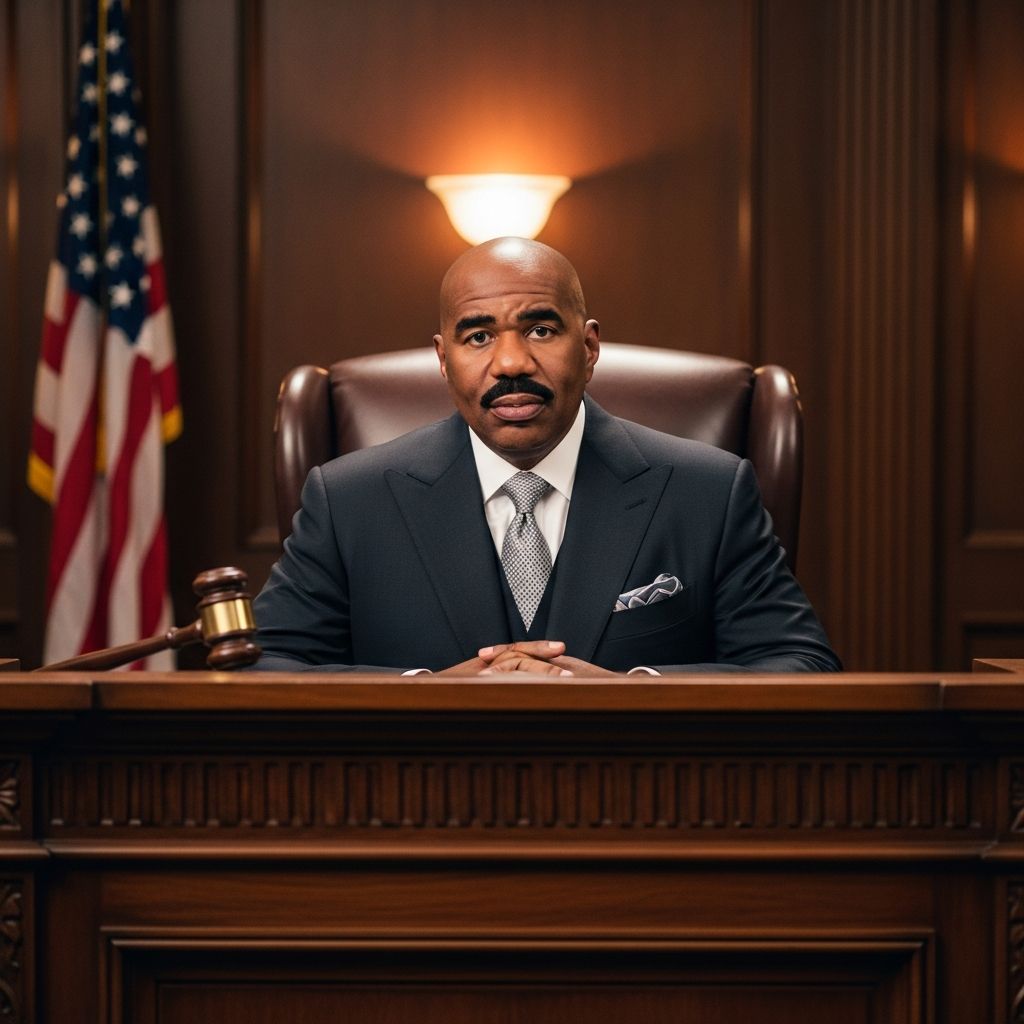
Steve Harvey’s prime-time show Judge Steve Harvey has revived a familiar question: when a celebrity sits behind a bench, wields a gavel, and issues “rulings,” are they acting as a real judge or simply playing a role for television. To answer that, it helps to unpack what a judge is in the legal sense, how arbitration works, and where reality court shows fit on the spectrum between law and entertainment.
Steve Harvey’s Role: TV Personality vs. Legal Judge
Steve Harvey is a highly successful entertainer, author, producer, and businessman who has hosted multiple shows, including Family Feud, The Steve Harvey Morning Show, Celebrity Family Feud, and the arbitration-style show Judge Steve Harvey on ABC. However, he has never attended law school and does not hold a law degree. That distinction is critical when assessing whether he is a judge in the legal sense.
According to reports on his educational background, Harvey attended Kent State University but did not graduate, and he has no formal legal training or license to practice law. On his TV show, he presides over disputes, questions participants, and renders decisions, but he does so as a television arbitrator and host, not as a government-appointed or elected judicial officer.
Key differences at a glance
| Aspect | Real Judge | Steve Harvey on TV |
|---|---|---|
| Legal education | Usually law degree and bar license (varies by state) | No law degree, not a lawyer |
| Appointment or election | Selected through formal public process (election, appointment, or merit system) | Cast by a television network and production team |
| Source of authority | Constitution, statutes, and court rules | Private contracts and participation agreements |
| Binding power | Can issue legally enforceable orders, judgments, and sentences | Issues arbitration-style decisions and TV outcomes; enforcement depends on contracts and show structure |
| Primary purpose | Administer justice under the law | Provide entertainment while resolving disputes |
What Makes Someone a Real Judge in the United States?
To see why a television role does not automatically equal judicial authority, it is useful to look at how judges are created under U.S. law. The process varies widely by state and by court level, but several consistent themes apply.
Typical path to the bench
For most courts, a person must:
- Earn at least a bachelor’s degree.
- Complete an accredited law degree (Juris Doctor) and pass a state bar exam.
- Gain professional legal experience, often as an attorney, prosecutor, public defender, or legal academic.
- Be selected via election, gubernatorial appointment, or a merit selection system depending on the jurisdiction.
Federal judges, for example, are nominated by the President and confirmed by the Senate under Article III of the U.S. Constitution. State judges may be chosen by voters or appointed, and many states impose additional training or ethical requirements.
Not all judges must be lawyers
Despite the common assumption that every judge holds a law degree, a significant minority of states allow some lower-level judges to serve without being licensed attorneys. A ProPublica investigation found that, as of 2019, only 28 states required a law degree for all judges handling misdemeanor criminal cases; 22 states did not. In South Carolina, for example, many magistrate judges overseeing minor criminal matters and civil disputes are not lawyers and are political appointees, raising concerns about qualifications and fairness.
Even so, those non-lawyer judges are still officially appointed or elected under state law and act within a defined judicial system. Steve Harvey does not occupy any such government-created judicial office.
How TV Courtroom Shows Actually Work
Programs like Judge Steve Harvey, Judge Judy, and similar shows are not formal courts. They are typically built on a foundation of private arbitration dressed in courtroom imagery:
- Participants agree in writing to have their dispute heard by the on-screen host.
- They often sign contracts waiving the right to sue each other in ordinary small-claims court over the same issue.
- The show’s producers cover any monetary awards or settlements, rather than forcing a losing party to pay personally.
- All proceedings are orchestrated to fit within a television production schedule and narrative structure.
Arbitration is a recognized form of alternative dispute resolution (ADR) in which parties empower a neutral third party (the arbitrator) to decide their dispute, often in a private setting instead of a public courtroom. The U.S. Federal Arbitration Act and similar state laws give arbitration agreements legal force if certain conditions are met.
On TV court shows, the host functions more like an entertainment-focused arbitrator than a traditional judge. The proceedings may loosely follow courtroom rituals—oaths, testimony, evidence—but they primarily aim for dramatic storytelling, humor, and ratings.
Why people still call them “judge” shows
Using the term “judge” in the title is largely a marketing and branding tool. Viewers immediately understand that disputes will be resolved in a courtroom-style setting, even though the power behind those decisions is contractual rather than governmental. Networks often emphasize the host’s personality and life experience, rather than formal legal credentials, to attract audiences.
Is Steve Harvey’s Show Legally Binding?
Whether a ruling on Judge Steve Harvey is legally binding depends on how the show structures its participant contracts and whether the parties’ agreement qualifies as valid arbitration under state and federal law. Many comparable shows operate as follows:
- The parties agree to submit their claim to binding arbitration.
- The on-screen “judge” is named as the arbitrator.
- The arbitrator’s decision is final and may be enforceable in court as an arbitration award if properly documented.
- The show pays the award, eliminating collection disputes between the parties.
Even if the arbitration is technically binding, its practical effect is different from a traditional courtroom judgment, because the show itself assumes the financial risk. As a result, the legal stakes for participants can be lower, and the emphasis can shift toward storytelling and closure rather than strict application of procedural rules.
Why Steve Harvey Was an Appealing Choice for an Arbitration Show
Georgia State University’s College of Law created a course called “The Legal Life of Steve Harvey” to examine the contracts, negotiations, and legal strategies that shaped his multifaceted career in comedy, television, books, and business. This academic focus highlights another dimension of the question: Harvey’s lack of legal credentials does not mean law is absent from his professional world. On the contrary, his career is saturated with legal issues such as:
- Talent and management contracts
- Production and distribution deals
- Intellectual property licensing
- Brand partnerships and endorsements
- Corporate structuring of ventures like Steve Harvey Global
Entertainment lawyers at Georgia State use Harvey’s career to teach students how real-world deals are negotiated and drafted, illustrating that “law” around Harvey is more likely to appear in boardrooms and contract negotiations than in a courtroom where he serves as judge.
That same career narrative helps explain why a network trusted him with an arbitration-based show:
- Decades of experience talking to ordinary people on radio and television.
- A reputation for frank advice and direct commentary in books and talk shows.
- A comedic style that lightens tense conflicts.
- Proven ability to hold audience attention in unscripted settings.
From the network’s perspective, those traits make Harvey well suited to host a show where the law is simplified and the human drama takes center stage.
Entertainment vs. Real Courtrooms: Why the Distinction Matters
Though audiences often understand that a TV judge is not necessarily a government judge, the visual cues—robes, gavels, witness stands—can still blur reality. Distinguishing between entertainment and actual law is important for several reasons.
1. Public understanding of legal rights
Television court shows can give the impression that cases move quickly, judges always have time for lengthy personal backstories, and legal standards are flexible or intuitive. In real courts, cases are governed by dense procedural rules, evidence standards, and appeals processes. Misunderstanding that complexity can lead people to:
- Underestimate the importance of legal representation.
- Assume that “common sense” alone determines outcomes.
- Misjudge deadlines, filing requirements, or appeal rights.
2. Perception of judicial qualifications
Because some U.S. states permit non-lawyers to serve as lower-level judges, critics argue that the line between “TV judge” and “real judge” is already too thin in certain contexts. When viewers see charismatic, non-lawyer celebrities deciding disputes on television, it may further normalize the idea that deep legal training is optional, rather than essential, for fair adjudication.
3. Trust in the justice system
Courts rely on public trust to function. If the public conflates entertainment justice with real justice, it can distort expectations, either by oversimplifying the law or by fostering cynicism (“it’s all a show”). Clarity about which forums wield real governmental power can help maintain confidence in institutions designed to protect rights and resolve disputes impartially.
How to Tell If a Legal Proceeding Is Real or TV-Style Arbitration
For viewers and potential show participants, a few questions can help reveal whether you are dealing with a governmental court or a privately produced tribunal:
- Who created the forum? A constitution, legislature, or judiciary—or a television network and production company?
- How are decision-makers selected? By voters, elected officials, or merit commissions—or by casting directors?
- What documents are you signing? Court-filed complaints and official summonses—or media releases, arbitration agreements, and appearance contracts?
- Who pays the award? The losing party out of pocket—or the show, according to its internal rules?
- Can decisions be appealed? Through a defined appellate process—or not at all, because arbitration rulings are typically final and limited in review.
Answering these questions makes it clearer that Judge Steve Harvey is part of the entertainment and ADR landscape, not the judicial branch of government.
Frequently Asked Questions (FAQs)
Q: Is Steve Harvey a real judge?
No. Steve Harvey is not a judge in any governmental court system. He has no law degree, is not a licensed attorney, and has not been appointed or elected to a judicial office.
Q: Does Steve Harvey have a law degree?
No. Steve Harvey did not complete law school, and public reports confirm he does not possess a law degree or any formal legal credentials.
Q: Are rulings on Judge Steve Harvey legally binding?
They can function as arbitration outcomes if parties sign valid agreements, but they are not traditional court judgments. The show often covers monetary awards, and enforcement rests on private contracts rather than direct judicial authority.
Q: What is the difference between a TV judge and a real judge?
A real judge derives authority from law and government, can issue enforceable orders, and typically has extensive legal training. A TV judge resolves disputes through arbitration-style agreements arranged by producers and focuses on entertainment, even when outcomes are contractually binding.
Q: If I have a legal problem, should I rely on advice from TV court shows?
TV shows can be educational in a general sense, but they simplify facts and law for entertainment. For real legal problems, official court resources, legal aid organizations, or licensed attorneys offer much more reliable guidance.
References
- Is Steve Harvey Really A Judge? — County Office / CountyOffice.org (YouTube transcript summary). 2025-03-07. https://www.youtube.com/watch?v=B41haL-PQSg
- College of Law Offers Legal Life of Steve Harvey Course — Georgia State University College of Law. 2022-01-12. https://news.gsu.edu/2022/01/12/college-of-law-offers-legal-life-of-steve-harvey-course/
- So Steve Harvey is now a judge? At least he plays one on TV — The Atlanta Journal-Constitution. 2022-01-06. https://www.ajc.com/life/radiotvtalk-blog/so-steve-harvey-is-now-a-judge-at-least-he-plays-one-on-tv/QOZKLADSZFBCBFJ5XGUXKHFFAM/
- Steve Harvey — Biography entry. Last updated 2024 (consulted for background; primary biographical details cross-checked with GSU and major news sources). https://en.wikipedia.org/wiki/Steve_Harvey
- Comedian wields gavel of justice on ‘Judge Steve Harvey’ — WABC-TV / abc7NY. 2022-01-04. https://abc7ny.com/post/judge-steve-harvey-nancy-price-abc-primetime-sandy-kenyon/11453671/
- Does Steve Harvey have a law degree? His educational background revealed — Tuko.co.ke. 2022-06-15. https://www.tuko.co.ke/facts-lifehacks/celebrity-biographies/458347-does-steve-harvey-a-law-degree-his-educational-background-revealed/
Similar Articles








Read full bio of medha deb


