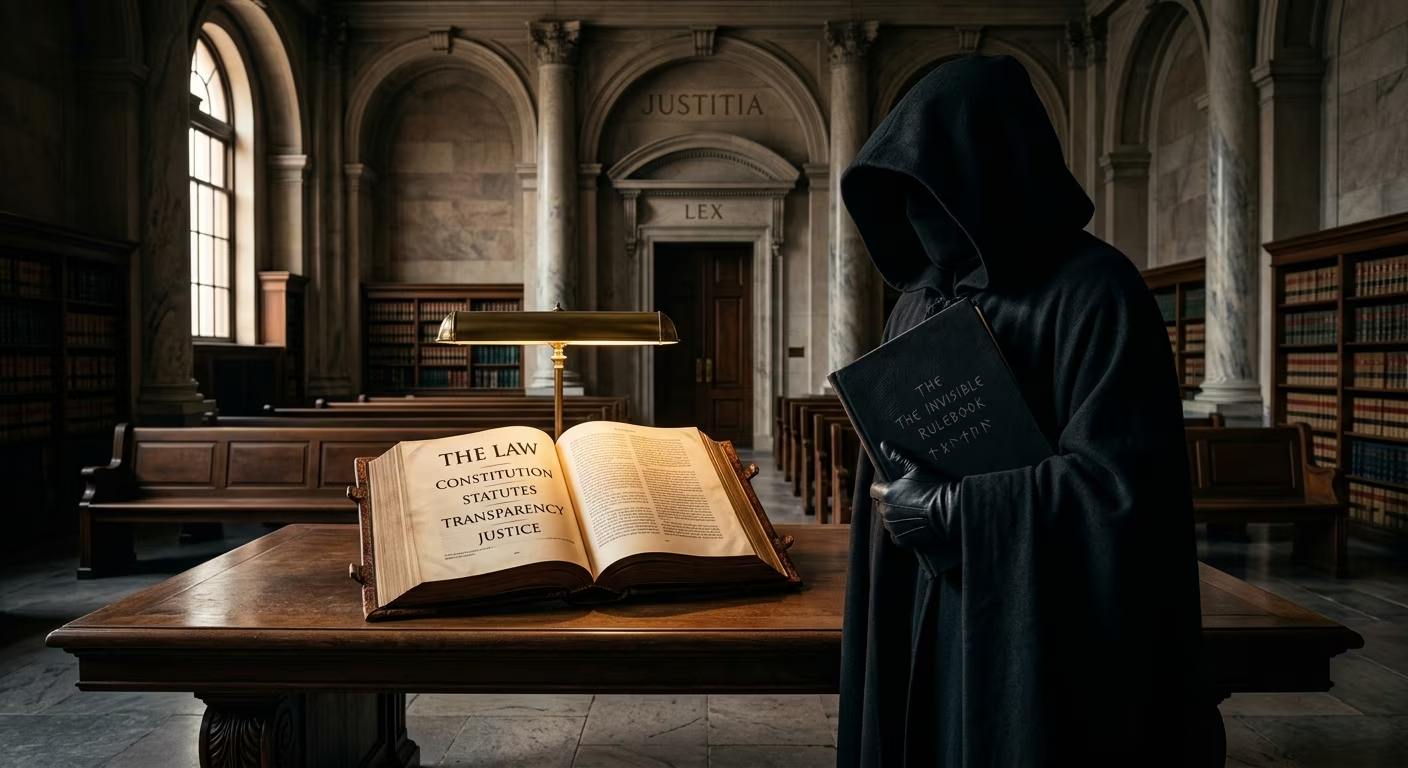
The Paradox of a Hidden Legal System
The phrase “rule of law” conjures images of majestic courthouses, public debates, and a society bound by clearly defined, accessible statutes. It is the cornerstone of democratic governance, ensuring that no individual—not even the highest executive official—is above the law. However, an unsettling paradox has emerged in modern governance. Beneath the visible framework of public statutes lies a shadow architecture of “secret law.” This invisible rulebook, often justified under the guise of national security, consists of classified legal interpretations, internal memoranda, and executive branch directives that shape the government’s most consequential actions.
When the legal reasoning that authorizes military force, mass surveillance, or executive privilege remains hidden from the public, it directly challenges the very foundations of democratic accountability. A democracy relies on visible rules; without them, the social contract fractures. Citizens cannot consent to powers they do not know exist. This article explores the delicate tension between necessary government secrecy and the indispensable need for legal transparency, analyzing how classified frameworks operate and why restoring public visibility to the law is critical for the future of democratic governance.
The Foundation of Democratic Governance: Why Laws Must Be Public
At its core, the rule of law demands absolute transparency. Regulated parties and the general public must know in advance the rules by which they are governed. The fundamental social contract of a democracy dictates that citizens consent to be governed by laws debated and enacted in the public square. When legal rules are hidden, citizens cannot challenge their legality, vote for representatives to change them, or hold officials accountable for violating them. Legal transparency ensures consistency, fairness, and predictability, preventing arbitrary exercises of immense state power.
In the United States, transparency laws were designed specifically to shed light on government operations and preserve this balance. The Administrative Procedure Act (APA), for example, was enacted to guarantee that administrative policies affecting individual rights are publicly promulgated. This was purposefully designed to avoid the inherently arbitrary nature of unpublished, ad hoc determinations. Similarly, the Freedom of Information Act (FOIA) serves as America’s landmark transparency law, designed to keep citizens in the know. Yet, these bedrock principles are frequently tested when governments invoke the state secrets privilege.
As legal scholars and governance experts have continually noted, excessive secrecy allows for both abuses of power and bureaucratic inefficiencies to be shielded from oversight. The rule of law cannot genuinely survive, let alone thrive, in an environment where the legal boundaries of executive authority are treated as classified information. A democratic state fundamentally contradicts itself when it demands strict legal compliance from its citizens while hiding the legal constraints governing its own agencies.
The Rise of the Executive Branch’s Internal Legal Memos
One of the most significant sources of hidden legal interpretation within the federal government originates from internal executive branch advisory offices. Offices such as the Department of Justice’s Office of Legal Counsel (OLC) provide authoritative legal advice to the President and all executive branch agencies. While intended to offer objective legal analysis, these internal opinions often serve as the definitive, binding interpretation of the law for the executive branch. Because they frequently address unprecedented issues that may never reach the federal courts, these offices act as a supreme arbiter for the executive, effectively creating a parallel legal system.
The problem arises when these binding legal opinions are kept completely secret. Over the past few decades, internal memos have been used to provide legal cover for highly controversial national security programs, ranging from expansive surveillance dragnets to targeted military interventions. Because these opinions effectively operate as a secret body of executive branch law, they insulate the executive from accountability. If an agency operates under a classified memo declaring an action legal, officials are shielded from prosecution, even if the public and legislative branches might view the action as blatantly unconstitutional.
Recognizing this threat to the separation of powers, lawmakers have periodically pushed for reform. Legislative efforts, such as the Demanding Oversight and Justification Over Legal Conclusions Transparency Act (DOJ OLC Transparency Act), aim to combat this secrecy by requiring the public disclosure of final legal opinions. Proponents of such legislation argue that while operational secrets—like troop movements or intelligence sources—must be protected, the legal rationale justifying those operations must be available for congressional and public scrutiny. Transparency in this realm is critical to ensuring that the executive branch does not sweepingly expand its powers without a structural check from the legislature and the electorate.
National Security vs. The Public’s Right to Know
The tension between transparency and national security is not easily resolved. Governments undeniably require a degree of secrecy to protect their citizens, gather foreign intelligence, and conduct diplomatic relations securely. Under the Freedom of Information Act, the government is explicitly permitted to withhold records under Exemption 1, which protects information properly classified in the interest of national defense or foreign policy. Additional FOIA exemptions protect sensitive law enforcement files, confidential commercial data, and internal personnel rules.
However, the application of Exemption 1 is frequently stretched beyond its intended scope to protect broad legal frameworks rather than strictly operational details. Intelligence and military agencies rely on classified legal authorizations to conduct complex operations globally. Agencies often invoke the “mosaic theory” of intelligence gathering, arguing that releasing even abstract legal interpretations could help adversaries piece together a broader picture of operational capabilities. While the specific targets of an operation or the technical methods employed legitimately warrant classification, the abstract legal interpretations of statutes—such as how the government legally defines an “imminent threat” or justifies sweeping data collection boundaries—should theoretically remain in the public domain.
When the government obfuscates how it interprets the laws passed by Congress, it deprives the public of the ability to debate the appropriateness of those laws. The routine invocation of national security exemptions to block FOIA requests concerning legal interpretations creates an insurmountable barrier for civil rights advocates, journalists, and everyday citizens trying to map the true extent of state power. Striking the right balance means strictly distinguishing between factual intelligence that endangers lives if released, and legal theories that endanger democracy if concealed.
The Ripple Effects of a Hidden Legal Framework
When the laws governing the state’s most coercive powers are shrouded in secrecy, the ripple effects are profoundly damaging to civil society and democratic institutions. First and foremost, a hidden rulebook erodes the system of checks and balances. Congress cannot effectively oversee, amend, or defund programs it does not fully understand. Furthermore, the judiciary is often sidelined; courts cannot easily rule on the constitutionality of actions shielded by the state secrets privilege or hidden behind highly redacted court filings. This creates a vacuum of accountability where executive power grows unchecked, fundamentally shifting the balance of power envisioned by constitutional framers.
The chilling effect on civil liberties is equally severe. When the legal boundaries of government surveillance are unknown, citizens and journalists may self-censor, fearing their legal, everyday activities might be swept up in a classified, broad interpretation of an intelligence-gathering statute. Whistleblowers face steep, life-altering legal consequences under the Espionage Act when attempting to clarify these boundaries for the public, creating a culture of fear rather than a culture of compliance.
Moreover, a hidden legal framework deeply damages public trust. When controversial government actions are eventually leaked or declassified, the resulting shock often leads to widespread cynicism and a loss of faith in government institutions. The perception that the state operates under a double standard breeds deep-seated resentment. If a democratic nation expects its citizens and global allies to respect the rule of law, it must demonstrate faithfulness to those ideals by publishing the rules it enforces upon itself. A society cannot champion freedom globally while governing via a shadow legal system domestically.
Pathways to Transparency: Reclaiming the Rule of Law
Restoring the visibility of the law requires a concerted, robust effort across all three branches of government. Legislatively, Congress must aggressively assert its constitutional prerogative to demand access to internal legal opinions that authorize significant national security programs. Passing robust transparency acts that mandate the publication of binding executive branch legal interpretations, with very narrow redactions solely for genuine operational intelligence, is an indispensable first step. Congress can leverage its power of the purse to condition funding on the delivery of these critical legal documents to oversight committees.
Judicially, federal courts must become more rigorous in their review of FOIA exemptions. Judges should be less deferential to blanket claims of national security and require agencies to provide detailed justifications for why the legal reasoning—not just the factual context—must remain classified. Courts have the inherent authority to conduct rigorous in camera reviews of classified documents to ensure that the executive branch is not using exemptions simply to avoid political embarrassment or cover up legally dubious activities.
Finally, within the executive branch itself, a cultural shift toward proactive declassification is essential. Internal watchdogs, such as Inspectors General, can play a pivotal role in reviewing the use of secret legal memos and recommending declassification where the public interest overwhelmingly outweighs the need for secrecy. Reclaiming the rule of law means recognizing that a true democracy cannot function in the dark.
Frequently Asked Questions (FAQ)
What exactly is “secret law”?
“Secret law” refers to legal interpretations, internal executive memos, and classified directives that establish binding rules or justifications for government actions but are entirely withheld from the public. Unlike statutes passed openly by legislative bodies, these interpretations are hidden, meaning citizens cannot know how the government is interpreting the legal limits of its own power.
Why does the government keep legal interpretations classified?
The government typically cites national security concerns, arguing that revealing the legal framework governing intelligence or military operations could inadvertently expose operational details, sources, or methods to adversaries. Additionally, officials often argue that keeping internal legal advice confidential encourages candid deliberations within executive agencies without the fear of immediate public backlash.
How does the Freedom of Information Act (FOIA) handle national security?
FOIA contains nine specific exemptions that allow the government to withhold requested records. Exemption 1 explicitly protects information that is properly classified under an Executive Order in the interest of national defense or foreign policy. However, transparency advocates heavily critique this exemption, noting it is frequently overused to hide sweeping legal interpretations rather than just sensitive operational facts.
How can citizens and lawmakers demand greater transparency?
Lawmakers have the authority to pass legislation requiring the mandatory publication of final legal opinions. Citizens, journalists, and organizations can continue to file FOIA requests, litigate unjustifiable denials in federal court, and support advocacy groups focused on government accountability. Sustained public pressure remains a vital tool in forcing the declassification of overarching legal frameworks and ensuring the government remains accountable to the people.
References
- Executive Order on Promoting the Rule of Law Through Transparency — Federal Register. 2019-10-15. https://www.federalregister.gov/documents/2019/10/15/2019-22624/promoting-the-rule-of-law-through-transparency-and-fairness-in-civil-administrative-enforcement-and
- FOIA Exemptions & Exclusions — U.S. Department of Health and Human Services. 2026-02-25. https://www.hhs.gov/foia/faqs/exemptions-exclusions/index.html
- Freedom of Information Act Exemptions — U.S. Department of Labor. 2024-01-01. https://www.dol.gov/general/foia/exemptions
- DOJ OLC Transparency Act — U.S. Senator Tammy Duckworth. 2025-05-18. https://www.duckworth.senate.gov/imo/media/doc/doj_olc_transparency_act.pdf