
Interspousal Transfer Grant Deeds vs. Quitclaim Deeds
Understand how interspousal transfer grant deeds differ from quitclaim deeds, and how each affects ownership, taxes, and divorce-related property transfers.
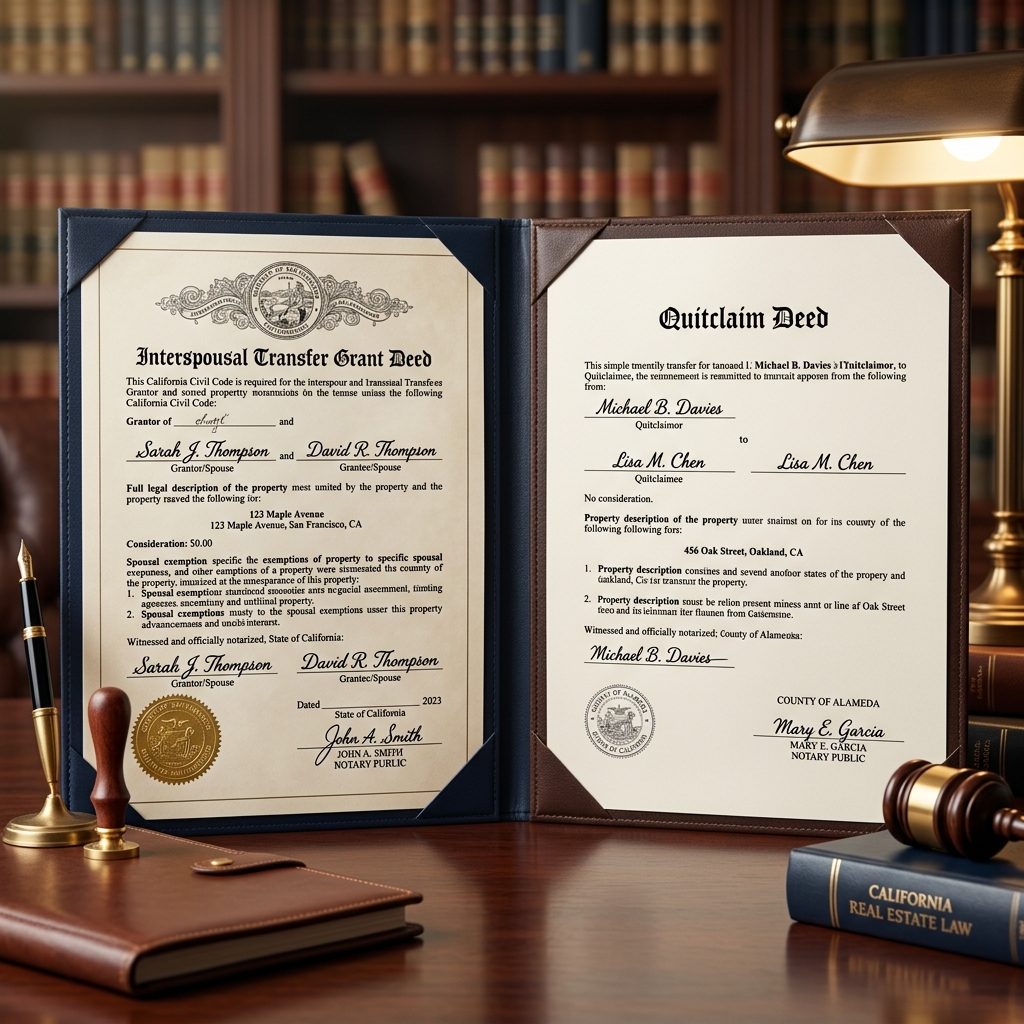
When spouses transfer real estate between each other, especially in states like California that follow community property principles, the type of deed they choose can have serious consequences for taxes, ownership rights, and future disputes in divorce or estate planning. Two of the most commonly used instruments are the interspousal transfer grant deed and the quitclaim deed. Understanding how these documents differ—and when each is appropriate—helps couples, divorcing spouses, and their advisors avoid costly misunderstandings and litigation.
Why Deed Choice Matters in Marital Property Transfers
Real estate deeds do more than move names on a title. They can affect:
- Who legally owns the property and in what proportion.
- How the property is classified (community vs. separate property) under family law.
- Property tax reassessment and transfer taxes when ownership changes.
- Future claims during divorce, such as reimbursement or disputes over whether one spouse truly gave up their rights.
Because of these impacts, deed selection is particularly important in situations such as divorce negotiations, refinancing a mortgage into one spouse’s name, or changing ownership for estate planning.
Core Concepts: Community vs. Separate Property
To understand interspousal deeds, it helps to start with how marital property is classified in community property jurisdictions like California. Under California Family Code section 760, most assets acquired during marriage are presumed to be community property, meaning both spouses have equal interests regardless of whose name appears on the title. Separate property generally includes assets owned before marriage, gifts, and inheritances, or property traceable to those sources.
Changing a property’s legal character from community to separate, or vice versa, is called a transmutation. California Family Code section 852 requires that any transmutation be in writing and include an express declaration by the spouse giving up rights that they understand and intend to change the property’s character. This requirement is critical when spouses use deeds between themselves: simply signing an interspousal transfer deed may not, by itself, achieve a valid transmutation if the document lacks clear language meeting statutory standards.
What Is an Interspousal Transfer Grant Deed?
An interspousal transfer grant deed is a specialized version of a grant deed used to transfer real estate interests between married spouses or registered domestic partners. It is customized to reflect that the parties are spouses and that the transfer is intended to adjust property rights within the marital relationship, such as converting community property to one spouse’s separate property or vice versa.
Key characteristics include:
- Grant deed foundation: The grantor (transferring spouse) generally states they own the interest being conveyed and are transferring it to the other spouse, often with implied assurances against undisclosed liens or encumbrances.
- Interspousal context: The deed language explicitly identifies the parties as spouses or domestic partners and may reference community property concepts, making the nature of the transaction clearer for tax and legal purposes.
- Frequent tax advantages: In California, many interspousal transfers are exempt from property tax reassessment and, in some cases, from documentary transfer taxes, because they are treated as transfers within a marital unit rather than a taxable change in ownership.
Interspousal transfer grant deeds are commonly used in scenarios such as removing a spouse from title during divorce, adding a spouse to title after marriage, or restructuring ownership as part of estate planning.
What Is a Quitclaim Deed?
A quitclaim deed is a more basic instrument. The person signing the deed gives up, or “quits,” whatever ownership interest they may have in the property, if any, without providing warranties or promises about their title. The grantor may or may not actually own an interest; they are merely relinquishing any claim they might have.
Key features include:
- No guarantee of ownership: The grantor does not promise they own the property; they simply surrender any rights they may hold.
- No warranties of title: Unlike a grant deed, a quitclaim deed does not assure the grantee that there are no hidden liens or other encumbrances.
- Versatility: Quitclaim deeds are often used in divorces, inheritance disputes, or to clear up potential claims when someone might have an interest but it is unclear.
Because quitclaim deeds are simple and do not include warranties, they are widely used in personal or informal transfers. However, in a marital context, they may not provide the same clarity about tax treatment or community property rights that a tailored interspousal transfer deed can provide.
Side-by-Side Comparison
| Feature | Interspousal Transfer Grant Deed | Quitclaim Deed |
|---|---|---|
| Typical Use | Transfers between spouses or domestic partners, often to adjust community vs. separate property rights. | Waiving any possible interest, commonly in divorce or inheritance situations. |
| Underlying Deed Type | Customized form of a grant deed. | Quitclaim; no warranty of ownership or clear title. |
| Title Warranties | Typically includes implied assurances that the grantor owns the interest and there are no undisclosed encumbrances. | No warranties or guarantees; the grantor only relinquishes whatever they may own. |
| Tax Reassessment | Often treated as an interspousal exclusion, avoiding property tax reassessment where applicable. | May trigger reassessment unless the transfer qualifies under another exclusion; not inherently interspousal. |
| Community Property Implications | Designed to interact with community property rules; can support transmutation if properly drafted. | Can be used in marital situations but may offer less clarity about community property intent. |
| Common Situations | Divorce settlements, refinance into one spouse’s name, estate planning within marriage. | Removing a spouse or heir with potential claims, resolving disputes over unclear interests. |
Tax and Assessment Considerations
Property tax rules add another layer of complexity. In California, county assessors treat many transfers between spouses as interspousal exclusions, meaning the transfer does not constitute a taxable change in ownership and does not trigger reassessment of the property’s value for tax purposes. The Los Angeles County Assessor, for example, recognizes exclusions when property passes between spouses upon death or when one spouse retains property in a divorce settlement.
Interspousal transfer grant deeds are frequently used because they clearly signal that the transaction is between spouses and may qualify for these statutory exclusions. By contrast, a generic quitclaim deed does not inherently indicate that the transfer is interspousal, which can complicate how assessors and tax authorities classify the transaction. Additional documentation might be necessary to prove that an exclusion applies.
Deeds and Transmutation: Changing Property Character
One of the most misunderstood aspects of interspousal transfers is the difference between changing title and changing property character. From a family law perspective, who is listed on the deed is not always decisive. Courts focus on:
- The source of funds used to acquire the property (community vs. separate).
- Whether a legally effective agreement exists to change the property’s status under transmutation rules.
Legal analysis points out that interspousal transfer deeds, standing alone, may not satisfy transmutation requirements unless they include an express declaration meeting Family Code section 852 standards. Without that level of clarity, a spouse could argue in divorce that the property remains community because the deed was only a change in title, not a knowing and voluntary relinquishment of rights.
Therefore, attorneys often recommend pairing an interspousal transfer grant deed with a separate written transmutation agreement signed by both spouses. This document explicitly states that the property is being converted to separate or community and confirms that the spouse giving up rights understands and intends this result.
Common Uses in Divorce and Separation
When couples divorce, real estate often becomes a central issue. Deeds are used to carry out settlement agreements and court orders. Typical patterns include:
- One spouse keeps the family home and refinances the mortgage into their sole name while the other spouse executes an interspousal transfer grant deed or a quitclaim deed to remove their interest.
- Property equalization, where one spouse receives the house and the other receives other assets of comparable value; the deed memorializes the property transfer.
- Transfers under court order, which may be exempt from property tax reassessment and can be structured using interspousal transfer deed language.
Choosing between an interspousal transfer grant deed and a quitclaim deed in these scenarios depends on the goals of the parties, local practice, and tax advice. Interspousal deeds tend to give clearer signals to courts and tax authorities about the marital context and may be preferred when preserving applicable exemptions.
Typical Steps in Completing an Interspousal Transfer Deed
Although requirements differ by county and state, completing an interspousal transfer deed usually involves several core steps:
- Obtaining the appropriate form from a title company, attorney, or legal document provider, ensuring that it matches local recording requirements.
- Accurately describing the property, including legal description, parcel number, and current vesting information so that the recorder can match the deed to the correct parcel.
- Identifying both spouses clearly, with full legal names and marital status as required by local practice.
- Stating the nature of the transfer, including whether it is a gift, part of a divorce settlement, a refinance-related change, or an estate planning move.
- Signing in front of a notary public, as deeds generally must be notarized to be recorded.
- Recording with the county recorder in the county where the property is located, along with any required change of ownership forms or preliminary change of ownership reports.
In California, recording a deed triggers notifications to the county assessor and may prompt requests for additional information about whether the transfer qualifies for an exclusion from reassessment. Proper completion of forms helps protect the parties from unexpected tax bills.
Risks of Relying Only on Title Changes
Practitioners warn that spouses sometimes sign interspousal transfer deeds at escrow without fully understanding the legal consequences. Potential risks include:
- Unintended loss of rights if a deed, paired with a clear transmutation agreement, truly converts community property to separate property and the spouse later regrets the decision.
- False sense of security if parties believe a simple deed alone changed property character, but courts later treat the asset as community because the legal requirements for transmutation were not satisfied.
- Tax surprises if the deed does not clearly qualify for an interspousal exclusion and reassessment or transfer taxes are imposed.
Careful planning, including independent legal advice for each spouse when rights are being surrendered, helps mitigate these risks.
FAQ: Interspousal Transfer Grant Deeds vs. Quitclaim Deeds
Is an interspousal transfer grant deed always better than a quitclaim deed?
No. An interspousal transfer grant deed is often preferable when the goal is to document a transfer clearly within a marital context and preserve tax exclusions, but a quitclaim deed can be appropriate where the main objective is simply to release any potential claim, such as clearing title in an inheritance dispute.
Does signing an interspousal transfer deed automatically make a property separate?
Not necessarily. In California, changing property from community to separate (or the reverse) generally requires a writing with an express declaration by the spouse giving up rights, as required by Family Code section 852. A deed that does not meet these standards may be treated as a change in title only, not as a valid transmutation.
Can a quitclaim deed be used between spouses?
Yes. Spouses may use quitclaim deeds to release claims in marital property, especially during divorce. However, quitclaim deeds may not provide the same clarity about community property rights or tax treatment as a specialized interspousal transfer deed.
Will property taxes go up if we transfer our home between spouses?
In many cases in California, transfers between spouses qualify for an interspousal exclusion and do not trigger reassessment. Proper documentation, including correctly identifying the transaction as interspousal, helps the assessor apply the exclusion. Tax outcomes depend on specific circumstances and local rules.
Do we need a lawyer to prepare an interspousal transfer grant deed?
Although standardized forms are available, involving a family law or real estate attorney is strongly recommended when changing property rights between spouses. Legal counsel can ensure the deed and any accompanying transmutation agreement comply with statutory requirements and accurately reflect the parties’ intentions.
Key Takeaways for Spouses and Divorcing Couples
- Deed choice affects more than title; it can impact taxes, community property rights, and future litigation.
- Interspousal transfer grant deeds are tailored to transfers between spouses and often support tax exclusions and clearer documentation of marital property goals.
- Quitclaim deeds are simpler and frequently used to relinquish claims, but they lack title warranties and may offer less clarity in a marital context.
- Transmutation law requires more than a change in title; spouses should consider separate written agreements with express declarations to validly change property character.
- Professional advice from attorneys and tax specialists is crucial whenever significant rights or tax consequences are involved.
References
- A Guide to Interspousal Transfer Deeds in California — Guideway Legal. 2023-05-10. https://guidewaylegal.com/say-i-do-to-easy-property-transfers-a-guide-to-interspousal-transfer-deeds-in-california/
- IN CALIFORNIA: Deed Types — Chicago Title Company. 2024-01-01. https://chicagotitleconnection.com/images2024/PDF/CaliforniaDeedTypes.pdf
- What Is An Interspousal Transfer Grant Deed & Its Purpose? — Schorr Law. 2022-09-15. https://schorr-law.com/interspousal-transfer-grant-deed/
- The Legal Limits of Interspousal Transfer Deeds in California — TALG. 2023-04-20. https://talglaw.com/the-legal-limits-of-interspousal-transfer-deeds-in-california/
- Transferring Property Between Spouses — Pinkham & Associates. 2022-11-01. https://www.pinkhamlaw.com/family-law-insights/transfering-property-between-spouses-transmutation/
- Inter-Spousal Exclusion — Los Angeles County Assessor. 2023-02-01. https://assessor.lacounty.gov/exclusions/inter-spousal
- Form: Interspousal Transfer Deed — Sacramento County Public Law Library. 2023-04-01. https://saclaw.org/wp-content/uploads/2023/04/form-interspousal-grant-deed.pdf
Similar Articles








Read full bio of Sneha Tete


