
International Child Custody in Japan and the Hague Convention
How Japan’s custody system interacts with the Hague Convention in cross‑border child abduction and return cases.
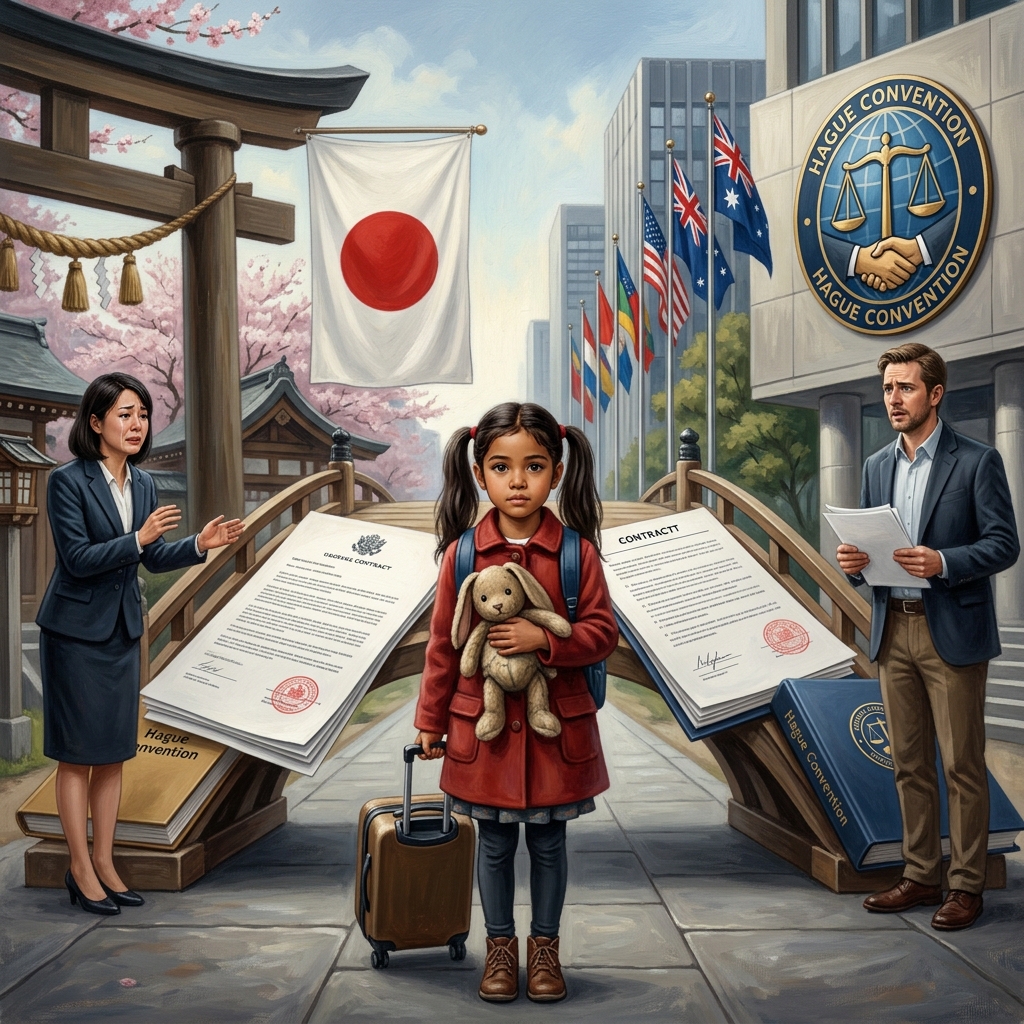
International child custody disputes involving Japan raise complex questions about how national family law interacts with the Hague Convention on the Civil Aspects of International Child Abduction. Japan’s historic focus on sole custody after divorce, combined with its relatively recent accession to the Hague Convention in 2014, creates a distinctive legal landscape for parents facing cross‑border child abduction or retention.
This article explains Japan’s approach to parental authority and custody, outlines how Hague Convention cases work when a child is taken to or kept in Japan, and highlights practical and strategic considerations for parents and practitioners dealing with these disputes. It also touches on upcoming civil code reforms that may reshape Japanese custody law and influence future Hague Convention proceedings.
Japan’s Custody Framework in an International Context
For many years, Japan has stood out among industrialized nations for maintaining a sole custody model after divorce, with only one parent typically given parental authority over the child. In practice, this has often meant that the parent living with the child becomes the primary decision maker, while the non‑custodial parent may have limited or no contact.
- Parental authority during marriage: Both parents normally share parental authority over their children while married, unless a court order provides otherwise.
- Parental authority after divorce: Traditionally, courts award parental authority to only one parent in formal proceedings, and joint custody is rare unless agreed privately outside the court system.
- Judicial discretion: Judges have broad discretion to decide which parent should have authority and how contact with the other parent should be structured, guided by principles such as continuity and stability for the child.
This emphasis on continuity means that the parent who has been caring for the child most recently and consistently is frequently favored in custody decisions, especially when there has been a unilateral move or separation. As a result, once a child is settled in Japan with one parent, courts have historically been reluctant to disrupt that arrangement.
Japan’s Accession to the Hague Convention
In response to growing international pressure and an increasing number of cross‑border disputes, Japan ratified the 1980 Hague Convention on the Civil Aspects of International Child Abduction on April 1, 2014. Implementation followed through a dedicated domestic statute, the Act for Implementation of the Convention on the Civil Aspects of International Child Abduction (2013).
Under the Hague Convention framework, a parent whose child has been wrongfully removed to or retained in Japan may seek the child’s prompt return to the country of habitual residence or court‑ordered access rights, provided the child is under 16 and the removal or retention occurred after Japan’s treaty entry date.
| Aspect | Japan’s Position |
|---|---|
| Treaty status | Party to the Hague Abduction Convention since April 1, 2014. |
| Central Authority | Hague Convention Division, Ministry of Foreign Affairs (MOFA). |
| Scope of applications | Return and access cases involving children under 16 wrongfully removed to or retained in Japan after accession. |
| Implementation law | Act for Implementation of the Convention on the Civil Aspects of International Child Abduction (2013). |
The Role of Japan’s Central Authority
The Japanese Central Authority (JCA) for Hague cases is the Hague Convention Division within MOFA. It is responsible for receiving and processing applications from foreign central authorities and left‑behind parents, coordinating legal assistance, and facilitating mediation and court proceedings.
- Application intake: Left‑behind parents submit Hague applications to the JCA, either directly or via their own country’s central authority.
- Legal aid and attorney referrals: The JCA can arrange referrals to attorneys in Japan and assist with access to legal aid systems where available.
- International mediation: MOFA has created an international mediation scheme specifically for child abduction and access disputes, using impartial mediators and voluntary participation to encourage negotiated resolutions.
Mediation can be particularly valuable in cases where swift court‑ordered return is unlikely, or where both parents intend to remain active in the child’s life but disagree on location or contact arrangements. However, mediation outcomes are ultimately voluntary; they rely on both parents’ willingness to compromise.
How Hague Return and Access Cases Work in Japan
Once a Hague application is filed, Japanese authorities and courts must evaluate whether the removal or retention is “wrongful” under the Convention and, if so, whether the child should be returned or whether access rights should be ordered. The Convention’s core objective is to restore the status quo by returning the child to their habitual residence, leaving long‑term custody decisions to that country’s legal system.
Return Applications
A parent seeking return generally needs to demonstrate that:
- The child was habitually resident in another country immediately before the allegedly wrongful removal or retention.
- The left‑behind parent had custody rights under the law of that habitual residence.
- The child was removed to or retained in Japan without consent or in breach of those custody rights.
- The application was filed within the time limits contemplated by the Convention (usually within one year of wrongful removal or retention for the strongest presumption of return).
If these elements are proven, Japanese courts must order return unless a Convention exception applies, such as grave risk of harm or the child’s objection if mature enough. The interaction between these exceptions and Japan’s domestic focus on continuity and stability can be complex, especially where the child has already settled in Japan.
Access Applications
The Convention also allows parents to seek judicial or administrative assistance in securing access rights (contact or visitation) with a child living in another treaty country. In Japan, this may involve court orders facilitating communication, visits, or other forms of contact, as well as arrangements for travel or supervision where appropriate.
Access cases are particularly important when return is denied or impractical but ongoing parental involvement remains in the child’s best interests. Japanese courts must interpret and apply these access provisions within the broader national context of sole custody and limited enforcement mechanisms.
Challenges Created by Japan’s Sole Custody Tradition
Despite formal accession to the Hague Convention, parents and practitioners have identified substantive and practical challenges when litigating international custody and abduction cases in Japan. These difficulties often stem from the underlying domestic custody framework.
- Sole custody dominance: The default expectation that post‑divorce custody will rest with one parent can make it harder for foreign judgments granting joint custody or shared parenting time to be recognized or given practical effect.
- Limited recognition of foreign orders: Japanese judges are not obliged to accept or enforce foreign custody decisions, even where those orders would normally be respected under comity principles.
- Continuity principle: Courts tend to favor the status quo and the parent with whom the child has most recently lived, which may effectively validate a unilateral relocation if enough time passes before proceedings.
- Enforcement difficulties: Historically, there have been limited mechanisms to compel compliance with visitation orders or return decisions, making access and parenting time dependent on the custodial parent’s cooperation.
Human rights organizations and legal scholars have criticized these structural issues, sometimes describing Japan as a “black hole” for international child abduction because parents who bring children there may face relatively few consequences and left‑behind parents may encounter serious obstacles obtaining effective relief.
Upcoming Reforms to Parental Authority and Their Impact
Japan is in the process of implementing significant reforms to its civil code governing parental authority after divorce. Effective April 1, 2026, amendments introduce the possibility of joint parental authority in certain circumstances, marking a major shift in Japanese family law.
- Parents will be able to agree to joint parental authority after divorce, subject to court approval.
- Family courts will have explicit authority to order either sole or joint parental authority when parents cannot reach agreement.
- Courts must consider all circumstances affecting the child’s welfare and must choose sole authority where joint authority would harm the child.
- Where joint authority is granted, both parents generally share decision‑making, although either may act alone for day‑to‑day or urgent matters.
These reforms are expected to reshape expectations around parental involvement after divorce, potentially increasing judicial willingness to consider shared decision‑making. However, the changes do not automatically create presumptions of shared physical custody or more robust enforcement of parenting time, and they may not immediately resolve the difficulties faced in international cases.
For Hague Convention disputes, the reforms might gradually influence how Japanese courts view foreign joint custody orders, transnational co‑parenting arrangements, and access claims by non‑resident parents. Their full impact will depend on judicial interpretation and whether enforcement practices evolve alongside the statutory changes.
Preventive Strategies for Parents at Risk of Abduction
Prevention remains critical in international custody situations. Once a child is taken to another country, including Japan, legal remedies under the Hague Convention can be time‑consuming, uncertain, and emotionally taxing for all involved.
- Secure clear custody orders: Obtaining a detailed custody and visitation order from a competent court in the child’s habitual residence can help establish rights and support a future Hague application if necessary.
- Use travel monitoring tools: Parents can enroll in programs such as the U.S. State Department’s Smart Traveler Enrollment Program (STEP) for better awareness of travel patterns and emergencies.
- Document information: Keeping thorough records of contact details, identification documents, and travel plans for both the child and the other parent can assist authorities quickly if abduction occurs.
- Notify schools and caregivers: Schools, childcare providers, and babysitters should be informed about any court‑ordered restrictions and supplied with copies of custody orders and photographs, where domestic law permits.
- Consult legal counsel early: Parents who foresee potential cross‑border disputes should speak with family law attorneys experienced in international cases before problems escalate.
Proactive measures are not a substitute for the Hague Convention, but they complement treaty protections by reducing opportunities for wrongful removal and making it easier to respond effectively if abduction occurs.
Practical Considerations for Hague Cases Involving Japan
Navigating a Hague case involving Japan requires combining knowledge of the Convention with an understanding of Japanese procedural and cultural realities. Parents and professionals should bear in mind several practical points:
- Time sensitivity: Hague applications filed promptly after removal or retention give the strongest basis for return and reduce the chance that a court will treat the child as “settled” in Japan.
- Local representation: Engaging a Japanese family law attorney familiar with Hague procedures is essential for handling filings, hearings, and potential appeals.
- Cultural context: Japanese courts often place considerable weight on social stability and the child’s immediate caregiving environment, which can influence how exceptions and defenses under the Convention are viewed.
- Mediation opportunities: The MOFA‑linked mediation program provides an option to resolve disputes more flexibly, especially where both parents expect long‑term involvement in the child’s life in different countries.
- Coordination with home country authorities: Parents should maintain close communication with their own central authorities (such as the U.S. Office of Children’s Issues) to coordinate efforts and ensure consistent information is presented throughout the case.
These considerations highlight that Hague litigation in Japan is both legally technical and deeply human. Outcomes depend not only on statutory rules but also on judicial attitudes, practical enforcement, and the willingness of parents to reach workable agreements.
FAQs: Japan, Child Custody, and the Hague Convention
Is Japan a party to the Hague Convention on child abduction?
Yes. Japan joined the Hague Convention on the Civil Aspects of International Child Abduction on April 1, 2014, and has implemented it through domestic legislation and the work of the Ministry of Foreign Affairs.
Can a left‑behind parent request return of a child from Japan?
A left‑behind parent may file a Hague application seeking return of a child under 16 who has been wrongfully removed to or retained in Japan after the treaty’s entry into force. The application is submitted via the relevant central authority, and Japanese courts then decide whether return is required under Convention rules.
Does Japan recognize foreign joint custody orders?
Japanese courts are not obligated to recognize or enforce foreign custody orders, including those granting joint custody, and historically the domestic system has favored sole parental authority. However, upcoming reforms introducing joint parental authority after divorce may gradually influence courts’ approach to foreign shared‑custody judgments.
What is the Japanese Central Authority’s role?
The Hague Convention Division of Japan’s Ministry of Foreign Affairs acts as the Central Authority. It receives and processes Hague applications, helps parents obtain legal representation and legal aid where possible, and facilitates international mediation for child abduction and access disputes.
Do the 2026 civil code reforms change physical custody patterns?
The 2026 reforms focus on legal parental authority and decision‑making after divorce, introducing the possibility of joint authority. They do not automatically change Japan’s traditional model of one primary residential parent and do not, on their own, greatly expand enforcement of parenting time orders.
References
- Japan’s ratification of the Hague Convention on the Civil Aspects of International Child Abduction — UN Office of the High Commissioner for Human Rights / Treaty Bodies. 2014-04-01. https://tbinternet.ohchr.org/_layouts/15/TreatyBodyExternal/DownloadDraft.aspx?key=fVSGJr4/nQfK82vM3fT0+t8lplxqYvU0i1p+e4I8tD3CVDHOi3cRA/dRvMDLsbFG
- Japan International Parental Child Abduction Information — U.S. Department of State, Bureau of Consular Affairs. 2023-08-10 (last updated). https://travel.state.gov/content/travel/en/International-Parental-Child-Abduction/International-Parental-Child-Abduction-Country-Information/Japan.html
- The “black hole” of child abduction: Japan’s child custody laws — Humanium. 2022-01-15. https://www.humanium.org/en/the-black-hole-of-child-abduction-japans-child-custody-laws/
- Japan 2026 Child Custody Reform & Hague Convention Impact — Multi-Jurisdictional Divorce / The Forefront. 2024-06-01. https://multi-jurisdictionaldivorce.com/the-forefront/japan-child-custody-reform-2026-hague-convention/
- International Custody Issues — Yokota Air Base, United States Air Force. 2021-03-01. https://www.yokota.af.mil/Portals/44/International%20Custody%20Issues%20(Last%20Updated%20Mar%2021)_1.pdf
Similar Articles








Read full bio of Sneha Tete


