
Institutional Responses to Protest in US Civil Detention
The systemic suppression of nonviolent hunger strikes in US civil detention.
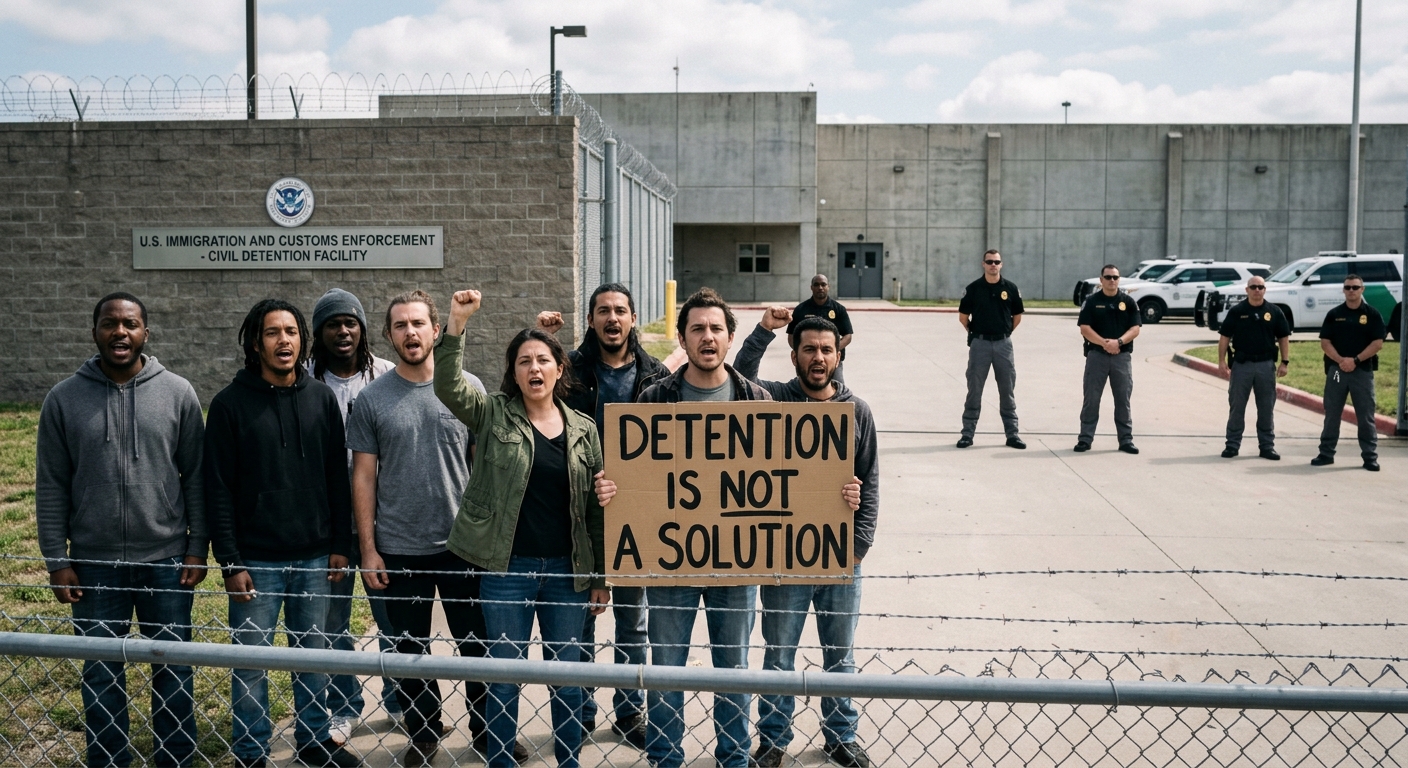
The concept of civil immigration detention in the United States is fundamentally designed to be administrative. It is intended merely to secure an individual’s presence for immigration proceedings or deportation, and is expressly not designed to be punitive. However, mounting evidence, testimonies, and human rights investigations suggest that the daily reality inside these facilities heavily mirrors criminal incarceration. Faced with conditions they perceive as inhumane, and possessing severely limited avenues for formal redress, many detainees resort to one of the most historically significant forms of nonviolent protest: the hunger strike.
Throughout history, the hunger strike has served as the ultimate bargaining chip for the disenfranchised. In the context of modern U.S. civil detention, this extreme measure is rarely undertaken lightly. It is the protest of last resort, utilized by individuals who feel entirely stripped of their voice, agency, and fundamental human rights. By putting their own bodies on the line, detained immigrants attempt to bypass the bureaucratic walls of the detention system and force visibility onto their plight. This dynamic creates an intense friction between a massive law enforcement apparatus designed to maintain absolute institutional control and vulnerable individuals asserting their ultimate right to bodily autonomy.
The Anatomy of a Hunger Strike in Confinement
What specifically constitutes a hunger strike within the rigid architecture of immigration detention? U.S. Immigration and Customs Enforcement (ICE) relies on specific metrics outlined in their National Detention Standards. Under these guidelines, a hunger strike is formally recognized and recorded when a detained individual misses nine consecutive facility-provided meals or completely fasts for a period of 72 hours. Once this threshold is crossed, a series of strict administrative and medical protocols are immediately triggered.
While policy dictates that these protocols are established to ensure the health and medical monitoring of the detainee, civil rights advocates argue that the resulting procedures frequently function as mechanisms of suppression. Detainees do not starve themselves out of convenience. The catalysts for these strikes are deeply rooted in systemic failures: severe overcrowding, unsanitary living conditions, prolonged and indefinite delays in immigration court proceedings, blatant medical neglect, and abuse by facility staff. Because detained immigrants are structurally deprived of traditional means of advocacy—often lacking legal representation and isolated from the outside world—the refusal to consume food becomes the only remaining currency with which they can purchase institutional attention.
Administrative Protocols versus Retaliatory Practices
When a detained individual initiates a hunger strike, the facility’s response is governed by complex internal directives. However, comprehensive human rights investigations have revealed a deeply concerning pattern regarding how these directives are actually implemented. A seminal 2021 report by Physicians for Human Rights (PHR) and the American Civil Liberties Union (ACLU), titled Behind Closed Doors, provided an unprecedented look into these practices. Based on the analysis of thousands of pages of internal agency documents obtained through Freedom of Information Act (FOIA) litigation, the researchers documented a systemic gap between the written illusion of medical care and the harsh reality of retaliatory practice.
The investigation uncovered that rather than addressing the core grievances driving the protests, facility administrators frequently respond with punitive escalations disguised as administrative necessity. The bureaucratic machinery of detention centers is fundamentally intolerant of disruption, meaning peaceful non-cooperation is often met with rapid and severe institutional force aimed at breaking the protest before it can garner external media attention.
The Weaponization of Solitary Confinement and Transfers
Among the most prevalent retaliatory responses is the use of administrative segregation—the bureaucratic euphemism for solitary confinement. Under the guise of providing closer “medical observation,” striking individuals are routinely removed from the general population and isolated in small, often windowless cells for up to 23 hours a day. The psychological devastation of solitary confinement is well-documented; international standards classify prolonged solitary confinement as a form of torture. For a hunger striker already enduring severe physical depletion, this extreme isolation exponentially exacerbates their mental anguish. The isolation serves as a coercive tool designed to fracture the striker’s resolve by depriving them of human contact.
In tandem with solitary confinement, authorities frequently deploy strategic facility transfers. By abruptly uprooting a striking individual and transferring them to a remote detention center—often hundreds of miles away—administrators can effectively sever the detainee’s critical lifelines. This tactic isolates them from their legal counsel, family members, and community advocacy networks. While detention standards permit “disciplinary transfers,” human rights watchdogs strongly condemn the application of this tactic against nonviolent protesters, viewing it as a deliberate strategy to inflict psychological pain and dismantle collective organizing efforts.
The Medical Ethics of Involuntary Intervention
The most severe escalation in the institutional management of a hunger strike is the utilization of involuntary medical interventions, specifically enteral feeding, colloquially known as force-feeding. This is a highly invasive procedure that typically involves strapping a resisting individual into a specialized restraint chair, securing their limbs and head, and forcibly inserting a nasogastric tube through their nasal cavity, down the throat, and into the stomach to pump liquid nutritional supplements.
From a framework of medical ethics, force-feeding a mentally competent adult who has consciously chosen to fast is profoundly unjustifiable. The World Medical Association (WMA), the premier global body establishing ethical directives for medical professionals, addresses this exact scenario in the Declaration of Malta on Hunger Strikers. The Declaration unequivocally states that force-feeding is never acceptable when the individual is mentally competent and has made a voluntary, informed decision to refuse nourishment. The guidelines dictate that physicians have an absolute duty to respect the autonomy of the patient. The WMA emphasizes that feeding induced by threats, coercion, or physical restraint fundamentally violates the principle of non-maleficence and constitutes a form of inhuman and degrading treatment.
Despite this clear international consensus, medical personnel working within U.S. detention facilities are frequently caught in a severe “dual loyalty” conflict. They are torn between their Hippocratic obligation to respect the patient’s autonomy and the administrative mandates of their employer. Facility directors prioritize institutional order and liability mitigation, often pressuring facility doctors to participate in or oversee involuntary feeding procedures, thereby conscripting medical professionals into roles of disciplinary enforcement.
Legal Frameworks and International Human Rights Perspectives
The domestic legal landscape governing hunger strikes in civil detention heavily favors institutional authority over individual liberty. When a facility wishes to initiate involuntary feeding, it typically seeks a court order from a federal judge. Historically, U.S. courts have been highly receptive to these requests. Judges balance the individual’s First Amendment right to expressive protest and Fifth Amendment right to bodily privacy against the government’s stated interests in preserving life and maintaining facility security. Unfortunately, courts frequently defer to the operational needs of the detention facility, effectively sanctioning invasive procedures that international human rights bodies explicitly condemn.
On the international stage, the perspective is starkly opposed to the U.S. domestic approach. The United Nations human rights apparatus has been highly critical of forced medical interventions in detention settings. The UN Special Rapporteur on Torture and Other Cruel, Inhuman or Degrading Treatment or Punishment has consistently issued statements clarifying that force-feeding individuals who have opted for a hunger strike to protest their detention conditions is tantamount to cruel, inhuman, and degrading treatment. When physical restraints are utilized to overcome the victim’s resistance, and the procedure is intentionally deployed to intimidate or punish, it clearly meets the threshold of torture under international human rights law.
The Physiological and Psychological Toll on Detainees
The physical and mental consequences of enduring a hunger strike, compounded by severe institutional retaliation, are devastating. Prolonged fasting triggers a cascade of severe physiological crises. As the body is deprived of nutrients, it begins to consume its own muscle tissue and fat for energy. As the strike progresses into weeks, the risk of catastrophic organ failure, severe electrolyte imbalances, and permanent neurological damage becomes imminent. If an individual is eventually fed after a prolonged period of starvation—whether voluntarily or forcibly—they face the additional, potentially fatal risk of “refeeding syndrome,” a dangerous metabolic shift in fluids that requires specialized critical care.
The intervention of force-feeding introduces its own profound physical trauma. The repeated, forceful insertion of nasogastric tubes into a struggling patient frequently causes severe nasal and esophageal abrasions, internal bleeding, and immense physical pain. Furthermore, the psychological toll of being physically restrained by guards and subjected to an invasive medical procedure against one’s will cannot be overstated. Survivors frequently report enduring psychological trauma, manifesting as symptoms consistent with Post-Traumatic Stress Disorder (PTSD), severe clinical depression, and chronic anxiety. The total erasure of bodily autonomy, combined with the sensory deprivation of solitary confinement, strips the individual of their dignity.
Pathways to Institutional Reform
Addressing the systemic abuses surrounding the management of hunger strikes in civil immigration detention requires aggressive, comprehensive policy reform and the establishment of robust oversight. Human rights advocates and medical associations advocate for several critical changes:
- Ending Retaliatory Segregation: Federal legislation must explicitly prohibit the use of solitary confinement and punitive facility transfers as retaliatory measures against nonviolent protesters.
- Aligning with Medical Ethics: ICE and associated private prison contractors must revise their National Detention Standards to definitively ban the procurement of court orders for the involuntary feeding of mentally competent adults, aligning with the WMA’s Declaration of Malta.
- Protecting Healthcare Workers: Healthcare professionals working within these environments must be granted statutory protections that shield them from administrative retaliation when they refuse to participate in forced feeding.
- Independent Oversight: Establishing independent oversight boards with the authority to conduct unannounced audits of facility responses to protests to ensure human rights compliance.
Frequently Asked Questions (FAQs)
What triggers a formal hunger strike protocol in immigration detention?
According to standard institutional guidelines published by ICE, a hunger strike is formally recognized and logged when a detained individual refuses food for 72 consecutive hours or misses nine consecutive facility-provided meals.
Is force-feeding legal in the United States?
Yes, under specific circumstances. Facility administrators can petition federal courts for orders permitting involuntary enteral feeding if they successfully argue the individual’s health is rapidly deteriorating and their action poses a threat to institutional security or order.
What is the medical community’s stance on involuntary feeding?
The World Medical Association explicitly condemns force-feeding a mentally competent individual who has made an informed, voluntary decision to refuse food. It views the practice as a profound violation of medical ethics, patient autonomy, and the principle of doing no harm.
How does international law view the use of restraints during forced feeding?
The United Nations Special Rapporteur on Torture has unequivocally stated that feeding induced by physical restraints, coercion, or threats constitutes cruel, inhuman, and degrading treatment, and depending on the context and severity, amounts to torture.
References
- 2019 National Detention Standards for Non-Dedicated Facilities — U.S. Immigration and Customs Enforcement (ICE). 2019-12-19. https://www.ice.gov/doclib/detention-standards/2019/nds2019.pdf
- Behind Closed Doors: Abuse and Retaliation Against Hunger Strikers in U.S. Immigration Detention — Physicians for Human Rights & ACLU. 2021-06-23. https://phr.org/our-work/resources/behind-closed-doors/
- WMA Declaration of Malta on Hunger Strikers — The World Medical Association. 2017-10-01. https://www.wma.net/policies-post/wma-declaration-of-malta-on-hunger-strikers/
- Report of the Special Rapporteur on Torture and Other Cruel, Inhuman or Degrading Treatment or Punishment — United Nations Human Rights Council. 2017-02-24. https://www.ohchr.org/en/special-procedures/sr-torture
Similar Articles








Read full bio of medha deb




