
Inside the Collapse and Rescue of BankUnited
How a risky mortgage strategy led to one of 2009’s biggest bank failures and a landmark private‑equity rescue.
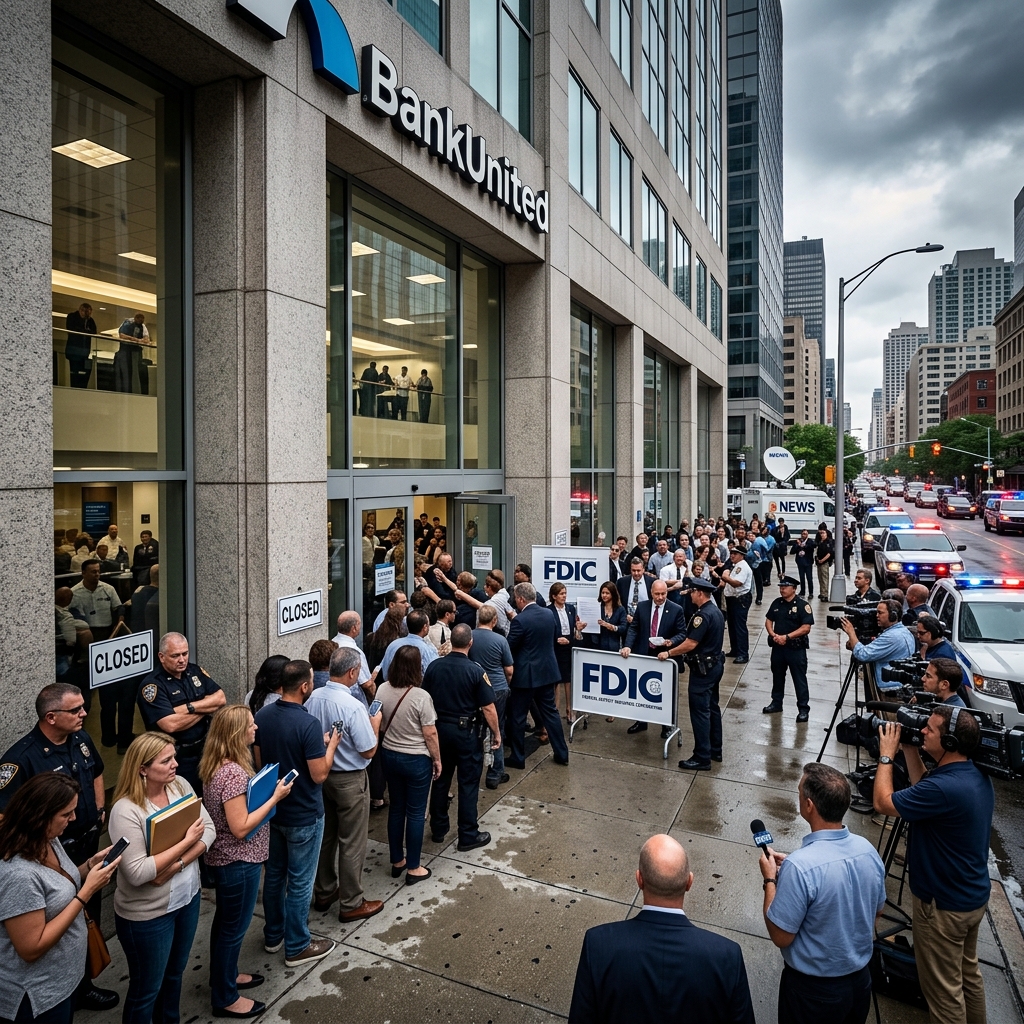
Bank failures are rarely simple events, and the story of BankUnited illustrates how aggressive growth, complex mortgage products, and weak risk controls can combine to produce enormous losses for regulators and investors. In 2009, BankUnited became one of the largest U.S. bank failures of the financial crisis, triggering a costly resolution by the Federal Deposit Insurance Corporation (FDIC) and an unusual rescue led by a consortium of private equity firms. This article explains how the institution collapsed, how regulators responded, and how investors later turned the failed bank into a profitable enterprise.
Background: Who Was BankUnited?
BankUnited FSB was a Florida-based savings bank that grew rapidly during the housing boom by specializing in residential mortgages, particularly in the state’s overheated real estate markets. The institution pursued a high-growth strategy, expanding its balance sheet through nontraditional mortgage products that were popular during the mid-2000s. By the time the housing market began to weaken, BankUnited held a sizable portfolio of loans that were highly sensitive to falling home prices and rising borrower defaults.
- Headquarters: Miami Lakes, Florida
- Business focus: Residential mortgage lending, including nontraditional products
- Regulatory charter: Federally chartered savings bank supervised by the Office of Thrift Supervision (OTS)
At first glance, BankUnited looked like a beneficiary of the housing boom. In reality, its concentration in a narrow set of complex mortgages left it extremely vulnerable when the market turned.
The Risky Bet on Option ARM Mortgages
According to a material loss review by the U.S. Treasury Inspector General, the primary cause of BankUnited’s failure was its heavy concentration in option adjustable-rate mortgages (option ARMs) and similar nontraditional products. Option ARMs allowed borrowers to choose among several payment options, including minimal payments that did not fully cover interest, causing loan balances to grow over time.
These loans contained multiple layers of risk:
- Payment shock: Borrowers could face abrupt increases in required payments when teaser rates expired or negative amortization limits were reached.
- Complex terms: Many borrowers did not fully understand the flexibility and future obligations built into the loan structures.
- High sensitivity to home prices: Falling property values limited borrowers’ ability to refinance or sell, raising default risk.
Regulators later concluded that BankUnited’s management pursued a high-risk growth strategy with inadequate controls. Underwriting standards and credit administration practices did not sufficiently account for the elevated risk embedded in these loans, especially once the housing market began to decline.
Why the Strategy Failed: Underwriting and Market Conditions
BankUnited’s vulnerability was not solely a function of the products it offered; it was also the result of how those products were underwritten and managed. The Inspector General’s review noted several weaknesses:
- Deficient underwriting: Loans were often approved with limited documentation, and borrower ability to repay under stressed conditions was not rigorously evaluated.
- Weak credit administration: Internal monitoring did not adequately track emerging problems within the portfolio as early indicators of distress appeared.
- Geographic concentration: A large share of the mortgage book was tied to Florida’s housing market, which experienced some of the steepest price declines in the country.
When home prices began to fall and economic conditions weakened, the bank’s option ARM portfolio deteriorated rapidly. Problem loans multiplied, losses surged, and the institution’s capital position was eroded. Ultimately, the thrift’s earnings turned sharply negative, and capital fell below regulatory requirements, prompting supervisory action.
Regulators Step In: Seizure and FDIC Receivership
By May 2009, BankUnited was deemed to be in an unsafe and unsound condition by its primary regulator. The Office of Thrift Supervision seized the institution and appointed the FDIC as receiver. This move effectively transferred the failed bank’s assets and certain liabilities to the FDIC, which is responsible for protecting insured deposits and managing resolutions.
Key elements of the failure and resolution included:
- Estimated loss to the FDIC insurance fund: Approximately $4.9 billion, making BankUnited one of the costliest bank failures of 2009.
- Transaction account losses: The FDIC estimated additional losses of around $25.7 million related to transaction accounts.
- Size of failure: At the time, it was among the largest bank failures of the crisis, drawing national attention to the risks posed by nontraditional mortgages.
The FDIC moved quickly to structure a sale of BankUnited’s franchise, aiming to preserve core operations and prevent disruption to depositors, while minimizing the cost to the Deposit Insurance Fund.
The Private Equity Consortium Acquisition
Rather than selling BankUnited to another traditional bank, the FDIC arranged an acquisition by a private equity consortium. Led by veteran banker John Kanas, the group included firms such as WL Ross & Co., Carlyle Group, and Blackstone. The consortium acquired the failed institution’s operations from the FDIC in May 2009 for roughly $900 million.
This deal was notable for several reasons:
- Unusual buyer profile: Large private equity firms, rather than a commercial bank, stepped in as acquirers of a failed depository institution.
- Loss-sharing arrangements: As is common in crisis-era bank resolutions, the FDIC entered into loss-sharing agreements to absorb a portion of future losses on certain assets, reducing risk for the buyers.
- Preservation of operations: The new BankUnited retained substantial assets, branches, and deposit relationships, helping maintain continuity for customers.
From the FDIC’s perspective, the transaction offered a way to transfer risk to private investors while protecting insured depositors and keeping the institution functioning. For the private equity group, the deal represented a potentially lucrative opportunity to acquire a distressed franchise at a discounted price.
Economic Outcomes for Investors
Over time, the private equity-backed BankUnited turned into a highly profitable investment. By the time of its initial public offering (IPO), the bank had rebuilt its balance sheet and repositioned its lending strategy. Reuters reported that the consortium’s overall investment was expected to more than double in value after the IPO, with Kanas’s personal stake projected to exceed $130 million—more than five times his original investment.
| Metric | Approximate Value | Source |
|---|---|---|
| FDIC loss from failure | $4.9 billion | Treasury OIG, WSJ |
| Consortium purchase price | ~$900 million | Reuters |
| Assets post-restructuring (Sept. 30) | $11.2 billion | Reuters |
| Branches operated | 78 branches | Reuters |
The transaction became a widely discussed example of how private investors could profit from bank resolutions during the financial crisis, even as the FDIC absorbed large losses.
Legal and Supervisory Aftermath
BankUnited’s failure did not end with the transfer to new owners. It generated legal disputes and regulatory scrutiny that extended for years. In one notable case, the FDIC successfully opposed an attempt by the holding company’s creditors’ committee to pursue certain claims related to the failure, securing a decision that could influence how similar disputes are handled in future bank insolvencies.
Separately, securities litigation alleged that BankUnited’s senior executives had misrepresented the company’s exposure to risky option ARM mortgages and its overall financial condition. Plaintiffs argued that public disclosures understated the risks embedded in the loan portfolio and the likelihood of significant losses. A settlement was ultimately reached, with the Treasury Inspector General’s subsequent report broadly confirming that the bank’s collapse was tied to concentrated exposure to high-risk mortgage products and unsafe practices.
Key Lessons for Risk Management and Regulation
The BankUnited episode offers several important lessons for banks, regulators, and investors.
1. Concentration in Complex Products Magnifies Risk
A central takeaway is the danger of concentrating a large portion of an institution’s balance sheet in complex, nontraditional products such as option ARMs. When these products are sensitive to economic conditions and borrower behavior, high concentrations can make an institution’s performance extremely volatile.
- High-risk strategies demand robust stress testing and scenario analysis.
- Diversification across product types and geographies can buffer shocks.
- Complex products require clear communication to borrowers and investors.
2. Underwriting Standards Must Reflect True Risk
Deficient underwriting was a critical factor in BankUnited’s collapse. Approving loans with limited documentation or optimistic assumptions about future refinancing opportunities left the bank exposed when conditions deteriorated. Strong underwriting should evaluate borrowers’ capacity to withstand changes in interest rates, payment schedules, and property values.
3. Supervisory Vigilance and Timely Intervention Matter
The Inspector General’s review emphasized how supervisory assessments needed to capture the evolving risk profile of institutions dealing heavily in nontraditional mortgages. Timely supervisory action—including elevating concerns about asset quality and capital adequacy—can help mitigate losses by encouraging corrective action earlier.
4. Private Capital Can Play a Role in Resolutions
BankUnited’s sale to a private equity consortium highlighted both opportunities and challenges in involving private capital in bank resolutions. On one hand, private investors can help recapitalize failed institutions and preserve operations. On the other, the scale of potential profits relative to public losses raises policy questions about how resolution frameworks allocate risk and reward.
Frequently Asked Questions (FAQs)
What ultimately caused BankUnited to fail?
Regulatory reviews concluded that BankUnited’s failure was primarily caused by losses in its higher-risk option ARM mortgage portfolio, combined with deficient underwriting, weak credit administration, and heavy geographic concentration in declining real estate markets. As loan losses mounted, the bank’s capital position deteriorated, leading regulators to deem it unsafe and unsound.
How large was the loss to the FDIC?
The FDIC estimated that BankUnited’s failure would cost its Deposit Insurance Fund around $4.9 billion, making it one of the costliest bank failures of 2009. Additional losses of about $25.7 million were associated with transaction accounts.
Who bought BankUnited after it failed?
A private equity-led consortium headed by banker John Kanas acquired BankUnited’s operations from the FDIC for approximately $900 million. The group included firms such as WL Ross & Co., Carlyle Group, and Blackstone. The recapitalized bank later went public, delivering substantial gains to the investors.
Did depositors lose their money?
Insured depositors were protected under the FDIC’s resolution framework, which aims to ensure that customers retain access to their insured funds even when a bank fails. The transfer of operations to the new BankUnited helped preserve continuity of service for retail and commercial customers.
What broader lesson does BankUnited’s story offer?
BankUnited’s collapse underscores how aggressive growth strategies centered on complex mortgage products can rapidly undermine an institution’s stability when combined with weak risk controls. It also illustrates the significant role that regulatory supervision and private capital can play in both preventing and responding to bank failures.
References
- Material Loss Review of BankUnited, FSB — U.S. Department of the Treasury, Office of Inspector General. 2010-06-23. https://oig.treasury.gov/system/files/Documents/OIG10042%20(BankUnited%20MLR).pdf
- Subprime Loans May Have Sunk BankUnited FSB — Center for Public Integrity. 2009-05-21. https://publicintegrity.org/inequality-poverty-opportunity/subprime-loans-may-have-sunk-bankunited-fsb/
- BankUnited Financial Corporation Case Summary — Berman Tabacco. 2010-06-30. https://www.bermantabacco.com/case/bankunited-financial-corp/
- FDIC Win in BankUnited Decision Could Set Standard for Future Bank Failures — Hughes Hubbard & Reed LLP. 2011-03-15. https://www.hugheshubbard.com/news-insights/news/fdic-win-in-bankunited-decision-could-set-standard-for-future-bank-failures
- DealTalk: BankUnited Owners Cash In, FDIC Nurses Loss — Reuters. 2011-01-27. https://www.reuters.com/article/business/dealtalk-bankunited-owners-cash-in-fdic-nurses-loss-idUSTRE70Q0LO/
- BankUnited Fails in Year’s Biggest Bust — The Wall Street Journal. 2009-05-22. https://www.wsj.com/articles/SB124294168567644901
Similar Articles








Read full bio of Sneha Tete




