
Indiana Workers’ Compensation Documents: 5 Essential Forms FAQ
Know which Indiana workers’ compensation forms matter, who files them, and when to act.
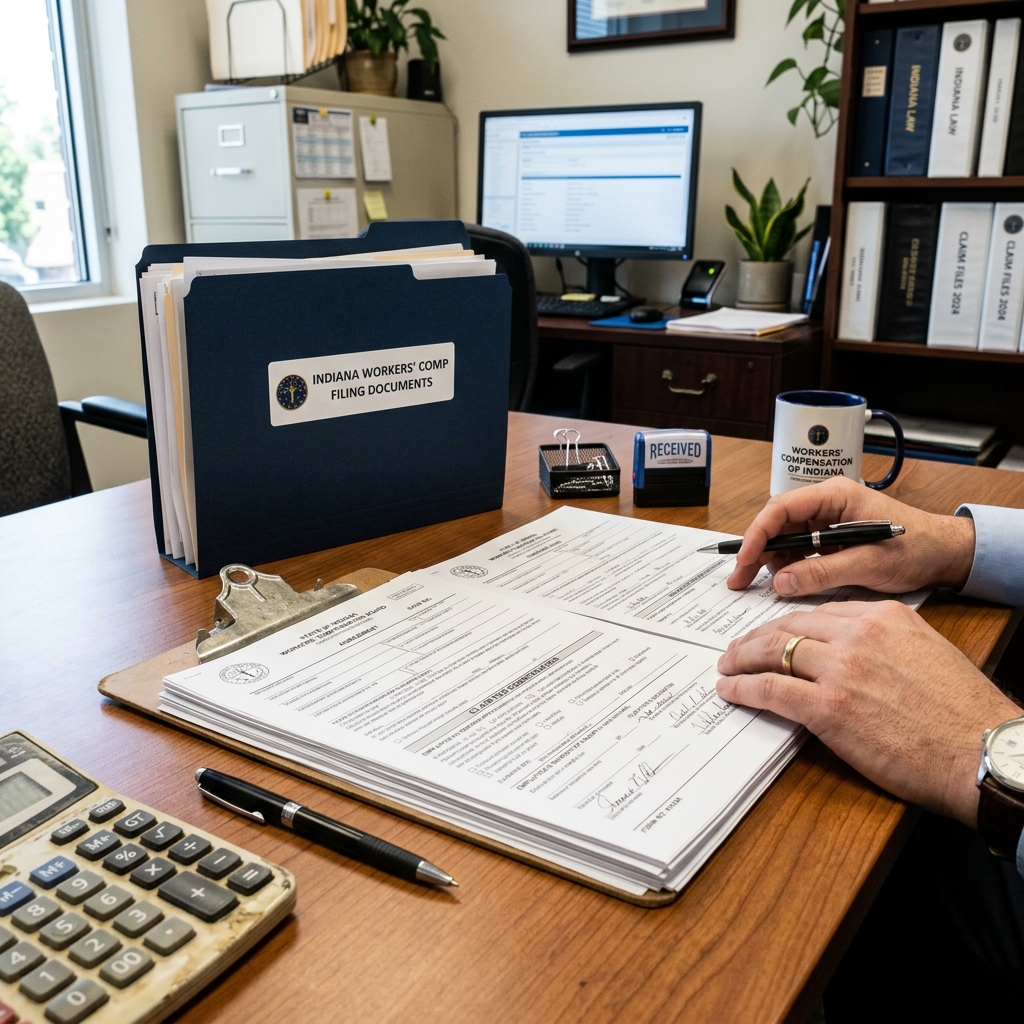
If you are injured at work in Indiana, the claim process begins with the right paperwork. The most important documents are the employer’s injury report, your medical records, and any forms used to accept, deny, or continue benefits. Without those records, a claim can stall before benefits are paid.
Indiana workers’ compensation is designed to cover qualifying work injuries and occupational illnesses, but the system depends on timely notice and accurate documentation. In practice, that means knowing which form starts the claim, which records prove the injury, and which deadlines control the next step.
The Core Documents in a Typical Claim
Most Indiana claims revolve around a small set of records. Some are completed by the employer or insurance carrier, while others come from doctors or the injured worker. Together, they create the paper trail used to determine whether benefits should be paid.
- First Report of Injury, which opens the claim record.
- Medical documentation, including treatment notes, test results, and restrictions.
- Wage information, such as pay stubs or wage statements used to calculate compensation.
- Denial or acceptance forms, if the employer disputes or accepts the claim.
- Claim filings with the state board, if a dispute must be formally resolved.
The First Report of Injury and Why It Matters
The foundational claim document in Indiana is the First Report of Injury, also called State Form 34401. Indiana’s Workers’ Compensation Board lists this as one of its official forms, and it is used to report a workplace injury or illness to the system. In many cases, the employer submits it after receiving notice of the injury.[10]
This report matters because it creates the official record that an incident occurred at work. It typically includes basic details such as the employee’s name, the date of injury, the body part affected, and a brief description of what happened. According to Indiana claim guidance, the employer should provide the worker with a copy of the form.
Even if your employer handles the filing, it is wise to keep your own copy. If a dispute arises later, the form can help show when notice was given and what was reported at the beginning of the claim.
Medical Records Are the Backbone of the Claim
Medical evidence is essential in Indiana workers’ compensation cases. One source on Indiana claims explains that injured workers must see a medical provider before benefits are available, and that medical records are necessary to support the claim. In practical terms, treatment records show both what injury occurred and whether it is connected to work.
Useful medical documents may include:
- Emergency room records
- Doctor’s notes
- Diagnostic imaging and lab results
- Physical therapy notes
- Prescription records
- Work restrictions or release-to-work instructions
These records help establish the seriousness of the injury, the type of treatment needed, and the period during which you were unable to work. They also help determine whether temporary disability benefits, medical care, or additional evaluations are appropriate.
Who Pays for Care and Why Provider Records Matter
In Indiana, the medical provider relationship can affect the claim. Claim guidance notes that the injured worker generally must see the provider chosen by the employer or insurer unless there is an emergency or another referral. That means records from authorized treatment are especially important because they are often the medical evidence the insurer reviews first.
Keep a simple file of every appointment date, diagnosis, prescription, referral, and bill. If you receive care outside the normal referral path, document why it happened and how the appointment related to the workplace injury.
Wage Records and Financial Proof
Workers’ compensation benefits are not only about medical care. They can also include wage replacement when an injury keeps you from working. To calculate that amount, the employer or insurer may rely on wage documentation. Some carriers request a wage statement form to calculate the correct compensation rate, and claim materials commonly ask for pay records.
Good financial records may include:
- Recent pay stubs
- Timesheets
- Tax forms showing earnings
- Employer wage statements
- Records of overtime or shift differentials, if relevant
These papers help establish your average weekly wage and may affect the amount of temporary total disability or similar benefits. If you worked irregular hours, overtime, or multiple jobs, complete records become even more important.
Documents That Support the Facts of the Accident
Not every case turns on medical evidence alone. Many claims are strengthened by documents that describe how the injury happened. This can be especially useful when the employer or insurer questions whether the event was work-related.
Supporting records may include:
- Written injury reports submitted to a supervisor
- Incident or accident reports
- Witness statements
- Photos of the scene, equipment, or visible injuries
- Emails or text messages reporting the injury
Indiana guidance emphasizes the importance of notifying the employer quickly after an injury. A written report, kept in your own files, helps show that the notice was timely and that the facts have remained consistent from the beginning.
Employer and Carrier Forms That May Follow
Once the injury is reported, the employer or insurer may generate additional forms. Indiana’s official form list includes documents such as the Agreement to Compensation, Notice of Denial of Benefits, Request for Additional Time to Determine Liability, and Report of Temporary Total Disability or Temporary Partial Disability Termination. These are not usually the worker’s first filing, but they strongly affect how the claim moves forward.
These forms can show that benefits were accepted, delayed, suspended, or denied. If you receive one, store it with your claim file and pay attention to the language, since the wording may affect payment timing or your right to challenge a denial.
| Document | Typical Purpose | Who Often Files It |
|---|---|---|
| First Report of Injury | Starts the claim record | Employer or carrier |
| Medical notes and test results | Proves diagnosis and treatment | Treating provider / worker keeps copies |
| Wage statement or pay records | Calculates compensation rate | Employer / worker supplies records |
| Denial or termination notice | Explains claim dispute or end of benefits | Employer or insurer |
| Application for Adjustment of Claim | Formally asks the board to resolve a dispute | Injured worker or attorney |
When a Dispute Requires a Formal Filing
If the employer or insurer denies the claim, delays action, or stops benefits, the matter may need to be taken to the Workers’ Compensation Board. Indiana’s official form list includes the Application for Adjustment of Claim, which is the main filing used when a dispute must be resolved through the board system. Claim guidance also notes that if an employer refuses to submit paperwork or disputes the injury, the worker may need to file directly with the board.
This step is usually more formal than the initial report. It is best supported by the earlier paperwork: the injury report, the medical records, wage records, and any correspondence with the insurer. The stronger and more organized those documents are, the easier it becomes to show what happened and what benefits are missing.
Deadlines You Should Track
Workers’ compensation claims can fail because paperwork is late, not because the injury is minor. Indiana claim guidance says workers must report a workplace injury within 30 days, and another source explains that employers have seven days after notice to file the First Report of Injury with the board. If benefits are denied or not provided, the injured worker may have up to two years from the date of injury to file an Application for Adjustment of Claim.
Deadlines may vary depending on the exact facts of the case, but the basic rule is simple: report quickly, preserve records, and do not wait to respond if the claim is denied.
How to Organize Your Claim File
A well-organized file can make a difficult process much easier. You do not need legal training to keep a claim folder that clearly shows what happened and when. A practical file should contain copies of every document tied to the injury.
- One section for accident reports and notices
- One section for medical records and bills
- One section for wage evidence and pay records
- One section for letters, emails, and claim decisions
- One section for forms filed with the state or returned by the employer
Keeping duplicates is also useful. If a document is lost, you will have a backup. If your case becomes disputed, you can show the history of the claim without trying to reconstruct it from memory.
FAQs
Do I personally file the First Report of Injury?
Usually, the employer files the First Report of Injury after learning about the incident, and Indiana guidance says the worker should receive a copy.
What if my employer says I never reported the injury?
That is one reason written notice matters. Emails, texts, incident reports, and witness statements can help prove that the employer was told about the injury in time.
Can I get benefits without medical records?
Medical documentation is central to an Indiana claim, and claim guidance says medical care is required before benefits are paid.
What should I save from every doctor visit?
Save visit summaries, diagnosis notes, work restrictions, prescriptions, referrals, test results, and any bills or receipts connected to treatment.
What if my claim is denied?
If the insurer denies benefits or does not move forward, a formal claim filing with the Workers’ Compensation Board may be necessary, using the appropriate board form.
References
- How to File a Workers’ Compensation Claim in Indiana — NLLE Law. 2026-07-10. https://www.nleelaw.com/workers-compensation-articles/how-to-file-a-workers-compensation-claim-in-indiana/
- What Documents Do I File for Workers’ Compensation in Indiana? — Super Lawyers. 2026-07-10. https://www.superlawyers.com/resources/workers-compensation/indiana/what-documents-do-i-file-for-workers-compensation-in-indiana/
- Forms — Indiana Workers’ Compensation Board / IN.gov. 2026-07-10. https://www.in.gov/wcb/forms/
- Indiana Workers Compensation Claim Forms & Resources — EMPLOYERS. 2026-07-10. https://www.employers.com/where-employers-does-business/indiana-workers-comp/indiana-claim-forms/
- Indiana Workers’ Compensation | Claims — The Hanover. 2026-07-10. https://www.hanover.com/claims/hanover-claims/report-claim/workers-compensation-information-and-forms-specific-states-30
- Indiana Workers’ Comp Timeline: From Injury to Resolution — Finderson Law. 2026-07-10. https://www.findersonlaw.com/blog/workplace-accidents/indiana-workers-comp-claim-timeline/
Similar Articles








Read full bio of Sneha Tete




