
Understanding Indiana Traffic Laws and Penalties
A practical, plain‑language overview of Indiana traffic rules, fines, points, suspensions, and your options after a ticket.
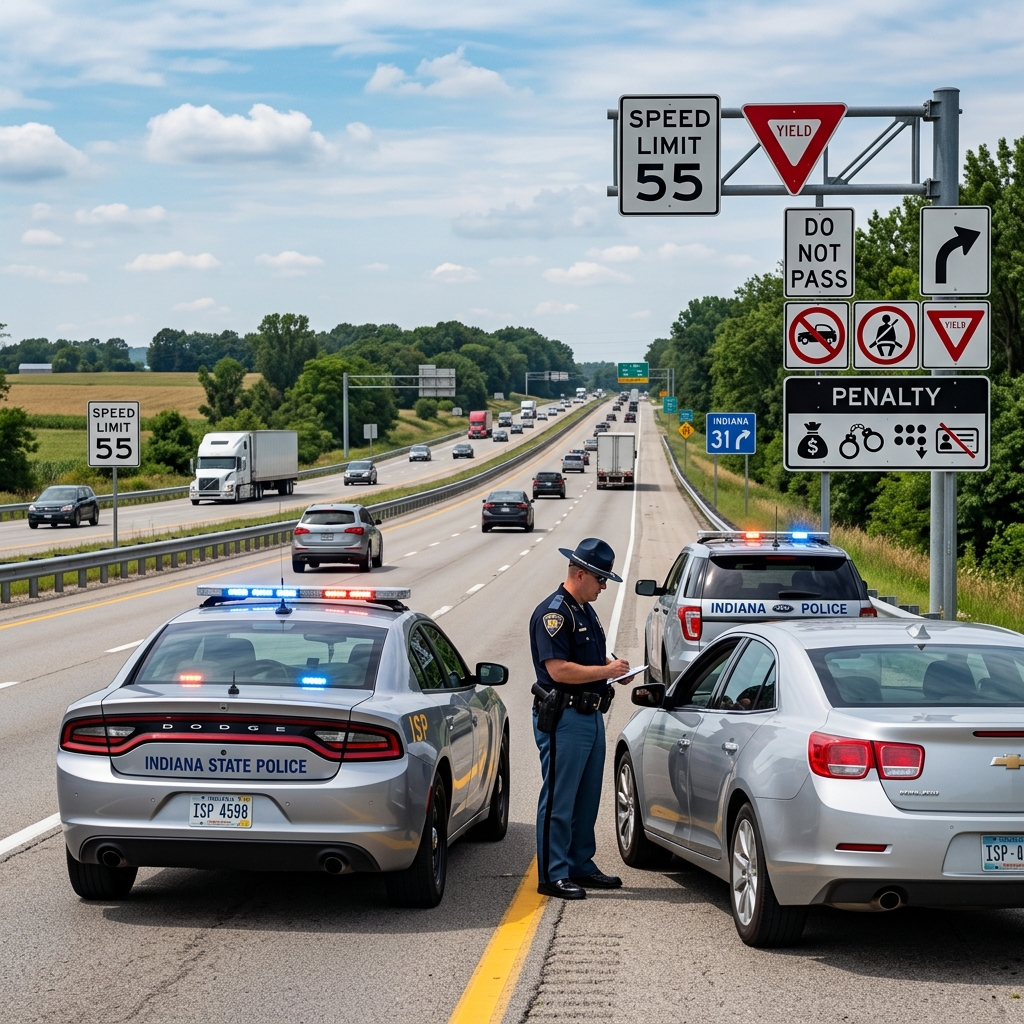
Indiana traffic laws govern everything from how fast you can drive to what happens if you are caught operating a vehicle while intoxicated. Knowing these rules is critical if you want to avoid fines, protect your driving record, and keep your license in good standing with the Bureau of Motor Vehicles (BMV). This guide explains the major traffic laws, penalties, and common options drivers have after receiving a ticket in Indiana.
1. Traffic Tickets and How Indiana Classifies Offenses
Indiana treats most traffic violations as civil infractions or criminal misdemeanors, depending on the nature of the conduct and the level of risk to others. Serious conduct such as operating while intoxicated or leaving the scene of an accident can even become a felony in certain circumstances.
1.1 Common Types of Traffic Violations
While Indiana law contains hundreds of specific traffic rules, most tickets fall into a few broad categories:
- Speeding and basic moving violations (e.g., running a red light, failing to yield, improper turns)
- License and registration violations (e.g., no valid license, expired plates)
- Insurance-related violations (e.g., driving without required liability coverage)
- Operating while intoxicated (OWI) and alcohol or drug-related offenses
- Reckless or aggressive driving, including racing or speed contests
Each type of violation carries its own potential fines, possible jail time if it is a misdemeanor or felony, and points on your driving record if it is a moving violation.
1.2 Misdemeanors vs. Felonies in Traffic Cases
Indiana uses a structured system to classify traffic-related crimes. For many drivers, the most important categories are:
- Class C misdemeanor – less serious traffic crimes such as operating without a license or certain OWI offenses; these can carry up to a $500 fine and possible jail time.
- Class B misdemeanor – includes conduct such as racing or holding a speed contest on public roads; fines can reach $1,000 in addition to other penalties.
- Class A misdemeanor – more serious traffic behavior, including aggravated OWI and some reckless driving situations; fines can reach $5,000 along with potential jail time.
- Felony traffic offenses – typically involve OWI with prior convictions, serious bodily injury, or death; fines can be as high as $10,000 and may include lengthy imprisonment and license suspensions.
2. Typical Fines for Indiana Traffic Violations
Exact fines can vary by county and court, but many traffic offenses have typical maximums set by statute. Below is a simplified overview of commonly cited fine levels.
| Offense Type | Example Classification | Typical Maximum Fine (Statutory) |
|---|---|---|
| Operating while intoxicated (OWI), basic offense | Class C misdemeanor | Up to $500 |
| OWI with aggravating factors (e.g., high BAC, prior OWI) | Class A misdemeanor | Up to $5,000 |
| Felony OWI (e.g., serious injury, death, or multiple priors) | Felony | Up to $10,000 |
| Racing or holding a speed contest on a public road | Class B misdemeanor | Up to $1,000 |
| Operating a motor vehicle with no valid driver's license | Class C misdemeanor | Up to $500 |
These fines often come on top of court costs, BMV reinstatement fees, and potential increases in car insurance premiums.
3. Indiana's Point System and How It Affects Your License
Indiana uses a points system to track moving violations and identify drivers who repeatedly break traffic laws. Each moving violation adds a set number of points to your driving record, and too many points within a certain time frame can trigger serious consequences.
3.1 How Points Are Assigned
Point values depend on how dangerous the violation is considered. While the exact schedule is established by the BMV, the pattern generally looks like this:
- Minor moving violations (e.g., low-level speeding, failure to use a turn signal) – fewer points
- Moderate violations (e.g., higher speeding ranges, failure to yield causing risk) – mid-range points
- Serious violations (e.g., reckless driving, certain OWI-related offenses) – high points
Points for a violation usually appear on your record after the court reports a conviction to the BMV.
3.2 How Long Points Stay on Your Record
Indiana keeps points from moving violations on your driving record for 24 months from the date of the offense. That means a violation today can continue to affect your insurance costs and your risk of suspension for two years.
3.3 Accumulating Too Many Points
Having a single ticket is often manageable, but accumulating many violations over time can trigger license-related consequences. The BMV may require safety courses, place you on probation, or suspend your driving privileges if you reach certain thresholds or show a pattern of dangerous driving.
4. Habitual Traffic Violators in Indiana
For drivers who repeatedly commit serious traffic offenses, Indiana has a separate legal status called a Habitual Traffic Violator (HTV). Being classified as an HTV can have long-lasting and severe effects on your ability to drive.
4.1 What Makes Someone a Habitual Traffic Violator?
Indiana's HTV law looks back over a 10-year period to determine whether a driver has accumulated enough serious violations to be considered habitual. The BMV reviews:
- Major offenses such as OWI with injury or death, reckless homicide with a vehicle, and certain felony traffic crimes
- Combinations of major and lesser offenses that show a pattern of dangerous behavior on the roads
- Multiple serious judgments (court determinations) resulting from traffic offenses within a 10-year window
4.2 Penalties for HTV Status
Once classified as an HTV, a driver faces mandatory long-term suspensions:
- Five-year suspension – for accumulating a defined mix of serious and other traffic offenses, including at least one major violation.
- Ten-year suspension – for accumulating at least two qualifying major judgments (such as certain OWI offenses) within ten years.
- Lifetime suspension – for drivers who, within ten years, have two qualifying judgments for operating while intoxicated resulting in death or similar serious offenses.
These suspensions are imposed by the BMV based on court records and do not always require a new criminal charge at the time the status is determined.
5. Insurance Requirements and Proof of Financial Responsibility
In addition to ticket-related penalties, Indiana requires drivers to maintain minimum liability insurance coverage, often referred to as financial responsibility. Driving without this coverage can lead to separate suspensions and financial consequences.
5.1 Minimum Liability Insurance Limits
Indiana law requires every driver to carry at least the following liability coverage on any vehicle operated on public roads:
- $25,000 for bodily injury or death of one individual in a single accident
- $50,000 for bodily injury or death of two or more people in a single accident
- $25,000 for property damage in a single accident
These limits are commonly described as 25/50/25 liability coverage.
5.2 Penalties for Driving Without Insurance
If a driver is caught operating a vehicle without the required liability insurance, the BMV can impose suspensions and financial penalties separate from any traffic ticket associated with the traffic stop. Penalties can include:
- Suspension of driving privileges for failing to provide proof of insurance when required
- Requirement to pay reinstatement and administrative fees to restore driving privileges
- Possible requirement to file an SR-22 certificate and maintain it for a set period
5.3 SR-22 Requirements
Drivers whose licenses are suspended for insurance violations or certain traffic offenses may be required to have their insurance company file an SR-22 financial responsibility form with the BMV. According to the Indiana BMV, you must typically maintain continuous SR-22 coverage for at least 180 consecutive days to regain and keep your driving privileges.
6. Operating While Intoxicated (OWI) in Indiana
Operating while intoxicated is among the most heavily penalized traffic-related offenses in Indiana. OWI laws address not only alcohol but also impairment due to drugs or a combination of substances.
6.1 Basic OWI Standards
Under Indiana law, you may be charged with OWI if you operate a vehicle with a blood alcohol concentration (BAC) at or above the statutory limit or if drugs or alcohol impair your ability to drive. Common thresholds include a BAC of 0.08% or higher for most drivers, with stricter limits for commercial drivers and underage drivers.
6.2 Administrative License Consequences
OWI cases often trigger administrative license actions separate from any criminal case. For example, a driver who fails a chemical test may face a license suspension of up to 180 days even before any criminal conviction is entered. Refusing a test can lead to additional or longer suspensions under Indiana's implied consent laws.
6.3 Criminal Penalties and Escalation
Criminal penalties for OWI depend on the driver's BAC, prior history, and whether anyone was injured or killed. They can range from a Class C misdemeanor with a fine up to $500 to a felony with fines up to $10,000 and potential prison time. OWI convictions also add points to a driver's record and may contribute to HTV status if combined with other serious offenses.
7. Speeding, Lane Use, and Safe Operation Rules
Beyond high-profile offenses like OWI, many drivers encounter everyday rules about speed, lane use, and safe operation. Indiana law sets basic standards that apply in addition to posted signs.
7.1 Speed Limits and the Basic Speed Law
Indiana's basic speed law requires drivers to operate at a speed that is reasonable and prudent under existing conditions, even if that is below the posted limit. Key points include:
- Speed must be adjusted for factors like weather, traffic, visibility, and road surface conditions.
- There are default maximum limits for different road types (such as rural highways, urban streets, and alleys), but these never override the basic duty to drive safely for conditions.
- Driving at the posted speed may still be unlawful if conditions make that speed unsafe.
7.2 «Move Over» and Lane-Change Duties
Indiana has a Move Over law that requires drivers to change lanes or slow down when approaching stopped emergency vehicles, tow trucks, and other designated service vehicles with flashing lights. Core requirements include:
- When possible, move into a non-adjacent lane away from the stopped vehicle.
- If a lane change is unsafe or impossible, reduce speed by at least 10 mph below the posted limit and proceed with extreme caution.
- Failure to comply can result in significant penalties, including fines and potential misdemeanor charges when violations endanger others.
7.3 School Buses and Stopping Requirements
Indiana law strictly regulates how drivers must act around school buses. When a school bus has its red lights flashing and its stop arm extended:
- Drivers approaching from either direction on a two-way road must stop.
- On a divided highway with a physical barrier or median, only drivers traveling in the same direction as the bus must stop.
- Drivers must remain stopped until the stop arm is retracted and the red lights are turned off.
8. Seat Belts, Cell Phones, and Parking Rules
Indiana also enforces safety and parking rules that apply to daily driving situations.
8.1 Seat Belt Requirements
Indiana law requires all drivers and passengers to wear seat belts whenever a vehicle is in operation, regardless of seating position. This rule applies even in vehicles equipped with multiple air bags, and bus operators are also required to use seat belts when provided.
8.2 Cell Phone and Texting Restrictions
Indiana prohibits drivers from using handheld telecommunication devices—such as cell phones—for texting, calling, or other manual uses while driving, unless the device is used in a hands-free mode or for emergency purposes. Violations can lead to fines and may increase the risk of collisions and insurance consequences.
8.3 Parking Restrictions
Common Indiana parking rules include prohibitions against:
- Stopping or parking on interstate shoulders except in emergencies
- Parking in intersections, crosswalks, or directly on sidewalks
- Blocking driveways or parking within 15 feet of a fire hydrant
- Parking on bridges, in tunnels, or adjacent to yellow curbs
- Using disabled parking spaces or striped access areas without a valid placard
9. Options After Receiving an Indiana Traffic Ticket
When you receive a traffic ticket in Indiana, you typically have several options, depending on the offense and the policies of the local court.
- Paying the ticket – often treated as admitting responsibility or guilt, resulting in a conviction, points on your record, and potential insurance increases.
- Contesting the ticket – you may plead not guilty and request a hearing; you can present evidence or legal arguments, often with the assistance of an attorney.
- Driver safety or defensive driving courses – for some violations, completing an approved course may reduce or prevent points, or satisfy a court requirement.
- Negotiating a resolution – in some cases, prosecutors or courts may allow amended charges, deferred judgments, or other alternatives that can limit long-term consequences.
The best option depends on your driving history, the specific charge, and how a conviction might affect your license, insurance, or employment.
10. Frequently Asked Questions About Indiana Traffic Laws
10.1 How long do traffic points stay on my Indiana driving record?
Points from moving violations generally stay on your Indiana record for 24 months from the date of the offense. After two years, the points are removed for BMV purposes, although the underlying conviction may still appear on your driving history.
10.2 Can my license be suspended just for too many tickets?
Yes. Accumulating multiple moving violations and associated points can result in suspensions or probation from the BMV, particularly if the violations show a pattern of unsafe driving or combine with serious offenses that qualify under the HTV law.
10.3 What happens if I drive without insurance in Indiana?
Driving without the required 25/50/25 liability insurance is unlawful and can cause the BMV to suspend your license and impose financial penalties. To restore your driving privileges, you may have to pay reinstatement fees and have your insurer file an SR-22 form, maintaining continuous coverage for at least 180 days.
10.4 Is OWI in Indiana the same as DUI or DWI in other states?
Yes in practical terms. Indiana uses the term Operating While Intoxicated (OWI), but it serves the same function as DUI or DWI in many other states: prohibiting driving under the influence of alcohol or drugs and imposing criminal and administrative penalties for violations.
10.5 Do out-of-state tickets affect my Indiana license?
In many cases, yes. Indiana may receive notice of out-of-state convictions through interstate compacts and can assign points, suspend your license, or treat those violations as if they occurred in-state, depending on the type of offense and applicable agreements. Drivers should check with the BMV or a legal professional if they receive a ticket elsewhere while holding an Indiana license.
References
- Indiana Traffic Laws — FindLaw. 2024-01-01. https://www.findlaw.com/state/indiana-law/indiana-traffic-laws.html
- Driver's Manual – Chapter 7: Safe Vehicle Operation — Indiana Bureau of Motor Vehicles (IN.gov). 2023-01-01. https://www.in.gov/bmv/licenses-permits-ids/files/Drivers_Manual_Chapter_7.pdf
- Common Traffic Violations and Financial Responsibility — Indiana Bureau of Motor Vehicles (IN.gov). 2023-06-01. https://www.in.gov/bmv/licenses-permits-ids/suspension-and-reinstatement/common-traffic-violations
- Indiana Code Title 9, Article 21 – Traffic Regulation — State of Indiana / Justia. 2025-01-01. https://law.justia.com/codes/indiana/title-9/article-21/
- Brief Review of Select Indiana Traffic Laws — At Your Pace Online / YouTube. 2021-01-01. https://www.youtube.com/watch?v=47ZUE5ny1Ps
Similar Articles








Read full bio of Sneha Tete


