
Income Statement vs Balance Sheet: Essential Guide
Master the differences between income statements and balance sheets to drive smarter business decisions and financial health.
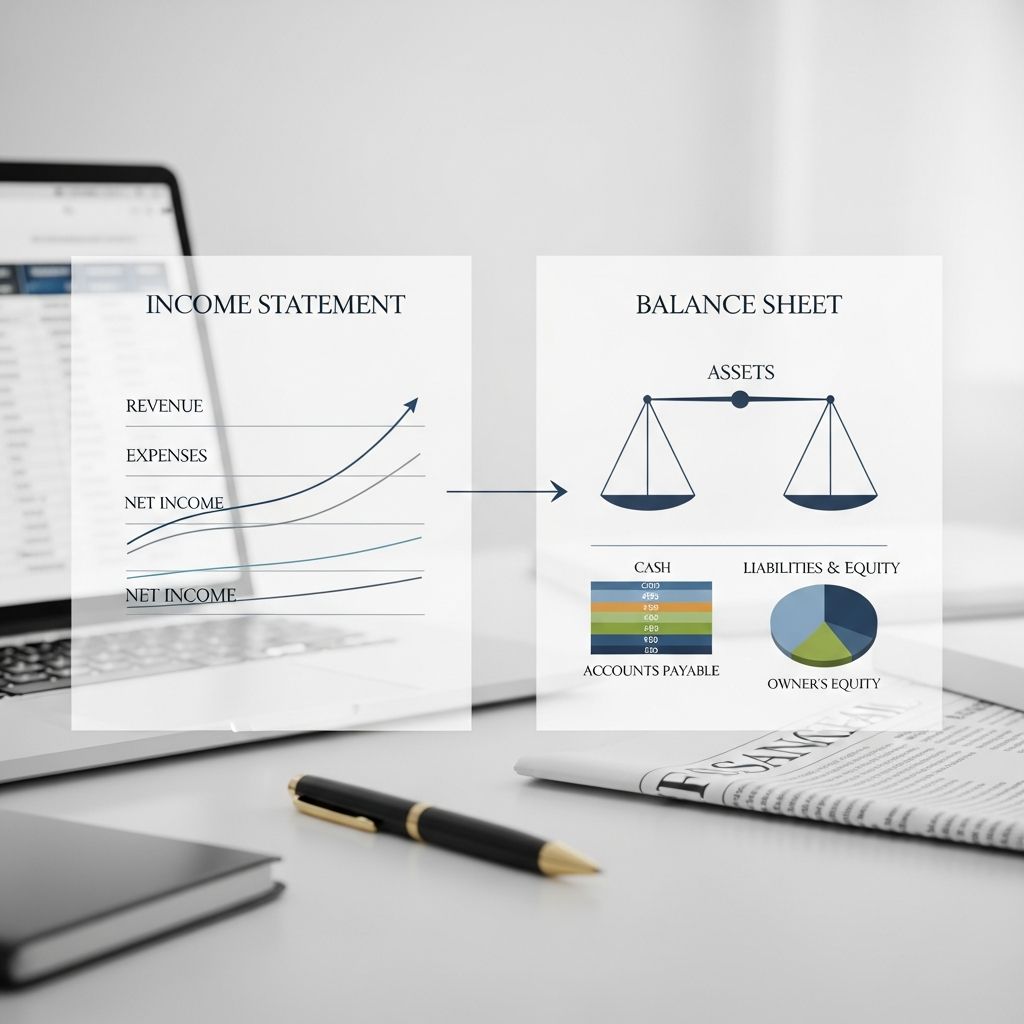
Financial statements are the backbone of business decision-making, with the
income statement
andbalance sheet
serving distinct yet complementary roles. The income statement reveals profitability over time, while the balance sheet captures financial position at a moment.Understanding the Income Statement
The income statement, also called the profit and loss statement (P&L), summarizes revenues, costs, and expenses to determine net profit or loss during a specific period, such as a month, quarter, or year. It provides insights into operational efficiency and overall performance.
Core Elements of an Income Statement
- Revenue: Total income from sales of goods or services, forming the top line.
- Cost of Goods Sold (COGS): Direct costs tied to production, like materials and labor.
- Gross Profit: Revenue minus COGS, indicating production profitability.
- Operating Expenses: Indirect costs such as rent, salaries, and marketing.
- Net Profit: Final figure after all expenses, taxes, and interest, showing true earnings.
Businesses use metrics like gross margin (gross profit/revenue) and net margin (net profit/revenue) to gauge efficiency. For example, a high gross margin suggests strong pricing power, while low net margins may signal excessive overhead.
Decoding the Balance Sheet
The balance sheet offers a snapshot of assets, liabilities, and equity on a specific date, adhering to the equation: Assets = Liabilities + Equity. It assesses financial stability, liquidity, and solvency.
Main Components of a Balance Sheet
- Assets: What the business owns, split into current (e.g., cash, inventory) and non-current (e.g., property, equipment).
- Liabilities: Obligations owed, including current (e.g., accounts payable) and long-term (e.g., loans).
- Equity: Owner’s stake, including retained earnings from profits.
This statement helps evaluate if a company can meet short-term debts or fund growth. For instance, high current assets relative to liabilities indicate good liquidity.
Key Differences at a Glance
| Aspect | Income Statement | Balance Sheet |
|---|---|---|
| Time Frame | Over a period (e.g., quarterly) | Point in time (e.g., year-end) |
| Focus | Performance and profitability | Financial position |
| Main Equation | Revenue – Expenses = Net Income | Assets = Liabilities + Equity |
| Frequency | Monthly/quarterly/annually | End of periods |
| Key Users | Managers for ops review | Investors for stability |
How These Statements Connect
The income statement feeds into the balance sheet: net profit increases retained earnings under equity. Expenses like depreciation reduce both P&L costs and asset values on the balance sheet. Revenue recognition affects accounts receivable on the balance sheet, even if cash isn’t received yet.
In construction, revenue methods like percentage-of-completion impact P&L timing and balance sheet assets. For manufacturers, heavy fixed asset investments tie up cash, visible on the balance sheet despite solid P&L.
Practical Uses for Business Owners
Leveraging Income Statements
Track trends in sales-to-payroll ratios or operating margins to optimize staffing and costs. Compare actuals to budgets for performance gaps.
Utilizing Balance Sheets
Monitor liquidity ratios like current ratio (current assets/liabilities) to ensure bill-paying ability. Spot trends in equity growth for long-term viability.
When to Rely on Each Statement
- Choose Income Statement for: Profitability analysis, cost control, pricing strategies, and investor pitches on growth.
- Choose Balance Sheet for: Loan applications, solvency checks, asset management, and merger evaluations.
- Use Both for: Comprehensive health checks, cash flow forecasting, and strategic planning.
Common Pitfalls and Best Practices
Avoid over-relying on P&L without balance sheet context—strong profits might hide cash shortages from receivables. Update statements monthly for small businesses to catch issues early.
- Automate with tools like QuickBooks for accuracy.
- Consult accountants for industry-specific tweaks, like construction revenue rules.
- Review ratios quarterly: aim for gross margins above 30-50% depending on sector.
Real-World Scenarios
Startup Scenario: A tech startup shows high P&L losses from R&D but a balance sheet with venture funding boosting equity—signaling potential despite red ink.
Retail Example: Seasonal sales spike P&L revenue, but inventory buildup on balance sheet warns of overstock risks.
Manufacturing Case: P&L looks lean, but balance sheet reveals equipment-heavy assets draining liquidity.
Frequently Asked Questions
What is the main purpose of an income statement?
It measures profitability by detailing revenues and expenses over a period, helping assess operational success.
How often should I prepare a balance sheet?
At period ends—monthly for active monitoring, quarterly for reports, annually for taxes.
Does net profit directly increase cash on the balance sheet?
No; it boosts retained earnings, but actual cash depends on collections and payments.
Can I run a business with just one statement?
No; P&L shows performance, balance sheet stability—use both for full insight.
What’s the role of equity on a balance sheet?
It represents owner investment plus accumulated profits minus losses and dividends.
Building a Strong Financial Foundation
Integrate both statements with cash flow reports for holistic views. Small businesses thrive by reviewing them regularly, adjusting strategies, and seeking professional advice for compliance and growth.
References
- Balance Sheet vs. Profit & Loss Account for Construction Accounting — Construction Cost Accounting. 2023-05-15. https://www.constructioncostaccounting.com/post/balance-sheet-vs-profit-loss-account
- The difference between the P&L and the Balance Sheet — Adams Accountancy. 2024-02-10. https://www.adams-accountancy.co.uk/blog/the-difference-between-the-pl-and-the-balance-sheet
- The Differences Between The Balance Sheet vs. Profit & Loss Statements — Get Better Bookkeeping. 2023-11-20. https://getbetterbookkeeping.com/the-differences-between-the-balance-sheet-vs-profit-loss-statements-a-guide-for-small-business-owners/
- Difference Between a Balance Sheet and Your Profit and Loss — Orba Cloud CFO. 2024-01-05. https://www.orbacloudcfo.com/difference-between-a-balance-sheet-and-your-profit-and-loss/
- Balance sheet vs income statement: Key differences — Rippling. 2024-08-12. https://www.rippling.com/blog/balance-sheet-vs-income-statement
- Balance sheet vs. profit and loss statement: What’s different? — QuickBooks Intuit. 2025-03-18. https://quickbooks.intuit.com/r/accounting/balance-sheet-vs-profit-and-loss-statement/
Similar Articles








Read full bio of Sneha Tete


