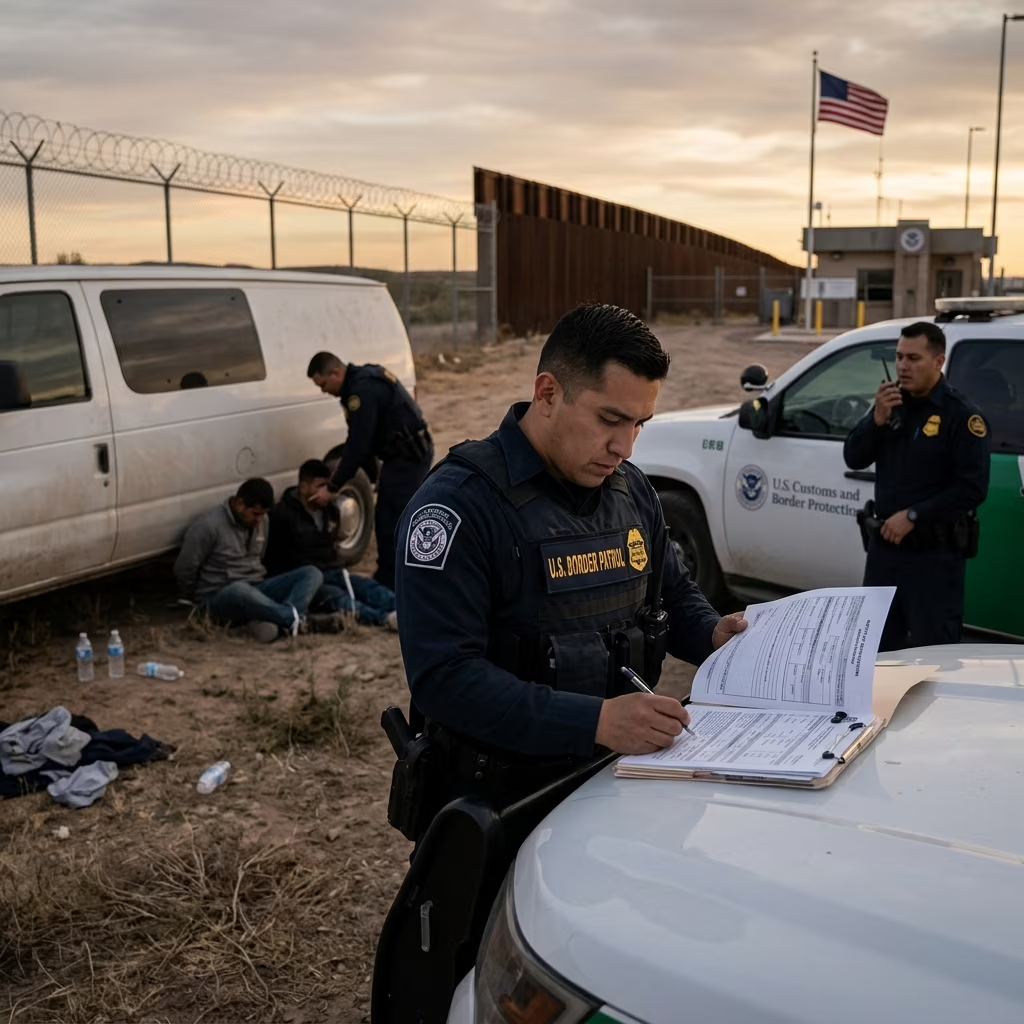
Immigration crimes and human smuggling sit at the intersection of border security, human rights, and transnational organized crime. Federal authorities in the United States treat these offenses as serious threats to public safety and the rule of law, especially when smuggling operations endanger lives or exploit vulnerable migrants.
This article explains how U.S. law approaches immigration offenses, with a particular focus on smuggling of migrants, commonly called alien smuggling. It also distinguishes smuggling from human trafficking, outlines the main federal statutes and penalties, and describes how law enforcement agencies work together domestically and internationally to combat these crimes.
1. Understanding Immigration Crimes Under U.S. Law
In the federal system, immigration crimes generally refer to violations of statutes that regulate who may enter, remain, or work in the United States. These crimes range from relatively simple offenses, like illegal entry, to complex felony conduct, such as organizing large-scale smuggling rings.
Typical immigration-related offenses include:
- Entering or attempting to enter the United States without authorization
- Reentering after being formally removed or deported
- Using fraud or false documents to obtain immigration benefits
- Employing or recruiting unauthorized workers in violation of federal law
- Smuggling, transporting, or harboring undocumented noncitizens for profit or other gain
Among these, smuggling of migrants plays a central role because it often involves organized criminal networks that exploit border vulnerabilities and put migrants at serious risk of injury or death.
2. Human Smuggling vs. Human Trafficking: Key Legal Differences
Human smuggling and human trafficking are related but distinct crimes. Governments and international organizations emphasize this distinction because each offense requires different prevention, protection, and prosecution strategies.
| Aspect | Human Smuggling | Human Trafficking |
|---|---|---|
| Basic concept | Illegal facilitation of border crossing or stay, usually for payment | Exploitation of a person for labor or commercial sex through force, fraud, or coercion |
| Consent | Person typically consents to be smuggled and pays for the service | Victim does not truly consent due to coercion, deception, or abuse of vulnerability |
| Border crossing | Almost always involves crossing an international border | May or may not involve crossing borders; can occur entirely within one country |
| Primary harm | Violation of state immigration laws; risks to life and safety from dangerous travel | Severe exploitation, including forced labor or sexual exploitation |
| Status of the person | Smuggled migrant is generally viewed as a participant in the illegal transaction under international law | Trafficked person is explicitly recognized as a victim of crime under international law |
According to international instruments developed by the United Nations, migrant smuggling is defined as facilitating the illegal entry of a person into a state of which they are not a national or permanent resident, in order to obtain a financial or material benefit. Human trafficking, by contrast, is defined by exploitation and the means used (force, fraud, coercion), not merely by illegal border crossing.
3. What Constitutes Human Smuggling in U.S. Law?
In U.S. federal law, human smuggling is frequently referred to as alien smuggling. The principal statute is 8 U.S.C. § 1324, which makes it a crime to knowingly bring, attempt to bring, transport, harbor, or encourage noncitizens to enter or remain in the United States in violation of law.
Conduct that can amount to smuggling-related offenses includes:
- Guiding individuals across the border between official ports of entry
- Driving unauthorized migrants away from the border to interior locations
- Providing housing, safe houses, or hiding places to evade detection
- Selling or providing fraudulent documents to facilitate unlawful entry or stay
- Coordinating or financing smuggling operations for profit
Smuggling schemes can range from small, ad hoc efforts to large transnational networks that operate like businesses, complete with recruiters, guides, transport coordinators, and corrupt officials. These networks often advertise their services in source countries, collecting high fees from would-be migrants and subjecting them to dangerous journeys, such as travel in unseaworthy boats or cramped vehicles.
4. Penalties and Sentencing for Alien Smuggling
Congress has created heavy penalties for alien smuggling in recognition of the dangers it poses. Under 8 U.S.C. § 1324 and associated federal sentencing guidelines, penalties depend on factors such as profit motive, number of migrants, and whether anyone was injured or killed.
4.1 Baseline penalties
Where smuggling is carried out for financial gain or commercial advantage, federal law allows substantial prison terms. Sentences can reach up to 10 years for each individual smuggled, especially when the offense involves organizing or directing the illegal entry of migrants.
Sentencing data from the United States Sentencing Commission show that smuggling offenses represent a significant portion of federal immigration cases, and most involve relatively small groups (fewer than six people). However, even these smaller cases are taken seriously due to the inherent risks and the potential to fuel broader criminal markets.
4.2 Enhanced penalties for harm or risk
Penalties increase sharply when the smuggling conduct places people in danger or results in injury or death. Federal law allows:
- Higher maximum sentences when bodily injury occurs or lives are put in jeopardy
- Up to 20 years per migrant where serious harm or life-threatening conditions are involved
- Potential life imprisonment, and in rare circumstances even the death penalty, when deaths result from the smuggling conduct
Aggravating factors can also include smuggling of minors, involvement of organized criminal groups, use of weapons, or smuggling in connection with other serious offenses.
4.3 Additional consequences
Beyond imprisonment and fines, convicted smugglers may face:
- Forfeiture of vehicles, vessels, property, or profits tied to the smuggling operation
- Immigration consequences, including removal or inadmissibility for noncitizens involved in smuggling
- Collateral consequences, such as loss of certain licenses or federal benefits
5. Why People Engage in or Rely on Smuggling
Smuggling does not occur in a vacuum. International research identifies multiple drivers that push people toward using smugglers and create opportunities for criminal actors.
Important underlying factors include:
- Poverty and lack of opportunity: Chronic economic hardship and limited job prospects in origin countries push people to seek work abroad, often with few legal channels available.
- Conflict and instability: Wars, persecution, and generalized violence force people to flee quickly, making them more likely to rely on smugglers who promise safe passage.
- Demand for cheap labor: In destination states, employers may seek low-cost, easily exploited labor, which can indirectly fuel both smuggling and trafficking.
- Restrictive migration policies: When legal migration pathways are limited or slow, migrants turn to irregular routes and smugglers to circumvent barriers.
- Established criminal networks: Gangs and transnational groups use smuggling as a source of revenue, sometimes shifting from other illicit activities, such as drug trafficking.
These structural drivers mean that law enforcement alone cannot solve the problem. Effective responses also require economic, social, and diplomatic strategies that reduce the incentives and vulnerabilities that smugglers exploit.
6. Law Enforcement and Policy Responses
U.S. authorities employ a combination of criminal enforcement, prevention, and international cooperation to combat smuggling. Similar approaches are recommended globally as best practices.
6.1 Criminal enforcement strategies
Law enforcement agencies use a range of tools to detect, disrupt, and dismantle smuggling operations, including:
- Targeting organizers and financiers rather than only low-level guides or drivers
- Gathering intelligence on routes, safe houses, and methods used to move migrants
- Conducting joint investigations with foreign counterparts to follow smuggling networks across borders
- Using financial investigations and asset forfeiture to seize profits and discourage future operations
Specialized task forces and interagency working groups coordinate these efforts, recognizing that smuggling often overlaps with other forms of organized crime, such as document fraud, corruption, and trafficking in persons.
6.2 Prevention and education
Prevention measures aim to reduce the demand for smuggling services and to make smuggling operations more difficult and less profitable. Best practices identified in research and policy documents include:
- Public information campaigns in communities of origin explaining the risks of smuggling and the realities of migration
- Training airline and shipping company personnel to detect fraudulent travel documents and suspicious travel patterns
- Strengthening document security and border management technologies
- Working with community groups and local authorities in border regions to identify smuggling activity
These efforts are most effective when paired with realistic legal migration options, so that people have alternatives to relying on smugglers.
6.3 Protection of migrants and victims
While smuggled migrants are not automatically considered victims of crime under international law, they often face high levels of danger, debt, and exploitation. Some individuals who initially consent to smuggling later find themselves subjected to trafficking, forced labor, or extortion.
Consequently, policy frameworks increasingly stress the need to balance enforcement with protection by:
- Identifying victims of trafficking or severe exploitation among smuggled migrants and referring them to appropriate services
- Providing access to medical care, shelter, and legal assistance, particularly for children and other vulnerable groups
- Establishing procedures to prevent re-victimization and to allow victims to cooperate safely with law enforcement
7. International Legal Framework and Cooperation
Because smuggling typically involves multiple countries of origin, transit, and destination, international law plays a critical role. The United Nations Convention against Transnational Organized Crime is supplemented by two key protocols: one on trafficking in persons and another on smuggling of migrants.
The smuggling protocol calls on states to:
- Criminalize the smuggling of migrants when carried out to obtain a financial or material benefit
- Enhance border controls and document security measures
- Promote law enforcement cooperation, including information sharing, joint training, and mutual legal assistance
- Protect the rights of smuggled migrants, particularly when their lives or safety are at risk
Organizations such as INTERPOL and the United Nations Office on Drugs and Crime (UNODC) support member states by providing analytical reports, capacity-building, and operational support to investigations targeting smuggling networks.
8. Frequently Asked Questions (FAQs)
8.1 Is human smuggling always a form of human trafficking?
No. Human smuggling and human trafficking are separate crimes. Smuggling is primarily about the unlawful movement of people across borders for profit, usually with the migrant’s consent. Trafficking, by contrast, centers on exploitation through force, fraud, or coercion, and victims are recognized as such under international law.
8.2 Can smuggled migrants become victims of trafficking?
Yes. Smuggled migrants often travel under dangerous conditions, incur heavy debts, and remain in an irregular status at their destination. These vulnerabilities make them susceptible to exploitation, and some are later coerced into forced labor or sexual exploitation, effectively becoming trafficking victims.
8.3 What are the typical penalties for alien smuggling in the United States?
Penalties vary but can be severe. Federal law allows substantial prison terms—often up to 10 years per smuggled person in cases involving financial gain—with significantly higher maximums if the offense causes serious injury or death. Courts also consider factors such as the number of migrants, the level of the offender’s role, and whether minors or vulnerable persons were involved.
8.4 Why does the United States treat alien smuggling as a serious crime?
Authorities consider alien smuggling a serious offense because it undermines border control, often enriches organized criminal groups, and regularly endangers human life. Smuggling operations may involve overcrowded vehicles, dangerous sea voyages, or abandonment in remote areas, all of which have led to numerous tragedies at and within U.S. borders.
8.5 How do international agreements affect U.S. responses to smuggling?
International protocols on trafficking and smuggling encourage states, including the United States, to harmonize laws, share information, and cooperate in investigations. They also emphasize balancing enforcement with protection of migrants’ fundamental rights, reinforcing the need for victim-centered approaches when exploitation is involved.
References
- Human Trafficking & Migrant Smuggling — U.S. Department of State. 2017-07-01. https://www.state.gov/wp-content/uploads/2019/02/272325.pdf
- Human trafficking and smuggling of migrants — INTERPOL. 2020-06-01. https://www.interpol.int/en/Crimes/Human-trafficking-and-migrant-smuggling
- Smuggling of migrants: the harsh search for a better life — United Nations Office on Drugs and Crime (UNODC). 2018-04-01. https://www.unodc.org/toc/en/crimes/migrant-smuggling.html
- Best Practices to Combat Smuggling and Protect the Victims of Trafficking — University of California, Davis. 2002-01-01. https://migration.ucdavis.edu/cf/more.php?id=100_0_2_0
- Alien Smuggling: Quick Facts — United States Sentencing Commission. 2025-02-01. https://www.ussc.gov/research/quick-facts/alien-smuggling
- Comparative Study on Smuggling and Trafficking Laws in the Western Hemisphere — Florida International University. 2018-01-01. https://gordoninstitute.fiu.edu/research/diplomacy-lab/comparative-study-on-smuggling-and-trafficking-laws-in-the-western-hemisphere.pdf
- Smuggling of Immigrants — EBSCO Research Starters. 2010-01-01. https://www.ebsco.com/research-starters/law/smuggling-immigrants