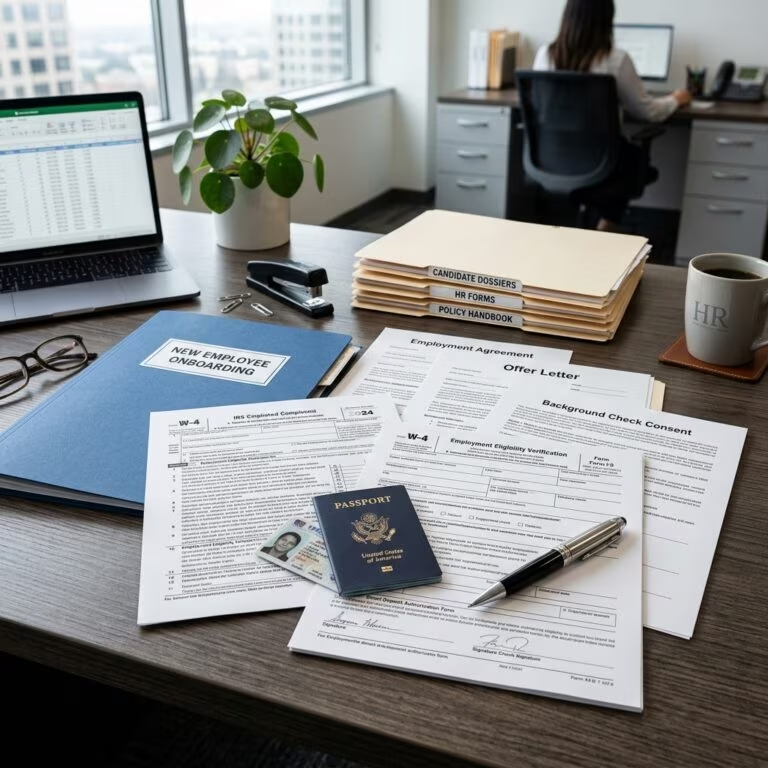
Small businesses in the United States must follow the same federal immigration and employment eligibility rules as large employers. Every new hire, regardless of citizenship or the size of the company, must be properly verified as authorized to work in the U.S using Form I-9 and, where applicable, E-Verify. Failing to follow these rules can expose small business owners to fines, audits, and potential criminal penalties, but a clear and organized compliance program can significantly reduce risk.
Why Immigration Compliance Matters for Small Businesses
Immigration and employment eligibility rules are not optional. Federal law requires all employers to confirm both the identity of each new hire and their authorization to work in the United States. Small businesses can be particularly vulnerable because they often have limited HR resources and may rely on informal hiring practices.
Key reasons compliance is critical include:
- Legal obligation: All U.S. employers must complete Form I-9 for every employee hired to work in the United States.
- Financial risk: Nona0compliance can result in civil fines, back pay orders, and, in serious cases, criminal sanctions.
- Business disruption: Government audits or investigations can interrupt operations and consume significant time and resources.
- Reputation and trust: A record of immigration violations can damage relationships with customers, investors, and regulators.
Who Must Be Verified and Who Is Exempt
Form I-9 rules do not distinguish between very small businesses and large corporations. If you have employees working in the United States, you must comply. However, not every individual associated with a business needs an Ia09.
Individuals who typically require Form I-9
- Fulla0time employees hired to perform services in the U.S.
- Parta0time and temporary employees who are on the employer’s payroll.
- Owners who perform employeea0like duties in a corporation, LLC, or partnership, if they work in a role that could be filled by an employee.
Individuals who typically do not require Form I-9
- Independent contractors and workers on another company’s payroll (though misclassification risks must be carefully managed).
- True sole proprietors who are not employees of a separate legal entity.
- Individuals working entirely outside U.S. territory, even if paid by a U.S. employer.
Because the line between employee and contractor can be complex, small businesses should review contractor agreements and job duties to avoid misclassification and unintended immigration violations.
Understanding Form I-9: Core Requirements
Form Ia09, Employment Eligibility Verification, is the central document used to demonstrate that an employer has checked each employee’s identity and work authorization. USCIS publishes and updates the official form and instructions, and employers must always use the current version.
| Requirement | Employer Responsibility | Employee Responsibility |
|---|---|---|
| Use current official form | Download latest Ia09 from USCIS and discard outdated versions. | Complete the form provided by the employer. |
| Section 1 completion | Provide the form on or before the first day of work. | Fill out Section 1 and attest to work authorization under penalty of perjury. |
| Section 2 verification | Review original documents and complete Section 2 within three business days of starting work for pay. | Present acceptable identity and work authorization documents from USCIS’s list. |
| Retention | Keep Ia09s for three years after hire or one year after termination, whichever is later, and store securely. | None, unless asked to provide updated documents for reverification. |
Stepa0bya0Step I-9 Process for Small Businesses
A consistent, documented process makes Ia09 compliance manageable even for very small employers.
- Obtain the current form: Download the latest version of Form Ia09 directly from USCIS.
- Provide Section 1 to the new hire: Ensure the employee completes Section 1 on or before the first day of work, including their attestation of work authorization.
- Review documents in person: Within three business days of the first day of work for pay, physically examine the original documents the employee presents.
- Complete Section 2: Record the document details, verify that the information is consistent, and sign to confirm that the documents reasonably appear genuine and relate to the employee.
- Store the form securely: Retain completed Ia09s in a dedicated file or system with controlled access.
- Track reverification dates: For employees with temporary work authorization, monitor expiration dates and perform timely reverification where required.
Ea0Verify: Optional but Powerful for Many Small Employers
Ea0Verify is a free, interneta0based system operated by the federal government that allows participating employers to electronically confirm a new hire’s employment eligibility based on information from Form Ia09. While federal law does not require all private employers to use Ea0Verify, some states and federal contracts mandate its use.
Benefits of Using Ea0Verify
- Faster confirmation: Results typically come back quickly, often within seconds or minutes.
- Improved accuracy: Electronic checks may detect inconsistencies or mismatches that manual review would miss.
- Audit trail: Electronic records can support the employer’s documentation in case of an inspection or audit.
Limitations and Considerations
- Not a replacement for Form I-9: Employers must still properly complete and retain Form Ia09 even if they participate in Ea0Verify.
- Uniform application: If a business uses Ea0Verify, it must do so consistently for all covered new hires, not selectively.
- Training needs: Staff must be familiar with handling tentative nona0confirmations and resolving mismatches without discrimination.
Hiring Immigrant Workers: Legal Pathways and Employer Responsibilities
Many small businesses rely on immigrant workers to meet staffing needs. Employers do not sponsor every immigrant employee, but they must ensure that anyone they hire already has, or lawfully obtains, authorization to work. USCIS recognizes a variety of temporary and permanent pathways that allow foreign nationals, including entrepreneurs and professionals, to work in the U.S.
Examples of Lawful Work Authorization Pathways
- Nonimmigrant visas that permit employment, such as certain professional and specialty occupation visas.
- Permanent resident status (green card), which generally allows unrestricted employment in the U.S.
- International entrepreneur options that allow foreign founders to live and work in the U.S. for qualifying starta0up entities.
- Student and training programs, such as Optional Practical Training (OPT), which may allow limited employment in certain fields.
Small business owners are not expected to be immigration lawyers, but they must respect visa limitations. For example, some categories allow selfa0employment or entrepreneurship, while others strictly limit the type and location of work permitted.
Recordkeeping, Audits, and Enforcement Risks
Form Ia09 is not filed with the government; instead, employers keep it on file and produce it when requested in an inspection. Agencies such as U.S. Immigration and Customs Enforcement (ICE) can audit employers and review Ia09 records, payroll data, and other information.
Retention and Storage Best Practices
- Follow retention timelines: Keep each Ia09 for three years after the date of hire or one year after employment ends, whichever period is longer.
- Store separately from personnel files: Many employers use a dedicated Ia09 file to simplify audits and protect sensitive data.
- Limit access: Restrict Ia09 records to staff with a legitimate need to handle them, such as HR or management.
- Maintain organization: Arrange forms by employee name or by termination date so you can quickly produce them in an audit.
Preparing for Possible Audits
A proactive approach can help small businesses handle government inspections with minimal disruption.
- Conduct periodic internal Ia09 audits to catch missing forms, errors, or outdated information.
- Review payroll and employee lists against Ia09 records so every active employee has a corresponding and properly completed form.
- Document policies and procedures for hiring, verification, reverification, and Ea0Verify participation.
- Identify legal counsel or outside resources in advance, so you know whom to contact if you receive a notice of inspection.
Antia0Discrimination Responsibilities in the Verification Process
Immigration compliance must be balanced with federal antia0discrimination laws. Employers cannot treat applicants or employees differently based on citizenship, immigration status, or national origin when completing the Ia09 or using Ea0Verify.
Common Pitfalls to Avoid
- Requesting specific documents: Employers must allow employees to choose which acceptable documents to present from the USCIS list, rather than insisting on a particular document.
- Overa0documentation: Requiring more documents than the law permits can be considered discriminatory document abuse.
- Selective Ea0Verify use: Using Ea0Verify only for workers of certain nationalities or perceived immigration statuses may violate antia0discrimination rules.
- Premature termination: Ending employment only because of a tentative nona0confirmation without allowing the employee to resolve the mismatch can create liability.
Building a Simple Compliance Program for Your Small Business
Even businesses with only a handful of employees can design a practical immigration compliance plan. The goal is to create consistent, repeatable steps that every hire goes through, backed by basic training and documentation.
Core Elements of a Small Business Compliance Plan
- Written procedures: Create a brief written policy describing when and how Form Ia09 is completed, who is responsible, how documents are reviewed, and how forms are stored.
- Staff training: Train anyone involved in hiring on the basics of Ia09 completion, antia0discrimination rules, and Ea0Verify procedures if applicable.
- Calendar reminders: Use calendars or HR software to track reverification dates and retention deadlines.
- Regular reviews: Schedule annual or semia0annual reviews of your process to incorporate regulatory changes and lessons learned from internal audits.
Special Considerations for Remote and Hybrid Work
Remote and hybrid work arrangements have made document verification more complex. Federal guidance has, at times, allowed alternative or remote inspection processes under specific conditions, but employers must follow current USCIS rules and note any special procedures used.
Small businesses employing remote workers should:
- Monitor USCIS announcements for updates to remote verification options.
- Document any remote inspection steps taken, including dates and methods used.
- Ensure that remote workers receive the same nona0discriminatory treatment in the verification process as ona0site employees.
Frequently Asked Questions (FAQs)
Do very small businesses with only one or two employees have to complete Form Ia09?
Yes. Federal law requires all U.S. employers to complete Form Ia09 for every employee hired for work in the United States, regardless of the number of employees or the type of business.
Does a business owner need an Ia09 for themselves?
If the owner is an employee of a separate legal entity such as a corporation, LLC, or partnership and performs work that could be done by an employee, the owner generally should have an Ia09. Sole proprietors who are not employees of a distinct entity normally do not complete the form.
Is Ea0Verify mandatory for small businesses?
Ea0Verify is voluntary for many private employers, but some states and certain federal contracts require its use. Even where not required, many small businesses choose to enroll for added assurance about employment eligibility.
How long must a small business keep Ia09 forms?
Employers must retain Form Ia09 for three years after the date of hire or one year after the date employment ends, whichever is later. After this period, forms may be securely destroyed.
Can an employer refuse to hire someone because they have a foreign passport?
No. Employers must focus on authorization to work in the U.S., not nationality. A foreign passport accompanied by appropriate work authorization documents can be perfectly valid for Ia09 purposes. Refusing to hire someone solely due to their citizenship or national origin can violate antia0discrimination laws.
What should a small business do if it discovers past Ia09 mistakes?
Employers should correct errors where possible by making clean, dated corrections or completing a new form and attaching it to the old one, following official guidance. Internal audits, training, and written procedures can help prevent future mistakes, and consulting legal counsel is advisable for serious issues.
References
- I-9, Employment Eligibility Verification — U.S. Citizenship and Immigration Services (USCIS). 2023-11-08. https://www.uscis.gov/i-9
- Legal Right to Work in the US/Employment Eligibility Verification — Idaho Department of Commerce. 2024-01-10. https://business.idaho.gov/employer-issues/legal-right-to-work/
- Form I-9 Compliance for Small Businesses — National Federation of Independent Business (NFIB). 2023-06-20. https://www.nfib.com/news/legal-blog/form-i-9-compliance-for-small-businesses/
- I-9 Requirements Made Easier: A Small Business Owner’s Helpful Guide — Equifax Workforce Solutions. 2023-12-01. https://workforce.equifax.com/solutions/i9-hq/blog/i-9-requirements-made-easier-a-small-business-owner-s-helpful-guide
- Options for Alien Entrepreneurs to Work in the United States — U.S. Citizenship and Immigration Services (USCIS). 2024-03-15. https://www.uscis.gov/working-in-the-united-states/options-for-alien-entrepreneurs-to-work-in-the-united-states
- How to Hire Immigrant Workers for Your Small Business — Cole, Scott & Kissane, P.A. 2022-09-05. https://www.csklegal.com/newsroom/news/how-to-hire-immigrant-workers-for-your-small-business
- I-9 Audits, Enforcement Trends, & Worker Protections — Employment law webinar (YouTube, transcript). 2023-05-12. https://www.youtube.com/watch?v=3aSGEVdKW6E