
Understanding Illegal U-Turn Laws Across the United States
Learn when a U-turn is legal, when it becomes a costly traffic violation, and how state rules, safety, and signage all intersect.
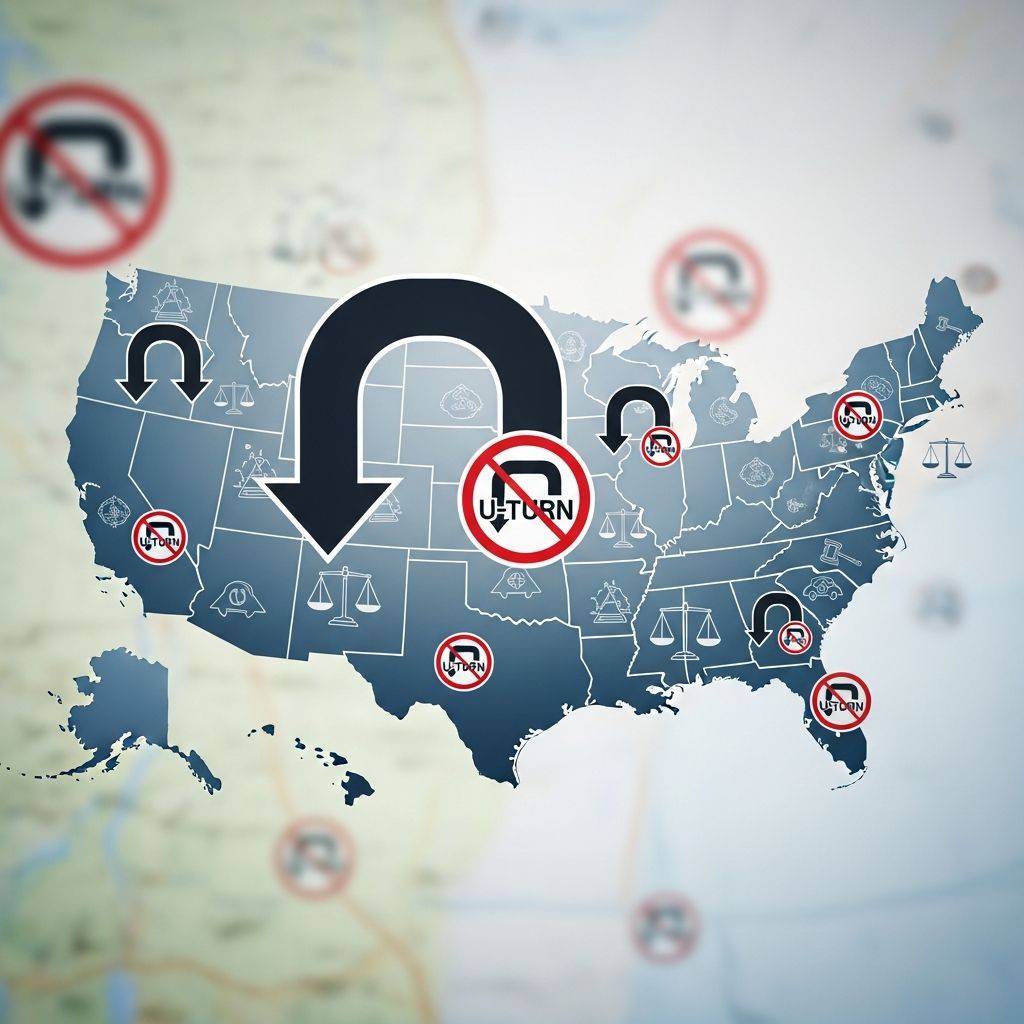
Making a quick U-turn can feel like the easiest way to correct a missed turn, but in many situations it can also lead to a traffic ticket, fines, and even increased insurance costs. U-turn laws are mostly written and enforced at the state and local level, and what is legal in one jurisdiction may be illegal just over the city or county line. Understanding these rules helps you avoid citations and reduces the risk of a crash.
What Is a U-Turn and When Does It Become Illegal?
A U-turn is a maneuver where a driver turns the vehicle around 180 degrees to travel in the opposite direction on the same road. In principle, there is nothing inherently unlawful about a U-turn—but it must comply with specific location-based and safety-based rules.
Basic definition
In most U.S. jurisdictions, a U-turn is treated as a type of turn similar to a left turn, but with added restrictions. Many state codes explicitly require that the maneuver be made only when it is safe and does not interfere with other traffic.
Typical situations where U-turns are illegal
Although each state writes its own traffic code, several patterns appear across the country.
- Where a posted sign prohibits U-turns (for example, a standard “No U-Turn” symbol).
- On curves, hills, or grades where approaching drivers cannot see your vehicle from a sufficient distance.
- On approaches to intersections or pedestrian crossings with limited visibility.
- On divided highways or at locations where medians and barriers make turning hazardous.
- On one-way streets where turning would send you against the flow of traffic.
- Near fire stations, school zones, or busy business districts, depending on local law.
How State and Local Laws Regulate U-Turns
There is no single national rule for U-turns in the United States. Each state enacts its own motor vehicle code, and cities or counties often add local ordinances. That means a maneuver that is legal in one state can be illegal in another—or even illegal on one side of an intersection and legal on the other side.
Common state-level patterns
State vehicle codes often address U-turns in two ways:
- General safety clause: U-turns are allowed only if they can be made safely and without interfering with other traffic.
- Specific location bans: U-turns are banned on curves, near hills or grades, on certain highways, or within specified distances of intersections or traffic signals.
For example, Virginia law prohibits turning to proceed in the opposite direction on any curve or near the crest of a hill when your vehicle cannot be seen by another driver from 500 feet, and limits U-turns in cities, towns, or business districts to intersections. Other states use similar distance rules, sometimes 500 feet or more, to define when visibility is adequate.
Local ordinances and posted signs
Even if state law allows U-turns in general, cities and counties can restrict them at specific intersections or corridors. These local limits typically appear as regulatory signs, but some jurisdictions also prohibit U-turns by ordinance even where no sign is posted.
As a driver, you should not assume that a U-turn is legal just because there is no explicit sign. In some states, the default rule is restrictive, allowing U-turns only when clearly permitted, while in others the default is permissive as long as the maneuver is safe and not explicitly banned.
Illustrative comparison of state approaches
| Example State | General Rule | Typical Limits |
|---|---|---|
| Virginia | Allowed with restrictions | Not on curves or near hills where vehicle cannot be seen from 500 ft; in many business areas only at intersections. |
| States using visibility rules (e.g., several Midwestern states) | Allowed when safe | No U-turns on hills or curves where visibility is less than a specified distance, often 500 ft. |
| Urban municipalities | Often more restrictive | May ban U-turns on major arterials, near schools, or in dense business corridors, sometimes even without posted signs. |
Typical Places Where U-Turns Are Banned
While precise wording varies across states, certain locations are frequently off-limits for U-turns because of higher crash risk or traffic disruption.
Intersections and traffic signals
- Against a red light: Making a U-turn against a steady red signal is generally unlawful.
- Where signs restrict turn movements: Some intersections allow left turns but prohibit U-turns, often marked with “No U-Turn” signs.
- Complex multi-lane intersections: Jurisdictions may ban U-turns at intersections with heavy traffic volumes or unusual configurations to avoid conflict points.
Curves, hills, and low-visibility areas
Most states forbid U-turns where other drivers cannot see you from a sufficient distance, commonly around 500 feet. That includes:
- Sharp curves.
- Approaches to the crest of a hill.
- Locations with frequent obstructions such as trees, walls, or parked vehicles.
Divided highways and limited-access roads
On divided highways or freeways, drivers are usually not allowed to make U-turns across medians or in emergency crossover areas. Some states design special median openings or “U-turn lanes” for controlled turning, but using them outside their intended pattern can still violate the law.
Special zones
- School zones: Some jurisdictions prohibit U-turns during school hours to protect pedestrians and school traffic.
- Fire stations and emergency facilities: U-turns may be banned directly in front of fire station driveways and similar locations to keep emergency routes clear.
- Business districts: Densely developed or downtown areas may have blanket restrictions, allowing U-turns only at certain controlled intersections.
When U-Turns Are Commonly Legal
Despite all the restrictions, drivers are allowed to make U-turns in many situations when they are clearly safe and not expressly prohibited.
Typical legal scenarios
- At a green light or green left arrow, where no sign bans U-turns.
- From the leftmost lane of a multi-lane road, assuming adequate space and visibility.
- From a dedicated left-turn lane, when the jurisdiction treats a U-turn as a form of left turn and allows it absent a restriction.
- In low-speed residential areas, where state law often allows U-turns if they can be made safely and without interfering with traffic.
Key safety requirements
Even where U-turns are legal, most state laws emphasize two core conditions:
- The maneuver must be safe under current traffic, road, and weather conditions.
- The driver must not interfere with other traffic by forcing abrupt braking or evasive action.
Failing to meet these conditions can result in a citation for an improper or unsafe U-turn even if there is no posted sign banning the maneuver.
Penalties and Consequences for an Illegal U-Turn
An illegal U-turn is usually treated as a moving violation, but the exact consequences depend on state law and your driving record.
Traffic tickets and fines
In most states, an illegal U-turn is a civil traffic infraction punishable by a monetary fine rather than jail time. Typical fines often fall in the range of dozens to a few hundred dollars, though specific amounts vary widely between jurisdictions.
Driver’s license points
Many states use a demerit point system. An illegal U-turn citation can add points to your license, similar to other minor moving violations. Accumulating too many points within a set period may lead to:
- Warning letters from the licensing authority.
- Mandatory driver improvement courses.
- License suspension or probation status, especially for repeat offenders.
Insurance impacts
Auto insurers often review your driving record when setting premiums. Even if an illegal U-turn is considered a relatively minor violation, it can still contribute to higher insurance costs, particularly if you already have recent tickets or at-fault crashes on your record.
More serious consequences when a crash occurs
If a collision results from an improper U-turn, the legal and financial consequences can escalate:
- Citation for the illegal turn plus any additional violations (such as failure to yield).
- Potential civil liability for injuries and property damage.
- Greater insurance premium increases due to an at-fault crash.
Safety Considerations Before Making a U-Turn
U-turn crashes often involve conflicts with oncoming traffic or vehicles emerging from side streets and driveways. Even where a U-turn is legal, drivers must evaluate the safety of the maneuver in real time.
Practical safety checklist
- Confirm that there is no sign prohibiting U-turns.
- Check that you are in the proper lane, usually the far-left lane or a marked left-turn lane.
- Ensure ample visibility of oncoming traffic and cross streets in both directions.
- Consider the speed of approaching vehicles; do not assume they will slow down for you.
- Watch carefully for pedestrians and cyclists in crosswalks and on shoulders.
- Avoid U-turns in heavy traffic or on wet, icy, or otherwise slippery pavement.
When to choose another option
Sometimes the safest choice is to continue straight and use the next safe intersection, roundabout, or designated turnaround. This is particularly true on high-speed roads, multilane arterials, and unfamiliar streets.
Responding to an Illegal U-Turn Ticket
If you receive a citation for an illegal U-turn, you typically have several options, though procedures vary by state and local court system.
Common options after a citation
- Pay the fine and accept the violation, which may result in points and possible insurance effects.
- Request a hearing to contest the ticket, usually by the deadline listed on the citation.
- Seek legal advice if the ticket involves an accident, high fines, or possible license suspension.
- Ask about diversion or traffic school, where available, to reduce or avoid points.
Potential defenses
Depending on the facts and your state’s laws, possible arguments may include:
- You did not actually perform a U-turn—for example, it was a legal three-point turn in a permitted location.
- There was no sign prohibiting a U-turn where local law otherwise allows them.
- The maneuver did not occur in a prohibited area such as a curve, hill, or restricted district.
- Visibility and traffic conditions satisfied the code’s safety requirement.
A local traffic attorney can review the specific statute cited on your ticket and help evaluate whether a legal defense is realistic.
Practical Tips for Staying on the Right Side of U-Turn Laws
Because U-turn regulations differ from place to place, a few cautious habits can save you from tickets and collisions.
- Review your state’s driver handbook and vehicle code, especially if you recently moved.
- Follow signage closely; assume that a “No U-Turn” sign applies until you have clearly passed it.
- Err on the side of caution when visibility is limited or traffic is heavy.
- Plan ahead for missed turns; continue to the next safe legal option instead of forcing a risky maneuver.
- Stay updated on local rules if you drive frequently in different cities or states.
Frequently Asked Questions About Illegal U-Turns
Are U-turns always illegal unless a sign says otherwise?
No. In many states, U-turns are legal by default as long as they are safe and do not occur in a location specifically restricted by statute or sign. Other states and municipalities adopt a more restrictive approach, so you must check local law.
Can I make a U-turn at a green traffic light?
Often yes, provided there is no sign prohibiting U-turns and the road design allows you to complete the turn safely without interfering with oncoming traffic. But some intersections or jurisdictions treat U-turns differently, so always confirm your state’s rules.
Is it legal to make a U-turn on a two-lane rural road?
Many states allow U-turns on low-volume roads if visibility is adequate (commonly at least several hundred feet) and no sign or statute prohibits it. However, U-turns on curves or hills that obscure your vehicle are commonly banned.
What if there is no “No U-Turn” sign?
The absence of a sign does not guarantee that a U-turn is legal. You still must comply with general safety rules and any state or local statutes that restrict U-turns in certain zones (such as school zones or business districts).
Does an illegal U-turn always raise my insurance rates?
Not always, but many insurers treat an illegal U-turn ticket as a moving violation that can contribute to premium increases, especially when combined with other violations or an at-fault crash. The impact varies by insurer and state.
References
- Are U-Turns Illegal? Safety Risks and Penalties — ConsumerShield. 2026-01-15. https://www.consumershield.com/injuries-accidents/car-accidents/are-u-turns-illegal
- U-Turns: Legal Until They’re Not? — The Wise Drive. 2023-05-10. https://www.thewisedrive.com/u-turns-legal-until-theyre-not/
- U-turn — Wikipedia (background only; not cited directly). 2024-03-18. https://en.wikipedia.org/wiki/U-turn
- § 46.2-845. Limitation on U-turns — Code of Virginia, Virginia Law Website. 2024-01-01. https://law.lis.virginia.gov/vacode/title46.2/chapter8/section46.2-845/
- U-Turn Laws Map — Matthew Miner. 2022-11-01. https://matthewminer.name/data/maps/us-states/driving/u-turns
- Are U-turns Illegal in Tennessee? — Hughes & Coleman Injury Lawyers. 2023-08-07. https://www.hughesandcoleman.com/are-u-turns-illegal-in-tennessee/
- Illegal and Legal U-Turns: A Brief Guide — CarParts.com. 2023-04-12. https://www.carparts.com/blog/illegal-and-legal-u-turns-a-brief-guide/
Similar Articles








Read full bio of Sneha Tete


