
Idaho Fence Law: What Landowners Must Know
Understanding Idaho’s property boundaries, fence rules, and neighbor responsibilities for landowners.
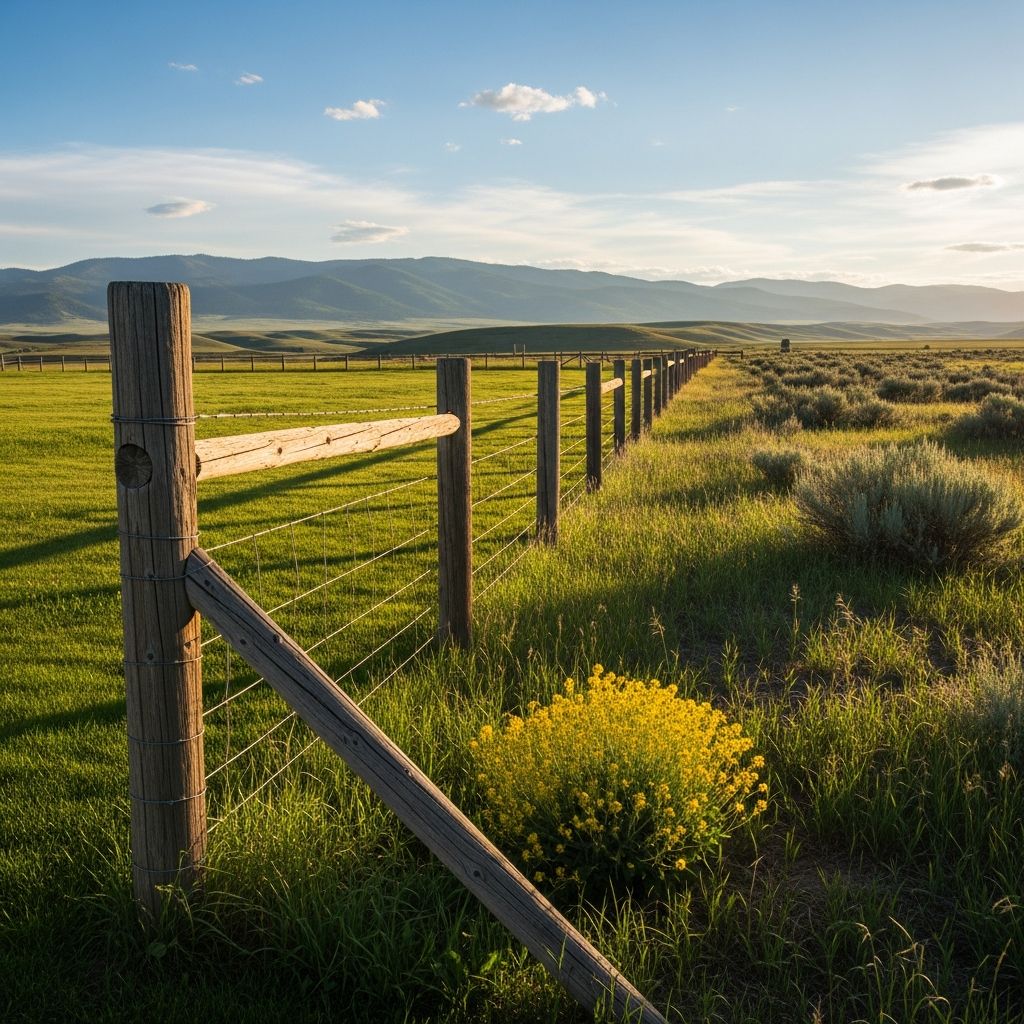
Understanding Property Lines and Fences in Idaho
For Idaho landowners, whether on a rural ranch, a small farm, or a suburban lot, property lines and fences are more than just physical markers—they’re legal boundaries that define rights, responsibilities, and potential conflicts. Knowing how Idaho law treats these boundaries and structures is essential for maintaining good neighbor relations, avoiding costly disputes, and protecting your investment in real estate.
How Property Lines Are Legally Defined
A property line is the legal boundary of a parcel of land, as shown on a recorded plat, deed description, or survey. In Idaho, these lines are established by:
- Legal descriptions in deeds and title documents
- Official surveys conducted by licensed land surveyors
- Recorded subdivision plats and maps
While fences, trees, or natural features may appear to mark a boundary, they do not automatically define the legal line. A fence that is built several feet inside or outside the true boundary does not change ownership or create a new legal line—unless certain legal doctrines apply over time.
When a Fence Becomes the De Facto Boundary
Idaho recognizes a legal principle known as boundary by acquiescence, where a long-standing fence or other boundary marker can effectively become the recognized property line between neighbors, even if it does not match the surveyed line.
For this doctrine to apply, courts generally look for:
- A visible, long-standing boundary feature (like a fence)
- Both landowners treating that feature as the boundary for many years
- Uncertainty or dispute about the true line, or at least a mutual understanding that the fence marks the division
- Conduct showing that both parties have accepted the fence as the boundary (e.g., mowing up to it, paying taxes on the land up to the fence, not objecting to improvements)
If these conditions are met, a court may rule that the fence line is the legal boundary, even if it differs from the original survey. This is why it’s risky to assume that a crooked or old fence is “just a fence” and not a legally significant boundary.
What Makes a Fence “Lawful” in Idaho
Under Idaho law, a “lawful fence” is one that meets specific standards designed to keep livestock contained and protect neighboring property. These standards are especially important in rural and agricultural areas.
A lawful fence in Idaho must generally:
- Be at least 4.5 feet high
- Have the bottom board, rail, pole, or wire no more than 20 inches above the ground
- Be constructed with substantial posts, typically no more than 20 feet apart
- Be strong enough to prevent livestock (cattle, sheep, horses) from passing through or over it
Materials like woven wire, barbed wire, wood rails, or solid panels can qualify, as long as they meet these criteria. Natural barriers like dense hedges or rock walls may also be considered lawful fences in some circumstances, depending on their effectiveness.
Partition Fences: Shared Responsibility
A partition fence is a fence built on or near the boundary between two properties to separate them. Idaho law creates a framework for how these fences are built, maintained, and paid for.
Key points about partition fences include:
- Either landowner can initiate the process by giving written notice to the other
- After notice, the parties have six months to agree on building or repairing the fence
- If no agreement is reached, the party who gave notice may build or repair the fence and then seek reimbursement for half the cost from the other owner
- Failure to pay can result in a lien on the non-paying owner’s land
This system encourages cooperation and prevents one neighbor from being forced to bear the full cost of a necessary boundary fence.
Who Pays for Fence Construction and Maintenance?
Idaho law does not automatically require neighbors to split the cost of every fence. Responsibility depends on the situation:
- Partition fences: Costs are generally shared equally between adjoining owners, unless they agree otherwise in writing.
- Enclosure fences: If one owner wants to fully enclose their property and uses the partition fence as one side, they may be responsible for half the value of the partition fence used in that enclosure.
- One owner chooses not to be enclosed: If one landowner decides to leave their side unenclosed, they are not liable for the cost of improvements made by the other owner to strengthen or raise the fence.
Written agreements are strongly recommended to clarify who pays for what, especially when building a new fence or making major repairs.
Can a Neighbor Remove a Fence Without Permission?
Removing a fence, especially one that serves as a partition between properties, is not as simple as taking it down. Idaho law places limits on when and how a fence can be removed.
General rules include:
- A partition fence cannot be removed without giving the adjoining landowner at least six months’ written notice
- If the fence is removed to vacate an enclosure or create a lane between properties, the same notice requirement applies
- An owner cannot remove a fence that was built in good faith on their land by a neighbor, at least not immediately
These protections help prevent sudden changes that could expose crops, livestock, or property to damage or trespass.
What Happens When a Fence Is Built on the Wrong Side of the Line?
Mistakes happen. A fence may be built several feet onto a neighbor’s property due to an outdated survey, misread markers, or simple error. Idaho law provides a process for dealing with this situation.
If a fence is built in good faith on a neighbor’s land:
- The builder (or their successor) can remove it within one year of discovering the mistake
- Removal must not cause damage to the land where it was mistakenly placed
- During that one-year window, the landowner whose property was encroached upon cannot modify or disturb the fence
If the line is in dispute, either party may hire a licensed surveyor to establish the true boundary. Once the line is confirmed, the party who built the fence in error is required to remove it within one year.
Resolving Disagreements Between Neighbors
When neighbors cannot agree on the location, construction, or maintenance of a fence, Idaho law provides a formal process to resolve the dispute.
If two adjoining owners disagree about:
- Where the fence should be located
- How much of the fence each should build or maintain
- How costs should be shared
Either party may request that “viewers” be appointed. These are neutral third parties (often local officials or appointed individuals) who inspect the property and make a binding decision on the proportion of the fence each owner must provide or pay for.
This process is designed to be fair and avoid the need for immediate litigation, though court action may still be necessary if the viewers’ decision is not followed.
City and Suburban Fence Rules
In cities and suburban areas, local zoning and development codes add another layer of rules on top of state law. These typically regulate:
- Fence height (e.g., front yard fences limited to 3–4 feet, side and rear fences up to 6 feet)
- Setbacks from property lines (how far a fence must be from the line)
- Materials and design (e.g., restrictions on solid privacy fences in front yards)
- Visibility at street corners (vision triangles where low fences or no fences are allowed)
For example, many Idaho cities:
- Limit front yard fences to 3–4 feet in height
- Allow up to 6 feet for side and rear yard fences
- Prohibit fences that obstruct sight lines at intersections
Before building or replacing a fence in a city or subdivision, landowners should check with the local planning or zoning department to ensure compliance with municipal codes.
Best Practices for Idaho Landowners
To avoid disputes and legal issues, Idaho landowners should follow these practical steps:
- Survey before building: Always have a licensed surveyor mark your property lines before installing a new fence.
- Talk to your neighbor: Discuss plans for a fence, including location, materials, and cost sharing, before construction begins.
- Get it in writing: Put any agreement about fence location, construction, and maintenance in a written, signed document.
- Maintain the fence: Regular upkeep prevents deterioration, livestock escapes, and neighbor complaints.
- Post your property: Use “No Trespassing” signs or purple paint on posts to clearly mark boundaries and deter unauthorized entry.
- Keep records: Save copies of surveys, deeds, agreements, and receipts for fence work.
Common Scenarios and How Idaho Law Applies
Understanding how the law works in real situations can help landowners make better decisions.
Scenario 1: The Old Crooked Fence
Two neighbors have lived next to each other for decades. A crooked, weathered fence has always been treated as the boundary. One owner wants to build a new straight fence along the surveyed line, but the other insists the old fence line is the true boundary.
How Idaho law may apply: If both parties and their predecessors have treated the old fence as the boundary for many years, a court could recognize it as the legal line under the doctrine of boundary by acquiescence. Simply surveying the line may not be enough to move the boundary if long-standing conduct supports the old fence.
Scenario 2: The Neighbor Who Won’t Pay
One owner builds a partition fence after giving proper notice. The neighbor refuses to pay their half of the cost.
How Idaho law may apply: The owner who built the fence can seek reimbursement for half the cost. If the neighbor still refuses to pay, a lien may be placed on their land, and legal action can be pursued to recover the amount owed.
Scenario 3: The Fence Built on the Wrong Side
A landowner builds a fence along what they believe is the property line, but a new survey shows it is actually on the neighbor’s land.
How Idaho law may apply: If the fence was built in good faith, the builder has one year from discovering the mistake to remove it, provided no damage is done to the neighbor’s land. During that time, the neighbor cannot alter or remove the fence without permission.
When to Consult an Attorney
While many fence and boundary issues can be resolved through communication and local processes, some situations require legal advice:
- There is a serious dispute over the location of the property line
- A neighbor is threatening to remove a fence or build on your land
- You are being asked to pay for a fence you believe is unnecessary or improperly located
- You want to formalize a boundary agreement or correct a title issue
- You are considering filing a lien or lawsuit over fence costs or encroachment
An experienced Idaho real estate or land use attorney can review deeds, surveys, and local ordinances, and help you protect your rights without unnecessary conflict.
Frequently Asked Questions
Can a fence become the legal property line in Idaho?
Yes, under the doctrine of boundary by acquiescence, a long-standing fence that both neighbors have treated as the boundary for many years can be recognized by a court as the legal property line, even if it differs from the original survey.
How high does a fence need to be to be lawful in Idaho?
A lawful fence in Idaho must be at least 4.5 feet high, with the bottom board, rail, pole, or wire no more than 20 inches above the ground, and built with substantial posts and materials sufficient to keep livestock contained.
Do neighbors have to split the cost of a fence?
For a partition fence between adjoining properties, Idaho law generally requires that costs be shared equally, unless the parties agree otherwise in writing. If one owner chooses not to enclose their land, they are not liable for improvements made by the other owner.
Can I remove my neighbor’s fence if it’s on my property?
Not immediately. If a fence was built in good faith on your land, the builder has one year from discovering the mistake to remove it. During that time, you cannot modify or remove the fence without permission, especially if doing so would expose crops or livestock to damage.
What should I do if my neighbor won’t agree on a fence?
First, try to resolve the issue through discussion. If that fails, you can give written notice to build or repair a partition fence. If no agreement is reached, you may build it and seek half the cost from your neighbor. If disputes persist, you can request that viewers be appointed or consult an attorney.
Are there different rules for city fences?
Yes. In cities and suburbs, local zoning and development codes regulate fence height, setbacks, materials, and design. For example, front yard fences are often limited to 3–4 feet, while side and rear fences may be allowed up to 6 feet, subject to local rules.
How can I protect my property from trespassers?
To enforce trespass protections, your property should be posted with “No Trespassing” signs at regular intervals, fenced, or marked with purple paint on posts or trees between 3 and 5 feet from the ground. Verbal notice can also be effective in some situations.
References
- Idaho Code Title 35, Chapter 1 – Fences in General — Idaho Legislature. 2024. https://law.justia.com/codes/idaho/title-35/chapter-1/
- Idaho Code § 18-7008 – Criminal Trespass — Idaho Legislature. 2024. https://law.justia.com/codes/idaho/title-18/chapter-70/section-18-7008/
- Idaho Fence Law Brochure — Idaho Farm Bureau. 2023. https://www.idahofb.org/media/5iwfukwl/fence-brochure-web-version-updated-photos.pdf
Similar Articles








Read full bio of Sneha Tete


