
ICE Raids vs. ICE Audits: A Practical Guide for Employers
Understand the real differences between ICE raids and I‑9 audits, and learn how to protect your workplace with clear, lawful preparation.
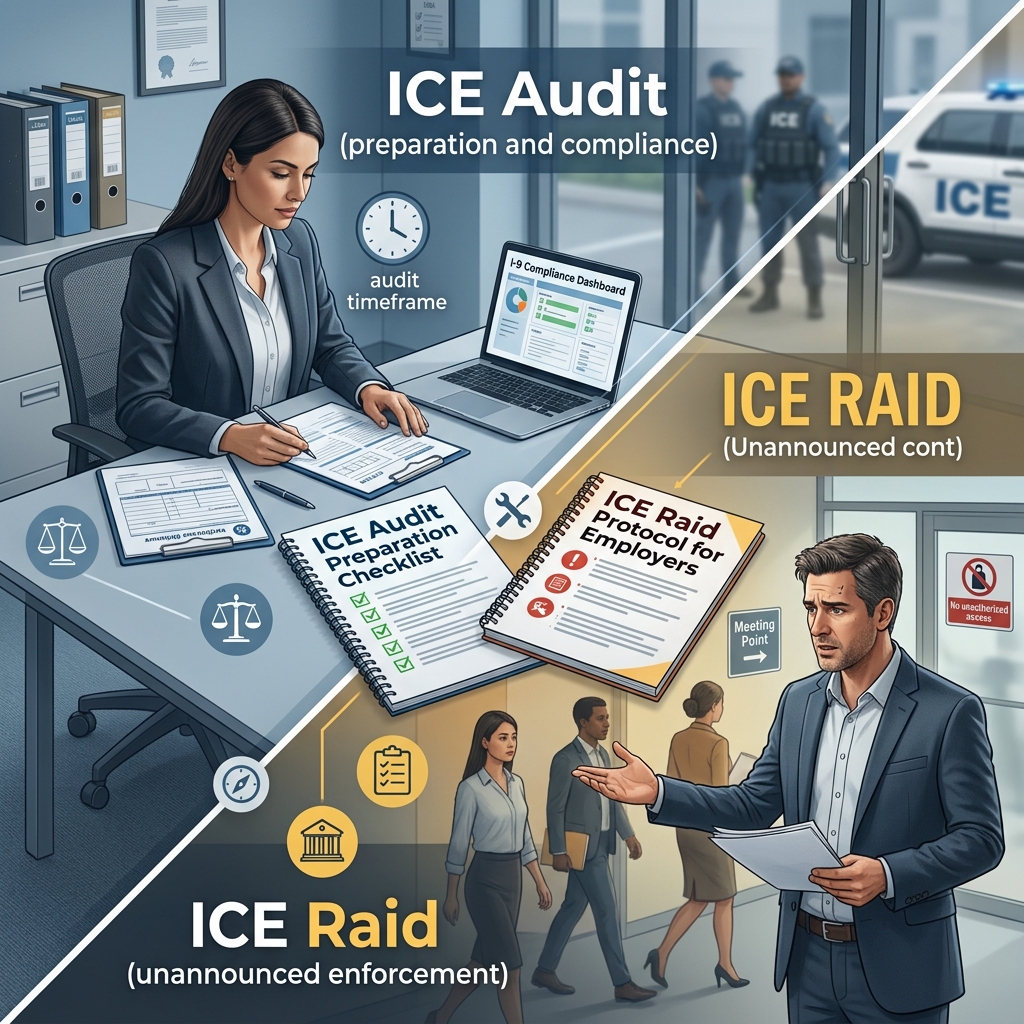
U.S. Immigration and Customs Enforcement (ICE) enforces immigration and work authorization laws not only through border actions, but also by investigating employers and their workforces inside the country. Employers may encounter two very different types of worksite enforcement: unannounced ICE raids and more orderly I‑9 paperwork audits. Understanding how each process works, what ICE can demand, and what your organization must do in response is essential to managing legal risk and minimizing disruption.
1. Why Worksite Immigration Enforcement Matters
Federal law requires every employer in the United States to verify the identity and employment authorization of each employee by completing Form I‑9 after hire. ICE and related agencies use this requirement as a core enforcement tool, combining administrative audits of records with on‑site investigations and arrests.
For employers, the stakes are significant:
- Civil penalties for I‑9 errors and paperwork violations, which can be assessed per form.
- Fines and debarment from federal contracts for knowing employment of unauthorized workers.
- Criminal exposure where there is evidence of harboring, document fraud, or a pattern of hiring unauthorized workers.
- Operational disruption, reputational damage, and employee trauma when a raid or large‑scale action occurs.
A clear strategy for both compliance (to reduce the likelihood and impact of an audit) and incident response (to manage a raid or inspection lawfully and calmly) is now a core part of responsible risk management for many employers.
2. ICE Raids vs. ICE Audits: Side‑by‑Side Comparison
Although both are forms of worksite enforcement, ICE raids and audits look and feel very different. The table below highlights the most important distinctions for employers.
| Feature | ICE Raid | ICE I‑9 Audit |
|---|---|---|
| How it begins | Agents arrive at the workplace without prior notice, often in significant numbers. | Employer receives a Notice of Inspection or subpoena requesting I‑9 and related records, generally with at least 3 business days to respond. |
| Legal authority | Typically based on a criminal search warrant describing areas to be searched and items to be seized. | Administrative notice used to inspect employer’s I‑9 forms and supporting documents; no judicial warrant is required for the audit itself. |
| Primary focus | Locating, detaining, and potentially arresting noncitizens suspected of lacking lawful status; investigating criminal violations. | Evaluating whether the employer has properly verified work authorization and maintained I‑9 records; assessing civil liability. |
| Impact on operations | Immediate disruption, possible detention of workers, and law‑enforcement presence throughout the facility. | Paperwork‑driven process; disruption is primarily administrative and can often be managed in the background. |
| Potential outcomes | Arrests, seizures of records, criminal or civil investigations of both workers and management. | Civil fines, required corrections, and—if serious violations are found—referrals for further investigation. |
3. What Happens During an ICE Raid?
An ICE raid is a rapid, unannounced enforcement action at a worksite. These operations are often described as workplace “enforcement actions” and may involve federal and sometimes local officers working together.
3.1 Typical sequence of a raid
- Arrival and perimeter – Agents enter the property, sometimes securing entrances and exits to control movement in and out of the workplace.
- Presentation of a warrant – For non‑public areas and searches of desks, computers, or files, officers usually rely on a criminal search warrant that identifies the location and items to be seized.
- Questioning and identification – Agents may ask workers for identification or immigration documents and attempt to determine who they believe is removable.
- Detentions and arrests – Some employees may be handcuffed and transported to a detention facility for further processing or removal proceedings.
- Seizure of records – Agents can seize physical and electronic records specified in the warrant, including I‑9 forms, payroll data, and other materials.
Although employers are not required to answer questions during a raid, they must not obstruct officers, destroy records, or give false information. A calm, structured response preserves legal rights while avoiding additional liability.
3.2 Employer rights and limits during a raid
Key rights and boundaries commonly recognized in guidance from attorneys general and legal practitioners include:
- The right to ask to see the warrant and review its scope before allowing access to non‑public areas.
- The right of managers and employees to remain silent and request to speak with a lawyer before answering substantive questions.
- The right to document the encounter—taking notes or video, where lawful, as long as it does not interfere with officers’ activities.
- No obligation to consent to any search beyond what the warrant or law requires; you are not required to sign documents you do not understand.
At the same time, employers have important obligations:
- Do not instruct workers to run, hide, or lie to officers.
- Do not destroy, alter, or conceal documents that may be relevant to the investigation.
- Do not physically block officers acting within the scope of lawful authority.
4. What Happens During an ICE I‑9 Audit?
An ICE I‑9 audit is a records inspection focused on whether an employer has satisfied its duty to verify work authorization and to maintain I‑9 forms and related documents. Rather than a surprise entry into the workplace, the process is initiated at the administrative level.
4.1 Launching the audit
The process typically begins when ICE serves a Notice of Inspection or similar notice demanding production of I‑9 forms and supporting records. Employers generally have at least three business days to provide the requested documents, though the notice may define a different timeframe.
ICE may select employers for audits in several ways, including tips, targeted industry sweeps, or follow‑up to previous investigations. While employers cannot prevent an audit, advance preparation can significantly reduce liability.
4.2 Scope of records reviewed
During an I‑9 audit, ICE may examine:
- Completed I‑9 forms for current employees and certain former employees.
- Copies of identity and work authorization documents, if the employer retains them.
- Payroll records, ownership and corporate information, and E‑Verify documentation (if applicable).
- Policies, training records, and internal audit documentation, where relevant.
After reviewing the documents, ICE may issue notices identifying technical or substantive violations and, in some cases, propose penalties. Employers may be allowed to correct certain technical errors within a defined period, but more serious issues—such as repeated failures to complete I‑9s or clear evidence of unauthorized employment—can result in substantial fines.
4.3 Potential consequences of an audit
- Notice of technical violations with an opportunity to correct them within a specified timeframe.
- Notice of intent to fine for substantive violations, such as missing forms, incomplete sections, or knowingly hiring unauthorized workers.
- Follow‑up investigations or referrals if the audit suggests broader patterns of unlawful conduct.
While an audit rarely has the immediate shock of a raid, employers often face significant financial and administrative burdens if record‑keeping has been neglected.
5. Building a Compliance Foundation Before ICE Shows Up
The most effective strategy for minimizing both raid and audit risk is a robust compliance program focused on I‑9 accuracy and lawful hiring practices. Legal and government guidance emphasizes proactive steps such as internal audits, clear policies, and training.
5.1 Strengthening I‑9 practices
- Complete and retain I‑9s for every employee hired after November 6, 1986, including citizens and noncitizens alike.
- Use the current I‑9 form and instructions issued by the Department of Homeland Security, and follow document review rules carefully.
- Conduct periodic internal audits to identify and correct errors, documenting what was reviewed and how corrections were made.
- Keep I‑9s separate from general personnel files to make production easier and protect other confidential data.
- Train HR staff on avoiding discriminatory practices—such as over‑documentation or treating workers differently based on appearance or perceived nationality.
5.2 Written policies and designated roles
Beyond the forms themselves, sophisticated employers often rely on formal policies that anticipate ICE contact:
- Document which areas of the workplace are public and which are non‑public. Non‑public areas generally require a warrant or consent for entry.
- Designate a primary contact person and backup to interface with ICE, supported by legal counsel when possible.
- Establish a written ICE response protocol accessible to reception staff, supervisors, and managers.
- Integrate immigration compliance into broader risk and crisis‑management plans.
6. Responding in Real Time: Step‑by‑Step Guidance
Even with strong compliance, an employer may still face a raid or an audit notice. Having a simple checklist for each scenario can reduce confusion and help protect both the company and its workers.
6.1 If agents appear at your workplace
When ICE agents arrive, front‑line staff should focus on safety, clarity, and escalation—not on solving the situation alone.
- Stay calm and respectful. Do not argue with officers. Ask them to wait while you contact the designated company representative.
- Ask what type of visit it is. Clarify whether they have come for an I‑9 audit, a criminal investigation, or another purpose.
- Request documentation. If they seek access beyond public areas or want to seize records, ask to see a warrant or written notice and read the details (location, scope, and items).
- Contact legal counsel immediately. Provide counsel with copies or photos of any warrants or notices.
- Accompany officers when possible. A trained employee can observe, take notes, and ensure the company understands what is occurring.
6.2 If you receive an I‑9 audit notice
When ICE serves an administrative notice for an I‑9 inspection, time is short but there is usually an opportunity to organize.
- Note the production deadline and confirm whether it can be extended; in some circumstances, ICE may grant short extensions.
- Gather all requested I‑9s and related records, ensuring that documents match the timeframe and categories specified in the notice.
- Perform a quick internal review to identify obvious errors or missing forms, and consult counsel about permitted corrections before submission.
- Keep copies of everything you provide to ICE, including transmittal letters and inventories.
- Prepare a point‑by‑point file documenting your I‑9 procedures, training, and prior corrective actions; this can help contextualize issues identified by ICE.
7. Communicating with Employees and Protecting Their Rights
Worksite enforcement affects not only employers but also workers and their families. Guidance from state attorneys general and advocacy groups emphasizes that workers generally have important constitutional rights, regardless of immigration status.
7.1 Employee education before an incident
Employers can prepare their workforce in ways that respect both legal obligations and employees’ rights:
- Offer “know‑your‑rights” information explaining that workers typically have:
– The right to remain silent when questioned about immigration status.
– The right to speak with a lawyer before signing documents.
– In many circumstances, the right to decline consent to searches of personal belongings. - Clarify company policy that no one should run, hide, or lie, and that safety and cooperation with lawful orders are paramount.
- Ensure employees know who the internal contact is if an enforcement action occurs.
7.2 After a raid or major enforcement action
Following a raid, employers may be dealing simultaneously with legal fallout, media interest, and a workforce that has experienced a traumatic event. Practical follow‑up steps include:
- Document everything that occurred—officer names, times, areas searched, items taken, and employees detained.
- Coordinate with counsel to understand any ongoing investigations or obligations, including subpoenas or follow‑up requests.
- Communicate carefully with remaining employees, providing factual information about what happened and what to expect, without interfering with any investigation.
- Facilitate access to legal resources for workers who were detained or whose family members were affected, where appropriate.
8. Strategic Takeaways for Employers
While every workplace and industry faces different levels of immigration enforcement risk, several strategic principles apply broadly:
- Treat I‑9 compliance as a continuous process, not a one‑time paperwork exercise at hire.
- Differentiate your response: a raid, an audit, and a routine site visit may all look different and carry different rights and obligations.
- Integrate immigration readiness into crisis planning, including media, employee relations, and business continuity.
- Seek specialized legal advice when designing policies, conducting internal audits, and responding to any enforcement activity.
By building a strong compliance foundation and preparing for both ICE raids and audits, employers can significantly reduce legal exposure, protect workers’ rights, and navigate enforcement events with greater confidence.
9. Frequently Asked Questions
FAQ 1: Can ICE conduct an I‑9 audit without a warrant?
Yes. An I‑9 audit is an administrative inspection, and ICE does not need a judicial warrant to review I‑9 forms and related records, though it must provide a Notice of Inspection or similar document identifying what is required.
FAQ 2: Do employees have to answer questions during a raid?
Guidance from state attorneys general and legal organizations indicates that workers generally have the right to remain silent and to ask to speak to an attorney before answering questions about immigration status or signing documents, though they should not lie or provide false information.
FAQ 3: What is the biggest difference between an ICE raid and an ICE audit for employers?
The most striking difference is that raids are unannounced, physical enforcement actions—often involving arrests—while audits are pre‑noticed reviews of paperwork focusing on I‑9 compliance. Raids tend to cause immediate operational disruption, whereas audits primarily create administrative and financial risk.
FAQ 4: Can employers correct I‑9 errors after receiving an audit notice?
In many cases, ICE allows employers to correct certain technical or procedural I‑9 errors identified during an audit, though substantive violations such as missing forms or knowingly hiring unauthorized workers may still result in fines. Employers should consult counsel before making corrections to ensure they are done properly.
FAQ 5: How can employers reduce the chance of facing heavy penalties?
Consistent use of the current I‑9 form, regular internal audits, thorough training of HR staff, clear policies on document handling, and early consultation with immigration‑savvy counsel are key steps that government and legal guidance consistently recommend for mitigating potential penalties.
References
- Understanding ICE Raids at American Workplaces — American Immigration Council. 2019-01-01. https://www.americanimmigrationcouncil.org/fact-sheet/understanding-ice-worksite-raids
- ICE Site Visit Q&A — Littler Mendelson, P.C. 2018-01-01. https://www.littler.com/sites/default/files/documents/immigration_ice_qanda.pdf
- How Employers Can Prepare for ICE Audits and Raids — Renne Public Law Group. 2019-07-01. https://rennepubliclawgroup.com/how-employers-can-prepare-for-ice-audits-and-raids-tips-for-compliance-and-crisis-management/
- Immigration Audits and Raids: Employer Preparations to Mitigate Risks — ConsensusDocs. 2018-08-01. https://www.consensusdocs.org/news/immigration-audits-and-raids-employer-preparations-to-mitigate-risks/
- Dealing with ICE in the Workplace — Office of the New York State Attorney General. 2020-01-01. https://ag.ny.gov/immigrants-rights/ice-workplace
- Employer Know Your Rights: ICE Raids, I‑9 Audits & Succession Planning — Stand Together Contra Costa. 2018-02-01. https://standtogethercontracosta.org/wp-content/uploads/2018/02/Employers-KYR-Presentation-English-and-Spanish.pdf
Similar Articles








Read full bio of Sneha Tete




