
The Digital Border: ICE, CBP & Cell-Site Simulators
Uncovering how federal immigration agencies use invasive mobile surveillance.
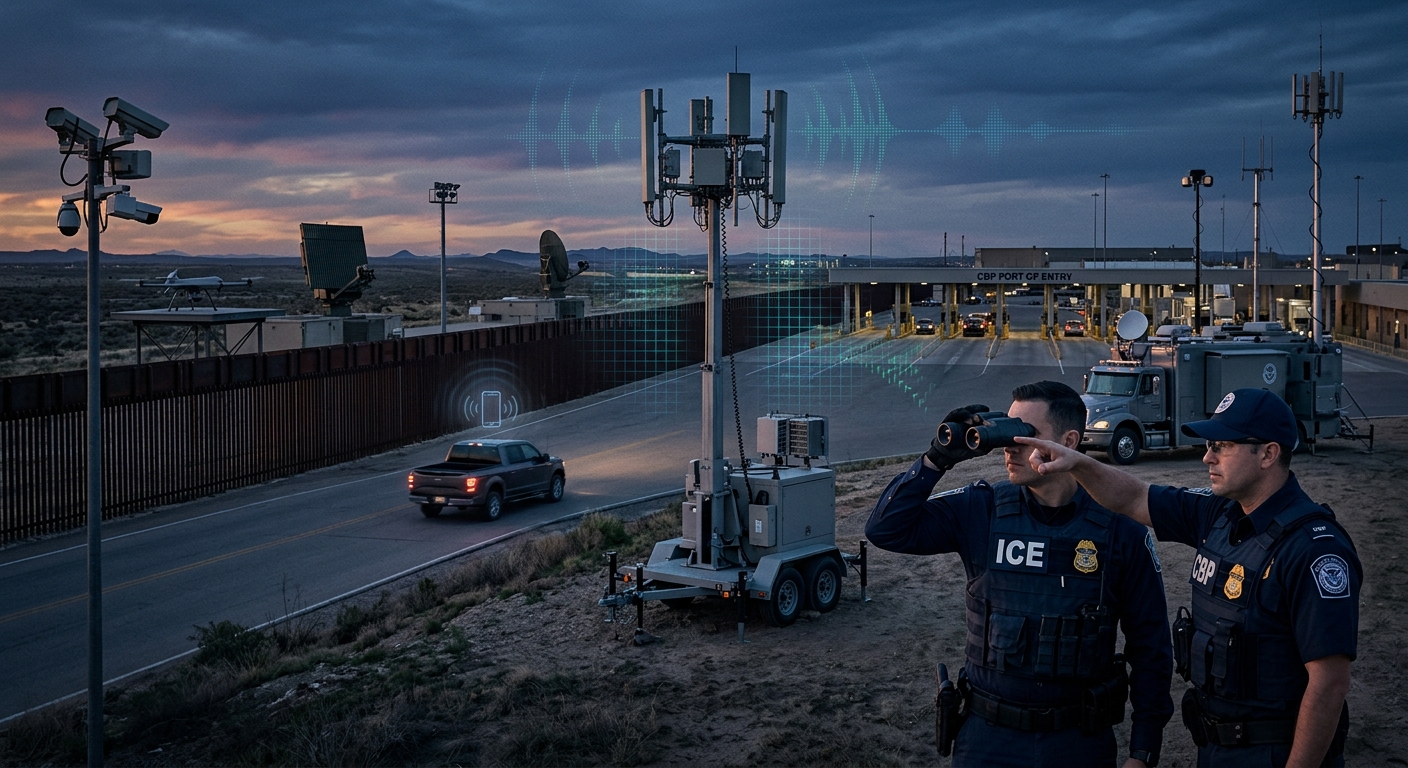
The Dawn of Digital Dragnets in Immigration Enforcement
The landscape of immigration enforcement has undergone a dramatic technological transformation over the past decade. Traditional methods of investigation and physical apprehension have increasingly been supplementednd in some cases, entirely replacedy highly sophisticated digital surveillance tools. The border is no longer merely a geographic or physical barrier; it has evolved into a vast, invisible digital net. Among the most controversial of these modern technologies are cell-site simulators, commonly referred to by their most popular brand name, “Stingrays.” Recently, a wealth of evidence has emerged highlighting how federal agencies, specifically Immigration and Customs Enforcement (ICE) and Customs and Border Protection (CBP), have quietly but aggressively integrated these invasive devices into their daily operations.
The deployment of cell-site simulators at the border and deep within interior enforcement zones represents a pivotal shift in how the federal government tracks individuals. It also ignites a fierce, ongoing debate regarding the delicate balance between national security objectives, civil immigration enforcement, and the fundamental privacy rights guaranteed by the United States Constitution. As these digital dragnets silently sweep across urban neighborhoods and rural communities alike, they bring forth pressing questions about operational transparency, government accountability, and the steady erosion of civil liberties in our modern, hyper-connected era.
Decoding the Technology: How Cell-Site Simulators Work
To truly grasp the profound privacy implications of this surveillance technology, it is essential to first understand the technical mechanics of how a cell-site simulator operates. Mobile devices are engineered with a specific, hardcoded protocol designed for the consumer’s benefit: to conserve battery life and ensure a seamless, uninterrupted user experience, cellular phones are constantly searching for and connecting to the telecommunications tower that is broadcasting the strongest signal in their vicinity. Cell-site simulators exploit this very mechanism to infiltrate the connection.
By mimicking the physical characteristics of a legitimate telecom tower and purposefully emitting a superior, overpowering signal strength, the police-operated simulator tricks every mobile phone within its operational radius into dropping its legitimate network connection. The phones are coerced into silently connecting to the law enforcement device instead. Once this artificial electronic handshake successfully occurs, the simulator forces the mobile device to transmit its International Mobile Subscriber Identity (IMSI) number. The IMSI is a unique 15-digit code tied to the phone’s SIM card, functioning essentially as an unchangeable digital fingerprint for the user.
Beyond merely extracting this identifying metadata, operators can use the simulator’s software to measure signal strength, latency, and direction, allowing them to triangulate the exact physical location of the targeted phone, sometimes down to a specific room inside a multi-story apartment building. In older iterations or specific configurations, this “man-in-the-middle” attack can degrade a phone’s service from modern 4G/5G networks down to less secure 2G networks, which has historically caused unintended disruptions to emergency 911 calls for completely innocent people located nearby.
The Expansion into Routine Immigration Enforcement
Historically, the procurement and deployment of cell-site simulators were strictly justified by the federal government as a necessary measure for high-stakes, specialized military operations. They were primarily utilized by the intelligence community and defense agencies in overseas counter-terrorism efforts to track high-value targets. However, much like many pieces of military-grade technology, Stingrays have inevitably trickled down into domestic law enforcement and federal civil immigration operations. Over the last several years, ICE and CBP have quietly spent millions of taxpayer dollars procuring these sophisticated tracking tools, successfully embedding them into their standard enforcement toolkits.
This paradigm shift marks a monumental escalation in domestic surveillance. Rather than reserving these highly intrusive devices exclusively for matters of imminent national security, international espionage, or severe criminal syndicates, immigration agencies have deployed them to locate undocumented immigrants for routine civil infractions and standard deportation proceedings. The transition from counter-terrorism to immigration enforcement highlights a systemic phenomenon known as “mission creep,” where a technology approved under a very narrow, extreme pretext gradually becomes normalized for everyday policing.
For marginalized communities, this reality means living under the invisible, constant gaze of federal surveillance. It transforms local neighborhoods into heavily monitored zones where the mere act of carrying a mobile phone can inadvertently turn an individual into a digital beacon for law enforcement, raising massive alarms among human rights advocates, community organizers, and legal scholars alike.
Collateral Damage: The Bystander Dilemma
Perhaps the most alarming and legally contentious characteristic of a cell-site simulator is its indiscriminate, sweeping nature. Unlike a traditional Title III wiretap that targets a single, specific phone line associated with a suspect, a Stingray inherently operates as a broad dragnet. When an ICE or CBP agent powers on a simulator in a dense urban environment, a busy commercial district, or a crowded border town, the device does not exclusively connect to the suspect’s phone. Instead, it forces every single cellular device within its active radiusnd capturing data from all nearby devicesor the device to transmit their unique identifying data and exact geographic location.
This unavoidable collateral damage is a fundamental flaw in the technology’s application. While federal agencies frequently assert that their internal policies dictate they must immediately purge the data of non-targets at the conclusion of a mission, the initial collection itself constitutes a massive, unwarranted digital seizure. Bystanders have absolutely no idea that their precise location data and unique phone identifiers have been momentarily hijacked, cataloged, and processed by a federal law enforcement agency. This indiscriminate sweeping of data is particularly problematic when deployed near locations traditionally afforded much higher privacy protections, such as medical clinics, places of worship, legal aid centers, or political protests. The mere presence of such technology can inadvertently create a profound chilling effect on society. Individuals may think twice about participating in constitutionally protected activities for fear that their digital footprints will end up forever stored in a federal immigration database.
Comparing Surveillance Capabilities
To better illustrate the massive leap in surveillance capabilities and the subsequent threat to general privacy, consider the structural differences between traditional monitoring methods and modern simulators.
| Surveillance Feature | Traditional Wiretap / Pen Register | Cell-Site Simulator (Stingray) |
|---|---|---|
| Targeting Scope | Specific, individualized phone line or subscriber account. | Geographic radius; captures data from all nearby devices. |
| Telecom Involvement | Requires active cooperation from the cellular service provider. | Direct airwave interception; completely bypasses telecom companies. |
| Bystander Impact | Minimal to none; isolated strictly to the targeted communication. | Extremely high; intercepts metadata from all local bystanders. |
Constitutional Crossroads: The Fourth Amendment in the Digital Age
The widespread, normalized use of cell-site simulators by ICE and CBP places federal law enforcement on a direct collision course with the Fourth Amendment, which strictly protects the American public against unreasonable searches and seizures. For decades, the legal framework governing electronic surveillance was anchored heavily in the physical trespass doctrinend meaning a constitutional search only occurred if the government physically intruded upon a person’s private property. However, as surveillance technology rapidly advanced, the courts adopted the “reasonable expectation of privacy” standard, an essential legal precedent first articulated by the Supreme Court in the landmark case of Katz v. United States.
Today, federal and state judges are increasingly scrutinizing how this exact standard applies to invisible, electronic incursions. A Stingray penetrates the walls of a private home digitally, extracting identifying data and pinpointing a person’s location without a federal agent ever having to cross the threshold or turn a doorknob. Historically, the government relied heavily on the “third-party doctrine,” arguing that individuals essentially forfeit their privacy rights by voluntarily transmitting signals to third-party telecom providers to receive service. However, the legal tides are decisively shifting.
The Supreme Court’s monumental decision in Carpenter v. United States explicitly recognized that cell phone location data provides an intimate, encompassing, and deeply revealing record of a person’s life, thereby demanding much stronger constitutional shields. While the Carpenter ruling specifically addressed historical location records held by wireless carriers, lower appellate courts and legal scholars have forcefully argued that the underlying logic equally applies to the invasive, real-time tracking facilitated by cell-site simulators. Consequently, when immigration officials attempt to deploy these devices to digitally invade private spaces, they are increasingly met with stiff judicial resistance demanding that such actions must be preceded by a judge-issued warrant strictly based on probable cause.
Secrecy, NDAs, and the Battle for Transparency
Compounding the severe constitutional concerns is the pervasive, tightly controlled veil of secrecy that has historically surrounded the use of cell-site simulators across all levels of government. For many years, the federal government went to extraordinary, sometimes legally questionable lengths to completely conceal the existence and technical capabilities of Stingrays from both the general public and the judiciary. Local and state law enforcement agencies seeking to borrow the technology were routinely required to sign incredibly strict Non-Disclosure Agreements (NDAs) mandated by the Federal Bureau of Investigation (FBI). These agreements were so overwhelmingly restrictive that local prosecutors frequently chose to drop serious criminal charges or offer highly lenient plea deals rather than disclose the use of a cell-site simulator during open court discovery.
This carefully orchestrated opacity actively prevented defense attorneys from ever challenging the legality of the digital searches and deliberately kept judges in the dark about the true nature of the surveillance they were authorizing. It was only through years of relentless Freedom of Information Act (FOIA) litigation, spearheaded by dedicated civil liberties advocates and persistent investigative journalists, that the true extent of ICE and CBP’s heavy reliance on these devices was finally exposed. By legally forcing the reluctant release of federal procurement logs, heavily redacted training manuals, and internal agency communications, privacy watchdogs have slowly dismantled the institutional wall of secrecy, revealing a vast, largely unregulated surveillance apparatus that operates aggressively outside the bounds of standard public scrutiny.
Legislative Guardrails and Policy Updates
In direct response to mounting public pressure, embarrassing media exposes, and critical court rulings, there have been nascent efforts to establish some semblance of legislative and policy guardrails. In recent years, the Department of Homeland Security (DHS) finally updated its internal policies, establishing a general baseline requirement for all ICE and CBP agents to formally obtain a search warrant supported by probable cause before deploying a cell-site simulator. While civil liberties groups welcomed the change, they quickly noted that internal agency memos are absolutely not a viable substitute for robust, codified statutory law. These internal policies are riddled with convenient loopholes and exceptions for loosely defined “exigent circumstances,” and, crucially, they can be easily rewritten, ignored, or entirely revoked by future political administrations without any congressional approval.
Furthermore, a comprehensive 2024 report published by the Government Accountability Office (GAO) explicitly highlighted that various agencies within the DHS still lack proper, overarching frameworks to adequately assess the civil rights impacts and potential racial biases of their advanced surveillance tools. Without strict, comprehensive federal legislationnd such as the repeatedly proposed Cell Site Simulator Warrant Actnd there remains no permanent, uniform legal standard in place to prevent future abuse. Meaningful, comprehensive reform must ultimately include mandatory public reporting requirements, incredibly strict data retention limits for all inadvertently captured bystander data, and severe, enforceable penalties for unauthorized or undocumented deployment.
Conclusion
The deep integration of cell-site simulators into the everyday enforcement strategies of ICE and CBP represents a critical, highly concerning juncture in the ongoing evolution of government surveillance. While federal law enforcement agencies legitimately seek modern, effective tools to conduct complex criminal investigations, these invisible digital dragnets pose an undeniable, existential threat to the basic privacy and civil liberties of millions of people. As the technological capacity of the government to track and monitor citizens continually outpaces our existing legal frameworks, it is more imperative than ever that lawmakers, the judiciary, and the voting public demand absolute transparency and strict constitutional adherence. Balancing national security with fundamental freedom requires dragging these highly secretive tools out of the shadows and firmly into the light of rigorous democratic oversight.
Frequently Asked Questions
- What exactly is a cell-site simulator?
A cell-site simulator, often referred to colloquially as an IMSI catcher or a Stingray, is a highly advanced surveillance device that actively mimics a legitimate cellular tower. It forces all nearby mobile phones to drop their normal connection and connect to it instead, allowing government operators to extract unique identifying metadata and track the precise physical location of the targeted devices.
- Do ICE and CBP agents need a judge’s warrant to use a Stingray?
Currently, under updated internal policies issued by the Department of Homeland Security, federal agents are generally required to obtain a traditional search warrant based on probable cause before deploying a cell-site simulator. However, there are broad exceptions built in for “exigent circumstances,” and civil rights advocates argue that internal policies are heavily flawed compared to actual federal laws.
- Does a cell-site simulator illegally capture innocent bystander data?
Yes. Because the surveillance device operates by mimicking a broad cell tower signal, it indiscriminately forces all cellular devices within its operational radius to connect to it. This means it temporarily sweeps up the location and identification data of hundreds of innocent bystanders, though agencies claim this data is later deleted.
References
- DHS Policy Regarding the Use of Cell-Site Simulator Technology nd Department of Homeland Security. 2022-05-31. https://www.dhs.gov/publication/dhs-policy-regarding-use-cell-site-simulator-technology
- GAO-25-107302, LAW ENFORCEMENT: DHS Could Better Address Bias Risk and Enhance Privacy Protections nd U.S. Government Accountability Office. 2024-12-03. https://www.gao.gov/products/gao-25-107302
- D.C. Court of Appeals Rules that Cell-Site Simulators Constitute a Search nd Harvard Journal of Law & Technology. 2017-10-02. https://jolt.law.harvard.edu/digest/d-c-court-of-appeals-rules-that-cell-site-simulators-constitute-a-search
- The Fourth Amendment Implications on the Real-Time Tracking of Cell Phones Through the Use of nd “Stingrays” nd Fordham Intellectual Property, Media and Entertainment Law Journal. 2016-01-01. https://ir.lawnet.fordham.edu/iplj/vol26/iss4/4/
Similar Articles








Read full bio of Sneha Tete


