
The Echoes of ‘Howl’: A Landmark 1957 Free Speech Trial
How a controversial poem broke censorship barriers and reshaped free speech.
The Collision of Conservative Culture and Avant-Garde Literature
In the mid-1950s, the United States was deeply entrenched in an era characterized by post-war conformity, political paranoia, and the idealized image of the nuclear family. The cultural landscape was rigorously monitored by governmental authorities, with stringent moral codes dictating what could be published, read, or discussed in the public square. The specter of McCarthyism cast a long shadow over free expression, and the “Lavender Scare” systematically targeted LGBTQ+ individuals, driving any mention of non-traditional sexuality deep underground. Against this backdrop of conservative orthodoxy, a countercultural movement began to stir in the dimly lit cafes and jazz clubs of cities like San Francisco and New York. This movement, later dubbed the Beat Generation, sought to dismantle the facade of American complacency through raw, unfiltered artistic expression.
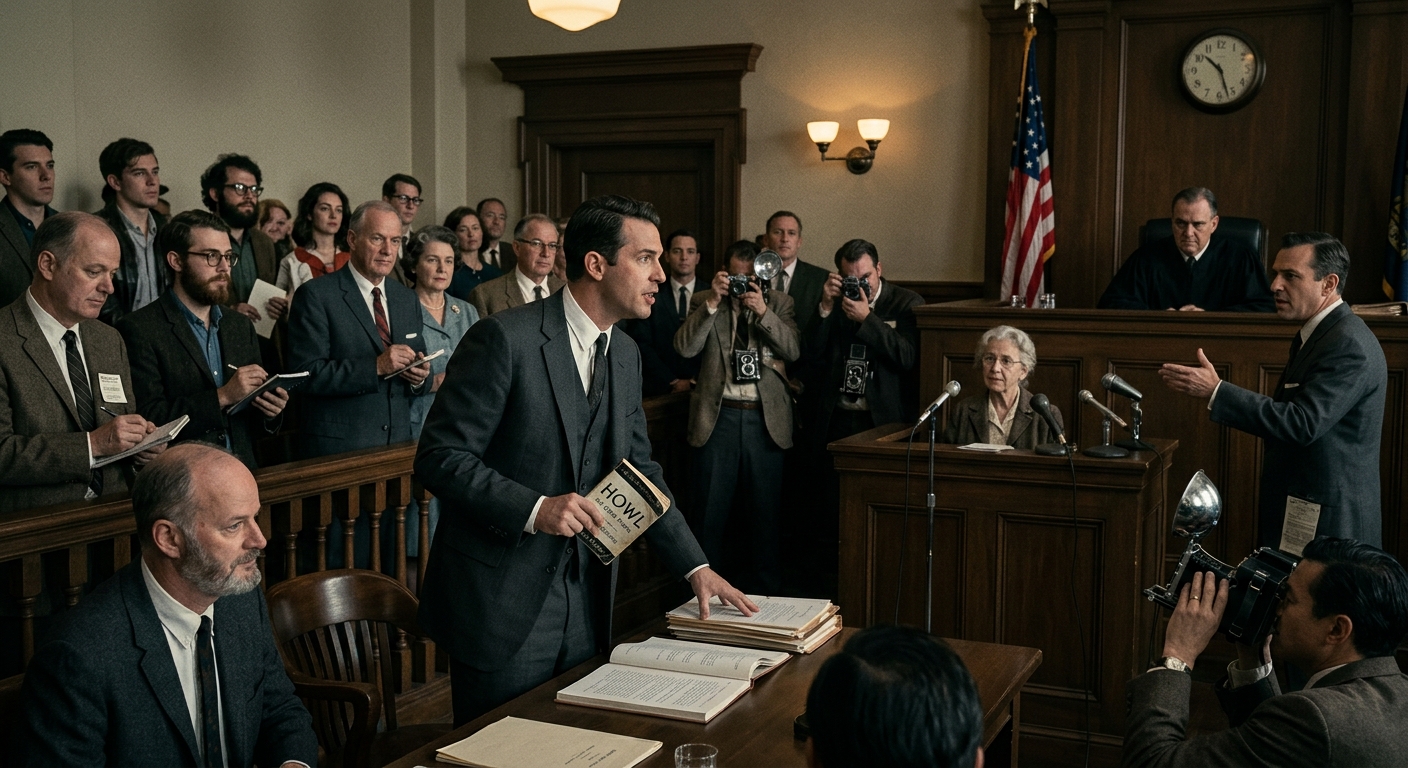
At the absolute forefront of this literary rebellion was Allen Ginsberg, a passionate young poet whose frantic, unvarnished verses would soon ignite one of the most consequential legal battles over freedom of expression in American history. The focal point of this collision between establishment morality and avant-garde literature was Ginsberg’s magnum opus, “Howl.” A sprawling, rhythmic lamentation that tackled themes of spiritual alienation, illicit drug use, anti-capitalism, and explicit homosexuality, the poem was designed to shock the sensibilities of 1950s America. However, the true historical weight of “Howl” was not forged solely on the printed page, but rather inside a San Francisco municipal courtroom in 1957. The ensuing obscenity trial tested the absolute boundaries of the First Amendment, ultimately setting a landmark legal precedent that demolished outdated censorship standards and paved the way for decades of literary and sexual liberation.
The Genesis of a Literary Rebellion
To fully grasp the magnitude of the legal battle that followed, one must first understand the origins and the disruptive nature of the poem itself. Allen Ginsberg composed “Howl” between 1954 and 1955, channeling his intense spiritual quests, his experiences in psychiatric institutions, and the profound struggles of his peers into a breathless incantation. The poem famously opens with the haunting line, “I saw the best minds of my generation destroyed by madness, starving hysterical naked,” which immediately set a tone of urgent defiance against the materialistic, industrialized society he allegorically termed “Moloch.”
In October 1955, Ginsberg performed “Howl” publicly for the first time at the legendary Six Gallery reading in San Francisco. The visceral, deeply emotional reading captivated the audience, signaling the arrival of an uncompromising new literary voice. In attendance that evening was Lawrence Ferlinghetti, a fellow poet and the founder of City Lights Books, a burgeoning independent publisher and local bookstore. Recognizing the profound cultural impact of the work, Ferlinghetti famously sent Ginsberg a telegram echoing Ralph Waldo Emerson’s historic message to Walt Whitman: “I greet you at the beginning of a great career. When do I get the manuscript?”
In the fall of 1956, City Lights Books officially published Howl and Other Poems as the fourth installment of its widely recognized Pocket Poets Series. The collection immediately drew widespread attention, not just for its structural brilliance and rhythmic intensity, but for its incredibly explicit content. In an era when even the subtle suggestion of homosexual activity or illicit drug use was heavily stigmatized and frequently criminalized, Ginsberg’s frank, unapologetic descriptions were viewed by conservative authorities as a direct and dangerous threat to public morality.
The Crackdown: Customs Seizures and Police Arrests
The institutional pushback against Ginsberg’s groundbreaking work was alarmingly swift. The first major attempt at state censorship occurred in early 1957 when the U.S. Collector of Customs in San Francisco seized a large shipment of the books arriving from a commercial printer in England. The federal authorities boldly declared the material obscene and unfit for the American public. Although the federal government eventually dropped its case following public outcry, local municipal authorities eagerly took up the mantle of moral guardianship.
In late May 1957, undercover officers from the San Francisco Police Department’s Juvenile Division entered the City Lights Bookstore and successfully purchased a copy of the controversial collection. Shortly after the purchase, they arrested Shigeyoshi Murao, the bookstore’s manager, for distributing what they deemed obscene material. Lawrence Ferlinghetti, who was out of town visiting Big Sur at the time, voluntarily surrendered to the local police upon his immediate return. Both men faced severe criminal charges under Section 311.3 of the California Penal Code for “willfully and lewdly” printing, publishing, and selling obscene literature.
While the criminal charges against Murao were eventually dropped because municipal prosecutors could not definitively prove he was fully aware of the book’s explicit contents, Ferlinghetti was left to face the full wrath of the legal system. The prosecution, spearheaded by local officials aggressively hoping to “clean up” the city’s independent bookstores, sought to use the highly visible case as a springboard for broader national censorship campaigns. The stage was rapidly set for a highly publicized legal showdown, and the American Civil Liberties Union (ACLU) of Northern California immediately stepped into the fray, posting bail and providing rigorous legal defense for the accused publisher.
The Courtroom Battlefield and the Roth Standard
The trial of The People of the State of California v. Lawrence Ferlinghetti officially commenced in the late summer of 1957, presided over by Municipal Court Judge Clayton W. Horn. Judge Horn, a notably conservative figure who regularly taught Sunday school, initially seemed like an incredibly unlikely champion for a profane, anti-establishment literary manifesto. However, the constitutional legal framework surrounding the concept of obscenity had recently undergone a massive shift that would profoundly influence the trial’s ultimate trajectory.
Earlier that exact same year, the United States Supreme Court had handed down a monumental ruling in the case of Roth v. United States. The Supreme Court decided that while true obscenity was not protected by the First Amendment, the legal definition of what constituted “obscene” material had to meet a highly specific, stringent, and multi-pronged threshold. The newly established Roth test dictated that material could only be legally banned if, to the average person applying contemporary community standards, the dominant theme of the material taken as a whole appealed to prurient interest. Crucially, the Supreme Court added that the work must be “utterly without redeeming social importance.”
This brand-new legal standard immediately became the absolute cornerstone of Ferlinghetti’s defense strategy. The defense team, brilliantly led by young ACLU attorney Albert Bendich and seasoned lawyer Jake Ehrlich, understood a critical legal loophole. They realized they did not need to prove that the poem was polite, comfortable, or appropriate for young children. They simply needed to prove that it held tangible literary value and some degree of social significance.
Establishing “Redeeming Social Importance”
To systematically dismantle the local prosecution’s censorship case, the defense brilliantly transformed the municipal courtroom into a high-level academic literary seminar. They called a long parade of prominent authors, literary critics, and respected university academics to the witness stand to testify under oath to the artistic merits of “Howl.” Experts from prestigious institutions meticulously dissected the poem’s complex structure, its deep historical allusions to classical literature, and its biting, necessary critique of post-war American materialism and spiritual emptiness.
The prosecution desperately countered by aggressively focusing on specific, isolated four-letter words within the text. They attempted to shock Judge Horn by repeatedly reading the sheer vulgarity of the language out of context. However, the defense skillfully argued that all literature must be judged “as a whole,” strictly as mandated by the recent Roth decision. They forcefully posited that Ginsberg’s deliberate use of sexually explicit language was not gratuitous smut designed to artificially arouse prurient interest. Rather, it was a necessary, completely authentic vocabulary required to express the grim, unvarnished reality of the marginalized, impoverished lives he was painstakingly documenting. To artificially sanitize the language, the defense compellingly argued, would be to fundamentally destroy the poem’s inherent artistic truth and its vital social commentary.
The Verdict That Shifted American Culture
On October 3, 1957, Judge Clayton W. Horn delivered a remarkably thorough 39-page judicial verdict that sent immediate shockwaves through both the literary and legal worlds. He firmly ruled that Howl and Other Poems was not legally obscene, thereby fully clearing Lawrence Ferlinghetti of all criminal charges.
In his meticulously crafted decision, Judge Horn heavily emphasized the “redeeming social importance” clause of the Supreme Court’s Roth test. He wisely noted that the first part of the poem presented a harrowing picture of a “nightmare world,” while the second part indicted institutional elements of modern society—namely hyper-materialism and forced conformity—that the author viewed as deeply destructive to human nature. “I do not believe that ‘Howl’ is without redeeming social importance,” Horn wrote in his landmark opinion. He further boldly asserted that an author should be completely free to express their thoughts using the language of their choosing, provided the overall work possesses intrinsic merit. “To act otherwise,” the conservative judge concluded, “would destroy our freedoms of free speech and press.”
The Enduring Legacy of the Trial
The immediate cultural aftermath of the obscenity trial propelled Allen Ginsberg to massive international fame and permanently solidified the Beat Generation as a dominant cultural force in America. The widespread media publicity surrounding the controversial case dramatically increased the nationwide sales of Howl and Other Poems, ironically ensuring that Ginsberg’s scathing critique of American society would be enthusiastically read by millions. Furthermore, the robust legal precedent firmly set by Judge Horn opened the floodgates for the eventual publication of other previously banned literary masterpieces, effectively ending the reign of Victorian-era censorship.
Today, the profound legacy of the “Howl” obscenity trial remains deeply relevant to modern society. As contemporary communities grapple with renewed, aggressive efforts to ban books in public schools and community libraries—frequently targeting marginalized works that explore LGBTQ+ themes, racial injustice, and political dissent—the core constitutional principles defended in that 1957 San Francisco courtroom serve as a vital, enduring reminder. The historic trial firmly established that literature exists to aggressively challenge the comfortable, to amplify the silenced voices of the marginalized, and to reflect the unvarnished truth of the human condition, regardless of how disruptive that truth may be to the prevailing societal status quo.
Key Figures in the 1957 Trial
| Name | Role in the Trial | Significance |
|---|---|---|
| Allen Ginsberg | Author of “Howl” | Composed the controversial poem that explicitly challenged the social and sexual conformity of 1950s America. |
| Lawrence Ferlinghetti | Publisher & Defendant | Owner of City Lights Books who courageously faced criminal obscenity charges for publishing and selling the poem. |
| Clayton W. Horn | Municipal Court Judge | The presiding judge who delivered the landmark verdict declaring the poem was protected by the First Amendment. |
| Albert Bendich | ACLU Defense Attorney | The brilliant legal mind who successfully utilized the Supreme Court’s newly established Roth test to defend the text. |
Frequently Asked Questions (FAQs)
What was the core legal issue in the “Howl” obscenity trial?
The primary legal issue was whether Allen Ginsberg’s poem “Howl” constituted illegal obscenity under California state law. The prosecution argued its explicit sexual references and drug use were a threat to public morality, while the defense successfully argued the work was protected by the First Amendment because it possessed significant literary and social value.
Did Allen Ginsberg himself face criminal charges?
No, Allen Ginsberg was not officially charged in the case. The criminal charges were specifically brought against the individuals who printed, published, and sold the physical book. Consequently, Lawrence Ferlinghetti, the publisher and owner of City Lights Bookstore, became the primary defendant.
Why was the Roth v. United States decision so important to this case?
Decided earlier in 1957, the Supreme Court case Roth v. United States established a new federal standard for evaluating obscenity. It stated that a work could not be banned simply for containing offensive words; the work had to be judged “as a whole” and must be “utterly without redeeming social importance” to be censored. The defense used this exact standard to clear Ferlinghetti.
How did the “Howl” verdict affect modern literature?
The non-guilty verdict drastically diminished the power of local authorities to censor books based on isolated explicit words. It created a robust legal shield for authors and publishers, directly paving the way for the open publication of avant-garde literature and significantly advancing the sexual liberation movement in American publishing.
References
- Banned Books Week Exclusive: The Howl obscenity trial opinion — Foundation for Individual Rights and Expression (FIRE). 2017-09-28. https://www.thefire.org/research-learn/banned-books-week-exclusive-howl-obscenity-trial-opinion
- A Howl of Free Expression: the 1957 Howl Obscenity Trial and Sexual Liberation — Portland State University / Jamie L. Rehlaender. 2015-04-28. https://pdxscholar.library.pdx.edu/younghistorians/2015/oralpres/1/
- Facial Hair Friday: Allen Ginsberg — National Archives and Records Administration / Thomas Richardson. 2021-06-04. https://prologue.blogs.archives.gov/2021/06/04/facial-hair-friday-allen-ginsberg/
Similar Articles








Read full bio of medha deb


