
Gift Card Survey Scams: 5 Warning Signs And How To Stay Safe
Learn how survey-based gift card scams work and how to avoid losing money or personal data.
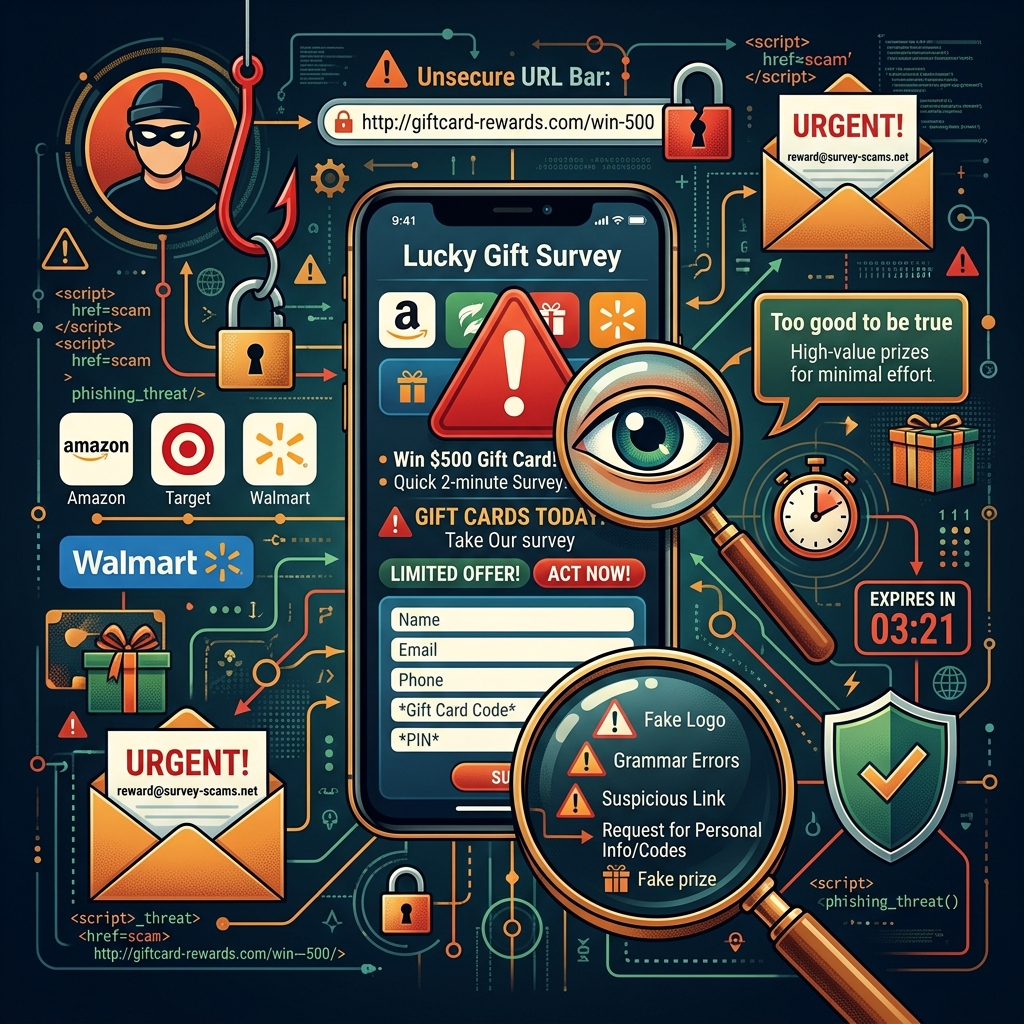
Fake survey promotions that promise a free gift card are a common scam tactic because they look harmless, urgent, and familiar. The real goal is often to collect credit card details, login credentials, or enough personal information to commit identity theft, not to reward you with anything valuable.
Why these offers are so effective
Scammers know that gift cards feel like a small, low-risk reward. A message that mentions a favorite retailer, a popular brand, or a limited-time prize can lower a person’s guard long enough to get a click. Once the target engages, the scam may ask for a survey response, a shipping fee, or sensitive information that can be used for fraud.
These offers are persuasive because they borrow the language of legitimate marketing. Real companies do use surveys and rewards programs, but fraudsters imitate the format and add pressure, such as deadlines, “only a few left” language, or claims that the offer is exclusive. That combination is designed to keep people from pausing to verify the source.
How the scam usually works
Although the details vary, many of these schemes follow the same pattern. A message arrives by email, text, social media, or a pop-up ad and claims the recipient can receive a free gift card after completing a short survey. In some cases, the victim is asked to pay a small shipping charge or enter card details to “confirm eligibility.”
After the person clicks through, the site may ask for contact details, credit card information, or other personal data. Some versions use fake order confirmations or fake voucher codes, while others direct people to lookalike websites that resemble a trusted retailer. In every version, the message is engineered to extract value from the victim while providing nothing real in return.
Common warning signs
Several clues can help separate a real promotion from a scam. One of the strongest warning signs is a request for personal or financial information that does not belong in a simple survey. Another is a promise of a valuable reward for very little effort, especially when the message is unexpected.
- Unexpected contact: The offer appears without any prior relationship or registration.
- Urgent language: The message pushes you to act quickly before the reward “expires.”
- Requests for sensitive data: The survey asks for credit card details, security codes, or identity-related information.
- Suspicious links: The web address does not match the retailer’s official domain or uses a lookalike variation.
- Small payment request: A “shipping fee” or “processing charge” appears even though the gift is supposedly free.
What legitimate companies do differently
Reputable businesses may ask customers to complete surveys, but they typically do not demand payment information for a no-cost reward. If a promotion is authentic, it should be easy to verify through the company’s own website, customer service line, or official app. Scamwatch specifically advises checking any offer against the retailer’s official channels rather than trusting the message itself.
That verification step matters because scammers often disguise fake pages as genuine brand pages. A message can be copied, a logo can be reused, and even a phone number can be fake. The safest approach is to ignore the embedded contact details and independently locate the company’s official contact information before responding.
How to protect your personal and financial information
The best defense is to slow down before clicking or replying. If an offer seems unusually generous, treat it as suspicious until you can confirm it through a trusted source. Consumers are safer when they avoid opening unknown attachments, entering information on unfamiliar forms, or paying fees for a prize that should be free.
| Risky behavior | Safer alternative |
|---|---|
| Clicking the link in the message | Visit the company’s official website directly |
| Entering card details to claim a reward | Refuse any offer that requires payment for a free gift |
| Using contact details in the message | Find the official customer-service number independently |
| Rushing because of a deadline | Pause and verify before taking any action |
If you are unsure whether an offer is real, search for the retailer’s official promotions page or contact its customer service team through a number or address you already know is legitimate. Avoid calling a number or opening a link that came from the message itself, because the scam may route you to a fake website or a fake call center.
What to do if you already responded
If you entered banking details, card numbers, or other sensitive information, contact your financial institution immediately. Quick action can help reduce unauthorized charges or limit further access to your account.
If you shared gift card numbers or PINs, treat the funds as compromised and report the incident right away. The FTC advises consumers to report gift card scams to the company that issued the card and then to the FTC complaint system.
- Contact your bank or card issuer immediately if payment details were provided.
- Change passwords if you used the same login on another site.
- Keep records of emails, texts, receipts, and screenshots.
- Report the scam to the appropriate consumer protection agency or complaint portal.
Why gift cards are often used in scams
Gift cards are attractive to scammers because they can be redeemed quickly and are difficult to reverse once the code is exposed. The FTC says that if someone tells you to pay with a gift card, that is a scam, plain and simple. Although the topic here is survey fraud, many fake offer schemes eventually lead to gift card misuse or other payment scams.
That is why consumers should treat gift cards as cash and protect the numbers on the back of the card with the same care they would use for a debit card PIN. Once those numbers are shared, it can be difficult to recover the loss.
Practical habits that reduce scam risk
Good habits make a major difference. A few simple routines can help prevent most gift card survey scams from succeeding.
- Ignore offers that arrive out of the blue.
- Verify any promotion through the brand’s official website.
- Never pay to receive a supposedly free prize.
- Do not share security codes, passwords, or gift card numbers.
- Read the website address carefully before entering information.
- Use two-factor authentication on important accounts whenever possible.
These habits matter because many scams rely on split-second decisions. If you create a pause between receiving the message and taking action, you give yourself time to notice problems that would otherwise be missed.
When a survey might be legitimate
Not every survey is fraudulent. Some retailers, credit unions, and service providers offer feedback forms to improve customer experience, and they may offer small rewards or sweepstakes entries. The difference is that legitimate programs usually come from an official domain, explain the rules clearly, and do not pressure you to provide unnecessary sensitive information.
A real survey invitation should be easy to verify. If the company truly wants your feedback, the invitation should be traceable to the business’s own channels, and the reward structure should be transparent. If any part of the message feels inconsistent, it is safer to step away and verify independently.
FAQs
Are all free gift card offers scams?
No. Some legitimate companies run surveys, contests, or loyalty programs that include gift cards. The important question is whether the offer can be verified through official channels and whether it asks for inappropriate information or payment.
What is the biggest red flag?
The biggest red flag is any request for personal or financial information that is not necessary for a simple survey, especially if the offer is tied to urgency or a prize that feels unusually generous.
Should I click the link if the brand looks familiar?
No. Scammers often impersonate well-known brands. Go directly to the company’s official website instead of using the link in the message.
What should I do if I already gave out my card number?
Contact your bank or card issuer immediately, monitor your accounts closely, and report the scam to the relevant consumer protection authorities.
Can scammers use survey pages to steal more than money?
Yes. They may try to collect names, addresses, login credentials, or enough data to support identity theft and account takeover.
Closing advice for consumers
Fake gift card surveys work because they combine a friendly reward with pressure and misinformation. If a message asks you to give up personal data, click a suspicious link, or pay a fee for something free, treat it as a likely scam and verify it through official company channels before doing anything else.
References
- Beware of scam surveys and fake free offers — Scamwatch. 2024-01-01. https://www.scamwatch.gov.au/about-us/news-and-alerts/beware-of-scam-surveys-and-fake-free-offers
- Gift Card Scams & Fraud Protection — Lowe’s. 2025-01-01. https://www.lowes.com/l/about/gift-card-scams
- Watch Out for Free Gift Scams — Elevate Credit Union. 2025-01-01. https://elevatecu.com/blog/watch-out-for-free-gift-scams
- Report Gift Cards Used in a Scam — Federal Trade Commission. 2024-01-01. https://www.ftc.gov/media/70967
- Avoiding and Reporting Gift Card Scams — Federal Trade Commission. 2024-01-01. https://consumer.ftc.gov/articles/avoiding-and-reporting-gift-card-scams
Similar Articles








Read full bio of Sneha Tete


