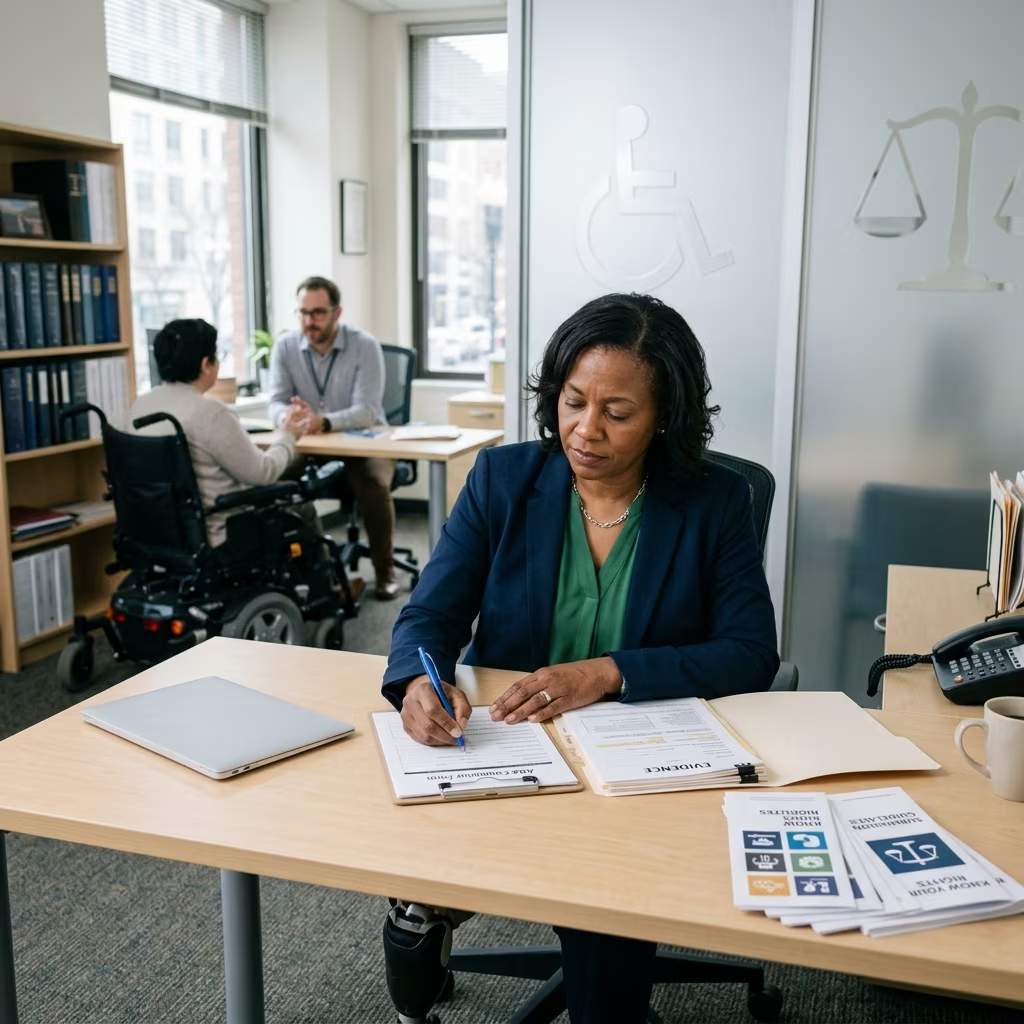
People with disabilities are protected by strong civil rights laws, including the Americans with Disabilities Act (ADA) and related federal and state statutes. When those rights are violated, filing a formal complaint is often the most effective way to seek remedies, prevent future violations, and help enforce disability protections nationwide. This guide explains how to recognize disability discrimination, choose the right enforcement agency, and prepare a clear, effective complaint.
Understanding Disability Rights and Legal Protections
Disability civil rights laws prohibit discrimination in employment, public services, transportation, housing, and businesses that serve the public. These laws generally require covered entities to provide equal access, reasonable accommodations, and non-discriminatory policies.
Key federal laws include:
- Americans with Disabilities Act (ADA) – Prohibits discrimination in employment (Title I), state and local government programs (Title II), and places of public accommodation such as businesses and nonprofit service providers (Title III).
- Section 504 of the Rehabilitation Act of 1973 – Applies to entities receiving federal financial assistance, including many schools, hospitals, and transit agencies.
- Fair housing and transportation laws – Other statutes prohibit disability discrimination in housing and air travel, enforced by specialized federal agencies.
States and local governments often have additional civil rights laws and human rights commissions that provide protections beyond federal minimums.
Recognizing Disability Discrimination and Access Problems
Not every disagreement or inconvenience is a legal violation. However, certain patterns clearly signal possible disability discrimination or failure to comply with disability access requirements.
Common examples of disability discrimination
- Refusing to hire, promote, or fairly pay a qualified worker because of a disability or perceived disability.
- Denying reasonable workplace accommodations, such as modified schedules, assistive technology, or accessible workspace, without an individualized assessment.
- Refusing service in a restaurant, store, hotel, or doctor’s office to a person with a disability or their service animal.
- Charging extra fees or imposing special conditions on customers with disabilities.
- Failing to provide accessible entrances, restrooms, websites, or communication methods where the law requires them.
- Excluding students from school programs or activities because of disability, or refusing necessary educational supports.
Access issues and abuse or neglect
In addition to discrimination, people with disabilities may face barriers to services or experience abuse.
- Access barriers include missing ramps or elevators, inaccessible transit stops, lack of captioning or sign language interpreters, and inaccessible digital content.
- Abuse or neglect should be reported promptly to the appropriate state social services or protective services agency.
Understanding the type of problem is essential because it determines which complaint process and agency will be appropriate.
Choosing the Right Agency for Your Complaint
Different agencies enforce disability rights in different settings. Filing with the correct agency can speed up review and increase the chances of meaningful action.
| Issue Type | Typical Covered Entity | Primary Federal Agency |
|---|---|---|
| Employment (hiring, firing, workplace | Private employers, state and local government employers | Equal Employment Opportunity Commission (EEOC). |
| Access to state or local government programs | Public schools, public hospitals, city services | Department of Justice (DOJ), Civil Rights Division, or appropriate federal funding agency. |
| Places of public accommodation | Private businesses open to the public: restaurants, hotels, shops, medical offices | DOJ, Civil Rights Division, ADA complaint process. |
| Housing | Landlords, property management, housing providers | Department of Housing and Urban Development (HUD). |
| Air travel | Airlines and airports | Department of Transportation (DOT). |
| Public transportation | Transit authorities, bus and rail operators | Federal Transit Administration Office of Civil Rights. |
In many cases, it is also possible to file complaints with state civil rights or human rights commissions in addition to federal agencies, which can offer local enforcement and remedies.
Preparing to File a Disability Rights Complaint
Strong complaints are organized, fact-based, and supported by documentation. Before you submit anything, assemble the information you will need and confirm deadlines.
Gathering evidence and documentation
Collecting relevant records can significantly strengthen your complaint because enforcement agencies depend on clear facts to evaluate claims.
- Medical documentation showing your disability and functional limitations, when relevant.
- Correspondence such as emails, letters, text messages, or notes of conversations with supervisors, landlords, business owners, or officials.
- Policies and forms including employee handbooks, written rules, applications, or notices describing practices that affect people with disabilities.
- Incident notes detailing dates, times, locations, people involved, and what exactly happened.
- Photographs or videos demonstrating access barriers or discriminatory treatment, where safe and lawful to obtain.
- Witness statements from coworkers, family members, or others who observed the events.
Organize these materials chronologically, and prepare a short timeline summarizing major events. This makes it easier for investigators to understand your case.
Key information to include in any complaint
Regardless of where you file, your complaint should answer several core questions:
- Who is filing the complaint (your name, contact information, and whether you are filing on behalf of someone else).
- Who is the respondent (the employer, business, government agency, housing provider, or other entity).
- What is your disability and how it is relevant to the situation.
- What happened, step by step, including dates, locations, and specific actions or decisions.
- Which rights you believe were violated (for example, denial of reasonable accommodation or exclusion from a service).
- What outcome you are seeking (policy changes, accommodation, reinstatement, financial compensation, or corrective actions).
Providing clear, factual details helps agencies determine whether legal violations likely occurred and what type of response is appropriate.
How to File an ADA Complaint with the Department of Justice
For many non-employment issues involving state or local governments or private businesses that serve the public, people can file ADA complaints with the Department of Justice (DOJ) Civil Rights Division.
Who can file and when
- Individuals who believe they were discriminated against based on disability.
- People filing on behalf of someone else, such as family members or advocates.
- Complaints should be filed as soon as reasonably possible after the discriminatory event; while some laws have specific deadlines, prompt filing generally improves investigation prospects.
Filing methods
DOJ provides multiple options to submit ADA complaints.
- Online submission – Through the DOJ Civil Rights Division ADA complaint portal, where you fill out a form describing the incident and upload supporting documents.
- Mail or fax – Using printed complaint forms or written letters with all required information.
- Assistance – You may ask a trusted person to help write or submit the complaint if you have difficulty communicating in writing.
What happens after you file
Once DOJ receives your complaint, staff review it to determine whether it falls within their enforcement authority and whether further action is warranted.
- They may open an investigation, request additional information, or decline to pursue the matter based on priorities and evidence.
- Some complaints are referred to other agencies better suited to handle the issue.
- DOJ may use mediation through its ADA Mediation Program to resolve disputes voluntarily between complainants and entities.
If you have not received a response after several months, DOJ provides an ADA Information Line you can call to check the status of your complaint.
Filing Employment Disability Complaints with EEOC
When disability discrimination occurs in employment, including hiring, promotion, pay, job assignments, or reasonable accommodations, the Equal Employment Opportunity Commission (EEOC) is typically the primary federal enforcement agency.
Examples of employment-related complaints
- A qualified applicant is rejected solely because of a disclosed disability.
- An employee is denied a reasonable accommodation and later disciplined for performance issues linked to that denial.
- Harassment or hostile work environment based on disability.
- Retaliation after requesting accommodations or complaining about disability discrimination.
How to file with EEOC
While procedures vary somewhat by region, typical steps include:
- Contacting EEOC via its online intake system, by mail, or in person to begin the charge process.
- Providing detailed information about your employer, your job, and what occurred.
- Signing a formal charge of discrimination, which is the official document EEOC investigates.
Deadlines for employment complaints are usually short (often measured in months), so it is important to act quickly after discriminatory events.
Other Common Disability Complaint Paths
Beyond DOJ and EEOC, several federal agencies handle specialized disability complaints, particularly in housing, transportation, and federally funded programs.
Housing discrimination
- Issues may include denial of housing, refusal to allow reasonable modifications, or discriminatory rules targeting people with disabilities.
- Complaints related to disability-based housing discrimination are generally filed with the Department of Housing and Urban Development (HUD) under fair housing laws.
Transportation access
- The Federal Transit Administration (FTA) Office of Civil Rights monitors ADA compliance for public transportation providers and enforces Section 504 requirements.
- Transit riders can submit rider complaint forms to raise concerns about inaccessible vehicles, stops, or discriminatory practices.
Air travel and airlines
- Disability-related complaints about airlines, such as lack of wheelchair assistance or damaged mobility devices, are filed with the Department of Transportation (DOT).
State and Local Disability Rights Complaint Options
In addition to federal enforcement, many states have human rights or civil rights commissions that investigate disability complaints. Filing at multiple levels can create complementary avenues for relief.
State agencies may provide:
- Local investigations and hearings.
- Education and technical assistance for businesses and public agencies.
- Alternative dispute resolution or mediation.
Because procedures vary by jurisdiction, it is helpful to review your state’s civil rights or human rights commission resources for disability-specific complaint information.
Internal Grievance Processes with Disability Advocacy Organizations
Sometimes the complaint is not against an employer or business, but against the disability advocacy organization or protection and advocacy agency itself. Many such organizations have formal grievance procedures that allow clients to challenge decisions or services.
Although these internal grievance processes do not enforce federal law in the same way as DOJ or EEOC, they provide an important mechanism for accountability and service improvement.
Typical features of internal grievance procedures
- Written grievance forms or letters submitted within a specified time after a decision or action.
- Options to request help from staff or trusted individuals to write grievances or file them verbally when written communication is difficult.
- Review by supervisors or legal directors with written decisions issued within set timelines (for example, 10–15 business days).
- Appeal rights to executive directors and boards of directors when complainants disagree with initial decisions.
These processes are important for ensuring disability rights organizations themselves remain responsive and fair to the communities they serve.
Tips for Writing an Effective Disability Complaint
Regardless of where you file, well-drafted complaints are easier to investigate and more likely to result in meaningful remedies.
Best practices
- Be clear and concise – Focus on the key facts, avoiding unnecessary detail that may obscure main points.
- Use a chronological structure – Describe events in the order they occurred, using dates whenever possible.
- Connect facts to legal rights – Explain how specific actions (such as refusal of accommodation) conflict with disability rights obligations.
- Include documentation references – Mention relevant emails, letters, or photos and attach copies when permitted.
- State your requested remedy – Clarify what you hope will happen (policy change, reinstatement, accessibility improvements, or other outcomes).
Common pitfalls to avoid
- Submitting complaints without contact information, making it difficult for agencies to follow up.
- Missing filing deadlines, particularly for employment claims.
- Making only general accusations without specific facts or examples.
- Sending complaints to agencies that do not have jurisdiction over the type of entity or issue.
Frequently Asked Questions (FAQs)
1. Do I need a lawyer to file a disability rights complaint?
You generally do not need a lawyer to file an administrative complaint with agencies like DOJ, EEOC, HUD, or state civil rights commissions. Many agencies provide forms designed for self-represented individuals and sometimes offer staff assistance. However, consulting an attorney can be helpful, especially if you are considering a lawsuit in addition to administrative remedies.
2. Can someone file a complaint on behalf of another person with a disability?
Yes. Complaints may often be filed by family members, advocates, or organizations on behalf of individuals affected by discrimination, particularly where the person has difficulty communicating or navigating complaint systems. It is important to clearly state the relationship and confirm consent whenever possible.
3. What if my complaint involves both employment and public access issues?
Complex situations can involve multiple laws and agencies. For example, a government employee may face workplace discrimination and also experience barriers to public services. In such cases, you may need to file with more than one agency—for instance, EEOC for employment issues and DOJ for access to government programs.
4. How long does it take for agencies to respond to complaints?
Timelines vary widely. Some organizations issue internal grievance decisions within 10–15 business days. Federal agencies may take months to review ADA complaints, and DOJ encourages complainants to call the ADA Information Line if they have not heard back after several months. Large investigations can take much longer.
5. What if my complaint is not accepted or I disagree with the outcome?
Agencies may decline to take action for a variety of reasons, including limited resources, jurisdictional limits, or insufficient evidence. In many systems, you can request reconsideration or appeal within the agency, and you may also explore other options such as state civil rights commissions or private legal representation. Internal grievance procedures at disability organizations often provide multiple levels of appeal, up to boards of directors.
Key Takeaways
- Federal and state laws provide broad protections against disability discrimination in employment, public programs, housing, transportation, and businesses.
- Choosing the correct agency—EEOC, DOJ, HUD, DOT, FTA, or state commissions—is crucial to effective complaint filing.
- Strong complaints rely on clear facts, supporting documentation, and timely filing.
- Internal grievance procedures within disability advocacy organizations add an important layer of accountability for services provided to people with disabilities.
- People with disabilities and their allies play a vital role in enforcing civil rights laws by filing complaints and reporting abuse or access barriers.
References
- Your rights under the Americans with Disabilities Act (ADA) — USAGov. 2024-02-22. https://www.usa.gov/disability-rights
- File a Complaint — ADA.gov, U.S. Department of Justice. 2024-03-01. https://www.ada.gov/file-a-complaint/
- Disability Rights Section — Civil Rights Division, U.S. Department of Justice. 2023-08-10. https://www.justice.gov/crt/disability-rights-section
- Complaint Process — Northwest ADA Center (ADANW). 2022-09-15. https://nwadacenter.org/toolkit/complaint-process
- Grievance Procedure — Disability Rights South Carolina. 2022-05-05. https://www.disabilityrightssc.org/about/grievance-procedure/
- Grievance Form — Disability Rights Oregon. 2021-11-30. https://www.droregon.org/grievance-form