
How to File a Civil Rights Complaint with the DOJ
A step-by-step guide to reporting civil rights violations to the U.S. Department of Justice and understanding what happens next.
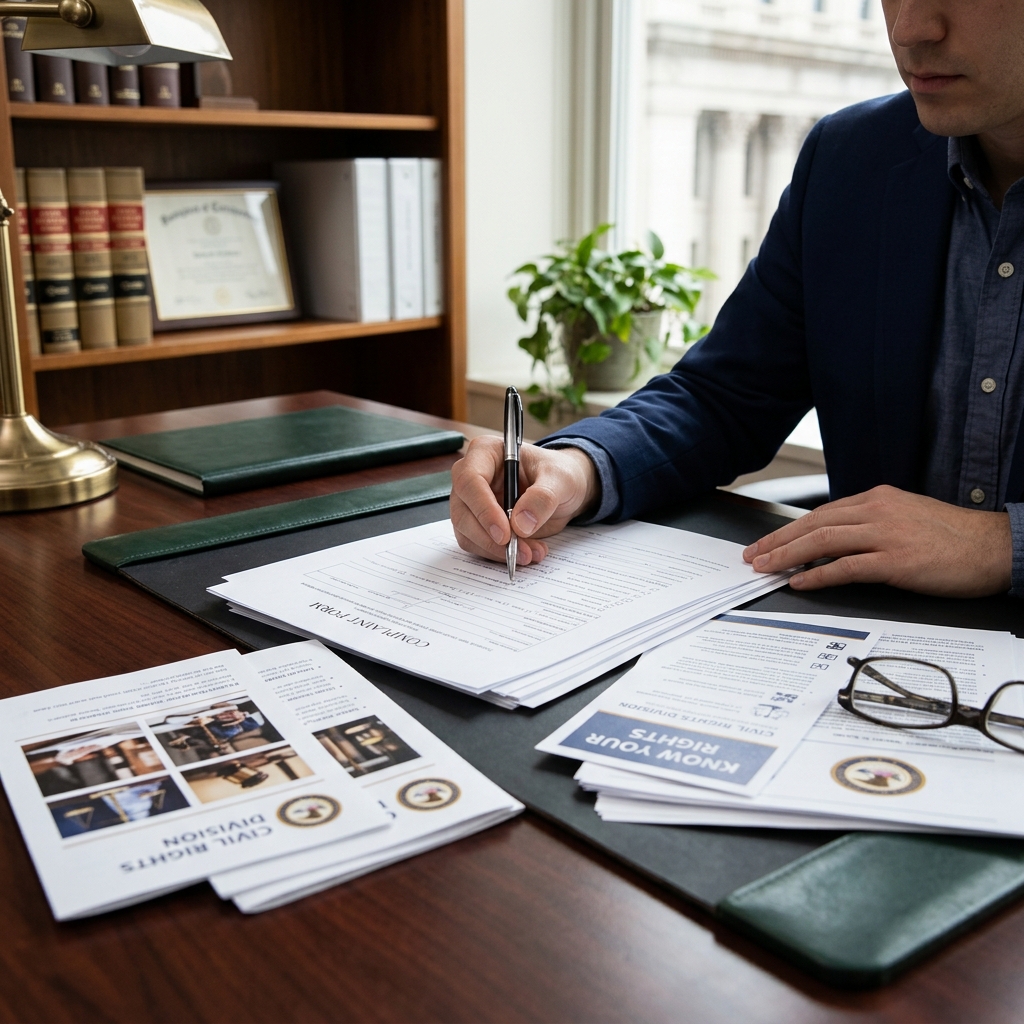
Civil rights laws protect people in the United States from unfair treatment based on protected characteristics and from interference with fundamental rights like voting, access to housing, education, and public services. When you believe those rights have been violated, you can submit a complaint to the U.S. Department of Justice (DOJ) so that the government can review and, when appropriate, enforce federal civil rights laws.
This guide explains, in plain language, how to prepare and file a civil rights complaint with the DOJ, what information you should gather, how your complaint is handled, and how this process relates to other civil rights enforcement agencies.
Understanding Civil Rights Complaints
A civil rights complaint is a written allegation that someone has violated your rights protected by federal civil rights statutes, regulations, or certain constitutional provisions. The DOJ’s Civil Rights Division enforces more than thirty different federal laws covering areas such as law enforcement misconduct, voting rights, disability rights, housing discrimination, hate crimes, and equal access to public facilities.
Not every unfair situation is a civil rights violation under federal law. Before filing, it is helpful to consider whether your experience falls into one of the common categories below.
Common Types of Civil Rights Issues Reported to DOJ
- Law enforcement misconduct involving excessive force, discriminatory policing, or unlawful detention
- Hate crimes where violence or threats are motivated by race, religion, national origin, sexual orientation, gender, gender identity, or disability
- Voting rights problems, such as barriers to voter registration, translation assistance, accessible polling places, or equal opportunity to cast a ballot
- Disability rights violations affecting access to government services, transportation, public spaces, or communications
- Language access issues in programs that receive federal funding and must provide meaningful access for people with limited English proficiency
- Discrimination by entities receiving federal funds in education, health care, or other programs subject to civil rights obligations
The DOJ will review complaints to determine whether they fall within the Civil Rights Division’s authority or another federal agency’s jurisdiction, such as the Department of Health and Human Services (HHS) for health programs or the Office for Civil Rights in the Office of Justice Programs for certain grant-funded entities.
Step 1: Prepare Before You File
Taking time to organize your information before you submit a complaint makes it easier for the DOJ or another civil rights agency to understand what happened and decide how to respond. Other civil rights offices, such as state and federal human rights agencies, strongly recommend collecting key details before filing.
Information You Should Gather
It is helpful to assemble the following items in advance:
- Basic personal information
- Your full legal name
- Current mailing address
- Phone number and email address
- Details about what happened
- Dates and approximate times of each incident
- Locations (address or description of where the events occurred)
- A clear, chronological description of events: who did what, when, and how
- Information about the person or entity you are reporting
- Names, titles, and contact information of individuals involved
- Official name and address of any agency, business, or organization
- Why you believe this is a civil rights issue
- Which characteristic or right you believe is involved (for example, race, disability, language access, voting, religion)
- Facts that suggest the treatment was discriminatory or violated a specific civil right
- Supporting documents and evidence
- Emails, letters, text messages, or social media posts
- Policies, forms, notices, or official documents
- Photographs, recordings, or physical evidence
- Names and contact information of any witnesses
Several civil rights agencies emphasize the importance of providing specific facts, documentation, and witness details so that investigators can assess jurisdiction and the strength of the allegations.[10]
Time Limits and Why They Matter
Federal and state civil rights laws usually require complaints to be filed within a set period after the last alleged violation. These deadlines are often called statutes of limitations. While exact timelines depend on the law and agency, many offices urge people to report as soon as possible to avoid missing important rights.
| Agency | Area | Typical Deadline (from last incident) |
|---|---|---|
| Colorado Civil Rights Division | Employment | 300 days |
| Colorado Civil Rights Division | Housing | 1 year |
| New York Division of Human Rights | Most discrimination occurring after Feb. 15, 2024 | 3 years |
| New York Division of Human Rights | Older workplace sexual harassment cases | 3 years |
Although the DOJ’s Civil Rights Division may have different deadlines depending on the statute involved, these examples illustrate why acting promptly and keeping track of dates is critical.
Step 2: Decide Where to File Your Complaint
The DOJ is a central civil rights enforcer, but it is not the only place to report a violation. In some situations, another agency might be better suited to handle your complaint or will need to be contacted first. For example:
- Employment discrimination is generally addressed by the Equal Employment Opportunity Commission (EEOC) or comparable state agencies.
- Discrimination in health programs or hospitals is usually handled by the HHS Office for Civil Rights.
- Discrimination by entities receiving Justice Department grants can be investigated by the Office for Civil Rights within the Office of Justice Programs.
- State and local civil rights issues may fall under state civil or human rights agencies.[10]
If you are unsure which office is appropriate, you can still submit a complaint to the DOJ. Your report will typically be reviewed and, if necessary, referred to a federal or state agency with the proper authority.
Step 3: How to File a Complaint with the DOJ
The DOJ provides a public reporting system that allows individuals to submit civil rights complaints online and by mail. The official purpose of this system is to make it easier for members of the public to notify the department of possible civil rights violations and support enforcement of federal law.
Online Submission
The primary way to report a civil rights issue is through the DOJ’s online civil rights reporting form. Through this form, you can submit information directly to the Civil Rights Division, which then routes your complaint internally or to appropriate partners.
When using an online form—whether with the DOJ or other offices—you should be prepared to:
- Answer questions about yourself and your contact information
- Identify the person, organization, or agency you are complaining about
- Describe each incident of discrimination or rights violation in detail
- Explain why you believe the conduct is discriminatory or violates a civil right
- Upload or later submit any supporting documents or evidence[10]
Submitting by Mail
The DOJ also accepts complaints and comments by mail. Official instructions for contacting the Civil Rights Division include a mailing address in Washington, D.C., where individuals can send written complaints and other information.
When sending a paper complaint, clearly print your contact information and a detailed description of the events. If possible:
- Include photocopies (not originals) of important documents
- Number or label pages to keep your narrative organized
- Sign and date your letter or form, as many civil rights offices require a signed complaint to proceed.
Step 4: What Happens After You File
After you submit a civil rights complaint, your information enters an administrative process that may vary depending on the DOJ component or partner agency handling the matter. However, most civil rights enforcement systems follow similar stages.
Initial Review and Intake
Many agencies use an intake process to determine whether your complaint:
- Is filed within the required time limits[10]
- Falls within the agency’s jurisdiction (the type of discrimination and type of respondent)
- Includes enough specific facts to support a potential violation (often called a prima facie basis)[10]
For example, the Maryland Commission on Civil Rights describes intake as a multi-step process that reviews basic criteria, checks jurisdiction, conducts an interview, and, if appropriate, drafts a formal charge.[10] The DOJ’s Civil Rights Division similarly uses submitted information to decide whether to open an investigation, refer the matter, or take another action.
Possible Outcomes of Your Complaint
Once your complaint is reviewed, several outcomes are possible:
- Investigation — If the issue appears to fall within civil rights laws enforced by the DOJ or a partner agency, officials may open an investigation. Investigations often involve requests for documents, interviews, and policy review.
- No action or referral — If the matter does not involve federal civil rights laws or is better handled elsewhere, the DOJ may decline to act directly but refer you to another agency, such as the EEOC, HHS, or state civil rights offices.
- Technical assistance — In certain cases, agencies may provide guidance to organizations to help them comply voluntarily with civil rights requirements rather than immediately pursue enforcement.
- Formal enforcement — When investigations uncover significant violations, the DOJ or other agencies may enter into settlement agreements, require corrective action, or, where authorized, bring enforcement proceedings.
Some civil rights offices publish timelines for their administrative processes. For example, Colorado’s Civil Rights Division notes that it generally has 450 days to complete its administrative process after a formal complaint is filed. While DOJ timelines may differ, this illustrates that investigations can take months or longer.
Step 5: Your Role During the Process
Filing a complaint is usually the beginning of a process, not the end. Complainants are often asked to stay engaged and responsive. To help your case move forward:
- Respond promptly to requests for additional information or documents
- Update the agency if your contact information changes
- Keep copies of all correspondence you send and receive
- Maintain organized records of incidents and evidence
Some agencies, including state civil rights departments, allow complainants to submit rebuttals to information provided by the respondent or to appeal certain decisions. The DOJ’s processes differ by program, but staying involved and informed is important in any civil rights complaint.
Accessibility and Language Assistance
Civil rights enforcement systems are intended to be accessible. While specific accommodations vary by agency, many offices:
- Provide telephone assistance and call centers for people who prefer or need to file by phone
- Offer reasonable accommodation for disabilities, including accessible formats and communication support[10]
- Work with relay services for people who are deaf or hard of hearing
- Provide translation or interpretation services for individuals with limited English proficiency
If you need accommodations or language support, indicate this in your complaint or contact the agency directly. Doing so early can help ensure you are able to participate fully in the process.
Frequently Asked Questions (FAQs)
1. Do I need a lawyer to file a civil rights complaint?
No. You generally do not need a lawyer to submit a complaint to the DOJ or other civil rights agencies. Many people file complaints on their own using online forms or written submissions. However, if you are considering a private lawsuit or have complex legal questions, you may wish to consult an attorney for independent advice.
2. Can I file anonymously?
Most civil rights reporting systems require your contact information so officials can follow up and determine whether they can act on the complaint. In addition, some enforcement actions may not be possible without a known complainant. You can, however, ask how your identity will be protected and whether it will be shared beyond the enforcement agency.
3. What if my complaint is about employment discrimination?
Employment discrimination is usually handled first by the EEOC or state-level civil rights agencies that focus on workplace rights. You can still report concerns to the DOJ, but you may be directed to file a charge of discrimination with the EEOC or the appropriate state agency, which has specialized procedures and deadlines for workplace cases.
4. Will filing a complaint affect my immigration status?
Civil rights agencies generally focus on whether a violation of law occurred, not immigration enforcement. While personal circumstances can be complex, people are encouraged to report discrimination regardless of status. If you have concerns, consider discussing them confidentially with a legal services provider or advocacy group before filing.
5. How long will the process take?
There is no single timeline. Some complaints are quickly referred or closed, while others lead to extended investigations and negotiations. As an example of an administrative civil rights process, one state division estimates up to 450 days for its complaint handling. Federal DOJ matters can vary widely based on complexity, resources, and legal requirements.
6. Can I file multiple complaints about the same issue?
In certain circumstances, you may report the same facts to more than one agency, especially if the issue affects different rights or falls under different laws. However, you should clearly explain if you have already filed elsewhere and avoid submitting duplicate information without updates, which can slow review.
7. What should I do if the problem is urgent or ongoing?
If the situation involves immediate danger, threats of violence, or a crime in progress, you should contact local law enforcement or emergency services. For ongoing civil rights concerns, filing a complaint as soon as possible can help agencies assess whether urgent intervention or additional steps are appropriate.
References
- Contact the Department of Justice to report a civil rights violation — U.S. Department of Justice, Civil Rights Division. 2023-08-01. https://civilrights.justice.gov/report/
- Filing a Civil Rights Complaint — U.S. Department of Health and Human Services, Office for Civil Rights. 2023-06-15. https://www.hhs.gov/civil-rights/filing-a-complaint/index.html
- Filing a Civil Rights Complaint — Office for Civil Rights, Office of Justice Programs, U.S. Department of Justice. 2022-11-30. https://www.ojp.gov/program/civil-rights-office/filing-civil-rights-complaint
- The Complaint Process — Colorado Civil Rights Division, Department of Regulatory Agencies. 2024-02-20. https://ccrd.colorado.gov/the-complaint-process
- Report Discrimination — New York State Division of Human Rights. 2024-04-10. https://dhr.ny.gov/report
- Complaint Process — Civil Rights Department, State of California. 2023-09-05. https://calcivilrights.ca.gov/complaintprocess/
- Intake Process — Maryland Commission on Civil Rights. 2023-05-12. https://mccr.maryland.gov/complaint-investigative-process/intake-process
Similar Articles








Read full bio of Sneha Tete


