
How Police Investigations Really Work: 8 Key Stages Explained
A clear guide to how law enforcement gathers facts, builds cases, and works toward charges.
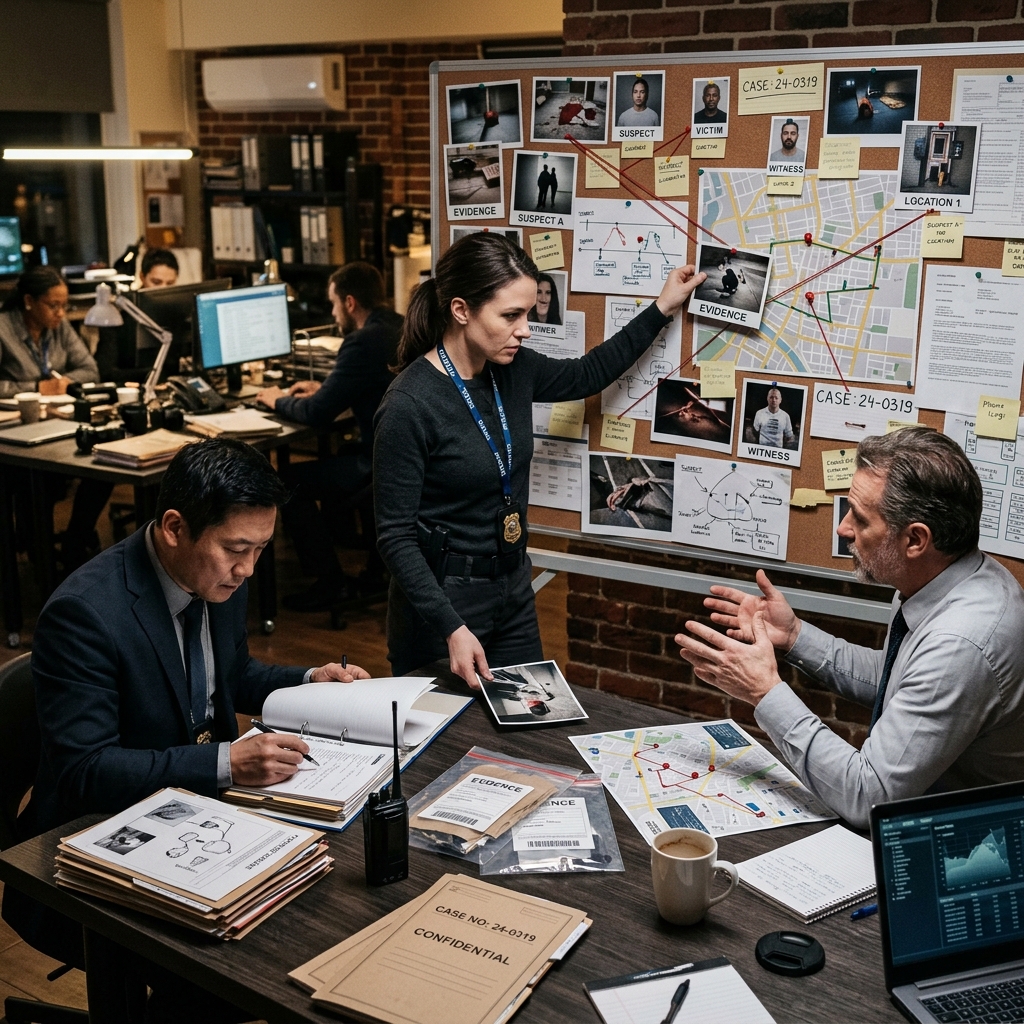
How Police Investigations Really Work
Police investigations are structured efforts to determine what happened, who was involved, and whether the evidence supports an arrest or criminal charges. In practice, an investigation may begin with a call for service, a victim report, a witness tip, or information developed by officers during routine patrol. The process is rarely instant or linear; it usually involves collecting facts, testing leads, and deciding whether the available evidence meets the legal standards needed to move forward.
Although television often presents investigations as fast and dramatic, real cases are slower and more methodical. Officers and detectives must balance speed with accuracy because mistakes can affect whether evidence is admissible, whether a suspect can be identified, and whether a prosecutor is willing to file charges.
The first response shapes the case
Many investigations start when an officer arrives at a scene to speak with the reporting party and determine whether a crime may have occurred. Early decisions matter: officers may need to assist injured people, secure the area, identify witnesses, separate individuals who may influence each other’s statements, and preserve any items that could be lost, moved, or contaminated.
If a suspect is still present, officers may act immediately to detain or arrest that person, depending on the situation and the level of evidence available. In other cases, they collect enough initial information to open a deeper investigation and then pass the matter to detectives or specialized units.
What investigators look for at the scene
Once a scene is stabilized, investigators begin documenting it in a careful, organized way. The goal is to create a reliable record of what existed before anything changed. Common documentation tools include photographs, written notes, and sketches that show the layout of the scene and the location of important objects.
Physical evidence can include a wide range of items, such as weapons, fingerprints, bloodstains, footprints, fibers, documents, broken objects, or electronic devices. Investigators may also collect digital evidence, including surveillance footage, phone records, and data from computers or mobile devices when legally authorized.
The quality of this step often affects the strength of the entire case. If evidence is not properly handled, its value in court may be reduced. For that reason, investigators typically follow chain-of-custody procedures so that each item can be traced from the moment it is collected to the time it is tested or presented in court.
Interviews help turn clues into facts
Evidence alone rarely tells the full story. Investigators also speak with victims, witnesses, and possible suspects to compare accounts and identify inconsistencies. These interviews may happen at the scene, later at a police station, or during follow-up meetings once new facts emerge.
Witnesses can help establish timelines, confirm locations, and describe people or vehicles involved in an incident. Victims may add details that are not obvious from the physical scene, such as prior threats, relationship history, or the sequence of events leading up to the offense. Suspects may deny involvement, provide an explanation, or make statements that later become important in court.
When a suspect is in custody, constitutional rules become especially important. In that setting, police must follow Miranda requirements before custodial interrogation. Outside custody, officers may still ask questions, but the legal consequences of any statement depend on the circumstances under which the questioning took place.
How investigators identify a suspect
Identifying a suspect is often the point where scattered pieces start to form a clearer picture. Investigators may use fingerprints, surveillance footage, phone records, database checks, public tips, and information from people connected to the event. They may also compare a suspect’s behavior, location, or access to the scene with the physical evidence they have collected.
In some cases, a crime is solved quickly because the suspect is seen on video or is found at the scene. In others, investigators must build the case gradually through repeated interviews, document review, and surveillance. Federal authorities may also delay an arrest in order to gather additional proof before taking action, especially when the offense is serious or when more evidence could strengthen later prosecution.
Modern investigations often rely on both traditional police work and technical analysis. That means a case might involve street-level canvassing, lab testing, records review, and digital searches all at the same time. The strongest cases usually combine several independent sources of information rather than depending on a single witness or piece of evidence.
Tools used during the investigation
Different cases call for different methods, but several investigative tools appear frequently across jurisdictions. These methods are often used together rather than in isolation.
| Tool | Purpose |
|---|---|
| Scene documentation | Creates a permanent record through photos, notes, and sketches |
| Physical evidence collection | Preserves items that may link a person, place, or event to the crime |
| Witness and suspect interviews | Clarifies timelines, relationships, and possible motives |
| Laboratory analysis | Tests DNA, toxicology, firearms, or digital material |
| Surveillance and records review | Identifies movements, contacts, and corroborating details |
Investigators may also conduct canvasses of nearby homes or businesses, review security systems, and revisit witnesses as new information emerges. In serious incidents, follow-up work can continue for days, weeks, or even months until all viable leads are exhausted.
The role of forensic testing
Forensic science often turns collected material into usable proof. Samples may be sent to laboratories for analysis of DNA, toxicology, ballistic comparisons, or digital data extraction. These tests can confirm whether a substance is illegal, whether an item was handled by a particular person, or whether a weapon matches a recovered projectile.
Forensic results do not always answer every question, but they can strengthen an investigation by confirming or ruling out theories. A lab result may connect a suspect to a scene, support a witness account, or reveal that an assumption made early in the case was incorrect. Because of that, forensic testing is typically one part of a larger investigation rather than the entire case by itself.
When prosecutors become involved
Police do not decide the ultimate legal outcome alone. Once investigators have gathered enough information, they may submit the file to a prosecutor for review. The prosecutor then decides whether the available evidence supports charges, whether more investigation is needed, or whether the case should be closed or declined.
This review stage is important because criminal charges require more than suspicion. Prosecutors look for evidence that can support probable cause at the charging stage and, later, proof strong enough to persuade a judge or jury. If the file is incomplete, inconsistent, or weak, prosecutors may ask for additional work before moving forward.
Why some investigations lead to arrest and others do not
Not every investigation ends with an arrest. Some cases stall because witnesses are unavailable, surveillance is inconclusive, physical evidence is limited, or the facts do not establish the legal threshold needed for an arrest. Other cases continue while investigators seek a warrant, wait for lab results, or try to confirm a suspect’s identity.
When the evidence does support an arrest, officers may proceed with a warrant or, in some situations, without one if the law permits. In federal matters, the process may also include an initial appearance before a magistrate and further court proceedings after arrest.
Common stages of a police investigation
- Initial report or call for service
- Scene response and safety assessment
- Evidence preservation and documentation
- Witness, victim, and suspect interviews
- Laboratory testing and records review
- Suspect identification and follow-up leads
- Case submission to a prosecutor
- Charging decision, arrest, or case closure
These stages may overlap. For example, detectives may interview a witness while another officer collects evidence, or a prosecutor may be consulted while additional lab work is still pending. Real investigations are flexible because the facts of each case are different.
What makes a strong investigation
Effective investigations are usually thorough, documented, and coordinated. Officers must be careful not to overlook evidence, but they also need to avoid jumping to conclusions too early. The best investigations use multiple sources of proof, preserve items correctly, and follow leads until the available facts are either confirmed or exhausted.
Good investigations also recognize the limits of the evidence. A statement from one witness may be useful but incomplete. A fingerprint may place someone in a location, but not explain why they were there. A surveillance clip may show movement, but not intent. The job of law enforcement is to assemble the whole picture in a way that can stand up in court.
Why the process matters to the public
Understanding how investigations work helps explain why police may ask repeated questions, collect items that seem minor, or take time before making an arrest. Each step is part of an effort to separate rumor from proof. The result is not always immediate, but the process is designed to improve accuracy and support fair decision-making.
For people involved in an investigation, this also means that early statements, digital records, and physical evidence can carry lasting consequences. What is said or found during the first hours of a case may influence everything that follows, including whether the matter becomes a formal prosecution.
Frequently asked questions
Do police always need a suspect before starting an investigation?
No. Investigations often begin before anyone is formally identified. Officers may start with a report, a scene, or a witness account and work outward from there.
Can police use surveillance and records in an investigation?
Yes. Investigators may review surveillance footage, phone records, database information, and other records when the law allows and when those materials are relevant to the case.
What happens after police finish gathering evidence?
They usually organize the file, continue follow-up work if needed, and submit the case to a prosecutor for charging review. The prosecutor may approve charges, request more investigation, or decline the case.
Why do investigators interview the same person more than once?
Follow-up interviews help clarify details, check consistency, and add information uncovered later in the case. New evidence often changes the questions investigators need to ask.
References
- What Happens During a Criminal Investigation in California — Bruzzo Law. 2024-10-01. https://www.bruzzolaw.com/blog/what-happens-during-a-criminal-investigation-in-california/
- The Criminal Investigation Process: An In-Depth Overview — American Public University System. 2024-01-01. https://www.amu.apus.edu/area-of-study/criminal-justice/resources/the-criminal-investigation-process/
- Investigative Steps — Syracuse University Department of Public Safety. 2024-01-01. https://dps.syr.edu/law-enforcement/investigations/investigative-steps/
- How the Police Conduct Criminal Investigations Before Arrest — Browning & Long, PLLC. 2024-01-01. https://www.browninglonglaw.com/library/how-pre-arrest-criminal-investigations-work-in-nc.cfm
- Investigation process — Royal Canadian Mounted Police. 2024-01-01. https://rcmp.ca/en/bc/ihit/family-guide/investigation-process
- A Brief Description of the Federal Criminal Justice Process — Federal Bureau of Investigation. 2024-01-01. https://www.fbi.gov/how-we-can-help-you/victim-services/a-brief-description-of-the-federal-criminal-justice-process
- The Criminal Investigation Process — U.S. Department of Justice, Office of Justice Programs. 1976-01-01. https://www.ojp.gov/pdffiles1/Digitization/148118NCJRS.pdf
Similar Articles








Read full bio of Sneha Tete




